- 388 pages
- English
- ePUB (mobile friendly)
- Available on iOS & Android
eBook - ePub
French Music Since Berlioz
About this book
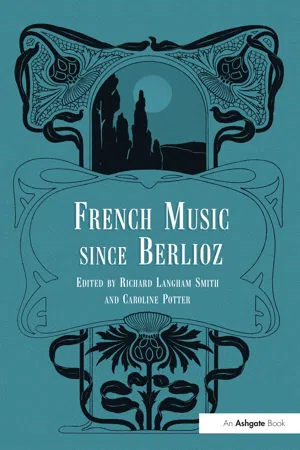
French Music Since Berlioz explores key developments in French classical music during the nineteenth and twentieth centuries. This volume draws on the expertise of a range of French music scholars who provide their own perspectives on particular aspects of the subject. D dre Donnellon's introduction discusses important issues and debates in French classical music of the period, highlights key figures and institutions, and provides a context for the chapters that follow. The first two of these are concerned with opera in the nineteenth and twentieth centuries respectively, addressed by Thomas Cooper for the nineteenth century and Richard Langham Smith for the twentieth. Timothy Jones's chapter follows, which assesses the French contribution to those most Germanic of genres, nineteenth-century chamber music and symphonies. The quintessentially French tradition of the nineteenth-century salon is the subject of James Ross's chapter, while the more sacred setting of Paris's most musically significant churches and the contribution of their organists is the focus of Nigel Simeone's essay. The transition from the nineteenth to the twentieth century is explored by Roy Howat through a detailed look at four leading figures of this time: Faur Chabrier, Debussy and Ravel. Robert Orledge follows with a later group of composers, Satie & Les Six, and examines the role of the media in promoting French music. The 1930s, and in particular the composers associated with Jeune France, are discussed by Deborah Mawer, while Caroline Potter investigates Parisian musical life during the Second World War. The book closes with two chapters that bring us to the present day. Peter O'Hagan surveys the enormous contribution to French music of Pierre Boulez, and Caroline Potter examines trends since 1945. Aimed at teachers and students of French music history, as well as performers and the inquisitive concert- and opera-goer, French Music Since Berlioz is an essential companion for an
Information
Chapter 1
French Music Since Berlioz: Issues and Debates
The death of Hector Berlioz in 1869 marked a significant turning point in the history of French music. This was not a reflection on the unfortunate Berlioz himself, but a symptom of a reaction against the domination of French musical life by foreign composers. At the time, the prevailing public taste was for the German Romanticism of Beethoven, Mendelssohn and Schumann, and the more flamboyant styles of Liszt and Chopin. Ironically, despite his romantic credentials, Berlioz enjoyed no such popularity in France during his own lifetime. Meanwhile, much to his chagrin, the Parisian stage was virtually monopolised by repeat performances of operas that had first seen the light of day in the 1830s and 1840s, and the public’s love of spectacle ensured the ongoing popularity of flamboyant productions of historical subjects in the grand opera style. The jaded repertoire of the Opéra consisted largely of Rossini’s Guillaume Tell (1829), Donizetti’s Lucia di Lammermoor (1835) and La favorite (1840) and Meyerbeer’s L’Africaine (1865) and L’étoile du nord (1854). The only French composers to have achieved comparable success were Daniel-François Auber (La muette de Portici, 1828) and Jacques Halévy (La Juive, 1835), while composers such as Adolphe Adam, Ferdinand Hérold and Adrien Boieldieu had to content themselves with more modest successes at the Opéra-Comique. Young native talent was given little encouragement, apart from those composers lucky enough to be produced by the Théâtre-Lyrique. This venue saw the premiere of Gounod’s Faust in 1859 (and numerous other operas by him), as well as Ernest Reyer’s La statue (1861), Bizet’s Les pêcheurs de perles (1863) and the first part of Berlioz’s Les Troyens à Carthage (1863). However, before the 1870s, with the possible exception of Gounod, French operatic composers were largely unsuccessful in their bid for public favour.
Meanwhile, in the concert halls, foreign composers also reigned supreme. In fact, the music of Beethoven, Mozart, Mendelssohn, Haydn and Weber accounted for half of all music performed in public concerts in Paris in the years immediately prior to 1870.1 This apparent inability of French composers to make their mark in the concert halls was partly due to the commonly held belief in France that dramatic music was the true measure of a composer’s talent. This belief was encouraged by the importance placed on dramatic music in the curriculum of the Paris Conservatoire, and the relative neglect of such skills as counterpoint and fugal writing.2 Students were generally limited to the study of classical models, with an overemphasis on dramatic works at the expense of the more intimate charms of chamber music. The neglect of instrumental writing was further exacerbated by the relative lack of public concert societies before 1870. Established concert societies (such as the Société des concerts du Conservatoire which was founded in 1828) catered mostly for a very select audience with conservative tastes. Although Jules Pasdeloup introduced music to a wider audience with his Concerts populaires (which began life as the Société des jeunes artistes du Conservatoire in 1851), this laudable aim was dampened somewhat by his preference for the German classical repertoire.3
The Franco-Prussian war ended the dissolute reign of Napoleon III and heralded the birth of the Third Republic. Following their humiliating defeat, anti-German feelings ran very high among the French. Shock at the ease with which France had been defeated inspired a revival of national pride. There was a growing realization among French musicians that national talent had been neglected in favour of what were now felt to be the over-indulgent excesses of the German romantic style. This had an inevitable impact on the popularity of German music.4 In particular, Wagner was virtually boycotted during the 1870s, although this was partly due to the composer’s misguided public taunting of the defeated French.5 This same climate also brought with it a decline in the popularity of foreign opera. Before the war, the success of Gounod’s Faust (1859), Mireille (1864) and Roméo et Juliette (1867) had already marked a change from the spectacle of grand opera in favour of greater emphasis on sentimental characterization and emotional intensity.
This more intimate approach is an important feature of Bizet’s Carmen (1875) but Bizet’s use of what was regarded as scandalous subject matter meant relative failure for the opera. Massenet had rather more success with audiences, although he, too, dealt with affairs of the heart. However, his gift for musical portraiture ensured him a string of successes, including Le roi de Lahore (1877), Manon (1884), Le Cid (1885), Thaïs (1894), Cendrillon (1899) and Grisélidis (1901). Mindful of the public mood in the aftermath of war, when the Opéra-Comique reopened its doors in 1872, the new season began with works by three French composers: Saint-Saëns’s La princesse jaune (1872), Bizet’s Djamileh (1872) and Émile Paladilhe’s Le passant (1872). Before the turn of the century, Chabrier and Lalo would also benefit from this revival of native opera, as would Vincent d’Indy, Alfred Bruneau, Reynaldo Hahn and André Messager. In particular, Bruneau produced his own brand of naturalist opera in collaboration with Émile Zola on no fewer than nine occasions, the most successful being Le rêve (1891), L’attaque du moulin (1893) and L’ouragan (1901). A further experiment in this direction was made by Gustave Charpentier, and his Louise (1900) was a resounding success. However, this success was not so much due to the popularity of realist opera as to Charpentier’s rather sentimental approach, and it was not to be repeated. Bruneau’s efforts in the genre also failed to find enduring popular support, and this is also reflected in the failure of Italian verismo opera composers to make their mark in Paris. Late nineteenth-century French opera could not have been said to form a cohesive style but its very diversity was a measure of the more healthy state of French opera in the thirty years since the Franco-Prussian war, while Massenet’s appointment as professor of composition at the Conservatoire between 1878 and 1896 ensured the continuation of this trend among the younger generation of composers.
It was with the aim of providing a platform for homegrown talent that the Société nationale was founded by Saint-Saëns and the singer Romain Bussine in 1871. Bearing the motto Ars gallica, the new society was originally conceived with the aim of devoting all of its resources to the performance of new French music.6 The new society was hugely successful and became a showcase for young talent. Between 1871 and 1918 it gave a total of 415 concerts and its members included many of the most prominent French musicians of the day, including Massenet, César Franck, Gabriel Fauré, Vincent d’Indy and Claude Debussy. However, financial limitations meant the new society was unable to present many orchestral concerts. As a result, chamber music experienced a revival as composers, eager to have their music performed, wrote music requiring smaller forces. Chamber music societies also flourished during this era, including the Nouvelle société de musique de chambre and Paul Taffanel’s Société de musique de chambre pour instruments à vent, in addition to which the numerous quartets and trios resident in Paris also held their own concert series.7 Meanwhile, the more populist concert societies also began to pay greater attention to French orchestral music. The first concert of Pasdeloup’s 1871 season included Massenet’s Les scènes hongroises (1865) and he also included performances of Lalo, Bizet, Saint-Saëns and Gounod in his concerts. The conservative audiences of the Société des concerts du Conservatoire were also introduced to works by Gounod, Franck, Saint-Saëns, Dubois, Massenet and Lenepveu in the 1871–72 season and, when Édouard Colonne gave his first Concert national in 1873, the inaugural programme included Massenet’s Marie Magdeleine (1872) and Franck’s Rédemption (1871). The Concerts Lamoureux (formed in 1881) became the main rival of the Concerts Colonne, but in the early twentieth century both faced increasing competition from the Concerts Sechiari, Concerts Rouge and Société Philharmonique de Paris. Although many of these societies had unashamedly populist programmes, they all contributed to the number of performances of native music in the French capital, as did the more avant-garde Société musicale indépendante, founded in 1910 as a rival to the Société nationale.8
Pride in French talent was also fostered by the Expositions Universelles that took place in Paris in 1867, 1878, 1889 and 1900. A government report on the 1878 event recorded a total of 108 official concerts, of which sixty-five featured French music. For the 1889 Exposition, five concerts were presented at the Trocadéro, showcasing exclusively French music, and featuring leading contemporary French composers. In addition, leading French organists gave a total of fifteen recitals while various chamber music societies also presented French music.9 Concerts of contemporary French music were used as a means of showing to the world (and particularly the Germans) that French musicians were as innovative and as advanced as their foreign counterparts. In this climate, French musical talent thrived to a degree that the previous generation, much as they might have wished for it, could not have foreseen.
However, despite this resurgent pride in French music, performances of German music were still the mainstay of Parisian concert life.10 Meanwhile, Wagner’s fall from grace proved short-lived. This was partly due to the composer’s death in 1883 (thereby removing the issue of his overbearing personality), but also due to the curiosity aroused by reports of the successful Bayreuth premieres of Der Ring des Nibelungen (1876) and Parsifal (1882). Younger composers, for whom the 1870–71 war was only a childhood memory, were particularly excited by Wagner. Although Pasdeloup’s performance of a brief extract from Rienzi (1842) was the only orchestral performance of Wagner’s music in 1871, by 1885 he was honoured with twenty-nine performances of orchestral extracts from the operas, and by 1895 this figure had reached thirty-five. Concert performances proved the main form of transmission of Wagner’s music during these years, although productions of Tannhäuser (1845), Lohengrin (1850), Die Walküre (1856), Die Meistersinger von Nürnberg (1868), Der fliegende Holländer (1843) and Tristan und Isolde (1859) also took place in Paris before the turn of the century.11
In fact, despite its apparent incompatibility with the concurrent reawakening of interest in French music, Wagnérisme was a dominant issue in the musical life of the French capital before the Great War. Many of the most fervent French Wagnerites (such as the younger Saint-Saëns and Vincent d’Indy) were also those most actively involved in the promotion of French music. This seeming contradiction gives an indication of the extent to which Wagner’s music fascinated French composers. He was both their greatest source of inspiration and the greatest single impediment to their finding a distinctively French musical language. Composers such as Chabrier, Saint-Saëns, Chausson, d’Indy, Duparc, de Bréville, Dukas, Massenet, Debussy, Charpentier and Dubois all made the pilgrimage to Bayreuth and they all, to some degree, came under his influence.12 His potent harmonies, rich orchestration and the semi-mystical atmosphere induced by the mythological subject matter of his operas proved too seductive to resist. However, there were some who were more covert in their relations with Wagner. In his articles Debussy deplored Wagner’s detrimental influence on French music, but he himself struggled to resist that influence. As Robin Holloway has noted, ‘[Debussy’s] hostility to Wagner is … entirely verbal; musically he remained a follower of Wagner, though in devious manner, for the rest of his life.’13 And, despite their varying degrees of submission, when questioned by the Mercure de France in 1903, those composers interviewed concluded that Wagner’s influence had waned, although they disagreed about the extent and nature of that influence.14
This last issue was complicated by extra-musical considerations. Wagner’s music was undoubtedly attractive to musicians, but French Wagnérisme was not only their affair. Many French Wagnérites, such as Catulle Mendès, Édouard Dujardin and Villiers de l’Isle-Adam, came from the French literary world, and the fanaticism with which they defended their idol was frequently inspired by the intensity and vividness of his music, which, to some extent, achieved the emotive and expressive qualities which they were often struggling to find in their own art. Wagner had found an early advocate in Baudelaire, who also sought to evoke a similar intensity of feeling in his poetry. The decadent movement, associated with Baudelaire, was indicative of a desire among poets and writers to create a language that could express and suggest feelings, as opposed to the external, objective realities de...
Table of contents
- Cover Page
- Title Page
- Copyright Page
- Contents
- List of Plates
- List of Figures and Tables
- List of Music Examples
- List of Contributors
- Preface and Acknowledgements
- List of Abbreviations
- 1 French Music Since Berlioz: Issues and Debates
- 2 Nineteenth-Century Spectacle
- 3 Nineteenth-Century Orchestral and Chamber Music
- 4 Music in the French Salon
- 5 French Operatic Spectacle in the Twentieth Century
- 6 Church and Organ Music
- 7 Modernization: From Chabrier and Fauré to Debussy and Ravel
- 8 Satie & Les Six
- 9 ‘Dancing on the Edge of the Volcano’: French Music in the 1930s
- 10 French Music and the Second World War
- 11 Pierre Boulez and the Foundation of IRCAM
- 12 French Musical Style and the Post-War Generation
- Index
Trusted by 375,005 students
Access to over 1.5 million titles for a fair monthly price.
Study more efficiently using our study tools.
Frequently asked questions
Yes, you can cancel anytime from the Subscription tab in your account settings on the Perlego website. Your subscription will stay active until the end of your current billing period. Learn how to cancel your subscription
No, books cannot be downloaded as external files, such as PDFs, for use outside of Perlego. However, you can download books within the Perlego app for offline reading on mobile or tablet. Learn how to download books offline
Perlego offers two plans: Essential and Complete
- Essential is ideal for learners and professionals who enjoy exploring a wide range of subjects. Access the Essential Library with 800,000+ trusted titles and best-sellers across business, personal growth, and the humanities. Includes unlimited reading time and Standard Read Aloud voice.
- Complete: Perfect for advanced learners and researchers needing full, unrestricted access. Unlock 1.5M+ books across hundreds of subjects, including academic and specialized titles. The Complete Plan also includes advanced features like Premium Read Aloud and Research Assistant.
We are an online textbook subscription service, where you can get access to an entire online library for less than the price of a single book per month. With over 1.5 million books across 990+ topics, we’ve got you covered! Learn about our mission
Look out for the read-aloud symbol on your next book to see if you can listen to it. The read-aloud tool reads text aloud for you, highlighting the text as it is being read. You can pause it, speed it up and slow it down. Learn more about Read Aloud
Yes! You can use the Perlego app on both iOS and Android devices to read anytime, anywhere — even offline. Perfect for commutes or when you’re on the go.
Please note we cannot support devices running on iOS 13 and Android 7 or earlier. Learn more about using the app
Please note we cannot support devices running on iOS 13 and Android 7 or earlier. Learn more about using the app
Yes, you can access French Music Since Berlioz by Richard Langham Smith,Caroline Potter in PDF and/or ePUB format, as well as other popular books in Media & Performing Arts & Music. We have over 1.5 million books available in our catalogue for you to explore.