eBook - ePub
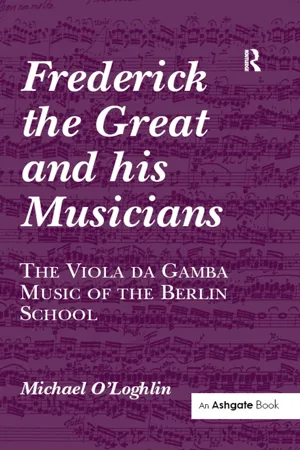
Frederick the Great and his Musicians: The Viola da Gamba Music of the Berlin School
- 272 pages
- English
- ePUB (mobile friendly)
- Available on iOS & Android
eBook - ePub
Frederick the Great and his Musicians: The Viola da Gamba Music of the Berlin School
About this book
After decades of stagnation during the reign of his father, the 'Barracks King', the performing arts began to flourish in Berlin under Frederick the Great. Even before his coronation in 1740, the crown prince commenced recruitment of a group of musician-composers who were to form the basis of a brilliant court ensemble. Several composers, including C.P.E. Bach and the Graun brothers, wrote music for the viola da gamba, an instrument which was already becoming obsolete elsewhere. They were encouraged in this endeavour by the presence in the orchestra from 1741 of Ludwig Christian Hesse, one of the last gamba virtuosi, who was described in 1766 as 'unquestionably the finest gambist in Europe'. This study shows how the unique situation in Berlin produced the last major corpus of music written for the viola da gamba, and how the more virtuosic works were probably the result of close collaboration between Hesse and the Berlin School composers. The reader is also introduced to the more approachable pieces which were written and arranged for amateur viol players, including the king's nephew and ultimate successor, Frederick William II. O'Loghlin argues that the aesthetic circumstances which prevailed in Berlin brought forth a specific style that is reflected not only in the music for viola da gamba. Characteristics of this Berlin style are identified with reference to a broad selection of original written sources, many of which are hardly accessible to English-speaking readers. There is also a discussion of the rather contradictory reception history of the Berlin School and some of its composers. The book concludes with a complete thematic catalogue of the Berlin gamba music, with a listing of original manuscript sources and modern publications. The book will appeal to professional and amateur viola da gamba players as well as to scholars of eighteenth-century German music.
Information
Table of contents
- Cover
- Half Title
- Title Page
- Copyright Page
- Dedication
- Table of Contents
- List of Figures
- List of Music Examples
- Foreword
- Acknowledgements
- Notes on the Text
- 1 Introduction
- 2 Berlin and the Berlin School
- 3 The Sources
- 4 The Forms and Genres Used in the Berlin Gamba Music
- 5 Alternative Instrumentation for the Viola da Gamba Parts
- 6 Ludwig Christian Hesse
- 7 The Composers and their Works
- Appendix
- Bibliography
- Index
Trusted by 375,005 students
Access to over 1.5 million titles for a fair monthly price.
Study more efficiently using our study tools.
Frequently asked questions
Yes, you can cancel anytime from the Subscription tab in your account settings on the Perlego website. Your subscription will stay active until the end of your current billing period. Learn how to cancel your subscription
No, books cannot be downloaded as external files, such as PDFs, for use outside of Perlego. However, you can download books within the Perlego app for offline reading on mobile or tablet. Learn how to download books offline
Perlego offers two plans: Essential and Complete
- Essential is ideal for learners and professionals who enjoy exploring a wide range of subjects. Access the Essential Library with 800,000+ trusted titles and best-sellers across business, personal growth, and the humanities. Includes unlimited reading time and Standard Read Aloud voice.
- Complete: Perfect for advanced learners and researchers needing full, unrestricted access. Unlock 1.5M+ books across hundreds of subjects, including academic and specialized titles. The Complete Plan also includes advanced features like Premium Read Aloud and Research Assistant.
We are an online textbook subscription service, where you can get access to an entire online library for less than the price of a single book per month. With over 1.5 million books across 990+ topics, we’ve got you covered! Learn about our mission
Look out for the read-aloud symbol on your next book to see if you can listen to it. The read-aloud tool reads text aloud for you, highlighting the text as it is being read. You can pause it, speed it up and slow it down. Learn more about Read Aloud
Yes! You can use the Perlego app on both iOS and Android devices to read anytime, anywhere — even offline. Perfect for commutes or when you’re on the go.
Please note we cannot support devices running on iOS 13 and Android 7 or earlier. Learn more about using the app
Please note we cannot support devices running on iOS 13 and Android 7 or earlier. Learn more about using the app
Yes, you can access Frederick the Great and his Musicians: The Viola da Gamba Music of the Berlin School by Michael O'Loghlin in PDF and/or ePUB format, as well as other popular books in Media & Performing Arts & Music. We have over 1.5 million books available in our catalogue for you to explore.