- 1,840 pages
- English
- ePUB (mobile friendly)
- Available on iOS & Android
eBook - ePub
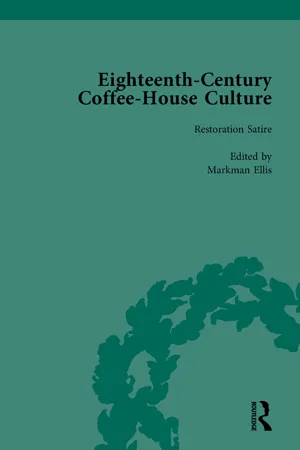
Eighteenth-Century Coffee-House Culture, vol 1
About this book
Helps scholars and students form an understanding of the contribution made by the coffee-house to British and even American history and culture. This book attempts to make an intervention in debates about the nature of the public sphere and the culture of politeness. It is intended for historians and scholars of literature, science, and medicine.
EXPLANATORY NOTES
M. P., A Character of Coffee and Coffee-Houses
p. 5, l. 15: Pantaloons: men’s loose breeches, a fashion introduced to London from France after the Restoration, and said to have been derived from the costume worn by the theatrical character of the same name, usually depicted as a foolish old man wearing Turkish slippers, loose red trousers and a skullcap (OED).
p. 5, ll. 16–17: a la mode de France: French, ‘in the French style’.
p. 6, ll. 1–2: The English-man … both feet and face: misquoted from George Herbert, ‘The Church-porch’, iv, in The Temple. Sacred poems and private ejaculations (Cambridge, Thom. Buck and Roger Daniel, 1633), p. 1. Should be: ‘O what were man, might he himself misplace! / Sure to be crosse he would shift feet and face’.
p. 6, ll. 3–4: Hop, Malt, Cock, China, Rash-berry: diverse ingredients used in drinks typically consumed in Britain: hops, the ripened cones of the female hop plant used to give a bitter flavour to beer; malt, barley prepared for brewing by steeping, germinating and kiln-drying; cock, the jelly and minced meat of a boiled cock infused in ale to make cock-ale; china, the fleshy rootstock of Smilax China (akin to sarsaparilla) used to flavour china-ale; and rash-berry or raspberry, the fruit of the common raspberry used to flavour ale or wine (OED).
p. 6, l. 11: voraginous: voracious, devouring (OED).
p. 6, ll. 15–16: Stygian Lake: pertaining to the River Styx, or more generally, to the infernal regions of classical mythology.
p. 6, l. 23: Dryer: in the humoural theory of physiology, a substance that removes moisture. For a full account of the effects of coffee expressed within the humoural account, see Walter Rumsey, Organon Salutis, Volume 4 of this edition, pp. 1–65.
p. 6, ll. 26–7: highshoon: one who wears high shoes, as rustics did, hence, a rustic boorish man (OED).
p. 6, l. 28: Crudities: an imperfect concoction (digestion) of the humours (OED).
p. 7, l. 7: Meagrim: headache, migraine (OED).
p. 7, ll. 12–13: Academians of Bedlam: literally, a member of the academy of the Hospital of St Mary of Bethlehem, outside Bishopsgate, London’s main lunatic asylum.
p. 7, l. 16: Neates-tongue: ox tongue, as an article of food (OED).
p. 7, ll. 16–17: a dish of Anchovaes, or a salt Bit: a dish of anchovies or another kind of salty victuals.
p. 7, l. 22: Liber Pater: a Roman god of fertility, both human and agricultural.
p. 8, ll. 2–3: ad unum / Mollis opus: Horace, Epodes, XII.15: ‘fit but for once’. Referring to the conventional view that men are able to perform coitus but once in each encounter.
p. 8, ll. 8–9: Hercules in one night got fifty Women with Child: sometimes included as one of the twelve tasks of Hercules.
p. 8, ll. 9–12: a Prince of Spain was forc’d to make an Edict … belike Men did exceed that proportion: The anecdote is untraced, but was repeated in The Women’s Petition against Coffee, see above, p. 114, ll. 7–9.
p. 8, l. 30: Cataracts of Nilus: the waterfalls on the river Nile, the first at Aswan.
p. 9, ll. 4–5: Hic fluvius Verborum, vix gutta Mentis: Latin, ‘here’s a flood of words with not a drop of sense’.
p. 9, ll. 9–10: Polewheel runs division on the Base Viol: A bass-viol is a stringed instrument played with a bow for playing the bass part in concerted music; to ‘run division’ is to execute a rapid melodic passage. Paul Polewheel (fl. 1650–60) was an English composer who achieved fame as a violinist during the Commonwealth.
p. 9, ll. 19–20: Who cannot rest … dores his mind: George Herbert, ‘The Church Porch’, xxv, in The Temple, p. 6.
p. 10, ll. 4–5: Mony! Thou art the Man, and Man but Dross to thee: A rough translation of Juvenal, Satires, V.136–7: ‘Money, you are the one he calls brother, the one he gives homage and honour’ (The Satires of Juvenal, trans. by Rolfe Humphries (Indianapolis, Indiana University Press, 1958), p. 60).
p. 10, l. 17: Suger-plum: a sugar-plum, a small round sweetmeat or comfit, hence, something very pleasing and agreeable (OED).
p. 11, ll. 9–10: as common, as Gold was once in Ierusalem, that is, as common, as Stones: 2 Chronicles 1:15: ‘And the king made silver and gold at Jerusalem as plenteous as stones’ (KJV).
p. 12, ll. 6–7: The Principles of a Popular Government at the Rota: James Harrington (1611–77), English political philosopher, author of Oceana (1656), a utopian fiction on aristocratic republican principles utilising a rotating system of government known as the rota. In 1659–60, Harrington established a debating club to disseminate his ideas, popularly known as the Rota, at Miles’s Coffee-house in New Palace Yard, Westminster. See. Ellis, Coffee-House, pp. 42–55.
p. 13, ll. 4–5: discoursing like a Parrat in the words of Aristotle: referring to an uncomprehending and mechanical repetition of speech, like a parrot: an observation here attributed to Aristotle (384–22 BC), erroneously supposed to be the first author who mentions parrots.
p. 13, ll. 8–9: jurare in verba Magistri: Latin, follow implicitly. The phrase is well known from Horace, Epistles, I.14: ‘Nullius addictus jurare inverba magistri’, ‘bound to swear as any master dictates’ (trans. by H. Ruston Fairclough (Cambridge, MA, Harvard University Press, 2005), p. 252.
p. 13, l. 10: Moderators: arbitrators (OED).
p. 13, l. 21: Spartan: an inhabitant of Sparta, a Lacedaemonian, characteristically distinguished by simplicity, frugality and courage.
p. 13, l. 23: Helot: one of a class of serfs in ancient Sparta, intermediate in status between the ordinary slaves and the free Spartan citizens. Plutarch, Lycurgus, xxviii, states that on occasion the Helots were compelled to appear in a state on intoxication in order to excite a repugnance to drunken behaviour amongst Spartan youth.
p. 13, ll. 27–31: Utrum corpus est immateriale … Utrum bestia honoranda sit: A series of scholastic coffee-house queries for disputation, all essentially quibbles: ‘Whether the self is immaterial / Whether a million angels may sit on the point of a needle / Whether Rome or Christianity was founded first / Whether an animal should be accorded honour’. The second one quoted from William Chillingworth, The Religion of Protestants a Safe Way to Salvation (London, Leonard Lichfield for John Clark, 1638), ‘Preface’, p. [x]: ‘Whether a Million of Angels may not sit upon a needle’s point?’.
p. 14, l. 2: Orpheus his Beasts did to his Charming Musick: in Greek mythology, Orpheus was the son of King Oaegrus and the muse Calliope. Taught to play the lyre by Apollo, Orpheus played so beautifully that animals and trees were charmed by his minstrelsy.
p. 14, ll. 4–5: nam quae comoedia? Mimus Quis melior?: Juvenal, Satires, V.156–7. Juvenal recounts that Virro has entertained Trebius with a horrible meal, in order to mock him. In this quote Juvenal comments he prefers the spectacle of Trebius’s discomfiture to the regular entertainments of dinner parties. ‘What comedy ever, what mime, is so amusing’ (Satires, ed. by Susanna Braund (Cambridge, Cambridge University Press, 1996), p. 73.
p. 14, l. 16: majore cachinno: Latin, ‘excessive laughter’.
p. 14, l. 19: Aspice quid faciunt commercia: Juvenal, Satires, II.166: ‘Just see what evil communications do!’.
p. 14, ll. 22–3: Virtuosi and Ingenuosi: a virtuoso was a learned person, a scholar or scientist; an ingenuoso a man with the education or culture befitting an honourable station. Both kinds of men were associated with the foundation of the Royal Society in 1660.
p. 14, l. 30: Verbum sat: Latin, ‘a word is enough’.
Woolnoth, The Coffee Scuffle
p. 19, l. 7: Polipheme: Polyphemus, a Cyclops with one eye in the centre of his forehead, the son of Poseidon and Thoosa.
p. 19, l. 8: Don Quixot: the hero of the novel of the same name by Miguel de Cervantes (published 1605 and 1615).
p. 19, l. 10: Noggin: a small drinking vessel or mug.
p. 19, l. 22: Hobedehoi: hobbledehoy, a youth at the age between boyhood and manhood, a stripling (OED).
p.20, l. 4: Prissians pate: unclear, but ‘Prissians head’ is mentioned in Roger Boyle, Mr Anthony: a comedy (London, James Knapton, 1690), pp. 4–5.
p. 20, l. 7: Ovid’s great Nose: Publius Ovidius Naso (43 BC–AD 17), Roman poet, author of the Metamorphoses, whose last name implied his family were known for large noses.
p. 20, l. 18: Euclid, Discartis: Euclid of Alexandria (325–265 BC), mathematician; Rene Descartes (1596–1650), French philosopher.
p. 20, l. 28: Mercuries: a person who brings news, hence newspapers.
p. 21, l. 12: Beza and Knox: Theodore Beza (1519–1605), a leading Protestant reformer in Geneva after Calvin’s death; John Knox (1505–72), the founder of Presbyterianism in Scotland.
p. 21, l. 14: Blundel and Grotius, Arminius and Vossius: Calvinist philosophers: David Blondel (1591–1655), Calvinist historian, author of a dissertation on Pope Joan (published 1647) arguing the story is a myth; Hugo Grotius (1583–1645), natural law theorist and jurist of the Dutch Republic; Jacobus Arminius (1560–1609), Dutch theologian; Gerhard Johann Vossius (1577– 1649), German scholar and Calvinist theologian.
p. 21, l. 17: Lockier, sweet Powel and Knocker: Nicholas Lockyer (1611–85), puritan divine; Vavasour Powell (1617–70), Welsh Baptist preacher; Knocker untraced.
p. 21, l. 18: Jesse and honey mouth’d Brook: Henry Jessey (1603–63), a Cambridge-educated Baptist from Yorkshire who led the Independent Baptist congregation in London; Humphrey Brooke (1618 –93), physician and Leveller.
p. 21, l. 22: Taylor … Naylor: Thomas Taylor (1617–82), Quaker minister and writer; James Nayler (1618–60), Quaker preacher and writer.
p. 21, l. 24: Kiffin … Giffin: William Kiffin (1616–1701), a prosperous merchant who became a leader of the London Particular Baptists; Giffin not identified, perhaps Lewis Griffin (fl. 1661), Baptist preacher and controversialist.
p. 21, l. 20: Paul Hobs: perhaps Paul Hobson (d. 1666), Baptist who questioned the validity of infant baptism.
p. 22, l. 2: Teazar … Keyser: not identified, perhaps Kaiser, meaning emperor.
p. 22, l. 3: Gildas: Gildas Bardonicus (fl. 5th–6th century) a British monk and historian.
p. 22, l. 7: Jack Straw or Wat Tyler: leaders of the Peasants’ Revolt of 1381.
p. 22, l. 8: Fifth-monarchy: The Fifth Monarchists were a religious political movement prominent 1649–61 who saw the execution of Charles I as a precursor of the imminent coming of Christ’s Kingdom on Earth. The Fifth Monarchists under Thomas Venner launched an uprising in January 1661.
p. 22, l. 9: Harringtons Rota or Boyls Vertuosa: notable coffee-house clubs of the late 1650s. For Harrington’s see above, note to p. 12, ll. 6–7. Richard Boyle’s club of virtuosi or scientists met at Tillyard’s Coffee-house in Oxford in the late 1650s, and in 1662 formed the nucleus of the Royal Society.
p. 22, l. 12: Wisson: Whit Sunday, the seventh Sunday after Easter, observed as a festival in commemoration of the descent of the Holy Spirit on the day of Pentecost.
p. 22, l. 14: Chimneys: The Chimney or Hearth Tax, a parliamentary levy imposed by statute in 1661 (13 and 14 Car. II., c. 10) givin...
Table of contents
- Cover
- Half Title
- Title Page
- Copyright Page
- Table of Contents
- General Introduction
- Bibliography
- List of Abbreviations
- Introduction
- M. P., A Character of Coffee and Coffee-Houses (1661)
- Woolnoth, The Coffee Scuffle 1662)
- The Tryall of the Coffee-Man (1662/3)
- Merc. Democ. [John Crouch], The maidens complain[t] against coffee (1663)
- A Cup of Coffee: or, Coffee in its Colours (1663)
- The Character of a Coffee-House (1663)
- News from the Coffe-House (1667)
- A Broad-side against Coffee; Or, the Marriage of the Turk (1672)
- The Character of a Coffee-House, with the Symptomes of a Town-Wit. (1673)
- Coffee-houses Vindicated in answer to the late published Character of a Coffee-House (1673)
- The Grand Concern of England Explained (1673)
- The Women’s Petition Against Coffee (1674)
- The Mens Answer to the Womens Petition Against Coffee (1674)
- A Brief Description of … Coffee the Excellent Vertues of that Sober and Wholesome Drink, called Coffee (1674)
- William Hicks, Coffee-house jests (1677)
- A Bridle for the Tongue: Or, A Curb to Evil discourse (1678)
- A Satyr Against Coffee ([1967])
- A dialogue between Tom and Dick, over a dish of coffee, concerning matters of religion and government (1680)
- At Amsterdamnable-Coffee-House On the 5th of November next, will be Exposed to publick Sale these Goods following [1682]),
- J. C. B. [Aphra Behn?], Rebellions antidote: or A Dialogue between coffee and tea (1685)
- The School of Politicks: or, The Humours of a Coffee-House. A Poem(1690)
- The Art of Getting Money by Double-Fac’d Wagers (1691)
- The City Cheat discovered: or, A New Coffe-house Song. (1691)
- The complaint of all the she-traders … against the city cheats, or the new coffee-houses ([1682–93])
- ‘Letter from a French gentleman in London to his friend in Paris… Containing an Account of Will’s Coffeehouse, and of the Toasting and Kit-Kat-Clubs. (1970)
- Edward Ward, The Humours of a Coffee-House: a Comedy (1707)
- Edward Arwaker, ‘Fable XXIX: The Coffee-House: Or, A Man’s Credit (1708)
- Edward Ward, Vulgus Britannicus: or, the British Hudibrass (1710)
- John Macky, A Journey Through England. In Familiar Letters. From a Gentleman Here, to his Friend Abroad (1714)
- Lewis Theobald, ‘No. 61: Coffee-House Humours Exposed’ (1717)
- Explanatory Notes
Trusted by 375,005 students
Access to over 1.5 million titles for a fair monthly price.
Study more efficiently using our study tools.
Frequently asked questions
Yes, you can cancel anytime from the Subscription tab in your account settings on the Perlego website. Your subscription will stay active until the end of your current billing period. Learn how to cancel your subscription
No, books cannot be downloaded as external files, such as PDFs, for use outside of Perlego. However, you can download books within the Perlego app for offline reading on mobile or tablet. Learn how to download books offline
We are an online textbook subscription service, where you can get access to an entire online library for less than the price of a single book per month. With over 1.5 million books across 990+ topics, we’ve got you covered! Learn about our mission
Look out for the read-aloud symbol on your next book to see if you can listen to it. The read-aloud tool reads text aloud for you, highlighting the text as it is being read. You can pause it, speed it up and slow it down. Learn more about Read Aloud
Yes! You can use the Perlego app on both iOS and Android devices to read anytime, anywhere — even offline. Perfect for commutes or when you’re on the go.
Please note we cannot support devices running on iOS 13 and Android 7 or earlier. Learn more about using the app
Please note we cannot support devices running on iOS 13 and Android 7 or earlier. Learn more about using the app
Yes, you can access Eighteenth-Century Coffee-House Culture, vol 1 by Markman Ellis in PDF and/or ePUB format, as well as other popular books in History & World History. We have over 1.5 million books available in our catalogue for you to explore.