- 416 pages
- English
- ePUB (mobile friendly)
- Available on iOS & Android
eBook - ePub
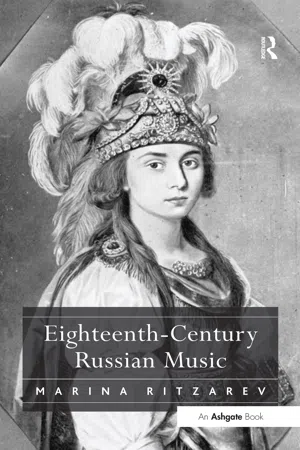
Eighteenth-Century Russian Music
About this book
Little is known outside of Russia about the nation's musical heritage prior to the nineteenth century. Western scholarship has tended to view the history of Russian music as not beginning until the end of the eighteenth century. Marina Ritzarev's work shows this interpretation to be misguided. Starting from an examination of the rich legacy of Russian music up to 1700, she explores the development of music over the course of the eighteenth century, a period of especially intense Westernization and secularization. The book focuses on what is characteristic and crucial to Russian music during this period, rather than seeking to provide a comprehensive survey. The musical culture of the time is discussed against the rich background of social, political and cultural life, tying together many of the phenomena that used to be viewed separately. The book highlights the importance of previously marginalized sectors - serf culture, choral sacred culture, the contribution of foreign musicians, the significant influence of Freemasonry, the role of Ukrainian and West-European cultures and so on - as well as casting new light on the well-researched topic of Russian opera. Much new archival material is introduced, and revised biographies of the two leading eighteenth-century Russian composers, Maxim Berezovsky and Dmitry Bortniansky, are provided, as well as those of the serf composer Stepan Degtyarev and the Italian Giuseppe Sarti. The book places eighteenth-century Russian music on the European map, and will be of particular importance for the study of European musical cultures remote from such centres as Italy, Germany-Austria and France. Eighteenth-century Russian music is organically linked with its past and future and its contributory role in forming the Russian national identity and developing the Russian idiom is clarified.
Information
Chapter 1
Rethinking Eighteenth-Century Russian Music
Due to the events of history and their complex intertwining, it was only in the last third of the twentieth century that the artistic treasures of Russian pre-Glinka music began to attract broad public attention even in Russia itself, while outside Russia they have remained virtually unknown. Anyone studying this fascinating repertoire from a broad historical and cultural perspective must face intriguing questions. We know, for example, that in 1726 J.S. Bach wrote to his Lyceum friend George Erdmann, resident consul of Danzig at the court of Empress Catherine I (widow of Peter I), asking about a possible position (Pantielev, 1983). Similarly, Mozart, exhausted by the uncertainties of his freelance existence, authorized Count Andrey Razumovsky, Russian ambassador in Vienna, to start negotiations with Prince Gregory Potemkin about his possible employment in Russia (Mooser, 1951, II:466). What was it that attracted these eminent West-European composers? What prior knowledge would they have had concerning contemporary Russian musical culture?
The European-like infrastructure of the musical culture that coalesced in Russia in the eighteenth century was striking in its unevenness and the contradictory nature of its manifestations: the old and the new not only interacted with each other but sometimes became thoroughly mixed. Eighteenth-century Russia closed the socio-cultural gap between the isolated pre-Petrine Rus’ and the remodelled strong Russian Empire that would successfully join European society at the beginning of the nineteenth century. Its culture in general, and music in particular, reflected the main social processes – secularization, Westernization and urbanization.
These processes, however, were of too dynamic and impetuous a nature to permit any smooth development of the accompanying culture, including the arts. The result was an uneven, frequently accelerated progress, without prior establishment of a solid base. The overall picture of eighteenth-century Russian fine arts is characterized by a quaint melange of copied foreign models and vernacular self-expression that appears naïve and unprofessional against the background of the centuries-old Western tradition of culture. Later, in the nineteenth-century Russian public consciousness, all this cast an odd light of condescending contempt toward the efforts of the eighteenth-century native Russian artists. The reputation of eighteenth-century culture suffered from two sides. On the one side, it was overshadowed by the glorious nineteenth-century accomplishments and considered as only an insignificant prelude to the real triumph. On the other side, it was also bereft of any national ‘authenticity’, unlike pre-Petrine culture, which was seen as having such authenticity. Contributing to this contempt was the fact that nineteenth-century musicians simply did not possess sufficient knowledge of the cross-cultural influences of earlier times to be able to assess the eighteenth century fairly.
Historiography in the Nineteenth and Twentieth Centuries
All this created tendentious overtones in the historiography of eighteenth-century Russian music. The moment that one tries to analyze stylistic features in order to separate the borrowed from the native (or what had become native by the eighteenth century), one becomes trapped either in exaggerated nationalistic pretensions or in a total rejection of native elements, throwing out the baby with the bath water. Sticking to the facts still remains the safest approach.
To this end, nineteenth-century studies are of little help, in that they mainly retell familiar legends in a nationalistic–romantic way. Twentieth-century studies, in contrast, have presented quite solid and reliable information on sources. They begin with research by the Russian historian Nikolai Findeizen (1868–1928), and the Swiss scholar Robert-Aloys Mooser (1876–1969). Both explored the Imperial archives. Findeizen’s work was published in the two-volume Essays on the History of Russian Music (1928–9), in which the entire second volume is devoted to the eighteenth century. Mooser published two valuable major works: Opéras, intermezzos, ballets, cantatas, oratorios joués on Russie durant le XVIIIe siècle (1945; 3rd edn, 1964) and the three-volume Annales de la musique et des musiciens en Russie au XVIIIe siècle (1948–51).
Exploring the sources is an ongoing effort. Boris Volman (1957) has contributed with research into eighteenth-century Russian printed music, while an array of monographs on individual composers or genres, containing new sources, appeared in the 1970s and 1980s. The collective twentieth-century efforts culminated in the highly respectable five-volume encyclopaedia of eighteenth-century musical St Petersburg. Muzykal’ny Peterburg: XVIII vek, entsiklopedicheskiy slovar’ (1997– 2000) edited by Anna Porfirieva.
Although the above-mentioned publications are mainly devoted to sources, the tradition of interpretive studies developed in parallel, providing those viewpoints that reflected the ideological agenda at any given moment in twentieth-century Russia. For most of the period this was the viewpoint of Soviet Russia, where general humanistic values had often been replaced with unconcealed imperial nationalism, little differing from that of Nikolai I. It is thus hardly surprising that the nationalism inherited from the nineteenth century caused a strong bias in twentieth-century Russian music studies too.
The nationalism of Nikolaian Russia, flavoured with the general views of the romantic era, provoked the subconscious preference of Russian society to perceive its cultural heroes as victims of cruel fates. This phenomenon was not specifically Russian; rather, it developed all over Europe in the post-Beethoven era (Raynor, 1972:350–5).1 A notable example of a biography turned into a hagiography was (and still remains) that of Maxim Berezovsky. Remarkably, sentimental fiction based on his biography appeared during the darkest, most chauvinistic periods of Russian history, those of Nikolai I and Stalin, and appealed to Russian nationalism at its worst. Berezovsky’s myth began from the drama by P.A. Smirnov, Maxim Sozontovich Berezovsky (1841), which paralleled an episode from young Franz Liszt’s life when he had fallen in love with his upper-class pupil and was thrown out of the house by her father. Continuing and contributing to this fiction at about the same time, closely following Berezovsky’s biography (as it was known at the time) Russian writer Nestor Kukolnik succeeded in creating a hagiographical masterpiece (Kukolnik, Maxim Berezovsky, 1844). In the twentieth century, following M. Alexeev’s drawing attention to the composer (1921) and Findeizen’s hints at his mysterious fate (1929), the young writer Vera Zhakova composed a no less tragic novel – Maxim Berezovsky, although stressing other aspects of his life (between 1932 and 1936).
A nineteenth-century Russian romantically-nationalistic cliché retrospectively applied to Berezovsky, Khandoshkin and Degtyarev, made them the most precious cultural protagonists of Catherine’s cosmopolitan and ‘corrupt’ age. Their biographies, indeed attracting sympathy, became flooded with moving details of their misfortunes and humiliations, justifying the ‘pure Russian’ abuse of alcohol and conveying the message of a national artist doomed to neglect in his own homeland. Degtyarev was the only serf among the three, but people tend to see serf in all of them. Interestingly, Andrey Tarkovsky, an avant-garde Soviet cinema producer, took Kukolnik’s story as a base for his film Nostalgia in the early 1980s. When I wrote to tell him that Kukolnik’s biography of Berezovsky is incorrect and that Berezovsky was not a serf, he changed the name of his protagonist to Sosnovsky (taken from the name of another tree; bereza means birch and sosna means pine) but did not change the fable, and Berezovsky’s spiritual choral concerto Ne otverzhi mene vo vremya starosti [Cast me not off in the time of old age] remained as the background music. A serf as a symbol of Russian subjugation was incomparably more important than historical scrupulosity for such a great artist as Tarkovsky, who had suffered enough from the Soviet regime.
Two decades later, while two generations of Russian musicologists had in general accepted my documentarily proved version of Berezovsky’s biography, another Russian artist, the composer Alexey Rybnikov, famous for his rock operas, announced his intention to write a musical based on the life of Maxim Berezovsky, as presented in Kukolnik’s story.2 His intention was to generalize the eighteenthcentury composer’s image, calling his protagonist ‘Berestovsky’ (beresta means birch-bark, again a tree reference), furnishing additional proof that a myth will continue to live its own independent life.
Although scholars tend to resist the influence of fiction, the pressure of nationalism inevitably left its stamp, climaxing in Stalin’s ideological terror in the late 1940s. The most telling example is the work of Moscow scholar Tamara Livanova (1909–86). In one study (1938), she diligently traced the features of western styles in seventeenth-century Russian music. However, in the Preface to her next, major work (1952–53), she repented having ‘exaggerated’ the alien influences in her earlier work. In 1948 she wrote denunciations of her Russian-studies colleagues – M. Pekelis and Yu. Keldysh – accusing them of cosmopolitanism. She seemed to have been neither regretful nor embarrassed by her actions, as evidenced by her leaving copies of these documents in her personal archive, which she sold to the State Museum of Musical Culture in 1980.
Yu. Keldysh, in contrast, having been forced to inflate the nationalistic traits in his History of Russian Music (1948), normalized his views as soon as possible after Stalin’s death and wrote a fundamental study on eighteenth-century Russian music (1965). A major scholar, he became an official and central figure in Russian music studies, tutoring disciples, founding the series Monuments of Russian Music Artl and the ten-volume History of Russian Music. A former member of RAPM (Russian Association of Proletarian Musicians, 1923–32), he was equally tolerant of nationalist opinions and of those open to other cultures. What he did not revise, however, was what had become the traditional conception of Russian music since the nineteenth century, which implied opera as its main genre and sign of maturity.
The ‘opera-centric’ conception was in fact a continuation of the conventional Russian ‘Glinka-centric’ conceit. Since operas were considered to be Glinka’s primary achievement, and Russian symphonic music had not yet been developed, opera was the only genre in which Russia could compete with the West. This idea was formed and promoted by the highly charismatic and influential critic Vladimir Stasov (1824–1906) and adopted by Boris Asafiev (1884–1949), a major Russian-Soviet scholar. Asafiev’s scope was immeasurably broader than Stasov’s. He realized that what might be true for nineteenth-century music was not fully compatible with eighteenth-century processes. In the early 1920s, influenced by a socio-anthropological trend in Russian arts and philology studies, he saw a major importance in researching Russian eighteenth-century popular genres beyond the Imperial court and estate cultural life. He supervised and edited Antonin Preobrazhensky’s study of Russian cult music (1924), in which the truly mass role of popular spiritual genres in eighteenth-century Russia was articulated for the first time.
The upswing and ideological freedom in Russian humanities, and sociomusicology in particular, was short-lived however. Stalin’s anticlassical and antireligious ‘cultural revolution’ ended it abruptly. The year 1927 witnessed a huge collection of eighteenth-century Russian sacred music being burned on the bridge connecting the building of the Imperial Court Cappella with the Palace Square (where a monument to three Russian religious composers – Bortniansky, Turchaninov and Lvov – was planned to be erected, but never realized due to the outbreak of World War I). Opera offered a more ideologically pure and safe subject for research into the eighteenth-century Russian music legacy. The same year also witnessed publication of Asafiev’s article On Studying Eighteenth-Century Russian Music and Two Operas by Bortniansky.3 The cornerstone of Soviet studies on eighteenth-century music had been laid. The secular part had been given the arterial road, while the sacred sector was channelled into the periphery.
I by no means wish to belittle the quality or quantity of eighteenth-century Russian operas, which comprised a significant corpus of works and were widely circulated in the courtly, aristocratic and urban strata of Russian society in the last third of the eighteenth century. Moreover, opera had its own great attraction and importance. It dramatically helped to change values in Russian urban society at the end of the Enlightenment era and greatly promoted its secularization and democratization. It prepared the people for the art of theatre, which in the following century took upon itself the role of high art indeed.
One has to note, however, that what Russia really knew as opera in the eighteenth century was in fact a quite simple model of comic opera, which had only begun to develop as late as 1772. Russian operas of this kind were actually theatrical comedies, with the addition of folk songs, and sometimes even quite developed overtures and other operatic elements. Most of their composers were foreign kapellmeisters, such as J. Kerzelli, H. Raupach, J. Starzer, M. Stabinger, A. Bullant, V. Martín y Soler and C. Canobbio, although some native composers eventually appeared, among whom the skilful Vasily Pashkevich and Evstigney Fomin were the most notable. The repertory was mostly from French and Italian sources, sometimes translated, although comedies by Russian writers were also played.
It is no accident that Pashkevich was chosen by Empress Catherine II to set to music her own folksy librettos, in which she shrewdly manifested her policy of official nationalism. To be fair, comic theatre in the last third of the eighteenth century was so popular among the enlightened circles of St Petersburg and Moscow, and the public consciousness reflected by this theatre was so multicoloured and active, that the interweave between official nationalism and the revolutionary outlook expressed by Alexander Radishchev, whom the Empress had arrested, was sometimes quite subtle. The same was true concerning not only opera but also collections of folk songs as well as the activity of Lvov’s famous late eighteenth-century salon, which anticipated Stasov’s nineteenth-century circle that nourished ‘The Mighty Five’. In the eighteenth century, like the century to follow, Russian, Rus’ian and a là Rus were not always interdistinguishable. These issues will be discussed in Chapters 7 and 9.
Among the defining features of eighteenth-century Russian culture was the purely Russian phenomenon of serf theatre. Serf actors/singers and musicians, sometimes highly trained, often directed by a foreign kapellmeister, staged a wide repertoire consisting mainly of French sentimental comedies, some works from the repertoire of the capital’s public theatres and occasional works by serf composers (see Chapter 12).
Another kind of opera theatre altogether existed at the Imperial court, where generously paid Italian stars – composers and singers – reproduced the fashionable repertory of Italian opera, a necessary attribute of all major European courts. Accessible only to the nobility, the court stage was the only place where opera seria could be watched. However, these rare productions failed to inculcate a taste for this genre in Russian society elsewhere at the time. Four native composers who had been able to study in Italy and gain experience in opera seria – Maxim Berezovsky, Dmitry Bortniansky, Peter Skokov and Evstigney Fomin – could not fully apply their newly acquired skill in Russia upon their return. Berezovsky died soon after his return. Skokov wrote occasional cantatas and Fomin wrote comic operas and music for melodramas. The only opportunity Bortniansky was given was to create three French-language operas (one pastoral and two semi-seria) composed in a mixed French-Italian style and produced by the improvised cast of trained noble amateurs for the ‘Young court’ of Grand Duke Pavel Petrovich in 1786–7. These operas remained unknown outside the narrow circle of young courtiers, with the apparent exception of two aristocratic estates where the scores were later found. It was two of these operas that Asafiev discovered in 1927 and realized how rich the eighteenth-century Russian legacy must have been to have produced such brilliant scores by a native composer (see Chapter 8).
Asafiev’s discovery was especially surprising because although the name of Bortniansky was very well known, it was exclusively as a composer of religious music and as the venerable director of the Imperial Court Cappella. This new revelation equally well suited both the traditional opera-centric conception of Russian music and the ideological limitations imposed by that critical period in Russian-Soviet historiography. It also indicated the safe direction in which Russian music studies were able to develop. Thus Bortniansky’s historical reputation was saved, while his religious scores blazed at the stake of the Bolshevik inquisition.
To summarize this brief survey of eighteenth-century Russian opera, one can see that despite all its flourishing, achievements and the involvement of professional and public forces, opera was unable to satisfy eighteenth-century Russian society in its search for artistic expression of the noble em...
Table of contents
- Cover Page
- Title Page
- Copyright Page
- Contents
- List of Figures and Tables
- List of Music Examples
- Preface
- Acknowledgements
- Note on Abbreviations, Transliteration and Dates
- 1 Rethinking Eighteenth-Century Russian Music
- 2 Pre-Petrine Legacy
- 3 Toward the New Russian Idiom: Between Germans and Italians; Between Italians and Russians
- 4 At the Court of Grand Duke Peter Fedorovich
- 5 The ‘Thaw’ of the 1760s
- 6 Lessons of the 1770s: Berezovsky and Bortniansky in Italy
- 7 The City in the 1770s
- 8 Bortniansky and the 1780s
- 9 The Late Eighteenth-Century Russian Salon
- 10 Sarti in Russia
- 11 1790s: Muses and Cannons
- 12 Master and Serf
- 13 The Choral Concerto in the 1790s
- 14 Bortniansky in the Nineteenth Century
- Bibliography
- Index
Trusted by 375,005 students
Access to over 1.5 million titles for a fair monthly price.
Study more efficiently using our study tools.
Frequently asked questions
Yes, you can cancel anytime from the Subscription tab in your account settings on the Perlego website. Your subscription will stay active until the end of your current billing period. Learn how to cancel your subscription
No, books cannot be downloaded as external files, such as PDFs, for use outside of Perlego. However, you can download books within the Perlego app for offline reading on mobile or tablet. Learn how to download books offline
Perlego offers two plans: Essential and Complete
- Essential is ideal for learners and professionals who enjoy exploring a wide range of subjects. Access the Essential Library with 800,000+ trusted titles and best-sellers across business, personal growth, and the humanities. Includes unlimited reading time and Standard Read Aloud voice.
- Complete: Perfect for advanced learners and researchers needing full, unrestricted access. Unlock 1.5M+ books across hundreds of subjects, including academic and specialized titles. The Complete Plan also includes advanced features like Premium Read Aloud and Research Assistant.
We are an online textbook subscription service, where you can get access to an entire online library for less than the price of a single book per month. With over 1.5 million books across 990+ topics, we’ve got you covered! Learn about our mission
Look out for the read-aloud symbol on your next book to see if you can listen to it. The read-aloud tool reads text aloud for you, highlighting the text as it is being read. You can pause it, speed it up and slow it down. Learn more about Read Aloud
Yes! You can use the Perlego app on both iOS and Android devices to read anytime, anywhere — even offline. Perfect for commutes or when you’re on the go.
Please note we cannot support devices running on iOS 13 and Android 7 or earlier. Learn more about using the app
Please note we cannot support devices running on iOS 13 and Android 7 or earlier. Learn more about using the app
Yes, you can access Eighteenth-Century Russian Music by Marina Ritzarev in PDF and/or ePUB format, as well as other popular books in Media & Performing Arts & Music. We have over 1.5 million books available in our catalogue for you to explore.