eBook - ePub
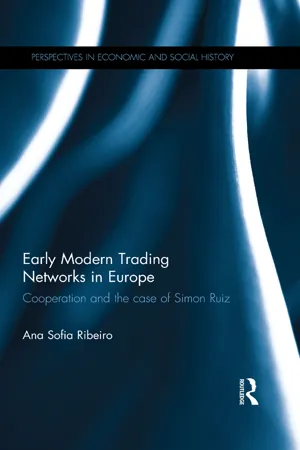
Early Modern Trading Networks in Europe
Cooperation and the case of Simon Ruiz
- 230 pages
- English
- ePUB (mobile friendly)
- Available on iOS & Android
eBook - ePub
Early Modern Trading Networks in Europe
Cooperation and the case of Simon Ruiz
About this book
In the early modern period, trade became a truly global phenomenon. The logistics, financial and organizational complexity associated with it increased in order to connect distant geographies and merchants from different backgrounds. How did these merchants prevent their partners from dishonesty in a time where formal institutions and legislation did not traverse these different worlds? This book studies the mechanisms and criteria of cooperation in early modern trading networks. It uses an interdisciplinary approach, through the case study of a Castilian long-distance merchant of the sixteenth century, Simon Ruiz, who traded within the limits of the Portuguese and Spanish overseas empires. Early Modern Trading Networks in Europe discusses the importance of reciprocity mechanisms, trust and reputation in the context of early modern business relations, using network analysis methodology, combining quantitative data with qualitative information. It considers how cooperation and prevention could simultaneously create a business relationship, and describes the mechanisms of control, policing and punishment used to avoid opportunism and deception among a group of business partners. Using bills of exchange and correspondence from Simon Ruiz's private archive, it charts the evolution of this business network through time, debating which criteria should be included or excluded from business networks, as well as the emergence of standards. This book intends to put forward a new approach to early modern trade which focusses on individuals interacting in self-organized structures, rather than on States or Empires. It shows how indirect reciprocity was much more frequent than direct reciprocity among early modern merchants and how informal norms, like ostracism and signalling, helped to prevent defection and deception in an effective way. This book will be of interest to all early modern historians, especially those with an interest
1 A model for the study of historic business cooperation
This chapter aims to propose a model for the study of cooperation in early modern trading networks, which will be based on three different concepts and built upon interdisciplinary bodies of knowledge. These concepts are cooperation, self-organization and network analysis. The following pages will describe the main contributions of these fields of study to the topic of this book and how they can be integrated and operationalized. They will describe the methodological path that has driven this research and will explain the effect of the methodological choices and theoretical approaches selected on the results presented in this book. These results will allow for a new and fresh approach to discussion concerning early modern trade.
The methodological course has departed from micro-analytical approaches in favour of an approach that will be more global in nature. The decision to study one business firm’s network instead of regional segments of trading networks or merchant networks devoted to a certain product is not random. Focusing on an individual network, using the example of Simon Ruiz, allows for an in-depth reconstruction of this man’s business contacts through a vast archive that has survived until today. Furthermore, the detailed analysis of the evolution of Ruiz’s network and the corresponding quantification of his partner choice strategies has made it much easier to locate evidence of qualitative aspects about the fostering of cooperation and what mechanisms of control and punishment were adopted. This approach allows for a richer and more detailed view of the complexity of this past reality, allowing the internal functioning of a network to become concretized in the eyes of the historian. In 2013, Aaron Graham compared seven different works with regard to the new findings in early modern trading history. He concluded that:
the study of an individual mercantile network therefore continues to offer methodological advances, above all where such work addresses the intersection and interaction of its individual components either with formal or quasi-formal institutions or with a wider matrix of other informal networks.1
This chapter will describe how the book proposes to address the interactions and intersections between the many individual components of Simon Ruiz’s network.
Cooperation: mechanisms and conditions for emergence
Scholars soon realized that cooperation was not only present in human behaviour – it was essential also in the natural world. In 1902, Petr Kropotkin argued that cooperation was liable to evolve more often than competition. Kropotkin’s book, Mutual Aid: A Factor in Evolution, highlighted the fact that cooperation was abundant in the natural world and that ecological conditions were central to its evolutionary success. This finding contradicted the principles of the inherent selfishness of the human being or the principles of the homo economicus propounded by John Stuart Mill. The economists of the nineteenth century perceived humans as being self-interested actors who based their decisions only upon rationality. The moral dimension of human beings in taking economic decisions was not considered. Humans attempt to maximize utility as a consumer and economic profit as a producer.2
In the field of Evolutionary Biology, Hamilton’s work focused in the evolutionary theory of social behaviour in nature. He classified these behaviours on the basis of the fitness consequences of the behaviour of the actor and the recipient. According to Hamilton, mutually beneficial (+/+) behaviour increases the fitness of the actor and the recipient; selfish (+/−) behaviour increases the fitness of the actor and decreases the fitness of the recipient; altruistic (−/+) behaviour decreases the fitness of the actor and increases the fitness of the recipient; and spiteful (−/−) behaviour decreases the fitness of the actor and the recipient. Hamilton saw social interaction between relatives everywhere in nature, and understood the potential for an evolutionary theory of altruism. He set about re-examining the fundamental theory of natural selection in light of relatedness and with the view that an individual’s fitness was determined, in part, by the behaviour of their neighbours, mostly their kin.3
The observation that humans forgot their selfishness to help another individual and that such help was given at a cost to the helper raised the curiosity of diverse scientific fields in order to understand why and how humans decided to help one another. Scholars called them the mechanisms of cooperation.
Proved the evidence of genetic relations in acts of cooperation (kin selection), Trivers drew attention to one other specific mechanism of cooperation: direct reciprocity, which evidences the principle ‘if I scratch your back, you’ll scratch mine’ in 1971.4 He also focused on another characteristic of cooperation – altruism. This is defined as the behaviour of suffering a cost to confer a benefit. ‘Reciprocal altruism is the exchange of such acts between individuals so as to produce a net benefit on both sides. Reciprocal altruism is one kind of return-benefit altruism.’5 Trivers also underlined the role of the cheater or non-reciprocator. In direct reciprocity, being a cheater could imply a difficult situation for the cheater himself, mainly due to the counteraction of the others. These counteractions could consist simply of breaking off a relationship with a cheater, thereby reducing the benefits of cheating, or could comprise direct punishment or mere non-reciprocation.
In the 1980s, Axelrod launched The Evolution of Cooperation, a work in which he posed the basic problem of cooperation, which ‘occurs when the pursuit of self-interest by each leads to a poor outcome for all’.6 He applied Game Theory to the study of cooperation, by implementing the Prisoner’s Dilemma game with humans to test the conditions that favoured the emergence of cooperation:
In the Prisoner’s Dilemma game, there are two players. Each has two choices, namely cooperate or defect. Each must make the choice without knowing what the other will do. No matter what the other does, defection yields a higher payoff than cooperation. The dilemma is that if both defect, both do worse than if both had cooperated.7
In this game, the tendency is to defect unless the game is repeated several times. There are repeated interactions that make cooperation possible.
This possibility means that the choices made today not only determine the outcome of this move, but can also influence the later choices of players. The future can therefore cast a shadow back upon the present and thereby affect the current strategic situation.8
Axelrod was the first to use the expression ‘Tit for Tat’, a cooperative strategy employed when a player cooperates on the first move and then does whatever the other player did on the previous move, a strategy to foster direct reciprocity.
With the publication of Alexander’s The Biology of Moral Systems, another mechanism of cooperation emerged in the literature, namely indirect reciprocity. He tried to explain clearly how human cooperation emerged in large groups and between individuals who never even met.9 This mechanism reports behaviour in which a donor helps a recipient (who neither belongs to the same family, nor helped him or her previously), hoping that a third party might replicate this behaviour in the future, and in return help him. Thus, the donor’s reputation is spread through direct or indirect observations to the rest of the individuals via gossip. According to Alexander, indirect reciprocity ‘involves reputation and status, and results in everyone in the group continually being assessed and reassessed’.10
This mechanism has caused great concern for researchers and the concept of ‘image scoring’ seems to have gathered some consensus. Nowak and Sigmund claim that information about another player does not require a direct interaction, but can be obtained indirectly, either by observing the player or by talking to others.11 The idea implies the assignment of a positive or negative individual image, depending on whether one agent was seen acting altruistically or selfishly towards another. These scholars have proved that the image scoring itself evolves. The effects on the observer strongly promote cooperation. The evolution of the model of indirect reciprocity demonstrates that reputation is essential ‘for fostering social behaviour among selfish agents, and that it is considerably more effective with punishment’.12
Scholars have been underlining the crucial role of culture in human cooperative behaviours, which seem particularly relevant if one is dealing with cooperation seen in past human activities. Historians acknowledge that time and space are relevant in life. Culture, for this purpose, is defined ‘as the information stored in individual brains that was acquired by imitation of, or [in] reaching by, others’.13 Anthropologists and other social scientists refer to the determinant role institutions perform in the evolution of cooperation, explaining the differences in diverse cooperative behaviour. Beliefs, skills, mental models, values, preferences and habits are inculcated in each individual through participation in various social groups such as family, local communities, employers, nations or governments. In this sense, cooperation implies a social structure conditioned by historical time and space. Bowles and Gintis maintain that prosocial emotions are essential for fostering cooperation, essentially ‘strong reciprocity’:
A strong reciprocator comes to a new social situation with a predisposition to cooperate, is predisposed to respond to cooperative behavior on the part of others by maintaining or increasing his level of cooperation, and responds to free-riding ...
Table of contents
- Cover Page
- Halftitle
- Dedication
- Title Page
- Copyright Page
- Table of Contents
- List of figures
- List of tables
- Acknowledgements
- List of abbreviations
- Network analysis brief glossary
- Introduction
- 1 A model for the study of historic business cooperation
- 2 The evolution of the Simon Ruiz network and partner choice criteria
- 3 The proximity to power
- 4 Endogamy in early modern trade: a necessity? The case of the Simon Ruiz network
- 5 Mechanisms of economic cooperation and competition between Simon Ruiz and his agents in Portugal, 1557–80
- 6 Informal promoters of merchant cooperation: the power of trust, gossip and reputation
- Conclusion
- Bibliography
- Index
Trusted by 375,005 students
Access to over 1.5 million titles for a fair monthly price.
Study more efficiently using our study tools.
Frequently asked questions
Yes, you can cancel anytime from the Subscription tab in your account settings on the Perlego website. Your subscription will stay active until the end of your current billing period. Learn how to cancel your subscription
No, books cannot be downloaded as external files, such as PDFs, for use outside of Perlego. However, you can download books within the Perlego app for offline reading on mobile or tablet. Learn how to download books offline
Perlego offers two plans: Essential and Complete
- Essential is ideal for learners and professionals who enjoy exploring a wide range of subjects. Access the Essential Library with 800,000+ trusted titles and best-sellers across business, personal growth, and the humanities. Includes unlimited reading time and Standard Read Aloud voice.
- Complete: Perfect for advanced learners and researchers needing full, unrestricted access. Unlock 1.5M+ books across hundreds of subjects, including academic and specialized titles. The Complete Plan also includes advanced features like Premium Read Aloud and Research Assistant.
We are an online textbook subscription service, where you can get access to an entire online library for less than the price of a single book per month. With over 1.5 million books across 990+ topics, we’ve got you covered! Learn about our mission
Look out for the read-aloud symbol on your next book to see if you can listen to it. The read-aloud tool reads text aloud for you, highlighting the text as it is being read. You can pause it, speed it up and slow it down. Learn more about Read Aloud
Yes! You can use the Perlego app on both iOS and Android devices to read anytime, anywhere — even offline. Perfect for commutes or when you’re on the go.
Please note we cannot support devices running on iOS 13 and Android 7 or earlier. Learn more about using the app
Please note we cannot support devices running on iOS 13 and Android 7 or earlier. Learn more about using the app
Yes, you can access Early Modern Trading Networks in Europe by Ana Sofia Ribeiro,AnaSofia Ribeiro in PDF and/or ePUB format, as well as other popular books in Economics & Economic History. We have over 1.5 million books available in our catalogue for you to explore.