- 1,840 pages
- English
- ePUB (mobile friendly)
- Available on iOS & Android
eBook - ePub
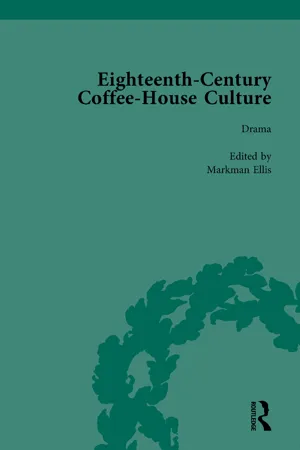
Eighteenth-Century Coffee-House Culture, vol 3
About this book
Helps scholars and students form an understanding of the contribution made by the coffee-house to British and even American history and culture. This book attempts to make an intervention in debates about the nature of the public sphere and the culture of politeness. It is intended for historians and scholars of literature, science, and medicine.
Trusted by 375,005 students
Access to over 1.5 million titles for a fair monthly price.
Study more efficiently using our study tools.
Information
Thomas Sydserf, Tarugo’s Wiles: or, the Coffee-House. A Comedy. As it was acted at his Highness’s The Duke of York’s Theatre (London, Henry Herringman, 1668), [8], 54pp.; 4° BL:644.f.44. ESTCR27882
Tarugo’s Wiles: or, the Coffee-House, by the Scottish dramatist Thomas Sydserf (also spelled St Serfe), is a reworking of a Spanish comedy by Moreto. The setting is announced as ’A Coffee-house, where is presented a mixture of all kind of people’ (p. 52). The bulk of the play is set in non-specific urban locations in Madrid, except for the coffee-house of Act III, which is located in London. At this period there were no coffee-houses in Spain: of this contradiction the play remains silent. The play is a translation of No puede ser [It Cannot Be] (Madrid, 1660), by Agustín Moreto y Cabaña, itself derived from Lope de Vega’s El Mayor Impossible. The plot turns on a complex series of courtship reversals, gender stereotypes and transgressive disguise scenes. Sydserf’s prose translation is fairly close to the original, except for the gratuitous addition of the third act, and the elevation of Tarugo from a servant to the brother of Don Horatio. No puede ser was translated again in 1685 by the English dramatist John Crowne as Sir Courtly Nice (see James Castañeda, Agustín Moreto (New York, Twayne Publishers, 1974), pp. 97–9).
Act III is set in the coffee-room, where Tarugo has sought refuge from his debtors by swapping clothes with the coffee waiter. The act offers a satirical portrait of coffee-house conversation, with the ironic punctum that the absurd debates witnessed there are mediated by the presence of Tarugo in disguise. In a series of small skits, a range of customers discuss a medley of fashionable topics: the physiological properties of coffee, inane syllogisms, the transfusion of the blood, utopian Harringtonian political philosophy, Italian painting, political allegiance, sexuality and military stratagems. While some debate and converse with apparent ease, others bicker and gossip: one discussion, on military fortifications, leads to a brawl precipitated by one protagonist having a dish of coffee thrown in his face.
Sydserf’s play met with some success in London. It was acted at the Duke of York’s theatre in Lincoln’s Inn Fields on Saturday 5, 7(?), 8 and 15 October 1667 (London Stage, part I, pp. 119–20). On 5 October, Pepys noted ’To the Duke of York’s playhouse, but the house so full, it being a new play, “The Coffee House”, that we could not get in’ (Diary, vol. VIII, p. 463). On Tuesday 15 October, Pepys went again, where in the presence of the King and the Duke of York he saw the play. He commented it was ’the most ridiculous, insipid play that ever I saw in my life, and glad we were that Betterton had no part in it’ (Diary, vol. VIII, p. 481) The Scottish traveller, Sir John Lauder, saw a performance on 5(?) October at ’the Dukes playhouse’ in Lincoln’s Inn Fields. He commented ’we saw Tom Sydserfes Spanish Comedie Tarugoes Wiles, or the Coffee House, acted. In the pit they payed 30p., in our place 18s. He could not forget himselfe: was very satyricall sneering at the Greshamers for their late invention of the transfusion of blood, as also at our covenant, making the witch of Geneva to wy [weigh] it and La Sainte Ligue de France togither’ (The Journals of Sir John Lauder Lord Fountainhall with his observations on public affairs and other memoranda 1665–1676, ed. by Donald Crawford, Publications of the Scottish History Society, 36 (Edinburgh, Edinburgh University Press, 1900), pp. 174–5). After publication in London in 1668, Tarugo’s Wiles was further acted at the Tennis Court Theatre in Edinburgh in 1668 (Bill Findlay (ed.), A History of Scottish Theatre (Edinburgh, Polygon, 1998), p. 68). In 1691, Gerald Langbaine’s An Account of the English Dramatic Poets (London, L.L. for George West and Henry Clements, 1691), noted that ’ This Comedy if not equal with those ofthe first Rank, yet exceeds several which pretend to the second; especially the third Act, which discovers the several Humours of a Coffee-house’ (pp. 434–5).
Sydserf (1624–69) was the son of the Bishop of Galloway and afterwards of Orkney (also called Thomas Sydserf, d. 1663), and was the publisher of the first Scottish newspaper, the Mercurius Caledonius, in 1660 (a Royalist news-sheet suppressed by the King in the interests of toleration). Like his father, he was closely attached to the Stuart cause, and received payments for espionage on their behalf (Terence Tobin, ’Thomas St Serf (Sydserf) 1624–69’, Theatre Notebook, 27:2 (1973), pp. 74–7). He was the manager of the Tennis Court Theatre in Edinburgh from late 1667 to 1669 (’Trial of Mungo Murray for assaulting Thomas Sydserf, Comedian (1669)’ in Miscellany ofthe Abbotsford Club, vol. I, ed. by James Maidment (Edinburgh, n. p., 1837), pp. 87–95). Tarugo’s Wiles was printed by Henry Herringman, at the Sign of the Anchor on the Lower-Walk of the New Exchange, a bookseller and publisher active 1653–93. In William Wycherley’s comedy The Country-Wife (London, Thomas Dring, 1675), Tarugo’s Wiles is mentioned as an example of a debased and unfashionable play that appeals only to country taste (Act III, p. 40). Charles Sackville (1643–1706), Lord Buckhurst and later Earl of Dorset, wrote verses ’To Sir Thomas St. Serfe: on the Printing his Play Call’d Tarugo’s Wiles’ praising him as the first Scot to have a play performed in London (the poem appeared anonymously in Covent Garden Drollery, 1672, and was attributed in Dryden’s Poetical Miscellanies: the fifth part (London, Jacob Tonson, 1704), p. 276).
TARUGO’S
WILES:
OR, THE
Coffee-House.
WILES:
OR, THE
Coffee-House.
A
COMEDY.
COMEDY.
As it was Acted at his Highness’s, the Duke
of York’s Theater.
of York’s Theater.
WRITTEN
By THO. St SERFE, Gent.
LONDON,
Printed for Henry Herringman, at the Sign of the Anchor, on the Lower-walk of the New-Exchange. 1668.
To the Right Honourable, and most Noble Lord,
GEORGE
MARQUESSE of HUNTLEY,
EARL of EIGNEY,
AND
LORD STRATHBOGY.
GEORGE
MARQUESSE of HUNTLEY,
EARL of EIGNEY,
AND
LORD STRATHBOGY.
My Lord,
Table of contents
- Cover
- Half Title
- Title Page
- Copyright Page
- Table of Contents
- Introduction
- [John Tatham], Knavery in all Trades: or, The Coffee-House. A Comedy (1664)
- Thomas Sydserf, Tarugo’s Wiles: or, the Coffee-House. A Comedy (1668)
- Elkanah Settle, The New Athenian Comedy (1693)
- Charles Johnson, The generous husband: or, the coffee house politician ([1711])
- Exchange-Alley: or, the stock-jobber turn’d gentleman (1720)
- James Miller, The Coffee-House. A Dramatick Piece (1737)
- The Usurpers: or the Coffee-House Politicians. Afarce (1749)
- Explanatory Notes
Frequently asked questions
Yes, you can cancel anytime from the Subscription tab in your account settings on the Perlego website. Your subscription will stay active until the end of your current billing period. Learn how to cancel your subscription
No, books cannot be downloaded as external files, such as PDFs, for use outside of Perlego. However, you can download books within the Perlego app for offline reading on mobile or tablet. Learn how to download books offline
Perlego offers two plans: Essential and Complete
- Essential is ideal for learners and professionals who enjoy exploring a wide range of subjects. Access the Essential Library with 800,000+ trusted titles and best-sellers across business, personal growth, and the humanities. Includes unlimited reading time and Standard Read Aloud voice.
- Complete: Perfect for advanced learners and researchers needing full, unrestricted access. Unlock 1.5M+ books across hundreds of subjects, including academic and specialized titles. The Complete Plan also includes advanced features like Premium Read Aloud and Research Assistant.
We are an online textbook subscription service, where you can get access to an entire online library for less than the price of a single book per month. With over 1.5 million books across 990+ topics, we’ve got you covered! Learn about our mission
Look out for the read-aloud symbol on your next book to see if you can listen to it. The read-aloud tool reads text aloud for you, highlighting the text as it is being read. You can pause it, speed it up and slow it down. Learn more about Read Aloud
Yes! You can use the Perlego app on both iOS and Android devices to read anytime, anywhere — even offline. Perfect for commutes or when you’re on the go.
Please note we cannot support devices running on iOS 13 and Android 7 or earlier. Learn more about using the app
Please note we cannot support devices running on iOS 13 and Android 7 or earlier. Learn more about using the app
Yes, you can access Eighteenth-Century Coffee-House Culture, vol 3 by Markman Ellis in PDF and/or ePUB format, as well as other popular books in History & World History. We have over 1.5 million books available in our catalogue for you to explore.