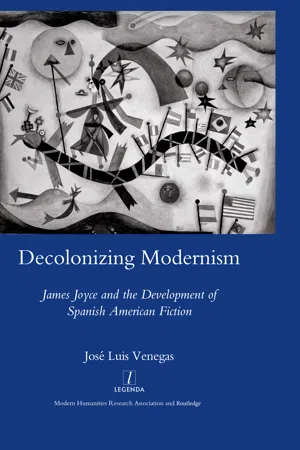
James Joyce's Ulysses (1922) has been recognized as a central model for the Spanish American 'New Narrative'. Joyce's linguistic and technical influence became the unequivocal sign that literature in Spanish America had definitively abandoned narrow regionalist concerns and entered a global literary canon. In this bold and wide-ranging study, Jose Luis Venegas rethinks this evolutionary conception of literary history by focusing on the connection between cultural specificity and literary innovation. He argues that the intertextual dialogue between James Joyce and prominent authors such as Argentines Jorge Luis Borges and Julio Cortazar, Cuban Guillermo Cabrera Infante, and Mexican Fernando del Paso, reveals the anti-colonial value of modernist form. Venegas explores the historical similarities between Joyce's Ireland during the 1920s and Spanish America between the 1940s and 70s to challenge depoliticized interpretations of modernist aesthetics and propose unsuspected connections between formal experimentation and the cultural transformations demanded by decolonizing societies. Jose Luis Venegas is Visiting Assistant Professor of Spanish at the University of North Carolina at Greensboro.
Dissociations of Sensibility: Cultural Decolonization and Joyce’s Reception in Spanish America
The Invention of Joyce’s Modernism
In Chapter 5 of Joyce’s A Portrait of the Artist as a Young Man, Stephen Dedalus explains his aesthetic theory to his fellow college student, Cranly. At a crucial point in his exposition, he makes a distinction between ‘static’ and ‘kinetic’ art: while the latter is ‘improper’ and incites feelings of ‘desire or loathing’, the former is the cause of the ‘esthetic emotion’ which arrests the mind and raises it above the squalid materiality of the external world.1 After a complex elaboration of his quasi-scholastic approach to the artistic object, Stephen culminates his argument with his often-quoted description of the artist as the ‘God of the creation, [who] remains within or behind or beyond or above his handiwork, invisible, refined out of existence, indifferent, paring his fingernails’. However, his carefully wrought argument is no sooner finished than it is gruffly deflated by another of his classmates, Lynch: ‘What do you mean’, he asks, ‘by prating about beauty and the imagination in this miserable, Godforsaken island? No wonder the artist retired within or behind his handiwork after having perpetrated this country’.2 With these remarks, it seems that Joyce is playing the aesthetic formalism of ‘static art’ against the social conditions of Ireland at the turn of the twentieth century. Early reviewers of Joyce’s A Portrait and Ulysses were quick to identify Stephen’s aesthetic views with those of Joyce and to oppose the structural complexity of his works to the Irish background of their contents.3 As Joseph Brooker has noted, while some of these critics celebrated Joyce’s narrative by focusing on its ‘static’ architectonics, others denigrated it on account of its ‘kinetic’ aspects.4 The opinions of the first group, which included Ezra Pound and T. S. Eliot, constituted the critical foundation of Joyce’s canonization as the epitome of ‘high modernism’; the often enraged reactions of the second group eventually resulted in the notorious censorship of Ulysses in the United States and Great Britain until the 1930s.
Joseph Kelly has claimed that Pound and Eliot ‘changed Joyce from an Irish writer into an avant-garde, cosmopolitan writer, shucking off his provincial husk’.5 But how can one ignore the ‘Irishness’ of a writer whose entire oeuvre revolves around Dublin and the speech and customs of its people? For Pound and Eliot, the Irish content of Joyce’s narrative was little more than the dull subject matter transfigured into art by the formal virtuosity of A Portrait and, most notably, Ulysses. This emphasis on the ‘static’ elements of Joyce’s prose was a necessary critical step toward establishing his style and techniques as the remedy for the rapid dissolution of European cultural values after World War I. For instance, Pound affirmed that the ‘realism’ of Ulysses was the solution to the ‘hell of contemporary Europe. The sense of style that Joyce’s narrative represents would have saved America or Europe. The mot juste is of public utility’.6 For the author of the Cantos, this stylistic precision was testimony to Joyce’s detachment from the ‘local stupidity’ of his native Ireland and to his entrance ‘into the modern world’: ‘He writes as a European, not as a provincial’, Pound unambiguously stated in a piece entitled ‘The Non-Existence of Ireland’.7
The ‘modern’ and ‘European’ characteristics of Joyce’s Ulysses were also the main concern of Eliot in his well-known 1923 review ‘Ulysses, Order and Myth’. Eliot perceived in the mythical structure of Ulysses a paradigm of order fulfilling a function analogous to that which Pound assigned to Joyce’s narrative precision, namely that of ‘controlling, of ordering, of giving a shape and a significance to the immense panorama of futility and anarchy which is contemporary history’.8 Though fragmentary, the post-Great War world of Eliot and Joyce could gain stability by association with the order of myth. Thus, what he called the ‘mythical method’ — the manipulation of ‘a continuous parallel between contemporaneity and antiquity’ — afforded the possibility of concentrating on the ‘static’ architecture of Ulysses, while ignoring its ‘kinetic’ contents. In this respect, A. Walton Litz maintained that ‘Eliot was troubled from the start by the threat which Joyce’s diverse and rambunctious prose might pose to the “classicist”’, adding that, like ‘a devoted but somewhat timid child, Eliot was trying to process Joyce’s novel into a congenial world of “authority” and “tradition”’.9 Therefore, the aesthetic principles of literary modernism as theorized and practised by Pound and Eliot found in Joyce’s Ulysses a space for projection.
Indeed, Eliot the ‘classicist’ considered the ‘static’ order of Ulysses to be a remedy for the cultural fragmentation of the West, which he surely perceived as an extreme case of ‘dissociation of sensibility’. Eliot introduced this concept in his essay ‘The Metaphysical Poets’ (1921), where he claimed that Donne, Chapman and other English poets of the early seventeenth century exemplified the perfect integration of lived experience and intellectual learning.10 For these poets, feeling and thought were in perfect harmony, since their intellects were constantly pressing their experiences into systems or ‘wholes’. Their minds were not assailed by the fragmentation that, according to Eliot, became increasingly frequent in English letters after the seventeenth century. Eliot must have noticed a strong parallel between this initial moment of ‘dissociation of sensibility’ in the English poetic tradition and the consequences for artistic expression that he attributed to the ‘immense panorama of futility and anarchy’ during the early decades of the twentieth century. In his review of Ulysses he sought an artistic frame to remedy the post-War ‘dissociation of sensibility’ in the interpretations of primitive myth elaborated by the emerging sciences of anthropology, ethnology and psychology:
Psychology (such as it is, and whether our reaction to it be comic or serious), ethnology, and The Golden Bough have concurred to make possible what was impossible only a few years ago. Instead of narrative method, we may now use the mythical method. It is, I seriously believe, a step toward making the modern world possible for art.11
What Eliot might have found appealing in these disciplines is their common goal to find in ‘savage’ cultures an organic and undivided mode of thought. Marc Manganaro has identified the French ethnologist Lucien Lévy-Bruhl as one of the central sources of Eliot’s views in ‘The Metaphysical Poets’. Manganaro argues that the unified sensibility that Eliot ascribed to these English poets closely resembles Lévy-Bruhl’s notion of the mentalité primitive, a mentality that perceives physical objects and their spiritual value as ‘un tout indécomposable’ [a synthetic whole].12 By linking Ulysses to the restorative potential of anthropological discourse, Eliot presents Joyce’s novel as an effort to regain for art the mythical value of the mentalité primitive and as a remedy against the ‘dissociation of sensibility’ that affected the European psyche after World War I. In other words, for Eliot, the ‘stasis’ of the mythical structure informing Joyce’s book emerges as a powerful and convincing illustration of how art can provide a redemptive space where the ‘futility and anarchy’ of contemporary life could be contained and controlled. Thus, the structural order of myth offers Eliot a space of representation where the unruliness of historical transformations and the external world could be successfully overcome. As Astradur Eysteinnson has noted, Eliot’s aesthetic ideas in ‘Ulysses, Order and Myth’ closely parallel those of Stephen in A Portrait, adding that their shared theory of art ‘is frequently taken to constitute the center of the revolutionary formal awareness and emphasis that most critics detect in modernist works’.13
If the idea of a ‘modernist’ Joyce goes hand in hand with a formalist and cosmopolitan reading of his work, those who decried Ulysses as mere pornography emphasized, more often than not, the author’s Irish ‘backwardness’. As Kevin Dettmar has aptly noted, to say that a writer was ‘Irish’ during the first decades of the twentieth century ‘was not simply to supply one’s readers with information about the author’s national origin; for whether consciously or unconsciously, the label “Irish” served to enmesh Joyce in a long history of British anti-Irish stereotypes’.14 A case in point is H. G. Wells’s 1917 review of A Portrait, where he interprets Joyce’s ‘cloacal obsession’ and his anti-English feelings as the result of his ‘limitations’ as an Irishman. The ‘kinetic’ nature of Joyce’s prose is perceived as a sign of underdevelopment with respect to England, whose modernity has successfully expunged the uncivilized features permeating A Portrait. Joyce, Wells writes, ‘would bring back into the general picture of life aspects which modern drainage and modern decorum have taken out of ordinary intercourse and conversation’. To these remarks, he adds the revealing comment that ‘We shall do Mr. Joyce an injustice if we attribute a normal sensory basis to him and then accuse him of deliberate offense’.15 It appears that the cause of Joyce’s impaired ‘sensory basis’ is, according to English novelist, his Irishness. Thus, where Pound and Eliot had to denationalize and ‘modernize’ Joyce to bring out the ‘static’ side of his work, Wells immediately links up his nationality and the ‘kinetic’ aspects of A Portrait to underscore the novel’s ‘backwardness’. Likewise, while Eliot saw in the ‘order’ of Ulysses a possible solution to the ‘dissociation of sensibility’ that plagued the modern world, Wells alerts us to the disrupting effects of A Portrait and Joyce’s deficient sensorial perception.
Wells’s notion of an Irish abnormal ‘sensory basis’ can be usefully connected to Kant’s ideas on how aesthetic perception or ‘taste’ varies depending on race and nationality. For Kant, the right mode of aesthetic perception is that which can connect the purposiveness of nature to the cognitive structures of enlightened reason. Ethnic or national identity is a factor that affects this rapport between perception and cognition. In section four of his Observations on the Feeling of the Beautiful and Sublime (1764), Kant argues that ‘finer feeling’ or appropriate taste is to be associated mainly with Europeans, and specifically with the Germans: they have ‘a fortunate combination of feeling, both in that of the sublime and in that of the beautiful’.16 This ‘fortunate combination of feeling’, reminiscent of Wells’s ‘normal sensory basis’, is denied to other nations and races in direct proportion to their geopolitical distance from Germany. The lowest end of this aesthetic spectrum is occupied by the ‘Negroes of Africa’ who ‘have by nature no feeling that rises above the trifling’.17 The racial difference between whites and blacks, the German philosopher believes, ‘appears to be as great in regard to mental capacities as in color’.18 It seems then that the racism behind colonial structures of power did not only find support in a ‘denial of coevalness’ between the colonizer and the colonized, as has been convincingly argued, but also in what we might call a ‘denial of finer feeling’.19
Indeed, Wells’s notion of what a ‘normal sensory basis’ should be might have been conditioned by his perception of the Irish not only as England’s colonized ‘other’, but also as racially inferior. As Vincent Cheng has shown, ‘the racial comparison most frequently and insistently made about the Irish during the latter half of the nineteenth century was with “negroes”’.20 Wells’s response to Joyce radically clashes with Eliot’s and Pound’s: far from being the champion of Western values, Wells sees Joyce as an intellectually deviant and anti-modern man, a man that, to borrow John Middleton Murry’s words, ‘would blow what remains of Europe into the sky […] [due to his] rebellion against the lucidity and comprehensibility of civilized art’.21
This brief survey of Joyce’s early reception in Europe illustrates the underlying connections between aesthetic theory, modernity and colonialism. These connections often determined and substantiated antithetical critical perceptions of A Portrait, and, most notably, Ulysses. Depending on the commentator, Joyce’s pros...
Table of contents
Cover Page
Title Page
Copyright Page
Table of Contents
Acknowledgements
Introduction
1 Dissociations of Sensibility: Cultural Decolonization and Joyce’s Reception in Spanish America
2 The Limits of Parody: Allusion and Cosmopolitanism in Jorge Luis Borges
3 Double Consciousness and Counter-Myth in Julio Cortázar’s Rayuela
4 Local Interests: The Aesthetics of the Joycean Novel in Spanish America
Conclusion
Index
Trusted by 375,005 students
Access to over 1.5 million titles for a fair monthly price.
Study more efficiently using our study tools.
Frequently asked questions
Yes, you can cancel anytime from the Subscription tab in your account settings on the Perlego website. Your subscription will stay active until the end of your current billing period. Learn how to cancel your subscription
No, books cannot be downloaded as external files, such as PDFs, for use outside of Perlego. However, you can download books within the Perlego app for offline reading on mobile or tablet. Learn how to download books offline
Perlego offers two plans: Essential and Complete
Essential is ideal for learners and professionals who enjoy exploring a wide range of subjects. Access the Essential Library with 800,000+ trusted titles and best-sellers across business, personal growth, and the humanities. Includes unlimited reading time and Standard Read Aloud voice.
Complete: Perfect for advanced learners and researchers needing full, unrestricted access. Unlock 1.5M+ books across hundreds of subjects, including academic and specialized titles. The Complete Plan also includes advanced features like Premium Read Aloud and Research Assistant.
Both plans are available with monthly, semester, or annual billing cycles.
We are an online textbook subscription service, where you can get access to an entire online library for less than the price of a single book per month. With over 1.5 million books across 990+ topics, we’ve got you covered! Learn about our mission
Look out for the read-aloud symbol on your next book to see if you can listen to it. The read-aloud tool reads text aloud for you, highlighting the text as it is being read. You can pause it, speed it up and slow it down. Learn more about Read Aloud
Yes! You can use the Perlego app on both iOS and Android devices to read anytime, anywhere — even offline. Perfect for commutes or when you’re on the go. Please note we cannot support devices running on iOS 13 and Android 7 or earlier. Learn more about using the app
Yes, you can access Decolonizing Modernism by Jose Luis Venegas,JoseLuis Venegas in PDF and/or ePUB format, as well as other popular books in Languages & Linguistics & Languages. We have over 1.5 million books available in our catalogue for you to explore.