- 282 pages
- English
- ePUB (mobile friendly)
- Available on iOS & Android
eBook - ePub
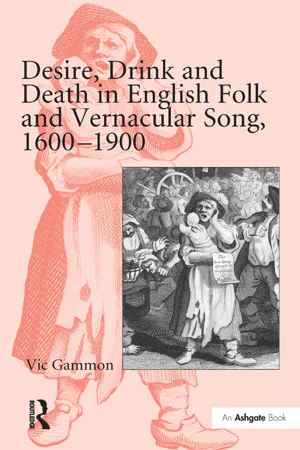
Desire, Drink and Death in English Folk and Vernacular Song, 1600-1900
About this book
This much-needed book provides valuable insights into themes and genres in popular song in the period c. 1600-1900. In particular it is a study of popular ballads as they appeared on printed sheets and as they were recorded by folk song collectors. Vic Gammon displays his interest in the way song articulates aspects of popular mentality and he relates the discourse of the songs to social history. Gammon discusses the themes and narratives that run through genres of song material and how these are repeated and reworked through time. He argues that in spite of important social and economic changes, the period 1600-1850 had a significant cultural consistency and characteristic forms of popular musical and cultural expression. These only changed radically under the impact of industrialization and urbanization in the nineteenth century. The book will appeal to those interested in folk song, historical popular music (including church music), ballad literature, popular literature, popular culture, social history, anthropology and sociology.
Information
Chapter 1
Song, Sex and Society in England, 1600–18501
A Problem of Perception?
Consider three statements, two from historians and the other from an anthropologist:
When dealing with the sexual behaviour of the lower orders, the historian is forced to abandon any attempt to probe attitudes and feelings, since direct evidence does not exist. He is obliged to deduce such things from legal records, the comments of literate contemporaries, and the stark demographic facts which he laboriously extracted from parish registers of marriages and baptism. (Lawrence Stone)
One way to discover unspoken norms is often to examine the untypical episode or situation. A riot throws light upon the norms of tranquil years, and a sudden breach of deference enables us to better understand the deferential habits that have been broken. This may be true equally of the public and social and of more private, domestic conduct. (E.P. Thompson)2
The myth is certainly related to given (empirical) facts, but not as a re-presentation of them. The relationship is of a dialectical kind, and the institutions described in the myths can be the very opposites of the real institutions. This will in fact always be the case when the myth is trying to express a negative truth. (Claude Lévi-Strauss)
In this chapter, I want to look critically at a very widespread popular misconception about England before mature industrialization. According to this view, propagated by some writers and in products of popular culture, the English people of the period were uninhibited in their sexual attitudes, activity and relationships. Applied to the realm of song study, this view derives from a fairly superficial study of songs without sufficient attention to the social context in which they had currency. I also want to consider whether songs allow us, in Lawrence Stone’s phrase, ‘to probe attitudes and feelings’. If this is possible, songs are an important source of direct evidence concerning the mentality of the ‘lower orders’ which Stone overlooked in spite of the broad sweep of his work. This area of investigation raises enormous problems of interpretation which are broached in the passages quoted above from Lévi-Strauss and E.P. Thompson.
The materials on which I have drawn are English traditional songs and broadside ballads about sex, sexual relations and sex roles. I wish to try to assess the significance of such songs in the light of developments in English social history, historical demography and the study of popular culture. In essence, this is an essay in interpretation which may show some material familiar to readers in a new light.3
Consonance with Nature?
A.L. Lloyd expressed his view of the significance of English erotic folklore in this way:
the erotic folklore of the soil … with its clean joy and acceptance of the realities of virginity and desire, passion and pregnancy, belongs to a country people living an integrated deeply-communal life, in tune with natural events, with the cycle of the seasons, seed-time and harvest, a people who ‘experience cherries as cherries’, and for whom all nature is sexualised and the closest relation exists between the fertility of seeds, beasts and humans. For them, a love affair is not simply established within the couple, nor even between the couple and the community, but extends beyond that to the whole natural environment as an echo, however faint, of an ancient ritualistic way of looking at the world. Nowhere does this intimate consonance with nature show clearer than in the erotic folk songs. Their symbols are of germination and of fruitfulness, while those of the pornographic song are generally of lovelessness and sterility. With misplaced sympathy, modern city writers have remarked on the ‘disconcerting ease’ with which young women in the folk songs become pregnant, forgetting that for balanced rural societies the arrival of children is vital and joyous because among other things it means more hands to help with the work. The notion of trying out a girl before marriage, in order to be sure of her fecundity, was common enough in a society where pregnancy was only unwelcome if the girl was deserted, and not always then.4
Alan Lomax, G. Legman and James Reeves, among others, have made similar statements.5 Some historians have also held similar notions.6
Most of the important collections of English folk songs were made between 1890 and 1920, although there are significant later collections.7 Despite the recent acquisition of this body of material, it is clear that many of the songs collected in the last century are of considerable antiquity. Many appeared on printed broadsides as far back as the seventeenth and even sixteenth centuries. I wish to suggest that, using the method put forward by Peter Burke, it is possible to ‘argue backwards’ and deduce from these songs attitudes and values of popular mentality belonging roughly to the period 1600–1850.8
Printed broadside ballads (and other literary sources) can be used with oral texts to underpin this regressive method. If it can be shown that a song collected within the last century was issued by a broadside printer in the period 1600–1850 then it is reasonable to assume that the song had continuous or intermittent life at least from its earliest printing. If a song on an early broadside is not substantially the same as that obtained by a collector, but shares structural, poetic, narrative or thematic features with it, then it is reasonable to assume that the song type is at least as old as the earliest printing.
Recent work in social history and historical demography (much of it produced since Lloyd wrote Folk Song in England) has begun to map out the social context in which the songs under discussion were produced.9 The picture that is emerging is far from the popular idea of a sexually free and open society. Pre-industrial England was a society in which food shortage was endemic, where diseases were commonplace, and where life was uncertain and, in terms of life expectancy, much shorter than it is today. It was a society in which poverty and material constraints determined the life experience of the vast majority of people. Although it was overwhelmingly rural, it was a very mobile society; the idea of the settled village community is far from the truth. It was hierarchical, rife with social conflict and tensions which expressed themselves in such things as witchcraft accusations, cases of defamation and riot. It was strongly patriarchal: women had a low status, and were thought to deserve special punishments such as the cucking-stool for scolding, and whipping or incarceration in a house of correction for bearing a bastard child. It was a society in which sexual activity outside marriage generally took place in a disapproving, inquisitive and regulative atmosphere. Church courts, the Poor Law and popular social sanctions, such as the skimmington, could be used against those who would not conform. People commonly married late and sex before betrothal was actively discouraged. Illegitimacy rates were relatively low; bastard children were most often born to a subgroup...
Table of contents
- Cover
- Half Title
- Dedication
- Title Page
- Copyright Page
- Table of Contents
- List of Illustrations
- List of Tables
- List of Music Examples
- Acknowledgements
- Guide to Abbreviations and Main Sources
- Introduction Exploring Old Songs
- 1 Song, Sex and Society in England, 1600–1850
- 2 Such a Merry Tune: Music, Musical Instruments and Dance as Sexual Symbols
- 3 Echoes of the Siren: Music, Charm, and Seduction in British Traditional Songs and Ballads
- 4 ‘Nothing Like Drinking’: English Vernacular Song and Strong Drink
- 5 Singing and Popular Funeral Practices in the Eighteenth and Nineteenth Centuries
- 6 Child Death
- 7 Song, Experience and Authenticity
- Index of Songs and Tunes
- General Index
Trusted by 375,005 students
Access to over 1.5 million titles for a fair monthly price.
Study more efficiently using our study tools.
Frequently asked questions
Yes, you can cancel anytime from the Subscription tab in your account settings on the Perlego website. Your subscription will stay active until the end of your current billing period. Learn how to cancel your subscription
No, books cannot be downloaded as external files, such as PDFs, for use outside of Perlego. However, you can download books within the Perlego app for offline reading on mobile or tablet. Learn how to download books offline
Perlego offers two plans: Essential and Complete
- Essential is ideal for learners and professionals who enjoy exploring a wide range of subjects. Access the Essential Library with 800,000+ trusted titles and best-sellers across business, personal growth, and the humanities. Includes unlimited reading time and Standard Read Aloud voice.
- Complete: Perfect for advanced learners and researchers needing full, unrestricted access. Unlock 1.5M+ books across hundreds of subjects, including academic and specialized titles. The Complete Plan also includes advanced features like Premium Read Aloud and Research Assistant.
We are an online textbook subscription service, where you can get access to an entire online library for less than the price of a single book per month. With over 1.5 million books across 990+ topics, we’ve got you covered! Learn about our mission
Look out for the read-aloud symbol on your next book to see if you can listen to it. The read-aloud tool reads text aloud for you, highlighting the text as it is being read. You can pause it, speed it up and slow it down. Learn more about Read Aloud
Yes! You can use the Perlego app on both iOS and Android devices to read anytime, anywhere — even offline. Perfect for commutes or when you’re on the go.
Please note we cannot support devices running on iOS 13 and Android 7 or earlier. Learn more about using the app
Please note we cannot support devices running on iOS 13 and Android 7 or earlier. Learn more about using the app
Yes, you can access Desire, Drink and Death in English Folk and Vernacular Song, 1600-1900 by Vic Gammon in PDF and/or ePUB format, as well as other popular books in Media & Performing Arts & Music. We have over 1.5 million books available in our catalogue for you to explore.