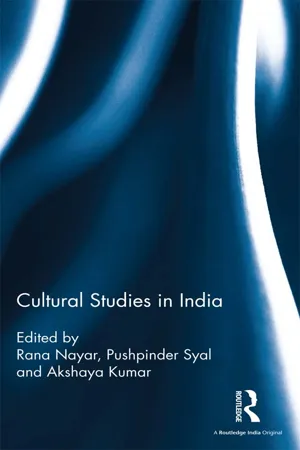
- 340 pages
- English
- ePUB (mobile friendly)
- Available on iOS & Android
eBook - ePub
Cultural Studies in India
About this book
This volume discusses the development of cultural studies in India. It shows how inter-disciplinarity and cultural pluralism form the basis of this emerging field. It deals with contemporary debates and interpretations of post-colonial theory, subaltern studies, Marxism and post-Marxism, nationalism and post-nationalism. Drawing upon literature, linguistics, history, political science, media and theatre studies, and cultural anthropology, it explores themes such as caste, indigenous peoples, vernacular languages and folklore and their role in the making of historical consciousness. A significant intervention in the area, this book will be useful to scholars and students of cultural studies and theory, literature, history, cultural anthropology, sociology, and media and mass communication, as well as the general reader.
Information
Part I
CULTURAL STUDIES AND INDIAN CONTEXT
1
CULTURE AND ENGLISH STUDIES IN INDIA
It is all too well known that the introduction of English in India in the mid-19th century had a clearly stated socio-political and cultural purpose. English has a long history in India of more than 150 years; before it became a subject of study in the UK, English literature became, for reasons of employment and social distinction, a subject of study with the establishment of the ‘presidency’ colleges. This had far-reaching consequences – on the positive side, it facilitated an interaction both with contemporary Western thought and with Western classics (writings of Plato, Aristotle, Homer, Virgil and Dante) and extended the horizons of the Indian mind by foregrounding socio-political thinking (Locke onwards) and the values of equity, social responsibility and honour. This was accompanied by the founding of new civilization institutions – the post office, the railways, the macadam road, the public hospitals and the municipality.
The new liberal thought also ushered in the much-needed social reform, and many Indians, for example Ishvarachandra Vidyasagar and Raja Ram Mohan Roy, distinguished themselves by introducing reform measures in Hindu society, according to their own understanding. In this sense, the English language may be called a language of liberation. But on the flip side, English became a language of subordination. The astounding material values bedazzled the educated, and the best Indian minds busied themselves acquiring these ideas, uncritically, while the Indian languages became recipient/borrowing languages and the Indian mind became ‘a translator’s mind’ and a ‘translated mind’. This subordination of the Indian mind (a) created a de-intellectualized community completely in disjunction with its own thought and its own self becoming, in the end, cheap labour, cheap soldiers and cheap ‘cyber-labour’. Above all, it (b) induced a conflict between the new civilization institutions and the inherited, sedimented cultural values. A duty-centred society began to think in terms of rights, the inherited values of restraint (sanyam), discipline (niyama), and reverence (shraddha) conflicted with Utilitarian values of ‘indulgence’, ‘freedom’ and ‘dispose-off’. India became ‘two-nations’ (Disraeli’s phrase for the rich and the poor 19th-century England) – those who know English and rule and those who do not know English and are the ruled. In such a divided society, the language pyramid debars the ruled masses from the higher echelons of the judiciary, the administration, the education and the media. Furthermore, it has excluded the rich Indian languages from many legitimate spheres of use, by initializing a process of pushing them down and out.
Of late, we have discussed the nature, role and teaching of English in India – both language and literature. English has become the second language in education in both Hindi and non-Hindi areas and in serious business has a role that rightfully would belong to an Indian language, regional or any other, and its scope and domain have extended beyond this and it often functions as L-1 in certain communities and classes. It is now being increasingly taught at early primary classes while a larger class even uses it as a mother tongue or as an alternative mother tongue. Though the changes in the language situation, as a whole, are very complex, given the spread and the ‘jeansification’ of English and the numerically large number of students being taught English, there is a need to reflect once again on its role and its impact on the society and the individuals. The same holds true for English studies, particularly the study and teaching of English literature which was the original agenda of English education. The Departments of English in the universities have of late been in flux, striving to relate English studies meaningfully to the Indian context, moving first to non-British literatures then to ‘theory’ and then to what is now called ‘culture studies’.
A realization of the need to disseminate ‘culture’ right down to the ‘populace’ was in fact the original impulse for introducing English literature even in England. Given the 19th-century pervasive social divisions in the English society in the background of the violent French Revolution, Matthew Arnold had articulated the developing climate of ideas that sought to assuage class conflict by promoting ‘culture’ through the teaching of English literature. (Arnold 1869). In the aftermath of loss of faith in the face of the onslaught of empirical sciences, Arnold offered literature as a new faith, a support for ‘culture’ that he thought needed to be maintained for social harmony, the Western Christian culture.
Lord Macaulay saw this as a useful project for the colonies also, albeit redefined for a colonial agenda. He saw the incorporation of English Language and literature in Indian Education for the spread of Western Christian culture that gradually took the form, avatara of the much touted ‘modern culture’ alienate the people, particularly the restless and intelligent Hindus from their own cultural roots. His views about producing ‘educated Indians’ who look Indian but feel English and about the great value of English literature as an instrument in this enterprise are too well known to be repeated, but the following letter that Macaulay wrote to his father from Calcutta, 23 years before he drafted his famous Minute, is a tell-tale document:
Our English schools are flourishing wonderfully. We find it difficult, – indeed, in some places impossible, – to provide instruction for all who want it. At the single town of Hoogly fourteen hundred boys are learning English. The effect of this education on the Hindoos is prodigious. No Hindoo, who has received an English education, ever remains sincerely attached to his religion. Some continue to profess it as a matter of policy; but many profess pure deism and some embrace Christianity. It is my firm belief that, if our plans are followed up, there will not be a single idolator among the respectable classes in Bengal thirty years hence. And this will be effected without any efforts to proselytize, without the smallest interference with religious liberty; merely by the natural operation of knowledge and reflection. I heartily rejoice in the prospect. (Macaulay 1836)
The world is in the middle of the neo-English empire. The English language is evolving from its status as the language of one empire among others to its current position as the only fully globalized language. Scholars have agreed that this poses a threat to the other cultures and the local languages. It has been suggested that the language policies of the third world countries continue to serve the interests of Western powers and contribute to preserve existing inequalities between the ‘first world’ and the so-called ‘third world’.
More importantly, this policy assumed that India has no worthy knowledge or ‘culture’ that deserved to be preserved or maintained. ‘A single shelf of a good European library’, said Macaulay, ‘was worth the whole native literature of India and Arabia’ (ibid.). Not surprising, the Bengali middle class and other local elites were interested in English language education as a means of access to social and political power. Today, for the same class, it is the road to employment and the means of upward mobility for those who are not yet in that class. It is the link established between education-English-employment that gave pace to English.
As of today a large mass of Indian people are becoming or have become adherents and admirers of Western culture. Linguistic monism is at variance with the extremely varied cultural contexts and conditions of and is actually inimical to local cultures. It is only to be expected that this cultural intellectual centralism in the end shall be resisted by communities particularly those that have a strong long-lived cultures.
Resistance to English in India, howsoever isolated and weak, stems from the danger that English poses to India’s culture – its long-held values and ways of life and thought. Sri Aurobindo way back reflected on the cultural loss that followed the imposition of English in Ireland and India:
Ireland had its own tongue when it had its own free nationality and culture and its loss was a loss to humanity as well as to the Irish nation. For what might not this Celtic race with its fine psychic turn and quick intelligence and delicate imagination, which did so much in the beginning for European culture and religion, have given to the world through all these centuries under natural conditions? But the forcible imposition of a foreign tongue and the turning of a nation into a province left Ireland for so many centuries mute and culturally stagnant, a dead force in the life of Europe. Nor can we count as an adequate compensation for this loss the small indirect influence of the race upon English culture or the few direct contributions made by gifted Irishmen forced to pour their natural genius into a foreign mould of thought. Even when Ireland in her struggle for freedom was striving to recover her free soul and give it a voice, she has been hampered by having to use a tongue which does not naturally express her spirit and peculiar bent. In time she may conquer the obstacle, make this tongue her own, force it to express her, but it will be long, if ever, before she can do it with the same richness, force and unfettered individuality as she would have done in her Gaelic speech. That speech she had tried to recover but the natural obstacles have been and are likely always to be too heavy and too strongly established for any complete success in that endeavour.
Modern India is another striking example. Nothing has stood more in the way of the rapid progress in India, nothing has more successfully prevented her self-finding and development under modern conditions than the long overshadowing of the Indian tongues as cultural instruments by the English language.
[…] Language is the sign of the cultural life of a people, the index of its soul in thought and mind that stands behind and enriches its soul in action. (Sri Aurobindo 1997)
It is the cultural invasion, subtle and manifest that concerns us directly here.
Cultures, dynamic cultures and societies are always changing but they change faster in periods of cultural contact with others. While India has had cultural intervention since virtually the 11th century and therefore has been undergoing processes of deep cultural interaction and change, it has, along with most of the Asian and African world, undergone another phase of colonization, the colonization by the West. In these last two or three centuries, there has been a marked change due to the presence of a superior political and military culture. Indian life and mind really started getting restructured radically in this phase in the name of ‘modernization’ and ‘progress’. The ‘Modern Culture’ of the West as a matter of policy was seen as an instrument of pushing what was believed to be a ‘pre-Modern’, traditional culture out of its ‘backwardness’.
The introduction of English studies became the medium of modern culture and has had far-reaching consequences on the Indian civilization and culture. There was so much visible change in Indian life and it made so much difference to the external, material conditions that the young Indian, completely sold on working for comfort and for good life, was virtually swept off his feet and filled with deep admiration for the West. The astounding material benefits that accompanied Western thought bedazzled the educated Indian so thoroughly that he began to admire without reflection. The best Indian minds busied themselves acquiring these ideas, uncritically, and disseminating them in the languages of the people. It is thus that the Indian languages became recipient/borrowing languages, lost their status and came to be looked upon as simply mediums for spreading borrowed thought. The Indian academy in a recipient-donor relationship with the Western academy created a de-intellectualized community completely in disjunction with its own thought and its own self. It started producing, and continues to produce, young people who at best are ignorant and at worst have contempt for themselves.
In the process, the Indian mind became ‘a translator’s mind’ and the best Indian minds that were earlier exegetes of great distinction became mere ‘translators’. Today, the educated Indian’s mind is at best a translator’s mind.
The Indian mind became docile and dependent, and given the innate good quality of our mind, our ability to learn, our obedience and our low economic expectations made us ‘ideal employees’ – the Indians became ‘ideal ruled people’ and forgot how to rule and are proving ‘bad rulers’ as far as good governance is concerned. Of late, a change is seen to be in the offing due to the world becoming increasingly a dangerous and an intolerant place. We are beginning to see ‘The Return of the Native’. Now the erstwhile colonized people have started critiquing the ‘Modern Culture’. This Modernity, a fact of the European history of ideas, is claimed to have its basis in science and reason in opposition to religion and faith. Through the Enlightenment Project, it sought to realize the ancient Western hope of the Millennium, ‘the Second Coming’ but it has landed the Western society into its present crisis. It sought to promote comfort and material well-being through maximum exploitation of nature and maximum industrial production, both facilitated by technology, but forgot the imperative of human happiness. The 19th-century ‘individual’ became first a citizen and then a mere number in the 20th century on a variety of cards – Pan Card, Identity Card, Ration Card and Adhaar Card. So much for the dream and the reality!
Latin American intellectuals have led the way in this and have since the nineties been discussing, among others, the issues of traditional–modern cultural relationship and the transformation of oral cultures into written, scriptal cultures, phenomena that we have also experienced, and have thus initiated a process of recovery of the ‘traditional’ cultures which are no longer seen as ‘backward’.
‘Modern’ period in European history began with the Renaissance and was characterized by the ontological shift from God to man and the epistemological shift from the verbal authority to reason. In the Indian history of ideas, Buddha in the sixth century BCE had decisively shifted the Indian mind from ritual to reason but the Indian mind did not prestige reason to the exclusion of other means of knowledge though reason, anumana, and reasoning, tarka, always remained high in the cline of epistemology. India’s is, and has been, a ‘non-modern’, not a ‘pre-modern’ culture and it has been invaded in the last 200 years by this Modern Culture and for more than a thousand years by the other monotheistic Semitic Cultures, each with its own foundational assumptions. What kinds of conflict have this confrontation of foundational beliefs and ideas generated in the Indian mind and to what consequences?
Two kinds of knowledge cultures are recognizable – the Hebraic and the Pagan. The Hebraic subsumes, with internal differences, the Judaic, the Christian and the Islamic sub-cultures, all marked by a belief in a personal God. The Pagan is represented by the | gvedic culture and subsumes with internal differences in different degrees of relationships, Sanatana Dharma, Jainism, Buddhism, Sikhism, the early Iranian (Zoroashtrian) and the Greek sub-cultures. The two cultures differ foundationally and the difference has produced the fragmented self, the splintered, fragmented mind (vikshiptamana) of the modern ‘educated Indian’.
What are the foundational differences? There are in fact basic differences in the drivers of the two cultures:
(a) In respect of man’s relationship with other species, Indians believe that all life is one; now, in the 19th century we have the man-centred worldview, the principle of man’s centrality in the universe. God had remarked (Genesis 1.26) He had created man in His own image and all fruits and birds and plants and trees and fish and fowl are for him to enjoy. Now this privileges man over nature and the animal world – ‘human rights’ not rights of all living beings. If the elephants intrude into farms, kill the elephants. But the core driver in our minds is that man is just a link in a chain of beings and has no more right to exist than the meanest of creatures. This explained the philosophy of ahimsa and the practice of vegetarianism. This grand idea has this concrete gross reflex – refusal to kill a mouse or a snake or a housewife getting up in the morning, feeding birds, dogs, cows and ants. This impulse is now weakening and the other driver, man’s centrality, is promoting a philosophy of self-indulgence, a philosophy of comfort, the search for comfort, to individualism, imperialism, everything – because ‘you’ are the lord and master. You have to pander to yourself, not cater only. We are today submerged in this philosophy in the cities at least.
(b) This is also related to a very different relationship with the environment. Nature is at your disposal. So, Descartes in On Method says the goal of knowledge is to bend nature to man’s purpose. And the modern civilization has been harnessing nature till it has brought about a virtual ecological disaster.
How do we, or how did we, look upon Nature – what is our basic system? In our view, there is no separateness of reality and we are a part of reality. Our metaphor for Nature is one of ‘mother’ as one that nourishes. I remember from my childhood that in the evening if a child plucked a flower, the grandfather would stop him by saying ‘the flower is also sleeping’. There is a whole different relationship with the environment. You worship the tree; you worship the river and all b...
Table of contents
- Cover
- Half Title
- Title Page
- Copyright Page
- Table of Contents
- List of figures
- Prologue
- Notes on contributors
- Part I Cultural studies and Indian context
- Part II Cultural studies and literary studies
- Part III Cultural history and local traditions
- Part IV Cultural politics and mass media
- Part V Cultural imagination and new identities
- Index
Trusted by 375,005 students
Access to over 1.5 million titles for a fair monthly price.
Study more efficiently using our study tools.
Frequently asked questions
Yes, you can cancel anytime from the Subscription tab in your account settings on the Perlego website. Your subscription will stay active until the end of your current billing period. Learn how to cancel your subscription
No, books cannot be downloaded as external files, such as PDFs, for use outside of Perlego. However, you can download books within the Perlego app for offline reading on mobile or tablet. Learn how to download books offline
Perlego offers two plans: Essential and Complete
- Essential is ideal for learners and professionals who enjoy exploring a wide range of subjects. Access the Essential Library with 800,000+ trusted titles and best-sellers across business, personal growth, and the humanities. Includes unlimited reading time and Standard Read Aloud voice.
- Complete: Perfect for advanced learners and researchers needing full, unrestricted access. Unlock 1.5M+ books across hundreds of subjects, including academic and specialized titles. The Complete Plan also includes advanced features like Premium Read Aloud and Research Assistant.
We are an online textbook subscription service, where you can get access to an entire online library for less than the price of a single book per month. With over 1.5 million books across 990+ topics, we’ve got you covered! Learn about our mission
Look out for the read-aloud symbol on your next book to see if you can listen to it. The read-aloud tool reads text aloud for you, highlighting the text as it is being read. You can pause it, speed it up and slow it down. Learn more about Read Aloud
Yes! You can use the Perlego app on both iOS and Android devices to read anytime, anywhere — even offline. Perfect for commutes or when you’re on the go.
Please note we cannot support devices running on iOS 13 and Android 7 or earlier. Learn more about using the app
Please note we cannot support devices running on iOS 13 and Android 7 or earlier. Learn more about using the app
Yes, you can access Cultural Studies in India by Rana Nayar,Pushpinder Syal,Akshaya Kumar in PDF and/or ePUB format, as well as other popular books in Social Sciences & Ethnic Studies. We have over 1.5 million books available in our catalogue for you to explore.