eBook - ePub
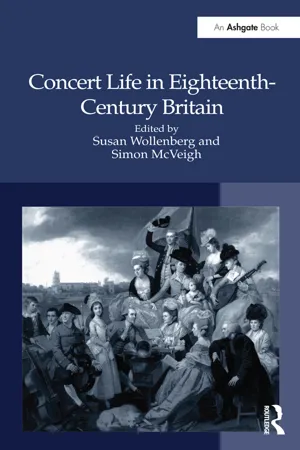
Concert Life in Eighteenth-Century Britain
- 320 pages
- English
- ePUB (mobile friendly)
- Available on iOS & Android
eBook - ePub
Concert Life in Eighteenth-Century Britain
About this book
In recent years there has been a considerable revival of interest in music in eighteenth-century Britain. This interest has now expanded beyond the consideration of composers and their music to include the performing institutions of the period and their relationship to the wider social scene. The collection of essays presented here offers a portrayal of concert life in Britain that contributes greatly to the wider understanding of social and cultural life in the eighteenth century. Music was not merely a pastime but was irrevocably linked with its social, political and literary contexts. The perspectives of performers, organisers, patrons, audiences, publishers, copyists and consumers are considered here in relation to the concert experience. All of the essays taken together construct an understanding of musical communities and the origins of the modern concert system. This is achieved by focusing on the development of music societies; the promotion of musical events; the mobility and advancement of musicians; systems of patronage; the social status of musicians; the repertoire performed and published; the role of women pianists and the 'topography' of concerts. In this way, the book will not only appeal to music specialists, but also to social and cultural historians.
Information
CHAPTER ONE
Introduction
As we struggle to imagine what a concert in the eighteenth century looked like, even perhaps what it felt like, we can hardly do better than start with Oxford’s Holywell Music Room; and it is fitting that this book should have had its origins in a celebration of its history. This small symmetrical room – with its tiered seating around three sides and performers only marginally separated from the audience behind a low balustrade – reminds us how very close they were in terms of social as well as acoustical space.1 Today the room is used as a recital hall, yet in the eighteenth century it witnessed orchestral and even choral concerts, the power and immediacy of a ‘grand crash’ that we can scarcely imagine.2
The very translation of the Oxford music society from tavern to specially built room is symptomatic of the increasing formality and gentility associated with the public concert (see Ch. 12). The Holywell room contrasts markedly with the ‘bung hole’ above Thomas Britton’s coal warehouse in Clerkenwell, where those ‘willing to take a hearty Sweat’ heard some of the best music in London around 1700; or the Whitefriars tavern, ‘rounded with seats and small tables alehouse fashion’ (a shilling and ‘call for what you please’) where John Banister put on the first recorded public concerts in 1672.3 The seventeenth-century concert was haphazard in its organization even at the fashionable York Buildings: ‘Here was consorts, fuges, solos, lutes, Hautbois, trumpets, kettledrums, and what Not but all disjoynted and incoherent for while ye masters were shuffling out & in of places to take their parts there was a totall cessation, and None knew what would come next …’.4
By the time the Holywell Music Room opened in 1748, the concert had crystallized into an event of its own, independent of the usual activities to which music formed an accompaniment, such as eating or drinking, dancing or conversing, praying or marching. The concept referred to all kinds of social models – tavern entertainment, gentlemen’s society, assembly, private soirée, and so on – but it modelled itself on the play or opera in presenting a self-contained programme in two ‘acts’, a remarkably resilient structure as it has turned out. The miscellaneous Concert of Vocal and Instrumental Musick had also developed a logical inner organization of sorts, alternating some 10 to 12 instrumental and vocal items in formal symmetry.
Yet if at first sight all of this is at least recognizable to the modern observer, indeed comfortingly so, on closer acquaintance we find ourselves constantly surprised. Take the shape of programmes themselves. At London’s subscription concerts in the later decades of the century it was fashionable not to arrive until well into the first half, while many wandered off before the end of the three-hour concert; so major items had to be placed somewhere around the interval, in clear distinction from the later preference for building programmes towards a climactic resolution, where the programme mirrored the aesthetic of nineteenth-century music itself. In the eighteenth century, the evening usually ended with an ill-defined ‘full piece’ as a light conclusion or play-out. The unquestioned alternation of vocal with instrumental items recognized both the centrality of vocal music (albeit usually borrowed from operas or oratorios) and the essentially instrumental raison d’être of a concert. Orchestral, solo and chamber items were carefully blended into the varied programme: no eighteenth-century organizer would have contemplated programming half a dozen Handel concertos in a row, a concept to which modern CD packaging and a ‘collected works’ mentality have somehow given a quite misplaced credibility.
At most London concerts there was a ‘buzz of conversation’ and members of the audience wandered around, visiting the refreshment room as they chose. Fanny Burney used her novel Cecilia to censure audiences at the Pantheon concerts:
They entered the great room during the second act of the Concert, to which as no one of the party but herself had any desire to listen, no sort of attention was paid; the ladies entertaining themselves as if no Orchestra was in the room, and the gentlemen, with an equal disregard to it, struggling for a place by the fire.
Since London audiences regarded the concert hall as an extension of their own drawing room (the Hanover Square room even had sofas round the sides), they naturally behaved much as they did at private soirées. Yet their ready appreciation of solo virtuosity or striking new passages suggests a visceral engagement with the music that is familiar to us only from modern jazz concerts. Mrs Papendiek, writing in her customarily overblown style, recalled Salomon’s debut in 1781:
The “Tutti” of his favourite concerto, by Kreutzer, commenced rather mezzo-piano, and increased to a crescendo that drew down volumes of applause … [The solo] was in the minor key, and the cadence he introduced was a long shake, with the melody played under – something new, which put Fischer almost into fits … Such a début has scarcely ever been experienced. We were jumping from our seats.5
Salomon’s performances of Haydn symphonies were similarly interrupted with spontaneous applause from listeners unable to contain their enthusiasm even ‘in the midst of the finest passages in soft adagios’.6
Etiquette at musical societies, usually directed more towards bourgeois self-improvement and definitely more devoted to music itself, was stricter: but the need for the Castle Society to exhort members not to talk or wander around during concerts, on pain of substantial fines, suggests that the point still needed to be emphasized even there. At an early Oxford music club, meeting at the Mermaid Tavern around 1690, ‘THE Steward is obliged to sconce any that makes a noise in time of performance, or to be sconced himself’: downing a tankard of ale might not, one would have thought, be the most effective remedy.7 Presumably quiet reigned at more august societies such as the Concert of Ancient Music, founded in 1776 to revere older music and often attended by George III: certainly by the mid-nineteenth century silent attention was demanded at classical chamber-music societies.8
Two surviving rooms intended for local musical societies seem extraordinarily small for their explicit purpose. The Holywell room at 65’ × 32’ was designed to accommodate 400 people; the still more elegant oval-shaped St Cecilia’s Hall in Edinburgh was of similar size but intended for 500. London’s Hanover Square room (where most of Haydn’s ‘London’ symphonies were premiered) was only marginally bigger at 79’ × 32’, but it too was meant for 500. Of course not everyone attended at the same time, but it is not surprising that there were often complaints about crowded and over-heated public spaces.
Another surprising feature is the interaction between professional and amateur musicians at most eighteenth-century venues. John Marsh, the attorney and landowner who tirelessly organized concerts in Canterbury and Chichester, assumed that he could call on local professionals at will. He also took every opportunity to harangue the country’s leading virtuosi into trying out his music, whether they were in Salisbury for the festival or assisting at Napier’s amateur concert in London (see Ch. 9, p. 174 below). Failing to get a place in the audience at the Anacreontic Society, he simply took out his violin and joined the orchestra. Nevertheless, for all his desperate desire to be regarded as a musician of professional standing – a barrier as hard to cross as any social divide – Marsh made sure never to relinquish his amateur status: though an accomplished violinist, he chose only to play ‘a ripieno bass’ at the Salisbury Festival in 1776 and the timpani three years later.9
But perhaps the most striking feature of all is the constant expectation of novelty and thus new repertoire. A myth has grown up around British musical conservatism that would suggest concert repertoire was entirely dominated by Handel to the end of the eighteenth century. It is true that there were those who resisted the new galant style (as in Durham; Ch. 4), and Britain certainly continued to enjoy older music, to the extent that the music of Handel began to achieve classic status. But the vociferousness with which early music was advocated in the later eighteenth century only goes to emphasize the general thirst for the latest symphonies and operas: it was simply taken for granted that London subscription concerts would parade the most up-to-date music, often only just imported from the continent. And the value of new music as a commodity was unquestioned. After all the attempts to lure Haydn to England during the 1780s, generating a febrile anticipation right up to his eventual arrival in 1791, Salomon was not about to lose out by allowing anyone to get hold of the new symphonies, delaying publication (except for domestic arrangements) as long as he could.
Music simply permeated everyday life right across the country, a theme that leaps out of this book. Church, theatre and the military may have provided the bedrock of the nation’s music, but concerts too were everywhere, from formal series and festivals, through musical societies to fashionable soirées and sociable glee clubs. Particularly inspiring are the enthusiasts who lived for music: the Yorkshire choral singers who walked from one festival to the next, before the establishment of the Halifax Harmonic Society and the like;10 the untutored Lancashire handloom weavers (the ‘Larks of Dean’), who made their own instruments and were so fond of ‘singing and fiddling’ that they worked day and night in order to indulge their hobby at weekends.11 Scarcely any social event or entertainment, whether scientific demonstration or equestrian display, lacked music – and, at the risk of stating the obvious, live music.
Music provided enjoyment as well as erudition at every social level. By the late eighteenth century, the concert had largely shed its image as dangerous or immoral, and was in most quarters regarded as a worthwhile pastime, even an uplifting moral experience – without as yet carrying the burden of worthiness or educational and social mission. The concert had begun to be perceived as something of symbolic importance, even of lasting significance. Provincial festivals – usually three-day events in the autumn, with top performers from London – made an important civic statement, contributing to pride in local cultural institutions and providing a focus for local gentry, professionals and leaders of commerce.12 Of course it was taken for granted that major national events would be celebrated by music: when in 1713 the ‘Oxford Act’ ceremony was revived to celebrate the Treaty of Utrecht, the two new Croft odes conveniently doubled as his submission for the degree of D.Mus. (see Ch. 10). More subtle, perhaps, in its message was the massive 1784 Handel Commemoration at Westminster Abbey, almost a state occasion, which vicariously reasserted national values and the established social order, unifying the country around the King and the new Pitt government after the shattering loss of the American colonies.13
This centrality of music has been increasingly recognized by social and urban historians. As Chapters 2 and 5 suggest, music was not just an idle fancy but an important shared experience. As a national form of entertainment and ritual, the concert or oratorio performance fitted most circumstances, offering a context for social status to be negotiated in an atmosphere of sociability, while at the same time providing a common ground that did not expose those conventions of conversation that differentiated social classes. If national identity was not yet strongly expressed in musical creation – there was not even a sense that this was lacking – by the late eighteenth century Messiah had undoubtedly assumed a national role.
Why then were concerts put on in eighteenth-century Britain, and why did the public concert develop so spectacularly here by comparison with the continent? Neither of these questions can be simply answered and it might be more helpful to address an apparently more straightforward question: who put on concerts? Two quite different modes of organization can readily be distinguished: the (often amateur) musical society, designed not for profit but for the enjoyment of the performers, and the professionally organized subscription or benefit concert, which was largely commercial in intent. Yet even this distinction proves much less rigid than might be imagined, as on the one hand musical societies became more professional in their performance and relationship with a paying audience; while on the other, commercial concert promoters endeavoured to hide their money-making intent. It is sometimes remarkably hard to discover into which category a particular concert series falls.14
Musical societies grew up in every town, formalizing the gathering of like-minded enthusiasts – perhaps cathedral singers and clergy, or amateur string-players – who met to sing sacred music or to play through concertos (this is why the concerti grossi of Corelli, Geminiani and Handel were so especially popular in Britain). Such societies reflected the propensity of eighteenth-century male society to organize itself in clubs and associations: often there were committees, drawn primarily from the performing members, and strict regulations about attendance and behaviour.15 Catch clubs were no different in kind, for all their more convivial atmosphere (see Ch. 8): indeed they shared a tavern setting with many musical societies, unlikely to afford the grandeur of their own music rooms.
The patronage of local dignitaries was of significant influence in such societies. Some operated on a grand scale, most remarkably that at Edinburgh with its sizeable subscription from the cream of Edinburgh society and professional classes: some professional stiffening was hired from London (where Robert Bremner, the Scottish music publisher, acted as an agent) or even directly from Europe.16 More typical were those based around a cathedral, such as the Hereford Society described in Ch. 3, formed by vicars choral b...
Table of contents
- Cover
- Half Title
- Title Page
- Copyright Page
- Table of Contents
- List of Figures
- List of Tables
- List of Music Examples
- Notes on Contributors
- Foreword
- Acknowledgements
- Abbreviations
- 1 Introduction
- Part 1 Towns and Cities
- Part 2 Sources and Genres
- Part 3 Contexts for Concerts
- Index
Trusted by 375,005 students
Access to over 1.5 million titles for a fair monthly price.
Study more efficiently using our study tools.
Frequently asked questions
Yes, you can cancel anytime from the Subscription tab in your account settings on the Perlego website. Your subscription will stay active until the end of your current billing period. Learn how to cancel your subscription
No, books cannot be downloaded as external files, such as PDFs, for use outside of Perlego. However, you can download books within the Perlego app for offline reading on mobile or tablet. Learn how to download books offline
Perlego offers two plans: Essential and Complete
- Essential is ideal for learners and professionals who enjoy exploring a wide range of subjects. Access the Essential Library with 800,000+ trusted titles and best-sellers across business, personal growth, and the humanities. Includes unlimited reading time and Standard Read Aloud voice.
- Complete: Perfect for advanced learners and researchers needing full, unrestricted access. Unlock 1.5M+ books across hundreds of subjects, including academic and specialized titles. The Complete Plan also includes advanced features like Premium Read Aloud and Research Assistant.
We are an online textbook subscription service, where you can get access to an entire online library for less than the price of a single book per month. With over 1.5 million books across 990+ topics, we’ve got you covered! Learn about our mission
Look out for the read-aloud symbol on your next book to see if you can listen to it. The read-aloud tool reads text aloud for you, highlighting the text as it is being read. You can pause it, speed it up and slow it down. Learn more about Read Aloud
Yes! You can use the Perlego app on both iOS and Android devices to read anytime, anywhere — even offline. Perfect for commutes or when you’re on the go.
Please note we cannot support devices running on iOS 13 and Android 7 or earlier. Learn more about using the app
Please note we cannot support devices running on iOS 13 and Android 7 or earlier. Learn more about using the app
Yes, you can access Concert Life in Eighteenth-Century Britain by Susan Wollenberg, Susan Wollenberg,Simon McVeigh in PDF and/or ePUB format, as well as other popular books in Media & Performing Arts & Music. We have over 1.5 million books available in our catalogue for you to explore.