- 632 pages
- English
- ePUB (mobile friendly)
- Available on iOS & Android
eBook - ePub
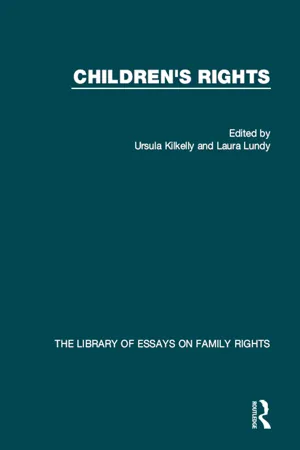
Children's Rights
About this book
The articles in this volume shed light on some of the major tensions in the field of children's rights (such as the ways in which children's best interests and respect for their autonomy can be reconciled), challenges (such as how the CRC can be made a reality in the lives of children in the face of ignorance, apathy or outright opposition) and critiques (whether children's rights are a Western imposition or a successful global consensus). Along the way, the writing covers a myriad of issues, encompassing the opposition to the CRC in the US; gay parenting: Dr Seuss's take on children's autonomy; the voice of neonates on their health care; the role of NGO in supporting child labourers in India, and young people in detention and more.
Part I:
Origins
1
Janusz Korczak – His Legacy and its Relevance for Children’s Rights Today*
Abstract
As a paediatrician and pedagogue,1 a writer and children’s rights advocate, Janusz Korczak (1878–1942) has had a large influence on thinking in Polish society. Most Poles still grow up with his children’s stories, and Korczak’s work culminated in Poland initiating and influencing the ten year process of writing the United Nations 1989 Convention on the Rights of the Child. Despite his cutting-edge ideas and his contribution to children’s rights, only a few of Korczak’s texts have been translated into English and his work has widely gone unrecognised. This paper aims to give English-speaking readers working in the children’s rights sector an insight into Janusz Korczak’s extraordinary life for children, into how his pedagogic thoughts and principles relate to newer ideas within the sociology of childhood and children’s participation, and into his compelling children’s rights advocacy and practice. His innovative ideas, preserved for future generations in his written work for children and adults, are still inspiring, prompting us to reflect on our own passion for children’s rights and are helpful guides for our own practice.
Introduction
Perhaps Janusz Korczak’s story is best told backwards, starting with his death that shows what an extraordinary personality Janusz Korczak is, how consistently he lived according to his own ideas and principles, and what it means to love and respect children. Understanding his death enables us to understand his life and work, as it sets an unforgettable example of commitment towards children.
Janusz Korczak died in August 1942, in the Nazis’ extermination camp Treblinka. He died together with the children from his Jewish orphanage in Warsaw and he died for them, giving them hope in a situation of despair. Korczak wanted to be with them in their darkest hour, when they needed him most, and had declined various offers to arrange his escape from the gas chambers.
Yet, while choosing his death is often portrayed as an exceptional moral decision, it was not much of a decision for the exceptional person Korczak himself – what else was there to do? Saving his life over the children’s would never have been an option for him. His last march with his orphans through the ghetto in Warsaw is therefore a very visible reflection of the moral standards Korczak outlined in his writings and followed in his own life. It is the philosophies guiding his life which are in focus of this paper.
Janusz Korczak – A Life for Children
The life and work of Janusz Korczak is well-documented, and his ideas are still proclaimed and referred to in many countries. Yet a translation of his complete works into English is still missing, which is why this paper has used German literary sources to underpin academically the narrative biography The King of Children: A Biography of Janusz Korczak by Lifton (1988) and has further drawn on the Janusz Korczak exhibition (06/12/2006–07/04/2007) at the Jewish Museum in London to obtain a better insight into Korczak’s life.
Childhood
The person who became the ‘King of Children’ was born in 1878 or 1879 as Henryk Goldszmit. He grew up in a well-educated Jewish family in a wealthy district of Warsaw during a time when Jews faced difficulties in integrating into Polish society. They were Jews first and Poles second, and this struggle to find a Jewish-Polish identity accompanied Henryk Goldszmit throughout his life. Class differences were stark, and, as he was not allowed to play with the poor boys in the street, his childhood was rather ‘sheltered’. In school he had to experience the hostile educational system of that time, in which teachers chastised with their cane, considered children as subordinate and ruthlessly ruled the children’s world. His love for storytelling made Henryk turn to reading and writing, experiencing his freedom through the characters in the literature.
To demonstrate his Polish identity in his literary work, Henryk Goldszmit adopted the Polish pseudonym Janusz Korczak and soon became famous for his adult stories and children’s books, his plays, educational studies and academic articles.
The Young Doctor
As a medical student he was drawn to the plight of the impoverished children living on the streets of Warsaw and developed an urge to ‘improve the living conditions of the poor, to bring social practice around to the principles of justice, and to win recognition for the universal right to live in dignity’, as Lewowicki summarizes (1997: 1). Goldszmit set himself no smaller aim than to make the world a better place, and he observed that to reform the world means reforming [sic.] the method of child rearing’ (Korczak cited in Kulawiec 1979: 23), because what needed to change were perceptions of children held by adults. This thought resonates with Prout and James (1997: 8), who demand a new paradigm of childhood sociology [which] is also to engage in and respond to the process of reconstructing childhood in society’.
In 1906, after his studies and his conscription as a field doctor at the Russian-Japanese front, Korczak worked as residential doctor in a Jewish children’s hospital. His dedication to bringing smiles on children’s faces, his kind and caring approach, the magic of Dr. Goldszmit’s way with children’ (Lifton, 1988: 46) appeared to have far more impact than the medicine he prescribed.
At the same time, Korczak was acutely aware that as a doctor he could only treat the symptoms of social illnesses and change little more: ‘“when the devil will we stop prescribing aspirin for poverty, exploitation, lawlessness, and crime?” he would complain to colleagues. But what could he prescribe to change his patients’ lives?’ (Lifton, 1988: 47).
New Concepts of Children
During educational trips to Berlin, Paris, and Zurich, Korczak became familiar with the latest ideas in paediatrics, child psychology and education. Jean-Jacques Rousseau’s Emile (1762) had paved the path for a new approach towards children that resonated with Korczak’s own notions; The Swiss educationist Johann Heinrich Pestalozzi had developed Rousseau’s ideas into a coherent pedagogic method, which he put into practice at a boarding school for poor children in Yverdon, Switzerland. Impressed by Pestalozzi’s achievements in the early nineteenth century, Korczak went to Zurich to study his work more closely. ‘Many of his later ideas on education, the dignity of work, and the importance of observing clearly in order to think clearly, reflect the influence of that dedicated Swiss educator’, as Lifton notes (1988: 36).
Another major influence in these days was Sigmund Freud’s innovative thoughts on psychoanalysis, emphasising the significance of early childhood experiences. During this time a fresh breeze was blowing from Vienna, Zurich, Paris and London regarding the appreciation of the childhood years of development’, Kulawiec suggests (1979: 23). The New Education movement blossomed all over Europe, with, for instance, Maria Montessori’s and John Dewey’s theories receiving wide attention. The new concepts of children as worthy persons, who needed to be valued for what they were, deeply resonated with Korczak’s own thinking and feelings. In London, where he visited orphanages and schools, he learned the true meaning of charity work and consequently decided to dedicate his life to children: ‘For a son I chose the idea of serving the child and his rights’ (Korczak cited in Kulawiec, 1979: 24).
Dom Sierot
Together with his confidante Stefa Wilczyńska, Korczak opened in 1911 Dom Sierot (Orphans’ Home), a shelter for Jewish orphans. This offered him a chance to do more for the poorest children than prescribe medicine which could not alleviate their squalor. From the beginning Stefa Wilczyńska shared his pedagogic ideas and his enthusiasm. She was the backbone of the home, managing the everyday and running the orphanage when Korczak was away. Yet, in por-trayals of Janusz Korczak, she is often neglected, although without her Korczak would not have been so influential, and she too led the children on their last march.
The decision to move from the hospital to the orphanage did not mean that he turned his back on medicine. His clinical observations allowed him to study children ‘day by day in those sunny periods when they are hale and hearty’ (Korczak cited in Kulawiec, 1979: 24). At that time child study, based on a collection of empirical, verifiable data of children’s cognitive, behavioral, and physical development, became a focus of psychological and pedagogical research’, as Efron notes (2005: 150), and it was solid part of Korczak’s practice. Living with the children in the new orphanage, Korczak used every opportunity to observe them closely, to understand their thoughts and feelings with the clinical precision of a surgeon and with the heart of a loving father’ (Kulawiec, 1979: 24). But he was cautious not to generalize from his observations and doubted whether scientific research methods can capture the mysteries and subtleties of children’s interpersonal emotions (Efron, 2005). The children in return loved the ‘slim, modest, balding doctor whose pockets were always filled with candy and magic tricks, and whose repertoire of riddles and fairy tales was limitless,’ like a father (Lifton, 1988: 60).
As Hendrick notes (1997: 10), Western childhood underwent a fundamental change between 1870 and 1930 which saw a transformation of children’s economic and sentimental value’ to their family. Where previously children’s value to the family had been primarily defined by their ability to work and thereby contribute to the household, ‘the emergence of this economically “worthless” but emotionally “priceless” child became what [Zelizer, 1994] calls the “essential condition of contemporary childhood’” (Hendrick 1997: 10). Similar concepts were common in the Polish upper-class, but Korczak’s passion to see as priceless every child, including particularly the poorest street children who lived in his orphanage, was certainly uncommon. He repeatedly demanded: ‘love the child, not only your own’ (1999).
How to Love a Child
When World War I broke out, Korczak was conscripted to serve again. In the battlefields of Eastern Europe, surrounded by atrocity and hatred, Korczak wrote one of his most influential works, How to Love a Child (published in 1919). One of his key theses in the book is that in order to love a child one has to ‘see him or her as a separate being with the inalienable right to grow into the person s/he was meant to be’ (Freeman, 1996: 31). This thought is in line with Pestalozzi’s notion that children need love and that they develop in accordance with their own nature – ‘as a little seed […] contains the design of a tree’ (Pestalozzi cited in Smith, 2005) – and that parents or pedagogues cannot determine what children grow into. They can merely take care ‘that no untoward influence shall disturb nature’s march of developments’ (Pestalozzi cited in Smith, 2005).
Due to the individuality of each child, Korczak wrote that there is no recipe for how to rear a child: ‘it is impossible to tell parents unknown to me how to rear a child also unknown to me under conditions unknown to me […] There are insights that can be born only of your own pain, and they are the most precious’ (Korczak cited in Lifton, 1988: 80). His individual pedagogic approach also warned against measuring an infant’s development against ‘standards’. ‘When is the proper time for a child to start walking and talking? When he does’, Lifton (1988: 80) quotes Korczak. Even today this message has not developed into common-sense, with the British government intending to have English child-care institutions ‘monitor children’s progress towards 69 government-set “early learning goals”, recording them against more than 500 development milestones as they go’ (Ward, 2007).
Nasz Dom
To help the countless children in Poland’s capital whom the war had left parentless, Korczak set up Nasz Dom (Our Home) – a shelter for orphans from Polish workers. As Lifton reports (1988: 100), Our Home was crowded with orphans, ‘its rooms so tiny that there was not even space to walk around the beds in the dormitories, yet the children had never seen anything so grand’.
The Last Years
Korczak’s last years were full of despair. In 1938 he was ‘relieved of his duty’ at the Polish orphanage Nasz Dom, possibly because of anti-Semitism, which also was the reason why his popular radio show The Old Doctor was cancelled. During this time the conditions for Jewish citizens deteriorated, Korczak struggled to raise funds and feed the hungry orphans. Shortly afterwards, the Nazis forced all Jews into the Warsaw ghetto, with the plan to let disease and hunger diminish them – survival became a struggle. Children caught outside the ghetto, trying to steal crops from the fields, were punished and brought back to Korczak, or simply shot. In 1942 the Nazis decided to cleanse the ghetto by transporting everyone who had remained into extermination camps. On August 6, 1942, Korczak and Stefa marched their 200 orphans to the Umschlagplatz in a peaceful demonstration for human dignity. This was their last march.
A Voice for Children – The Children’s Republic
Characteristic for Korczak’s pedagogic approach was the radical involvement of children: self-governing structures are at t...
Table of contents
- Cover
- Half Title
- Title Page
- Copyright Page
- Table of Contents
- Acknowledgements
- Introduction
- Part I: Origins
- Part II: Influential Scholarship
- Part III: Implementation
- Part IV: International Reach
- Part V: Interdisciplinary Scholarship
- Part VI: Involving Children
- Part VII: Issues that are Contested
- Index
Trusted by 375,005 students
Access to over 1.5 million titles for a fair monthly price.
Study more efficiently using our study tools.
Frequently asked questions
Yes, you can cancel anytime from the Subscription tab in your account settings on the Perlego website. Your subscription will stay active until the end of your current billing period. Learn how to cancel your subscription
No, books cannot be downloaded as external files, such as PDFs, for use outside of Perlego. However, you can download books within the Perlego app for offline reading on mobile or tablet. Learn how to download books offline
Perlego offers two plans: Essential and Complete
- Essential is ideal for learners and professionals who enjoy exploring a wide range of subjects. Access the Essential Library with 800,000+ trusted titles and best-sellers across business, personal growth, and the humanities. Includes unlimited reading time and Standard Read Aloud voice.
- Complete: Perfect for advanced learners and researchers needing full, unrestricted access. Unlock 1.5M+ books across hundreds of subjects, including academic and specialized titles. The Complete Plan also includes advanced features like Premium Read Aloud and Research Assistant.
We are an online textbook subscription service, where you can get access to an entire online library for less than the price of a single book per month. With over 1.5 million books across 990+ topics, we’ve got you covered! Learn about our mission
Look out for the read-aloud symbol on your next book to see if you can listen to it. The read-aloud tool reads text aloud for you, highlighting the text as it is being read. You can pause it, speed it up and slow it down. Learn more about Read Aloud
Yes! You can use the Perlego app on both iOS and Android devices to read anytime, anywhere — even offline. Perfect for commutes or when you’re on the go.
Please note we cannot support devices running on iOS 13 and Android 7 or earlier. Learn more about using the app
Please note we cannot support devices running on iOS 13 and Android 7 or earlier. Learn more about using the app
Yes, you can access Children's Rights by Ursula Kilkelly,Laura Lundy in PDF and/or ePUB format, as well as other popular books in Law & Family Law. We have over 1.5 million books available in our catalogue for you to explore.