- 242 pages
- English
- ePUB (mobile friendly)
- Available on iOS & Android
eBook - ePub
About this book
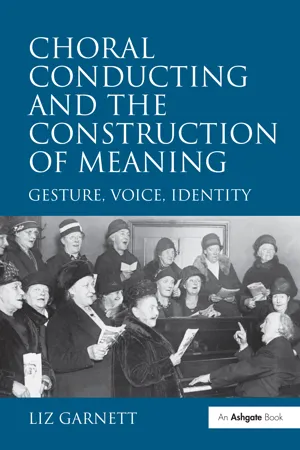
It is a truism in teaching choral conducting that the director should look like s/he wishes the choir to sound. The conductor's physical demeanour has a direct effect on how the choir sings, at a level that is largely unconscious and involuntary. It is also a matter of simple observation that different choral traditions exhibit not only different styles of vocal production and delivery, but also different gestural vocabularies which are shared not only between conductors within that tradition, but also with the singers. It is as possible to distinguish a gospel choir from a barbershop chorus or a cathedral choir by visual cues alone as it is simply by listening. But how can these forms of physical communication be explained? Do they belong to a pre-cultural realm of primate social bonding, or do they rely on the context and conventions of a particular choral culture? Is body language an inherent part of musical performance styles, or does it come afterwards, in response to music? At a practical level, to what extent can a practitioner from one tradition mandate an approach as 'good practice', and to what extent can another refuse it on the grounds that 'we don't do it that way'? This book explores these questions at both theoretical and practical levels. It examines textual and ethnographic sources, and draws on theories from critical musicology and nonverbal communication studies to analyse them. By comparing a variety of choral traditions, it investigates the extent to which the connections between conductor demeanour and choral sound operate at a general level, and in what ways they are constructed within a specific idiom. Its findings will be of interest both to those engaged in the study of music as a cultural practice, and to practitioners involved in a choral conducting context that increasingly demands fluency in a variety of styles.
Information
Chapter 1
Introduction: Choral Conducting in Context
DOI: 10.4324/9781315095714-1
The single element that most affects the eventual sound quality of a chorus in performance … is the actual conducting technique or physical movements of the conductor.11 Abraham Kaplan, Choral Conducting (New York, 1985), p. 18.
With these words, Abraham Kaplan summarizes a truism in choral practice: that the director should look like he or she wants the choir to sound. The character of the conductor’s physical demeanour is believed to have a direct effect on how the choir sings, at a level that appears to be largely unconscious and involuntary. this effect encompasses not only deliberate conducting choices, but also habitual elements such as stance and mannerism.
It is also a matter of simple observation that different choral traditions exhibit not only different styles of vocal production and delivery, but also different gestural vocabularies. These are shared not only between conductors within that tradition, but also, to varying degrees, with the singers, and indeed the audiences. it is as possible to distinguish a gospel choir from a barbershop chorus or a cathedral choir by visual cues alone as it is simply by listening. John Blacking’s category of ‘sound groups’ would thus appear also to be one of movement, or stance groups.2
There has been, however, little attempt to explain the nature of these forms of physical communication. Do they belong to a pre-cultural realm of primate social bonding, or do they rely on the context and conventions of a particular choral culture? Is kinaesthetic experience and body language an inherent part of musical performance styles, or does it come afterwards, in response to music? At a practical level, does one understand the music differently if one has or has not mastered the idiom’s characteristic ways of using the self?
This book presents the outcomes of a long-term project that has explored these questions. The questions are simultaneously theoretical (in what ways is musical style stored in our bodily experiences, and how does it then relate to our sense of self?) and practical (how does one conduct a choir, especially in stylistic contexts that may feel ‘foreign’?). It has examined the praxis of a variety of choral traditions, and has investigated the relationship between conductor demeanour and choral sound in general, and the ways it is constructed within the stylistic constraints of specific idioms. Its findings will be of interest both to those engaged in the study of music as a cultural practice and to practitioners involved in a choral conducting context that increasingly demands fluency in a variety of styles.
My central thesis is that the gestural languages of choral conducting, and their choirs’ associated body languages and styles of vocal production, are integral to the way that musicians understand both the music they perform and – as a consequence – their own identities as performing musicians. My aim has therefore been to examine the ways in which choral practitioners inhabit the repertoires they perform (and vice versa) in order to analyse the processes by which people constitute themselves as choral conductors and singers. The pages that follow both theorize the relationship between musical style, social meanings and the performative construction of identity in choral performance, and draw practical conclusions regarding the transferability of good practice in choral conducting between different musical idioms.
Hence, this book lies at the intersection of two well-developed, but hitherto largely distinct disciplinary worlds in the study of music: critical musicology and choral practice. Members of each constituency might reasonably ask what is to be gained from their combination.
Critical musicology is accustomed to imagining the voice as a site where social processes and individual identity meet most intimately. The voice is singular and unique, to the extent that it acts as a standard image for originality and agency of thought throughout the arts and humanities: we talk of the poet’s voice, or the composer’s. At the same time it is generic, formed by forces beyond the control of the individual, whether those of nature (lungs, larynx, resonant cavities) or of nurture (language acquisition, gender roles, conventions of expression). The ideological, aesthetic, and – increasingly – technological contexts in which vocality is constructed have consequently been investigated in a plethora of idioms from bel canto to extended vocal techniques, from crooning to cock-rock.3 The majority of this work, however, has focused on the singer as soloist; ensemble singing has received far less attention.
There are several reasons why it is valuable to critical musicology to redress this soloistic bias. First, the study of choral music presents interesting theoretical questions about the relationship between individual and corporate identities, between the personal and the supra-personal. The practical experience that choral practitioners have in melding disparate voices into a unified ensemble can usefully inform critical musicology’s investigations into the role of musical participation in the ‘project of the self’.4 Related to this, it moves the focus away from the exceptional voice towards the ‘typical’. While it is undoubtedly important to understand the passion that a diva, a torch singer or a rock star arouses in their devotees, it is also important to understand how the ‘ordinary’ singer might experience their own voice. Choral singing (however broadly or narrowly one defines this) involves many more people in the act of musical performance than solo genres, and as such arguably represents a more fertile ground for the production of socio-musical meanings.
The widespread nature of the activity also gives it significance in its own right: many people experience choral singing as an integral part of their week-to-week lived experience. in particular, many choral organizations are deeply concerned with questions of social inclusivity, whether from an educational perspective, through the agenda of funding bodies, or simply from the pragmatics of recruiting and retaining choir members in an era of falling participation in organized leisure.5 Contemporary choral music thus fulfils several of the theoretical interests that helped define critical musicology as a self-aware discipline: the concern with democratic, not just elite, musics; an interest in the cultural politics of classical music; and the desire to operate as an ‘epic’ theory, that is, a theory that addresses crises in the world, not just in theory.6
This in turn suggests where critical musicology can be of service to choral culture. In recent years choral singing has embraced an increasingly varied range of musical idioms and their associated cultural practices. The growth of international organizations and festivals has promoted an awareness of different national traditions, while national organizations have increased the contact between choral groups from a variety of different performing traditions within individual localities. These developments have produced much that is both artistically exciting and educationally enriching, opening up possibilities for the expansion of musical horizons and development of community ties in what is primarily an amateur art form.
Differences in approach, however, have also sometimes emerged as conflicts of taste and mutual misunderstanding that serve as barriers within the wider choral community. Indeed, there sometimes seems to be a greater continuity of approach and understanding between choral groups of different nationalities that share a common repertoire than between geographically close choirs performing in different styles. When these misunderstandings occur between a choir accustomed to performing in one idiom and a director that does not directly share this musical background, or a student director whose experience is in one idiom and a teacher with experience in another, the results can be unhappy for all concerned. The dilemma a performer faces when instructed to do something as a matter of ‘good practice’ that disconnects them from their experiential relationship with musical content needs handling with sensitivity. Critical musicology offers theoretical tools to analyse the nature and significance of both overlap and difference in performance practices and their associated meanings, and hence help individuals and ensembles involved in choral performance find their way through this stylistic pluralism. Negotiating between nature and nurture is a theoretical mainstay of the critical musicology project, as well as a constant practical challenge for the choral practitioner. Bringing the two together promises useful insights in both directions.
Contexts 1: Bodies of Knowledge
Within these broad disciplinary boundaries there are four specific bodies of knowledge that this study draws upon and to which it aspires to contribute. These are: theories of music and identity, with particular reference to voice; performance studies in music; the choral conducting literature itself; and theories of nonverbal communication.
Music and Identity; Voice and Identity
Music and its relationship with identity has been a central theme in the critical musicology project, not least because it was an interest shared by several of the subject areas whose interaction fed the growth of the ‘new’ musicology of the 1990s. Popular music studies, ethnomusicology, music and gender studies, and music psychology all shared a belief that traditional musicology’s almost exclusive focus on the Western art music composer and ‘his’ (it was usually assumed) works took an unduly limited view of music’s interest and importance in people’s daily lives. What does music mean to us? Why and how do different people choose to align themselves with different types of music? In what ways is music integral to who we think we are? These were questions that all these disparate subject areas were asking in one form or another.
This heterogeneous origin has produced a literature that is vibrant and stimulating, but which also contains a potentially bewildering range of theoretical models and approaches to research method. Popular music studies started off in sociology departments in the days before they found favour in musicology, while ethnomusicology drew on the methods of anthropology. Music and gender studies drew on a range of feminist and literary/critical theories, while music psychology’s disciplinary antecedents were visible in its more empirical approach. Music and identity as a subject area cuts across traditional lines not only between university departments but even faculties: it can sit not only in the arts or the humanities, but also the social sciences. It is something of a pleasant surprise, therefore, that it presents as coherent and stable a literature as it does.
Raymond MacDonald, David Hargreaves and Dorothy Miell, while writing from a music psychology perspective, make some useful points that generalize well across other approaches. First, they point out that theories of identity have moved away from the idea of the self as the stable core or essence of an individual towards a conception of identity as much more fluid and emergent. They describe the self as ‘something which is constantly being reconstructed and renegotiated according to the experiences, situations and other people with whom we interact in everyday life’.7 They attribute this shift to the rapid changes in peoples’ lifestyles that accompany globalization and technological change, and indeed it may be that the dislocations of modern life bring to our attention how much psychological effort the individual needs to invest in order to maintain a sense of personal continuity. However, it is also worth pointing out this change has its theoretical origins in the work of critical and literary theorists from the 1960s onwards. The idea of a ‘decentred’ subject – that is, one that assembles him or herself from available cultural discourses rather than consisting of a central nucleus that preexists its encounter with culture – appears in various forms in the writings of Barthes, Lacan, Derrida, Kristeva and Foucault. It has subsequently infiltrated concepts of identity across many disciplines, including, of course, music.8
MacDonald et al. also make the distinction between identities in music, by which they mean aspects of identities defined, or at least shaped, by musical activities, and music in identities, by which they mean the ways that music acts as one of the resources people use to create their d...
Table of contents
- Cover
- Half Title
- Title Page
- Copyright Page
- Contents
- List of Figures
- List of Tables
- DVD Track Listing
- Acknowledgements
- 1 Introduction: Choral Conducting in Context
- Part I How To Study Conducting: Model, Method, Metalanguage
- Part II Choral Singing and Enculturation
- Part III Conducting Gesture and Musical Thought
- PART IV The Conductor–Choir Bond
- Bibliography
- Index
Trusted by 375,005 students
Access to over 1.5 million titles for a fair monthly price.
Study more efficiently using our study tools.
Frequently asked questions
Yes, you can cancel anytime from the Subscription tab in your account settings on the Perlego website. Your subscription will stay active until the end of your current billing period. Learn how to cancel your subscription
No, books cannot be downloaded as external files, such as PDFs, for use outside of Perlego. However, you can download books within the Perlego app for offline reading on mobile or tablet. Learn how to download books offline
Perlego offers two plans: Essential and Complete
- Essential is ideal for learners and professionals who enjoy exploring a wide range of subjects. Access the Essential Library with 800,000+ trusted titles and best-sellers across business, personal growth, and the humanities. Includes unlimited reading time and Standard Read Aloud voice.
- Complete: Perfect for advanced learners and researchers needing full, unrestricted access. Unlock 1.5M+ books across hundreds of subjects, including academic and specialized titles. The Complete Plan also includes advanced features like Premium Read Aloud and Research Assistant.
We are an online textbook subscription service, where you can get access to an entire online library for less than the price of a single book per month. With over 1.5 million books across 990+ topics, we’ve got you covered! Learn about our mission
Look out for the read-aloud symbol on your next book to see if you can listen to it. The read-aloud tool reads text aloud for you, highlighting the text as it is being read. You can pause it, speed it up and slow it down. Learn more about Read Aloud
Yes! You can use the Perlego app on both iOS and Android devices to read anytime, anywhere — even offline. Perfect for commutes or when you’re on the go.
Please note we cannot support devices running on iOS 13 and Android 7 or earlier. Learn more about using the app
Please note we cannot support devices running on iOS 13 and Android 7 or earlier. Learn more about using the app
Yes, you can access Choral Conducting and the Construction of Meaning by Liz Garnett in PDF and/or ePUB format, as well as other popular books in Media & Performing Arts & Music. We have over 1.5 million books available in our catalogue for you to explore.