- 270 pages
- English
- ePUB (mobile friendly)
- Available on iOS & Android
eBook - ePub
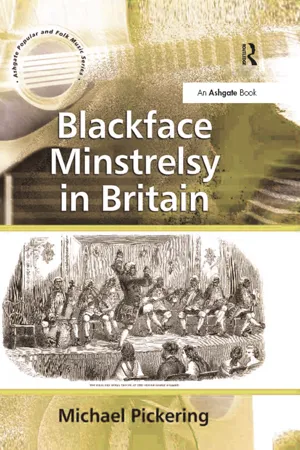
Blackface Minstrelsy in Britain
About this book
Blackface minstrelsy is associated particularly with popular culture in the United States and Britain, yet despite the continual two-way flow of performers, troupes and companies across the Atlantic, there is little in Britain to match the scholarship of blackface studies in the States. This book concentrates on the distinctively British trajectory of minstrelsy. The historical study and cultural analysis of minstrelsy is important because of the significant role it played in Britain as a form of song, music and theatrical entertainment. Minstrelsy had a marked impact on popular music, dance and other aspects of popular culture, both in Britain and the United States. Its impact in the United States fed into significant song and music genres that were assimilated in Britain, from ragtime and jazz onwards, but prior to these influences, minstrelsy in Britain developed many distinct features and was adapted to operate within various conventions, themes and traditions in British popular culture. Pickering provides a convincing counter-argument to the assumption among writers in the United States that blackface was exclusively American and its British counterpart purely imitative. Minstrelsy was not confined to its value as song, music and dance. Jokes at the expense of black people along with demeaning racial stereotypes were integral to minstrel shows. As a form of popular entertainment, British minstrelsy created a cultural low-Other that offered confirmation of white racial ascendancy and imperial dominion around the world. The book attends closely to how this influence on colonialism and imperialism operated and proved ideologically so effective. At the same time British minstrelsy cannot be reduced to its racist and imperialist connections. Enormously important as those connections are, Pickering demonstrates the complexity of the subject by insisting that the minstrel show and minstrel performers are understood also in terms of their own theatrical dynamics, t
Information
Chapter 1
Mock Blacks
Introduction
From the earliest days of white settlement, emigrants to North America from Britain, Ireland and western Europe took with them in steerage their songs, dances, folklore and other vernacular cultural forms. These contributed, in layer after changing layer, to the development of local and regional cultures across the continent. The same was true, under very different conditions, of the many people from western Africa who were forced into slavery and shipped in chains to North America via the infamous Middle Passage.1 Various aspects of the cultures of white and black people, in these voluntary and involuntary movements, fed into the phenomenon of blackface minstrelsy, which emerged in its characteristic form in the second quarter of the nineteenth century. Fiddle dance tunes central to North American Irish music were adapted for minstrelsy, with jigs, reels and hornpipes being common musical elements in the repertory and the fiddle figuring as a key minstrel instrument.2 Many nineteenth-century minstrel songs imitated the ‘Scottish snap’ and gapped scale characteristic of traditional Anglo-Celtic tunes.3 These were direct inputs, whereas borrowings from black slave cultures in minstrelsy were filtered through white (blacked-up) theatrical performance. From at least the eighteenth century onwards, the fusion of European and African elements by African-Americans created a new musical matrix of creativity and performance that would become hugely significant in its twentieth-century developments, from ragtime through to rap. White minstrels exploited some of the earlier vocal, instrumental and dance manifestations of this emergent tradition and through their mediation made it acceptable on both sides of the Atlantic, despite any connection to African-American musical traditions being in some cases extremely remote.
Quickly taken up in England after its introduction in London in the 1830s, so-called ‘nigger’ minstrelsy became a pre-eminent form of British popular entertainment during the rest of the century, and for much of the twentieth century as well. Throughout the Victorian period, blackface artistes appeared in solo and duo music hall turns as a particular item of a more general repertory, but they were most prominent in separate shows either in fixed metropolitan venues such as St James’s, Piccadilly, or in provincial halls and theatres during the visits of touring minstrel troupes or companies. Minstrelsy was packaged and presented from the first as an alluring cultural commodity. It contributed to the formation of a commercial popular culture of the industrialized town whose representative features included the prototypal music halls, gin palaces, the circus and travelling menagerie, a new popular Sunday press, criminal gazettes and a combination of politics and entertainment in newspapers such as those run by G.W.M. Reynolds and Edward Lloyd. Blackface minstrelsy during this period became very much a part of this process of cultural change, involving a reaction between and creative re-assemblage of old and new.
There was clearly a demand for new material and forms. Minstrelsy in certain ways met with an appetite already whetted and amenable to it. Audiences thrived on its novelty, but this only partly explains its success. If minstrelsy had only manifested passing novelty value, its theatrical presence would have been no more than a sudden flare in the night sky. As one writer put it, looking back retrospectively in the 1870s, ‘it was a great deal more’ than novelty – ‘it was real music, and it had a meaning, and the common people were too good judges of the article to allow it to fade out of hearing’.4 This is an important recognition, for it signals the popular evaluation of British minstrelsy’s intrinsic merits as ‘real music’, but if it was this broad judgement which refused to allow it to fade out of hearing and quickly pass away as a musical fad, it nevertheless begs the difficult question of whose judgements were involved and how its ‘meaning’ was conceived across the marked divisions within British society. The point to emphasize at the start is that minstrelsy’s appeal was widespread and not confined in any direct way to the ‘common people’ in the usual sense of this term as equivalent to the working class. As we shall see, the attractions of minstrelsy were registered up and down the social scale, so that in time and over time, it attained differential value as popular entertainment according to who, where and when it was taken up. While it was part of the new urban culture developing from the mid-nineteenth century, its patronage included many who would otherwise have dissociated themselves from such emerging cultural institutions as the music hall. The minstrel show was popular in a far broader sense, so complicating the historical semantics of the ‘popular’ in popular culture.
The long-lasting success of minstrelsy across the whole social spectrum in Britain was due to a range of different, fluctuating factors, and while this makes certain generalizations about its popularity difficult, certain aspects of blackface minstrelsy did at times attain greater prominence than others. This is particularly true of its racial dimension. What most distinguished minstrelsy in Britain from mumming in the vernacular arts, and from other kinds of disguise and masking in pantomime, music hall and circus entertainments, was its theatrical impersonation of black people. As a form of ideological mediation, such impersonation popularized and amplified the historically limited knowledge of the ‘negro’ and in so doing helped to crystallize particular stunted characterizations and recognitions of black people and the cultural practices associated with them. Minstrelsy specialized in mock blacks and racial mockery. It offered a stereotypical depiction of African-American people and their vernacular cultures as these had developed within the system of British slavery and its historical continuations.
While its racism is undeniable, this changed historically and was never of a time-defying piece. Neither can it be taken as the sole reason for its enduring success. Demeaning and pathetic depictions of black people were certainly to the fore in its two key registers of comic ridicule and sentimentalism, but its magnetic appeal and diverse pleasures were not confined to racial mockery and pity. The reasons for this will gradually unfold, but the difficulty of dealing with its representations of black ethnicity needs special emphasis. Allowing its other sources of attraction and pleasure into the analytical fold doesn’t mean that its white-centredness is accepted as unproblematic, but it does highlight what is perhaps the greatest impediment to developing a cultural history of blackface minstrelsy. This is the restriction of attention to what, in a changed historical context, we now define and rightly condemn as racist.
It is of course impossible to escape at will from the ways our contemporary understandings ground and give shape to historical research. In the case of racism it is undesirable too. This is different to the pitfall of presentism, which allows our interpretation and understanding of the past to be monopolized by contemporary values and preconceptions. These are not the sole basis of our engagement with the past, for if they were the possibility of historical understanding would vanish into thin air. Historical methodology requires a reciprocal process of interaction between historians in a given present and their evidence from the past, and between contemporary ideas and concepts and the inevitably contradictory manifestations of historical phenomena. For this reason, a singular emphasis on the racist elements of ‘nigger’ minstrelsy, for the purpose of ideological censure, would blinker our vision of its other important aspects. It would also fail to grasp why British minstrelsy’s racism proved so effective, so impeding our understanding of the efficacy of the blackface code in facilitating a range of artistic acts. Recognising this pitfall isn’t synonymous with pretending that our interpretation and understanding of the past is separate or separable from our own values and identities in the present. These are as historically conditioned as those of people in the past and cannot help but affect how we approach past cultural phenomena. That is why researching cultural history requires reflexive conversation rather than one-way monologue.
Without wishing to minimize the contribution of ‘nigger’ minstrelsy to a developing English racism during the Victorian period, I shall argue that the significance of minstrelsy has to be understood in terms of a complex and variable relationship between theatrical conventions, symbolic meanings and the politics of representation. The symbolic meanings associated with minstrelsy were manifold and contradictory, and moved in an oscillating process between the two other coordinates, so that we have now to attempt to understand the rhythms of that movement if we are to explain the meanings it generated.
In overcoming the historiographical neglect of blackface minstrelsy in Britain, three points need to be underlined. First, British blackface acts and shows didn’t speak to a racialized sense of cultural difference in the same way as in North America, which was in any case internally divided between its northern and southern states. Second, despite the blurred boundaries between American and British minstrelsy because of the continuous trafficking between them, distinctively British aspects of minstrelsy emerged from very early on in its history. Third, its audiences were not confined to young working-class males, as they tended to be in North America, at least in its early days. From the outset, as already mentioned, British minstrelsy was cross-class and cross-gender in its popular attractions. All of these points will be elaborated at length throughout the book.
Following the outline of British minstrelsy’s development on the professional stage, I shall turn to its absorption into more casual forms of popular entertainment, and its different manifestations in everyday culture. These show how minstrel impersonation and performance in one form or another were just as broadly based as the constitution of the audience for the professional minstrel show. Before that, in this opening chapter, I shall offer an account of how blackface minstrelsy developed in Britain, tracing how its jumbled components of song and dance, comedy and theatrical display, combined into a new and dynamic form of popular entertainment. In some ways its development was paralleled by its American counterpart, which has been amply chronicled and assessed, both for the periods before and after the Civil War and the formal termination of slavery. But its British incarnation developed quite differently, as did the reasons for its long-enduring popularity. The book is an attempt to fathom this.
Solo Act to Minstrel Band
As a form of popular drama and music, the history of blackface minstrelsy in Britain falls roughly into three main stages. It would be folly to give these any rigid definition, since there was considerable overlap between them, but they are distinctive enough in themselves. In the first phase, from the 1830s to the mid-1840s, minstrelsy evolved from an initial solo type of performance within a routine theatrical package towards an autonomous genre of entertainment with established conventions, a specific style of performance, and sufficient magnetism and repute to warrant the staging of an entire show in separate halls and theatres. During its first decade in England, minstrelsy chimed in with the existing popular taste for melodrama, with its abrupt changes of pace and mood, emotional display and athletic, stylized acting, but also began to shift in tone from an earthy robustness and frenzied excitement towards an appeal in refinement and sentimentalism. The former elements were always vital to minstrelsy’s appeal, but were blended with the latter in ways which made British minstrelsy distinct from its American versions. The process of adaptation to the conventions, traditions and practices of popular culture in Britain, and the emergence of relatively distinct British features, began in this first stage of its development, and were continued in the second stage, which lasted until the end of the nineteenth century.
This period saw the maturation of the minstrel show, particularly between the 1860s and the turn of the century. British minstrelsy was then at its height. Its basic structure as a form of theatrical entertainment was rapidly developed, while individual components within the show became specialized and certain roles delineated. In contrast to the early music hall, the minstrel show in Britain quickly established a reputation for respectability and propriety that was long maintained. For example, the various minstrel shows in late nineteenth-century Bristol were polite ‘drawing-room versions’ of the music-hall programme long familiar in the city’s taverns.5 The acquisition of this air of decency and decorum, making British minstrelsy a unique blend of polite and vulgar cultures, meant that actual connections with any lived version of African-American culture became increasingly strained. Imaginary connections became more important. Minstrel troupes, a development occurring towards the end of the first phase, gradually grew larger, leading to the formation of companies along conventional business lines, and a general shift in the shows themselves towards diversity, grandeur and lavishness. As competitive pressures grew in the later nineteenth century, commercial tactics and gimmickry were cultivated as a way of promoting custom and countering show-biz competitors. The ownership of minstrel companies became increasingly concentrated, and a diversification of entrepreneurial interests began in order to secure greater control of the entertainment market and protect companies against rival concerns or shifts in taste in one particular sector of the market. One such shift affected minstrelsy itself as rival forms of musical and theatrical entertainment, such as ragtime and musical comedy, became increasingly popular during the 1890s and 1900s. While both ragtime and musical comedy had links with minstrelsy, they outgrew blackface entertainments in appeal and success.
This immediately requires some qualification. The minstrel show in its stage form dwindled in popularity, but didn’t disappear till the late twentieth century. The description o...
Table of contents
- Cover
- Half Title
- Title Page
- Copyright Page
- Table of Contents
- List of Illustrations
- General Editor’s Preface
- Preface
- Acknowledgements
- 1 Mock Blacks
- 2 Metropolitan Minstrelsy
- 3 Everyday Ethiopians
- 4 British Masks
- 5 Racial Mockery
- 6 Black Clowns
- 7 Early Ragtime
- 8 Blackface Media
- 9 Minstrelsy’s Legacy
- Select Bibliography
- Index
Trusted by 375,005 students
Access to over 1.5 million titles for a fair monthly price.
Study more efficiently using our study tools.
Frequently asked questions
Yes, you can cancel anytime from the Subscription tab in your account settings on the Perlego website. Your subscription will stay active until the end of your current billing period. Learn how to cancel your subscription
No, books cannot be downloaded as external files, such as PDFs, for use outside of Perlego. However, you can download books within the Perlego app for offline reading on mobile or tablet. Learn how to download books offline
Perlego offers two plans: Essential and Complete
- Essential is ideal for learners and professionals who enjoy exploring a wide range of subjects. Access the Essential Library with 800,000+ trusted titles and best-sellers across business, personal growth, and the humanities. Includes unlimited reading time and Standard Read Aloud voice.
- Complete: Perfect for advanced learners and researchers needing full, unrestricted access. Unlock 1.5M+ books across hundreds of subjects, including academic and specialized titles. The Complete Plan also includes advanced features like Premium Read Aloud and Research Assistant.
We are an online textbook subscription service, where you can get access to an entire online library for less than the price of a single book per month. With over 1.5 million books across 990+ topics, we’ve got you covered! Learn about our mission
Look out for the read-aloud symbol on your next book to see if you can listen to it. The read-aloud tool reads text aloud for you, highlighting the text as it is being read. You can pause it, speed it up and slow it down. Learn more about Read Aloud
Yes! You can use the Perlego app on both iOS and Android devices to read anytime, anywhere — even offline. Perfect for commutes or when you’re on the go.
Please note we cannot support devices running on iOS 13 and Android 7 or earlier. Learn more about using the app
Please note we cannot support devices running on iOS 13 and Android 7 or earlier. Learn more about using the app
Yes, you can access Blackface Minstrelsy in Britain by Michael Pickering in PDF and/or ePUB format, as well as other popular books in Media & Performing Arts & Music. We have over 1.5 million books available in our catalogue for you to explore.