- 192 pages
- English
- ePUB (mobile friendly)
- Available on iOS & Android
eBook - ePub
About this book
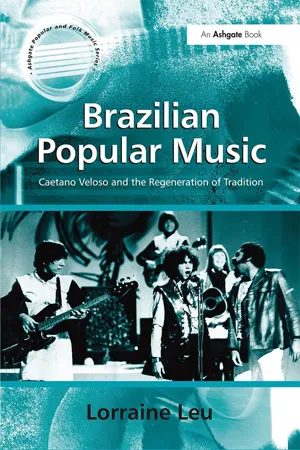
Brazilian Popular Music, or M'sica Popular Brasileira (MPB), developed in the mid 1960s as a response to the re-thinking of Brazilian national identity following the establishment of the post-1964 military regime. A leading figure in MPB at this time was Caetano Veloso, and it is his music and its reception that form the focus of this book. A leader of the Tropicalist movement, Veloso sought to initiate a critical debate on Brazilian Popular Music and the political and ideological foundations which underpinned its aesthetic. Lorraine Leu examines Veloso's musical and vocal styles, revealing the ways in which they play with traditional expectations between the performer and listener, and argues that they represent an important response to the severe censorship and repression of the military regime.
Information
Chapter 1
Culture, Politics and the Weight of Tradition in 1960’s Brazil
Imaginary identities, sentimental adventures, a taste of what reality represses: pop songs open the doors to dream, lend a voice to what is left unmentioned by ordinary discourse. But pop is not only a dream machine … it is the unofficial chronicle of its times, a history of desires existing in the margins of official history …. In setting out a history of today, popular culture etches the contours of a history of tomorrow in that it ‘feels’ a social atmosphere in its earliest, unformulated stages; pop music senses the current and projects a first image of it, long before the politicians have grasped its real nature or had the time to quell it, before words have been found to express it or betray it.1
In the course of visits to Brazil in recent years, my choice of Caetano Veloso as the subject of research on a national musical tradition has frequently provoked the question: “Why Caetano and not Chico?”2 Chico Buarque’s importance to Brazilian cultural history as a poet and samba composer was once famously described by a journalist as the only consensus shared by the whole nation. There is a public perception that his life’s work of polishing and refining samba is more valid as a form of expressing the national than Veloso’s hybrid work, with its polemical and inconclusive notions of Brazilianness. It is undoubtedly Veloso’s treatment of tradition that “disqualifies” him as a spokesperson on national tradition for many Brazilians. Rejecting the idea of tradition as a static and hallowed national patrimony, Veloso’s work emphasises the importance not only of the continuity of tradition, but also of rupture, which allows tradition to be reworked and made relevant to a contemporary context. Speaking to me about the relationship between tradition and rupture in his work, he observed: “That’s the story of my life! I always find myself trying to examine that relationship and interpret it as best I can.”3
Veloso’s contribution to the tradition of Brazilian popular music and his importance within the history of Música Popular Brasileira (MPB) are significant. MPB developed in the mid 1960s out of a split within the bossa nova phenomenon that had made a huge impact in Brazil and beyond. Bossa nova emerged in the late 1950s at a moment of great optimism that a new age of progress was dawning in Brazil. This confidence was inspired by a policy of frenetic development pursued by the government of Juscelino Kubitschek, responsible for the construction of the futuristic city of Brasília on an arid plateau in the interior of the country. Kubitschek’s other enduring legacies, rampant inflation, massive foreign debt and the human cost of his promise of “fifty years progress in five”, would be felt later. However, at the time that bossa nova appeared, the most pressing concerns for its mainly middle-class songwriters and public were loves won and lost and the sun, sand and sea of the good life in the affluent beach districts of Rio de Janeiro.
By the time that the radical populist João Goulart came to power in 1961, Brazil was a country mired in a severe financial crisis. Convinced that attempts to solve the crisis he had inherited could only bring political unpopularity, Goulart concentrated on what he called “basic reforms” as a means of creating a political following. The prospect of educational, tax and particularly, agrarian reform which had the potential to significantly alter the political balance and divert wealth away from the privileged sectors of society, soon created fierce opposition to Goulart’s government. The conservative middle classes took to the streets to persuade the military to move against Goulart. With the support of the US government, the military conspiracy began on 31 st March 1964, bringing to an end a period of nearly two decades of populist politics in Brazil.
MPB emerged as a musical response to the rethinking and re-articulating of Brazilian identity after the coup. The term does not connote a coherent movement or style, and came to encompass most of the popular music produced in Brazil until the 1990s.4 The crisis of populism that was produced by the overthrow of Goulart was articulated within the new current of music as a crisis in representing the popular. Brazilian sociologist Renato Ortiz identifies two main currents of thinking on a national-popular culture in the 20th century, which prevailed up until 1968 and the military’s draconian Fifth Institutional Act, known as the AI–5.5 The first emerged in the 1920s and 1930s, and conceptualised “popular” as “folkloric”. This perspective advocated fashioning a national identity by reviving and preserving the folkloric traditions of the Brazilian people. The second school of thought developed around the mid 1950s and was characterised by a concern to politicise popular traditions. This period saw the activities of ISEB, the Instituto Superior de Estudos Brasileiros (Higher Institute for Brazilian Studies), Paulo Freire’s literacy campaign and the Centros Populares de Cultura (Popular Culture Centres or CPCs).6 Before 1964, left-wing cultural activity was dominated by the CPCs, whose production of “popular revolutionary art” was fuelled by debates on modernisation, democratisation, nationalism and “faith in the people”. The CPCs had responded to the ascendancy of the left in politics under the Goulart administration by declaring that “in our country and at this stage of our history, outside of political art, there is no popular art.”7 The middle-class CPC poet sought to educate the people and raise consciousness in the intellectual, by relying on the power of the word to bring about social transformation: “With almost evangelical zeal, he mythifies the power of the word to effect change and his goal becomes to play on the emotions and to create guilt: to play on the emotions with his moving denunciations of poverty, and create guilt in the presumed critical and revolutionary conscience of the intellectual”8
Under the Goulart government left-populist cultural production was predicated on the politicisation of traditional cultural forms and on the viability of a link between the middle-class producers of this culture and the working classes. After 1964 these fundamental assumptions were undermined. In the first place, the “Economic Miracle” initiated by the new regime relied on a huge influx of foreign capital and led to an increasing internationalisation of Brazilian society and culture. Secondly, the growth of the mass media as a result of heavy investment by the military government began to result in a conceptualising of “popular” as that which drew a large audience.9 Additionally, the classification “popular” was always a complicated one, given the fact that a consistent characteristic of Brazilian popular music has been its ability to combine the erudite and the popular within the creative space of song. Significantly, the military also succeeded in breaking organised contacts that had been created by intellectuals and cultural producers with workers and students during the Goulart government. Having deprived the cultural left of its public, the state felt able to allow a considerable degree of artistic freedom during the first four years following the coup. As a result, left-wing cultural activity continued to flourish until 1968 and the Fifth Institutional Act (AI–5). Two strong currents of nationalism emerged from this early period of the dictatorship. The military’s programme for economic development was accompanied by an intense nationalist propaganda drive, communicated via a mass media system with close links to the State. All over Brazil bumper stickers and TV and radio advertisements proclaimed the army’s ominous message to dissenters: “Brazil – love it, or leave it.” The left responded to this authoritarian nationalism by embracing its own nationalist ideology, with cultural production inspired by traditional regional popular culture, the conditions of the urban worker and a rejection of the government’s modernising project.
Before 1964 cultural expression under the CPCs had been dominated by literature. After the coup, having failed in their revolutionary aims and cut off from the popular classes, committed cultural production turned away from literature, which did not appear to answer the needs of the current political circumstances, towards the spectacle – theatre, cinema, music and the plastic arts.10 In December 1964, Teatro Arena presented Opinião (Opinion), one of the first cultural responses to the coup, whose title samba proclaimed: “They can arrest me/ They can beat me up/ They can leave me to starve/ But I won’t change my opinion” (Podem me prender/ Podem me bater/ Podem até deixar-me sem comer/ Que eu não mudo de opinião). Opiniâo staged the meeting of the popular classes with the middle classes which was made impossible by political circumstances. Although it expressed some uncertainty about this contact, the musical retained the nationalist, populist ideals of pre-1964 Brazil.11 By 1967, however, reactions to the social and political scene took on a very different character, with the release of Glauber Rocha’s film Terra em Transe (Land in Anguish), the story of an intellectual who wrestles with the question of his role in society and eventually commits suicide when confronted with his futility. The film constituted an incisive critique of populism, class alliances and even artists of the left and had a profound influence on the cultural scene, stimulating a wave of cultural production which came to be described as “Tropicalist”.
The name “Tropicália” derives from an installation by plastic artist Hélio Oiticica. It was borrowed by Veloso for the song that was to be a significant statement of intent with regard to his relationship with the tradition of Brazilian popular music. The song was included on the 1968 album Caetano Veloso and in the same year, the name “Tropicália” was given to the album that resulted from the collaboration of a group of like-minded musicians and performers. After the release of the Tropicália album, the term began to be applied to other areas of the arts that shared similar aesthetics and concerns. For Celso Favaretto, the main point of contact between them was a radical social critique, based on a contemporary rearticulation of Modernist poet Oswald de Andrade’s theory of antropofagia, or cultural cannibalism, a selective devouring of foreign culture by national culture.12 However, although the circulation of ideas between artists from different spheres was one of the most prominent characteristics of the period immediately following the coup, it is important not to generalise, or homogenise Tropicália into a single cultural movement. Despite their points of contact, the application of the term “Tropicalist” to these distinct forms of cultural production can be misleading, particularly as it was only in the field of popular music that artists defined their movement and agenda as “Tropicalist”. My references in this work to the “Tropicalists” and “Tropicália” therefore, are to the group of composers and performers who collaborated under that name.
The influence of Brazil’s Cinema Novo (New Cinema) on the Tropicalist musical aesthetic is evident in the cinematographic quality of much of the imagery of the movement’s songs during this period. Cinema Novo techniques, such as fragmentation, juxataposition and the characteristic dreamlike quality of its narratives, can be seen in the lyricism and structures of Tropicalist song.13 For Glauber Rocha, the movement’s most prominent theoretician, Cinema Novo combined auteur cinema with a social conscience and the creation of a language of underdevelopment, capable of turning limited resources into artistic invention. This “estética da fome”, or “aesthetic of hunger”, was at the heart of Cinema Novo’s vision of Brazil. According to Rocha, hunger was the distinctive characteristic of life in underdeveloped countries, whose societies were perceived by developed countries as existing in a “strange tropical surrealism”. The originality of Cinema Novo on the international film scene would lie in its representation of this hunger, and of violence, its “most noble cultural manifestation”.14 Violence would not only be the way for Brazilian cinema to assert its individuality, it would also offer a way of negotiating cinema’s problematic position within the film industry. After years of attempting to produce “anti-industrial” cinema, Cinema Nova finally acknowledged that the market and industrial distribution were necessary evils and instead turned its attention to confronting the challenge of working within these parameters.15 An additional complication was that the international distribution agency for Brazilian films, Embrafilme, was a state organisation, supported by a repressive regime. Cinema Novo film-makers explored the concept of cannibalism which had also begun to re-emerge in the theatre and on the music scene, exemplified by Joaquim Pedro de Andrade’s Macun...
Table of contents
- Cover
- Half Title
- Dedication
- Title Page
- Copyright Page
- Table of Contents
- List of Illustrations
- List of Music Examples
- General Editor’s Preface
- Acknowledgements
- 1 Culture, Politics and the Weight of Tradition in 1960’s Brazil
- 2 Style and Sexual Politics in the Tropicália Period
- 3 “You Don’t Know Me At All” – Challenging Vocal Traditions
- 4 Language, Meaning and Memory: The Songwriting Tradition
- 5 The Tradition of the Love Song in Brazil
- 6 Unidentifiable Objects of Desire: Caetano Veloso’s Love Songs
- Conclusion
- Appendix: Interview with Caetano Veloso
- Bibliography
- Index
Trusted by 375,005 students
Access to over 1.5 million titles for a fair monthly price.
Study more efficiently using our study tools.
Frequently asked questions
Yes, you can cancel anytime from the Subscription tab in your account settings on the Perlego website. Your subscription will stay active until the end of your current billing period. Learn how to cancel your subscription
No, books cannot be downloaded as external files, such as PDFs, for use outside of Perlego. However, you can download books within the Perlego app for offline reading on mobile or tablet. Learn how to download books offline
We are an online textbook subscription service, where you can get access to an entire online library for less than the price of a single book per month. With over 1.5 million books across 990+ topics, we’ve got you covered! Learn about our mission
Look out for the read-aloud symbol on your next book to see if you can listen to it. The read-aloud tool reads text aloud for you, highlighting the text as it is being read. You can pause it, speed it up and slow it down. Learn more about Read Aloud
Yes! You can use the Perlego app on both iOS and Android devices to read anytime, anywhere — even offline. Perfect for commutes or when you’re on the go.
Please note we cannot support devices running on iOS 13 and Android 7 or earlier. Learn more about using the app
Please note we cannot support devices running on iOS 13 and Android 7 or earlier. Learn more about using the app
Yes, you can access Brazilian Popular Music by Lorraine Leu in PDF and/or ePUB format, as well as other popular books in Media & Performing Arts & Music. We have over 1.5 million books available in our catalogue for you to explore.