- 248 pages
- English
- ePUB (mobile friendly)
- Available on iOS & Android
eBook - ePub
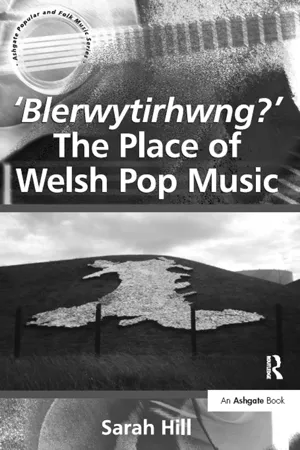
'Blerwytirhwng?' The Place of Welsh Pop Music
About this book
In the 1960s, Welsh-language popular music emerged as a vehicle for mobilizing a geographically dispersed community into political action. As the decades progressed, Welsh popular music developed beyond its acoustic folk roots, adopting the various styles of contemporary popular music, and ultimately gaining the cultural self-confidence to compete in the Anglo-American mainstream market. The resulting tensions, between Welsh and English, amateur and professional, rural and urban, the local and the international, necessitate the understanding of Welsh pop as part of a much larger cultural process. Not merely a 'Celtic' issue, the cultural struggles faced by Welsh speakers in a predominantly Anglophone environment are similar to those faced by innumerable other minority communities enduring political, social or linguistic domination. The aim of 'Blerwytirhwng?' The Place of Welsh Pop Music is to explore the popular music which accompanied those struggles, to connect Wales to the larger Anglo-American popular culture, and to consider the shift in power from the dominant to the minority, the centre to the periphery. By surveying the development of Welsh-language popular music from 1945-2000, 'Blerwytirhwng?' The Place of Welsh Pop examines those moments of crisis in Welsh cultural life which signalled a burgeoning sense of national identity, which challenged paradigms of linguistic belonging, and out of which emerged new expressions of Welshness.
Information
PART I
‘Blerwytirhwng?’
Chapter One
Introduction
‘Blerwytirhwng?’ – ‘Whereareyoubetween?’ This title of a song by the Welsh band Super Furry Animals asks a complicated question about an in-between place called Wales.1 Geographically, this small peninsular country sits on the edge of the United Kingdom; to the east of Wales is England, separated by Offa’s Dyke, a long earthwork,2 and to the west, America, separated by the North Atlantic. Politically, Wales has taken tentative steps from centralized British power to devolution. Culturally, Wales is home to two unrelated languages, Welsh and English. Temporally, it exists on a fulcrum of five hundred years of colonization and these brief, furious decades of globalization. Wales is a concertina of cultures and languages wondering what kinds of sounds it can or should make in the world. ‘Blerwytirhwng?’ is a question posed as much to Super Furry Animals’ Welsh audience as to Wales itself, and it is the structural question around which this book is based.
‘Blerwytirhwng’ is itself a concertina question, with the compacted words suggesting the pressures at work on the place. Super Furry Animals, a Welsh band signed to the global Sony label, represent the most recent phase in a multi-layered cultural process. Since the Second World War, Wales has undergone an extended period of self-examination, community formation, and political activism, and over the past fifty years, Welsh musicians have appropriated a variety of Anglo-American musical styles to expedite the Welsh quest for national self-definition. This process is by no means unique to Wales, but as a peripheral culture, Wales has often lagged behind the mainstream; cultural change has only shadowed, not instigated, political upheaval.
So what follows is an exploration of something called ‘Welsh popular music’. Popular music could be defined generally in stylistic, class and commercial terms,3 but ‘Welsh popular music’ is a relative term which challenges a fundamental assumption: that the word ‘popular’ is meant to signify something which is liked by a large group of people. Whatever the collection of people, the adjective ‘Welsh’ makes the group much smaller. The term ‘popular’ is one half of an historically assumed opposition between ‘high’ and ‘low’ art. In the Welsh model, ‘popular music’ includes all musics not embraced within the ‘art music’ category – traditional, folk, rock, and the like. These ‘popular’ categories cannot, in most circumstances, be treated as interchangeable signifiers of the same music. In the Welsh example, traditional, folk and rock may be three different musics, yet they are complementary, and have historically been covered by the same umbrella term, ‘popular’, to denote ‘of the people’.
‘The people’ in Wales occupy similarly hazy territory. The history of the Welsh people is not one of an indigenous, internal class system, but rather one of historical subjugation by their more powerful neighbors to the east, the English. The five hundred years of English rule which the Welsh have endured gave rise to the generic Welsh term, gwerin, to denote ‘the people’ of Wales as a populace apart from an increasingly English land-owning class.4 This term suggests a community united in the religious ideals of Protestant Nonconformity, in the use of the Welsh language, and in the adherence to and development of popular traditions. Though gwerin implies a sense of the ‘ordinary’, the ‘common’, ‘folk’, it has been the central term around which certain musical traditions and a common cultural history have evolved. This particular Welsh ‘popular’ history shadows the history of the popular traditions in Anglo-British and Anglo-American life, and it is the combination of these histories, borrowed and indigenous, which has informed the evolution of that contemporary tradition to which I refer, loosely, as ‘Welsh popular music’.
But it is not just the term ‘popular’ that is problematic; to residents of Wales, that English term ‘Welsh’ is inherently controversial, too. Anglophone residents of Wales might assume that a study of ‘Welsh popular music’ would signify exclusive interest in Anglo-Welsh musicians, while Welsh speakers would question the inclusion of Anglo-Welsh music in an otherwise unique cultural history. Because the English term ‘Welsh popular music’ implies all popular music performed, recorded, or produced in Wales, it is inclusive of Welsh- and English-language work. One Welsh formulation of the term, cerddoriaeth bop Gymreig, signifies primarily Anglophone music; another, cerddoriaeth bop Gymraeg, signifies exclusively Welsh-language music; the third, less satisfactory formulation, cerddoriaeth bop Cymru, the popular music of Wales, signifies an unwillingness to commit to either linguistic category – and, for all its inane inclusivity, is the only term which one can use to describe the following to those Welsh-speakers who express an interest in it. And it is, after all, primarily their cultural history which is explored in the following pages.
That there should be such difficulty describing an otherwise easily defined project is an indication of the range of problems involved. But it should be stated at the outset that there are, in Wales, three distinct identity formations – Welsh, Anglo-Welsh, and English.5 The cultural-linguistic determination is a central component to any discussion of Welshness, for it immediately places the subject in one of the above three categories. These categories are themselves problematic, and while some may claim that they are not as distinct as they once were, others may claim that the distinctions became more apparent in the final decades of the twentieth century. The process of Welsh identity in the post-war years, like the struggles for identity in a number of other minority cultures in Europe and beyond, may be mapped in a variety of ways, but I will chart the cultural formation of ‘popular’ music and its touchstone role in the creation of Welshness from the end of the Second World War to the close of the twentieth century.
‘Welshness’, of course, is a contested construction. Because the term is invariably linked to issues of linguistic territory, it is volatile and requires clarification. Assertions of Welshness have often arisen in the face of an external threat to the Welsh identity, and one of the clearest examples of such a threat would be in the historical motion by the English to eradicate the indigenous language of Wales. In the face of this opposition, the Welsh language has been protected by certain cultural traditions. The National Eisteddfod, for example, can trace its roots back to the twelfth century. The basic traditions established in the first Eisteddfod – poets and musicians competing for a ‘chair’ at the host’s table – were codified in the nineteeth century, and the National Eisteddfod has been held annually since then, alternating between locations in the north and the south, throughout the first week of August. The competitions around which the Eisteddfod is based celebrate Wales’ unbroken bardic tradition of cynghanedd – strictly-metred alliterative verse – and the unique musical tradition of cerdd dant – impromptu singing to harp accompaniment. Most importantly, it is the one week in the year when Welsh becomes the majority language. Thousands of Welsh speakers converge at the Eisteddfod, effectively shifting the linguistic structure of the host area. Concessions are made to Anglophone visitors to the Eisteddfod field, but the underlying belief is that the Eisteddfod represents a protected, and protective, linguistic environment. The cultural traditions celebrated at the Eisteddfod are not translateable; admission to the inordinately powerful community formed during Eisteddfod week requires the acquisition of the Welsh language. For one week a year, the minority becomes the majority.6
A second example, Urdd Gobaith Cymru, the Welsh League of Youth, was founded in 1922. Intended as a means of ensuring a future for the Welsh language, the Urdd’s activities include summer camps, magazines, sporting competitions, and annual Eisteddfods. Its fifty thousand members pledge their allegiance to ‘Christ, our fellow-men, and Wales’, thereby establishing from the age of eight a commitment to a Welsh-speaking Wales, founded in a common religious ideal. The Urdd Eisteddfod similarly instills in young Welsh persons an understanding of a shared cultural history – and also a familiarity with a system of public competition and performance in poetic and musical arts which had an enormous effect on the development of an indigenous popular culture in the Welsh language.
The Eisteddfod and the Urdd may seem able to ensure the health of the Welsh language, but it is important to remember that they are isolated within the larger political construct of the United Kingdom. When the status of the Welsh language reached crisis point in the early 1960s, the Welsh-speaking population fought for their linguistic rights and the assurance of governmental acceptance of the language, which would lead to its ultimate survival.7 This period of language activism was instigated by Saunders Lewis, the author and former president of Plaid Cymru, the National Party of Wales. On 13 February 1962 Lewis delivered his radio lecture, Tynged yr Iaith (The Fate of the Language),8 in which he stated:
Nid dim llai na chwyldroad yw adfer yr iaith Gymraeg yng Nghymru heddiw. Trwy ddulliau chwyldro yn unig mae llwyddo. Efallai y dygai’r iaith hunan-lywodraeth yn ei sgil; ‘wn i ddim. Mae’r iaith yn bwysicach na hunan-lywodraeth. Yn fy marn i, pe ceid unrhyw fath o hunan-lywodraeth i Gymru cyn arddel ac arfer yr iaith Gymraeg yn iaith swyddogol yn holl weinyddiad yr awdurdodau lleol a gwladol yn y rhanbarthau Cymraeg o’n gwlad, ni cheid mohoni’n iaith swyddogol o gwbl, a byddai tranc yr iaith yn gynt nag y bydd ei thranc hi dan Lywodraeth Lloegr.
[Restoring the Welsh language in Wales today would be nothing less than a revolution. Success is only possible through revolutionary means. Maybe the language would bring self-government in its wake; I don’t know. The language is more important than self-government. In my opinion, if Wales gained any kind of self-government before the Welsh language was accepted and used as an official language in all local and state administration in the Welsh-speaking areas of our country, the language would never be an official language at all, and the death of the language would come more quickly than it will under English rule.9]
Tynged yr Iaith heralded an extended period of civil disobedience in Wales, and led directly to the creation of Cymdeithas yr Iaith Gymraeg, the Welsh Language Society. The Cymdeithas was the central force for language activism from the 1960s onwards, and was responsible for organizing rallies, campaigns and protests throughout Wales in an effort to establish linguistic rights for Welsh speakers and to secure the future of the Welsh language. The demands for linguistic survival in the early days of the Cymdeithas included the publication of bilingual government-issued forms, bilingual road signs throughout Wales, the establishment of Welsh-medium schools, and an increased presence of the Welsh language in all areas of public life. Because these demands required a mobilization of forces and the unification of a community, the notion of ‘Welshness’ fostered under these circumstances is a very powerful one. It is not, however, a ‘Welshness’ shared unilaterally by the entire Welsh population, for it is based on linguistic territory, and in the last century the number of Welsh speakers in the country has wavered only slightly on either side of the twenty per cent mark.
To define an identity based solely on the linguistic struggles of a minority community within an historically subjugated society is not without its problems. Struggles for community survival in Wales, on the local and the national levels, have also been centered around rising unemployment, miners’ strikes, governmental neglect, and chapel closures; the history of Welsh-speaking Wales merely provides one pathway through those moments when the notion of a Welsh identity was destroyed, debated, and defended. Because these moments signify points of dissent or rebellion, points of societal fracture, they are the most vivid indicators of the development of a common identity, of a community. The music which emerged at these moments of fracture is indicative of the ways in which contemporary Welshness was articulated, and it is these moments which serve to illuminate the present study, for they show the negotiation of new traditions, of new ways of understanding selfhood and nationhood, new ways of understanding cultural identity. Language assumes the central symbolic power of identity negotiation; as a result, this study considers music in a context formed by language, rather than for its own, ‘purely musical’, qualities. While there is much to be gained from the detailed analysis of musical form and content, issues of style and culture are of greater significance here.
While it would be absurd to suggest an absolute inception of any tradition, musical or otherwise, a study of this type can only begin at a clear point of crisis, and conclude at another moment of crisis or resolution. This of course creates a further set of problems. The history of Anglo-American popular music provides its own evolutionary map onto which the development of a Welsh identity in the latter half of the twentieth century may be superimposed. The political and social motivations behind Anglo-American popular music led to the emergence of communities, subcultures and countercultures in Britain and the United States; the political and social motivations behind the emergence of Welsh popular music led to the creation of a community which was by its very nature a subculture of the larger British model.10 Because Wales is located culturally within Anglo-America, her contributions to this larger history are occasionally noted in more general studies. Anglophone Wales has as much ownership of this common history as does any other Anglophone culture on the Celtic fringe; but the adoption of this Anglophone tradition into the Welsh-language culture is a telling phenomenon. In this way points of intersection can be identified between Welsh popular music and Anglo-American culture, and points of fracture examined as evidence of crises in the process of a Welsh identity. More importantly, these serve as a gauge of changing perceptions of Welshness.
Welsh-language popular music follows the same trajectory as Anglophone popular music, but at a different chronological pace. It follows the pace of a culture in the process of defining itself, of developing a sense of self-confidence, of providing for itself that which the dominant culture fails to provide for it. Because Welsh-language culture exists within the larger Anglo-American culture, many of its points of enunciation are the same as those of the wider model, but the musical symbols of those moments often betray its relative youth and inexperience. Those are the moments which are of particular importance in the following pages, for they provide a grounding rhythm to the process of Welshness at issue: slow and tentative at first, accelerating through its development, and climaxing in a bilingual cacophony toward the end of the century.
Notes
1 First released on Llanfairpwllgwyngyllgogerychwyrndrobwllantysiliogogogochyny gofod (in space) (Ankst 057, 1995), and subsequently re-released on Outspaced: Selected B-Sides and Rarities (Creation Records, 1998).
2 Offa, the King of Mersia, reigned from 757 to 796. Offa’s Dyke is among the oldest built structures in Britain. There is some debate, however, as to whether the dyke was constructed from the West, to keep people out, or from the East, to keep people in.
3 For a thorough exploration of the problems associated with the definitions of ‘popular music’, see Richard Middleton, Studying Popular Music (Milton Keynes: Open University Press, 2002).
4 For a thorough exploration of the development of the notion of gwerin, see Gwyn Alf Williams, When Was Wales? (London: Pengui...
Table of contents
- Cover
- Half Title
- Title Page
- Copyright Page
- Table of Contents
- List of Illustrations
- General Editor’s Preface
- Acknowledgments
- Part I ‘Blerwytirhwng?’
- Part II A Cultural History of Welsh Popular Music
- Part III Case Studies
- Appendix: A Brief Timeline
- Bibliography
- Index
Trusted by 375,005 students
Access to over 1.5 million titles for a fair monthly price.
Study more efficiently using our study tools.
Frequently asked questions
Yes, you can cancel anytime from the Subscription tab in your account settings on the Perlego website. Your subscription will stay active until the end of your current billing period. Learn how to cancel your subscription
No, books cannot be downloaded as external files, such as PDFs, for use outside of Perlego. However, you can download books within the Perlego app for offline reading on mobile or tablet. Learn how to download books offline
Perlego offers two plans: Essential and Complete
- Essential is ideal for learners and professionals who enjoy exploring a wide range of subjects. Access the Essential Library with 800,000+ trusted titles and best-sellers across business, personal growth, and the humanities. Includes unlimited reading time and Standard Read Aloud voice.
- Complete: Perfect for advanced learners and researchers needing full, unrestricted access. Unlock 1.5M+ books across hundreds of subjects, including academic and specialized titles. The Complete Plan also includes advanced features like Premium Read Aloud and Research Assistant.
We are an online textbook subscription service, where you can get access to an entire online library for less than the price of a single book per month. With over 1.5 million books across 990+ topics, we’ve got you covered! Learn about our mission
Look out for the read-aloud symbol on your next book to see if you can listen to it. The read-aloud tool reads text aloud for you, highlighting the text as it is being read. You can pause it, speed it up and slow it down. Learn more about Read Aloud
Yes! You can use the Perlego app on both iOS and Android devices to read anytime, anywhere — even offline. Perfect for commutes or when you’re on the go.
Please note we cannot support devices running on iOS 13 and Android 7 or earlier. Learn more about using the app
Please note we cannot support devices running on iOS 13 and Android 7 or earlier. Learn more about using the app
Yes, you can access 'Blerwytirhwng?' The Place of Welsh Pop Music by Sarah Hill in PDF and/or ePUB format, as well as other popular books in Media & Performing Arts & Music. We have over 1.5 million books available in our catalogue for you to explore.