- 336 pages
- English
- ePUB (mobile friendly)
- Available on iOS & Android
eBook - ePub
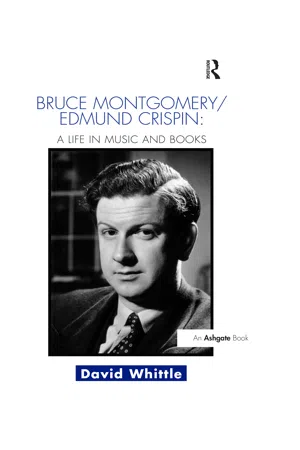
Bruce Montgomery/Edmund Crispin: A Life in Music and Books
About this book
Under his real name, Bruce Montgomery (1921-1978) wrote concert music and the scores for almost 50 feature films, including some of the most enduring British comedies of the twentieth century, amongst them a number in the series started by Doctor in the House and the first six Carry On films. Under the pseudonym of Edmund Crispin he enjoyed equal success as an author, writing nine highly acclaimed detective novels and a number of short crime stories, as well as compiling anthologies of science fiction which helped to increase the profile of the genre. A close friend of both Philip Larkin and Kingsley Amis, Montgomery did much to encourage their work. In this first biography of Montgomery, David Whittle draws on interviews with people who knew the writer and composer. These interviews, together with in-depth research, provide great insight into the development of Montgomery as a crime fiction writer and as a composer in the ever-demanding world of films. During the late 1950s and early '60s these demands were to prove too much for Montgomery. Alcoholism combined with the onset of osteoporosis and a retreat into a semi-reclusive lifestyle resulted in him writing and composing virtually nothing during the last 15 years of his life. David Whittle examines the reasons for Montgomery's early and rapid decline in this thoroughly researched and engagingly written biography.
Information
Chapter 1
‘Daydreaming child with nice manners’: 1921–1928
There is little in Bruce Montgomery's family history to suggest such diverse musical and literary talents. On the back of the distinctive green penguin paperbacks in which his detective stories were published, Montgomery is described as of ‘Scots-Irish parentage’. His father, Robert Ernest, the second son of William Jamison and Eleanor Harper Montgomery, was born in Belfast on 9 July 1878. Robert's father was a merchant originally from Bangor, County Down. By the time Robert entered King's College London, the family had moved to a house in Balfour Avenue, Hanwell, in west London, and Robert's brother had already emigrated to Australia where he started an eiderdown factory. The second of Bruce Montgomery's three sisters, Sheila, recalls hearing of her paternal grandfather's death whilst skating with her father on a pond near the family home at Chesham. Thereafter, the girls would stay occasionally with their grandmother in Hanwell. Eleanor Montgomery was a strict member of the Plymouth Brethren, and the girls were expected to worship with her.
Robert Montgomery joined the civil service in 1898 as a Second Class Clerk in the India Office and spent his whole working life serving the interests of a country he never actually visited. By the time Bruce was born in 1921 Robert was principal Clerk. He was an intelligent, thorough, honest and placid man, never known to use strong language about anything or anyone. Once in a while, every three years perhaps, he might lose his temper over some trivial matter, but it was soon forgotten and no grudges were borne. The meticulousness that Bruce showed in certain aspects of his life came from his father's side of the family. Robert's qualities were doubtless a consequence of his firm religious faith, and it was through the church that he met his wife.
Bruce Montgomery's mother, Marion Blackwood Jarvie, was ten years her husband's junior. Her side of the family was far less stable. Born in Cramond, a village on the banks of the Forth outside Edinburgh, on 18 September 1888, she was brought up by her grandparents. She told her own children that her parents had drunk themselves into paupers' graves. On another occasion, it was made clear that her father had drunk away a fortune. Bruce's own reliance on alcohol in later life may have owed something to the influence of his mother's family. Whereas on his father's side Montgomery claimed in later life to be descended from ‘various Earls of Arundel, Shrewsbury and Eglinton’,1 his mother's family boasted a more colourful history. Marion's father thought he was an illegitimate descendant of Bonnie Prince Charlie and his grandchildren wore the Royal Stewart tartan in their childhood. Bailey Nichol Jarvie, otherwise known as Rob Roy, was also claimed as an ancestor. A less glamorous relative was the Laird of Blackwood, a small village south of Glasgow.
It was while Marion Jarvie and her two sisters were living with relatives in London that she joined the choir of St Andrew's Presbyterian Church in Mount Park Road, Ealing. Also in the choir was Robert Montgomery. He proposed to Marion several times before she accepted him in a telegram he received whilst playing cricket at Horsham. They were married at St Andrews by the Reverend Herbert Wylie on 22 August 1910. The Montgomerys were sufficiently sentimental to return there for the christening of their youngest daughter, Elspeth.
The couple made their home at Chesham Bois in Buckinghamshire. The house was named Blackwood after Marion's ancestral laird and stood on Bois Lane, at the corner of Stubbs Wood. All four children were born at Blackwood. The first three were all girls: Eleanora (known as Nora) was born on 4 May 1911; Sheila on 13 March 1913; Elizabeth, always called Elspeth, on 9 January 1916.
The fourth child, Robert Bruce, was born on 2 October 1921, well over five years after the arrival of Elspeth. The boy was always known as Bruce and was called quite openly his parents' ‘afterthought’. He was given a spider on every birthday to celebrate his names.2 After three girls the proud parents were delighted to have a boy, but their joy was slightly tempered by the infant's congenital deformity of the feet. Before the birth Marion Montgomery had been visited with a premonition that there would be something wrong. She was right: both of Bruce's feet were turned in. This meant frequent operations until the age of 14; it also meant that he had to wear callipers well up to his shins.
When Bruce was two years old, the family moved to a new home, Domus in Stubbs Wood Lane, just around the corner from Blackwood. This big house in a rural setting was built for them, much of it to Robert Montgomery's design. There were six bedrooms, a dining room, a lounge and a large drawing room which was used for dances, musical evenings and Marion Montgomery's many bridge parties. On warm summer nights the children were sometimes allowed to sleep downstairs in the L-shaped verandah. The acre of garden gave evidence of Robert Montgomery's sporting enthusiasms. There was a nine-hole putting lawn, and on the tennis court Mr Montgomery, true to his character, would play his game as a steady doubles partner and leave the flashy shots to others. The children's interests were served by a swing and a see-saw. They could also play in the wild section and amongst the cherry trees. Robert Montgomery was particularly fond of roses, and the garden was full of standard and bush varieties. At Christmas, when Eleanor Montgomery and Aunt Lucy, one of Robert's sisters who lived with his mother at Hanwell, came to stay, there was always a vase of roses on the dinner table. A gardener was employed for most days of the week.
It was a happy family life for the four children. Robert Montgomery's quiet character was rarely ruffled by his wife's more variable temper. Arguments between the two were so rare that it was quite an event when Sheila once reported that she had overheard one. Neither Marion nor Robert retained a brogue from their upbringing, but Marion occasionally used some strange Scottish words with a bit of an accent.
The church was a very important part of Robert Montgomery's life. He was a prominent member of the Free Church in Amersham where he formed the choir, became Choir Secretary and then served as Treasurer of the Church for many years. Marion Montgomery was a devoted bridge player. The family's interest in the game was such that the children even played a hand or two sometimes before leaving for school in the morning. Their father's strict religious beliefs meant that no money could be played for. Marion seemed rarely to be in when the children came from school, and they were looked after by their live-in maid. Olive was first engaged at the age of 14 when Nora was born. She remained with the family until Bruce left school. Olive always called Marion ‘mummy’, and Bruce was known as ‘my Brucie boy’. When she left the Montgomerys, Olive went to Canada, married an old widower friend and gave birth to a boy whom she christened Bruce.
As one of the family, Olive accompanied the Montgomerys on their annual summer holiday. Robert took the whole of August off, Domus was let to help pay for the rent of the holiday home, and the whole family transferred to the south coast. Broadstairs, the Isle of Wight and Hayling Island were favourite haunts. By the time Bruce was a teenager, Fowey in Cornwall had become established as the regular summer retreat.
Bruce Montgomery wrote later of his childhood:
My mother was Scottish and my father an Ulsterman; I myself was born in England. My upbringing was in the twenties and thirties, conventionally middle-class, and I look back on it with pleasure and gratitude. The middle-class standards demonstrated to me then still seem to me worth serious consideration. They were kindness, politeness, strictness in money matters, conscientiousness in work, marital fidelity and a regular (in all senses) life. Religion was there too, but was an option – i.e., up to the age of fourteen or so some small acquaintance with it was obligatory, but after that one was left to choose for oneself. Since children are at their happiest when bombinating inside a framework of unoppressive but definite rules and conventions, I was happy, and although I have often failed to live up to those bourgeois standards, I've always regretted my failures. For all its limitations, decent bourgeoisisme seems to me not at all a bad or unreasonable code to live by – or to write by, either.3
Bruce, as the only boy, was spoiled by his mother: she went as far in his adulthood as to wash his first car. He had inherited the Titian hair which had made Marion quite a belle in her youth. The sisters were pleased to have a little brother whom they could take out in his pram, even if Sheila did once tip him out of it. Elspeth used to lead him to his first school, Chesham Bois High School, a dame school run by three elderly sisters. Elspeth would ride her bicycle whilst Bruce followed on his fairy-cycle. It was two miles each way, and he could recite the names of all the houses they passed. With no school lunches they had to go each way twice every day. As Bruce always had his feet encased in plaster or callipers from surgery, this was no easy journey. Sheila taught him to ride a proper bicycle later. But Bruce did not see much of his sisters after they were sent away to Crediton High School in Devon, their father having decided that if the girls were going to board, they might as well be a good distance away.
Towards the end of his life, Bruce Montgomery described himself as a ‘timid, lazy, daydreaming child with nice manners’.4 These nice manners did not prevent him from saying exactly what he thought, however. At the age of seven he was obliged to attend a children's party. As he left he said to his hostess: ‘Thank you very much. I have not enjoyed myself, but it was not your fault.’5 Bruce's ‘obligatory’ acquaintance with religion was confined to attendance with his sisters at services on Sundays, usually having to endure sermons which lasted at least half an hour. The daydreaming was a result of his having to amuse himself, partly because of his regular confinements for surgery and partly because his sisters were away at school. He slept with a toy pistol, caps primed, under his pillow.
When he was four years old, Bruce was taken on an outing to a nearby farm. Elspeth and he were stroking a horse when the animal suddenly kicked out and split open the boy's head. There was a lot of blood and the family was very alarmed. The curtains in the house were drawn. The girls, who at one stage wondered if he would live, were relieved to hear that there was no lasting damage except for a horseshoe-shaped scar on the top of his head which could be seen only when the wind ruffled his hair. Opinion in the family was that this kick gave impetus to Bruce's brain and was responsible for his subsequent academic career.
In 1925, some time later than their friends, the Montgomerys bought their first car, a second-hand open Peugeot. Robert Montgomery was never the best of drivers. His wife said that on hills he always went backwards to go forward. Even so, the car was very useful particularly for getting Robert to his work in London during the General Strike. It was also useful for getting Bruce to Amersham station for his daily train ride to his new school.
1 World Authors, Wakeman, p. 344
2 To commemorate the Scottish king Robert the Bruce (1274–1329) who, whilst hiding in a cave, took heart from the persistence of a spider weaving its web.
3 World Authors, Wakeman, p. 344
4 Ibid.
5 ‘Fen's Creator’, Critchley
Chapter 2
‘An intellectual snob’: 1928–1940
In 1928, when he was seven, Montgomery started at Northwood preparatory school. This school had been founded in 1910 by Francis Terry, the third son of a Nottinghamshire clergyman. there were about 80 pupils, all but a handful of whom were day boys. The boarders lodged with Mr Terry and his wife, and those whose parents lived abroad often remained with the couple during the holidays. The boys came mostly from middle-class professional families, some of whom ran their own businesses. There were a few sons of traders. Because of the headmaster, the school was known locally as Terry's.
Frank Terry was primarily a disciplinarian, and he kept a cane on his desk during lessons. The boys regarded him with a mixture of ‘awe and healthy respect’,1 but found him firm and fair. The atmosphere of the school was contented, probably because Terry kept everything firmly under control. He had read History at Oxford, but at Northwood he taught in most areas of school life, including Latin and games. At the end of lessons Terry would line up his pupils and move them up or down the order depending on the answers to his questions. Five minutes before the end of a games session he would blow his whistle and exhort each boy to use up all his energy in the time that remained. At the opening of new buildings in March 1912, Terry spoke of his view that the job of a preparatory school education was to ‘form habits in its pupils, to awaken and maintain interest and to stimulate effort’.2 He thought that his school should not fill boys with stock ways of impressing examiners but should lead them to think on their own. The way to do this was to organise their instruction very carefully. Terry expected his staff to spend a good deal of their holidays planning the work of the next term. He wrote very full reports on each boy at the end of every term and staff were instructed to do the same. Loyalty to the school was everything and Mr Terry led by example. Many boys recall him marching up and down the touch line during matches shouting ‘Buck up, Northwood!’ This phrase was the last line of the school song:
So let’s cheer, Boys, cheer the Old School
As along through life we go.
Keep it firm in our affection
Because we love it so.
And in far off years may the same loud cheers
Ring out where we have stood
As we pass the torch-light onward
Singing ‘Buck up, Northwoo...
Table of contents
- Cover
- Title Page
- Copyright
- Contents
- Introduction
- 1 ‘Daydreaming child with nice manners’: 1921–1928
- 2 ‘An intellectual snob’: 1928–1940
- 3 ‘A seminal moment’: 1940–1943
- 4 ‘What a bloody business’: 1943–1945
- 5 ‘You mustn’t mind if I pay for it’: Music and Novels 1945–1952
- 6 ‘It ought to go off all right’: Music 1948–1950
- 7 ‘I still think it isn’t half bad’: Music 1951–1952
- 8 ‘The home of lost corpses’: Novels 1947–1948
- 9 ‘Mania for needless impostures’: Novels 1950–1953
- 10 ‘A genuine unforced enthusiasm’: Films 1948–1962
- 11 ‘Complicated by downright panic’: Films 1958–1962
- 12 ‘Much engrossed with Doom’: Anthologies 1954–1966
- 13 ‘I’ve become an Immobilist’: 1950–1962
- 14 ‘A sort of slack sabbatical’: 1962–1976
- 15 ‘A full scale replica of Chatsworth’: 1962–1976
- 16 ‘Slightly low water’: 1959–1970
- 17 ‘High time I was under new management’: 1957–1976
- 18 ‘The bonelessness of the short-distance funner’: 1974–1978
- Postscript
- Appendix 1: Montgomery and Detective Fiction
- Appendix 2: Montgomery and Film Music
- Appendix 3: List of Montgomery’s Novels and other Books
- Appendix 4: List of Montgomery’s Compositions
- Appendix 5: Discography
- Bibliography
- Index
Trusted by 375,005 students
Access to over 1.5 million titles for a fair monthly price.
Study more efficiently using our study tools.
Frequently asked questions
Yes, you can cancel anytime from the Subscription tab in your account settings on the Perlego website. Your subscription will stay active until the end of your current billing period. Learn how to cancel your subscription
No, books cannot be downloaded as external files, such as PDFs, for use outside of Perlego. However, you can download books within the Perlego app for offline reading on mobile or tablet. Learn how to download books offline
Perlego offers two plans: Essential and Complete
- Essential is ideal for learners and professionals who enjoy exploring a wide range of subjects. Access the Essential Library with 800,000+ trusted titles and best-sellers across business, personal growth, and the humanities. Includes unlimited reading time and Standard Read Aloud voice.
- Complete: Perfect for advanced learners and researchers needing full, unrestricted access. Unlock 1.5M+ books across hundreds of subjects, including academic and specialized titles. The Complete Plan also includes advanced features like Premium Read Aloud and Research Assistant.
We are an online textbook subscription service, where you can get access to an entire online library for less than the price of a single book per month. With over 1.5 million books across 990+ topics, we’ve got you covered! Learn about our mission
Look out for the read-aloud symbol on your next book to see if you can listen to it. The read-aloud tool reads text aloud for you, highlighting the text as it is being read. You can pause it, speed it up and slow it down. Learn more about Read Aloud
Yes! You can use the Perlego app on both iOS and Android devices to read anytime, anywhere — even offline. Perfect for commutes or when you’re on the go.
Please note we cannot support devices running on iOS 13 and Android 7 or earlier. Learn more about using the app
Please note we cannot support devices running on iOS 13 and Android 7 or earlier. Learn more about using the app
Yes, you can access Bruce Montgomery/Edmund Crispin: A Life in Music and Books by David Whittle in PDF and/or ePUB format, as well as other popular books in Media & Performing Arts & Music. We have over 1.5 million books available in our catalogue for you to explore.