- 304 pages
- English
- ePUB (mobile friendly)
- Available on iOS & Android
eBook - ePub
About this book
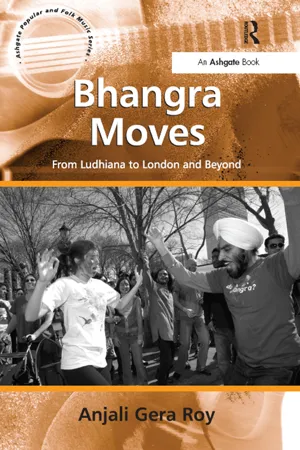
Bhangra is commonly understood as the hybrid music produced in Britain by British Asian music producers through mixing Panjabi folk melodies with western pop and black dance rhythms. This is derived from a Punjabi harvest dance of the same name. This book looks at Bhangra's global flows from one of its originary sites, the Indian subcontinent, to contribute to the understanding of emerging South Asian cultural practices such as Bhangra or Bollywood in multi-ethnic societies. It seeks to trace Bhangra's moves from Punjab and its 'return back' to look at the forces that initiate and regulate global flows of local texts and to ask how their producers and consumers redirect them to produce new definitions of culture, identity and nation. The critical importance of this book lies in understanding the difference between the present globalizing wave and previous trans-local movements. Gera Roy contrasts the frames of cultural imperialism with those of cultural invasion to show how Indian cultures have constantly reinvented themselves by cross-pollinating with 'invading' cultures such as Hellenic, Persian, Arabic and many others in the past. By looking at Bhangra's flows to and from India, the book revises the relation between culture, space and identity and challenges boundaries. It weighs both the uses and costs of visibility provided by global networks to marginalized groups in diverse localities and explores whether collaborations between Bhangra practitioners, largely of working class origin, give ordinary people any control over the circulation of culture in the global village. Finally, the book considers whether cultural practices can alter hierarchies and power structures in the real world.
Information
Chapter 1
Flows across the Chenab
Bhangrascapes
Some love it; others consider it a sonic assault. Some like it pure; others display a preference for remixes. Many don’t know what it is called or might know it by some other name. But most are likely to have sampled it as a remix. Bhangra, the loudest Asian sound in global pop, is in so many places today that it cannot be ignored. Its high decibel sound can be heard from Ludhiana to Vancouver across Delhi, Mumbai, Lahore, Dubai, Nairobi, London, Birmingham, New York, California, Sydney, Melbourne and Toronto. The new Bhangra map covers almost every part of the world. Bhangra greats today include not only Panjabi paajis (brothers) Gurdas Mann, Malkit Singh and Daler Mehndi but also desi bhaiyyas (brothers) Aadesh Srivastava and Sonu Nigam, vilayeti or British Asian cousins Apache Indian, Bally Sagoo and Panjabi MC, kale or black soul brothers Maxi Priest and MC Solar, and goris or white girls Britney Spears and Tata Young.1 Bhangra labels include transnational giants like Sony and Columbia but also independent outfits like Bally Sagoo’s Ishqrecords, do-it-yourself organizations like Independent Records and desi companies like Saregama HMV and T-Series.
What is this strange music anyway? Who produces it and who consumes it? Where does it come from and where does it go? Bhangra is now understood as the hybrid music produced by second generation British Asian youth by mixing Panjabi melodies with Western and black beats. But it is derived from the Panjabi folk genre of the same name, which has spawned other Bhangra mutants such as Bhangrapop or Panjabipop. With the number of Bhangra mutants, both pure and hybrid, being produced, circulated and consumed across different Panjabi sites, it becomes increasingly difficult to tell what Bhangra is. With gore, kale, and other Indian linguistic groups jumping into the multi-hued Bhangra space, Bhangra consumers, if not producers, cannot be exclusively Panjabi. Bhangra comes from everywhere – Lahore, Ludhiana, London, LA – and goes everywhere today and may be found in the most unlikely places.
Irrespective of where it comes from and goes to, all Bhangra mutants, diasporic and homeland, intersect in their returning to the memory of a somewhere, Panjab, a region split between India and Pakistan. Its roots in the doabe, or deltas, of Panjab’s five rivers connect Bhangra’s history and geography to the cultural geography of Panjab, the historic site of the subcontinent’s multiple land invasions and to the history of Panjabi migration and partition. With so many comings and goings, forced settlements and outward journeys, Panjab’s history offers more instances of the mixing of languages, cultures, religions than any other region on the subcontinent. Even the etymology of the name Panjab, from the Persian panj, five, and aab, waters, suggests a Perso-Arabic influence cutting the region off from the Hindu Sanskritic mainstream.2 How did Bhangra flow from the doaba of the five rivers to different parts of the globe? The answer to this question must be found as much in the older history of Panjabi migration as in the contemporary globalizing wave. The romance of rivers, invasions, travels and the borderland location fits in perfectly with the text of flows, networks, webs deployed to describe the movement of people and goods in the new global order.
Though contemporary Bhangra is only as old as the Indian nation state, it evolved from Panjabi dance genres whose history is embedded in the geography of ancient rivers and the bars or jungle regions between them, older than nations, which recognize no barriers or boundaries (Singh 1988). Cyril Radcliffe’s overwriting of their natural topography in the 1947 partition of India through the imaginary lines that divided the new nation states could neither divide the memory of the rivers nor stem the cultural flows that leaked across the borders.3 The imagery of networks, flows, webs, neighbourhoods and sites is apt in delineating Bhangra’s circulation across the globe. Moreover, the moves of the Panjabi harvest rite to the global city can tell us a great deal about the cultures of globalization, the relationship between the local and the global, the systems of control in the new world order and resistance. This book traces Bhangra’s moves from Ludhiana to London and beyond to investigate the meaning of globalization from the non-West, the Indian subcontinent and, in particular, the Panjab.
Bhangra has been examined in British sociology, anthropology and culture studies to celebrate cultural difference in the production of hybrid youth subcultures and ethnic identities in multicultural Britain. Among these studies, we may include Sanjay Sharma, John Hutnyk and Ashwani Sharma’s groundbreaking rejoinder to ethnographic othering, Dis-Orienting Rhythms, Andy Bennett’s correction of subcultural theory, John Hutnyk’s Marxist take on the misuses of hybridity and the selling of Asian music as exotica in The Critique of Exotica, Rehan Hyder’s examination of musicians and producers in Brimful of Asia and Sunaina Maira’s coverage of Bhangra in the desi party circle in the US (Sharma, Hutnyk and Sharma 1996; Bennett 2000; Hutnyk 2000; Hyder 2004; Maira 2002). These books have been extremely useful not only in making Asian popular culture the subject of formal, serious inquiry but also in establishing its social and political uses. Lately, ethnomusicologists have turned to an intensive analysis of music and lyrics (Leante 2004; Schreffler 2004b). But they have all studied Bhangra in a diasporized domain ignoring that Bhangra now flows in multiple directions, which calls for a transnational framework. Timothy Taylor’s Global Pop and George Lipsitz’s Dangerous Crossroads may be cited as two examples of the advantages of investigating contemporary musical flows in a global framework (Taylor 1997; Lipsitz 1994). Both books deal with non-Western appropriations of Anglo-American popular music in different localities and include Bhangra as an example of sonic experimentation. Tony Mitchell’s Global Noise, the first book to focus solely on the hip-hop Bhangra connection, turns the cultural imperialism argument around by reclaiming localities in the construction of imaginary local identities (2001).
In this book, I hope to adopt such an approach by combining a global frame with local and grounded perspectives to examine the various Bhangra mutants that have emerged on the Indian popular musical scene in the wake of globalization. Yet I also seek to complement and supplement existing work on Bhangra as global music for there seems to be a lacuna in existing scholarship on the issue of globalization itself. First, Bhangra’s flows are invariably cited to express concerns about the othering and consumption of non-Western musics in the metropolitan centres of Europe and America. However, not much has been said about Bhangra’s return to India where it is caught up in quite different cultural battles involving not only the West and the rest but also the centre and the region. Bhangra’s mixing with other musics has invited the wrath of cultural purists who regard them as alien cultural invasions. This, in turn, throws open the question of what is Indian and what is not in which Bhangra, as the first regional non-film music to have crossed over into the Indian popular music market, plays a crucial role. To what extent does Bhangra’s global visibility enable it to participate in the cultural politics of the nation? Does the voice gained by regional and ethnic minorities help redefine the meaning of culture, identity, hegemony and resistance? I hope to bring together such reinventions of Bhangra in India and its intervention in the politics of Indian popular music and regional identity to ground the globalization debate in India.
Secondly, Bhangra is usually cited as an example of conscious resistance and appropriation. In this book, I show that not all Bhangra mutants are inspired by the openly political agendas of groups and bands like Fun^da^mental or Asian Dub Foundation but might resist within the market, like Bally Sagoo does, or without any desire to resist, like Daler Mehndi and other Bhangrapop practitioners in India do. This would divert the “orientalizing” gaze from the “duped” to the “wily” native and how (s)he manipulates global networks. The questions it will address are: How does Bhangra’s hybridity face the purity fetish and fear of contamination on the subcontinent? How do Bhangra’s transnational flows and crossovers from Ludhiana to LA relate to boundaries, myths of origin and authenticity cults? What impact do travel technologies, electronic media, digital networks have on Bhangra’s global circulation, for instance the movement of Bhangra artists and cassettes between various Bhangra sites, or the global airplay of Bhangra albums on transnational satellite television, and exchange of albums by fans on the internet? How is Bhangra “vulgarized” in its marketing by the music industry and how does it turn the sacred Panjabi ritual into a spectacle for global consumption? Can the collaborations and exchanges between disenfranchised Bhangra producers, urban working-class youth and rustic cultivator castes bring globalization from below and challenge national structures of domination? How do Indian families perform traditional values and youth Indian modernity by dancing the Bhangra? How is Bhangra brought back into the Panjabi ritual setting? This book aims to answer some of these questions to examine hegemony and resistance in relation to new Bhangra mutants. The central argument of the book is that though global media, markets and networks have initiated Bhangra’s transnational flows and brought local artists international visibility, they have removed them from the lifeworld of Panjabis in which it was used to perform important rites of passage.
The critical importance of this book lies in addressing the impact of the intersection of local and global on the understanding of culture in the present phase of globalization. It compares Bhangra’s contemporary hybridization with earlier ones to show how Indian cultures have constantly reinvented themselves by absorbing the other while maintaining boundaries. By looking into the breaking of boundaries of nations, castes, gender, location, religion, language and race through Bhangra’s flows to and from India, it hopes to revise the relation between culture, space and identity and problematize boundaries. It weighs both the uses and costs of visibility provided by global networks to marginalized groups in diverse localities and inquires if the collaborations between Bhangra practitioners give ordinary people any control over the circulation of culture in the global village. Finally, it asks if cultural practices can alter hierarchies and power structures in the real world.
Cultural Imperialism or Cultural Invasion?
Globalization refers to the political, economic, technological transformations of the last decade of the twentieth century, which have turned the world into a single place. Whether one grasps it as an economic phenomenon created through “the ceaseless accumulation of capital” (Wallerstein 1993: 293) or views it as a “communicational concept” (Jameson 1998: 55) predicated on “long-distance connectedness” (Hannerz 1996: 17) and “complex connectivity”, it cannot be denied that the “time-space compression” (Harvey 1990: 240) of the last two decades has brought a degree of interdependence and interpenetration not previously imagined. Walter Mignolo, therefore, defines globalization as “the geopolitical imaginary that lays claim to the homogeneity of the planet from above economically, politically and culturally” (2000). Sheldon Pollock agrees that despite their being several previous attempts to homogenize the planet, “the homogenization of culture today, of which language loss is one aspect, seems without precedent in human history” (2000). The present global process, like all previous ones, legitimizes itself through a utopian vision of a world predicated on interdependence and interconnectedness. However, Zygmunt Baumann, in Globalization: The Human Consequences points out that while globalization might be “an irreversible process” affecting all of us, the difference in “the social causes and outcomes” of “time/space compression” would reveal that “the globalizing processes lack the commonly assumed unity of effects” (1998: 4).
Not only is the discourse of globalization defined in Euro-American idioms but concerns about the autonomy of local non-Western cultures are also voiced in the same languages in what has come to be known as the cultural imperialism thesis. John Tomlinson defines cultural imperialism as “a critical discourse which operates by representing the cultures whose autonomy it defends in its own (dominant) Western cultural terms” (1991: 2). The gap between the dream of one world and asymmetries of the global village, however, leads post-colonial nations to regard globalization as neo-imperialism and spawns resistant nationalisms. In India, as in other post-colonial nations, nationalist resistance to globalization has converged on the issue of locality in the new global formation. In this book, I wish to explore if it is possible to speak about globalization in an idiom other than the dominant Euro-American and to investigate what globalization has meant to the rest through examining the transnational flows of Bhangra, a Panjabi harvest rite, that has travelled from Panjab to different parts of the world.
Tomlinson calls attention to the Western provenance of cultural imperialism as the concern in the West about the imposition of Western cultures on the rest borrowing Turnstall’s definition to illustrate the underlying premises of the theory,
The cultural imperialism thesis claims that authentic, traditional and local culture in many parts of the world is being battered out of existence by the indiscriminate dumping of large quantities of such commercial and media products, mainly from the United States. (1991: 4)
Tomlinson’s critique of cultural imperialism identifies a number of flaws in “the global debate about cultural imperialism” (1991: 14). The main problem that Tomlinson sees with the cultural imperialism theory is the assumption that there is a unified discourse defined by a global community of intellectuals with shared concerns. But he also touches upon other issues such as its nationcentric thrust, the impositional myth, the question of representation and the denial of agency to receiving cultures. Defined as “use of political and economic power to exalt and spread the values and habits of a foreign culture at the expense of a native culture” (Tomlinson 1991: 3), the cultural imperialism argument privileges the category of the nation in formulating domination and resistance. Globalization’s effects are attributed to the hegemonic design of a supernation, which is intent on erasing local national cultures. The thesis not only visualizes global asymmetries as those between nation states but also displays a confusion in defining the local, which is defined alternatively as the nation, the region or the continent. Tomlinson’s question “who speaks” is equally valid in the context of the domination of the discourse of cultural imperialism by Euro-American voices (1991: 11).
At the popular level, cultural imperialism has indeed been translated in its most naïve articulation, that is – to repeat the formula given in the previous paragraph – “the use of political and economic power to exalt and spread the values and habits of a foreign culture at the expense of a native culture” (Tomlinson 1991: 3). Even after Hardt and Negri revealed the new systems of control in the Empire, the cultural imperialism thesis continues to be invoked on the subcontinent in oft repeated protests against “Americanization” and “alien cultural invasion” (2000). The Indian debate on the effects of globalization borrows the contested parameters of the cultural imperialism discourse developed in the West and displays a confusion between the four ways Tomlinson said one could look at cultural imperialism.4 Indeed, a new cultural nationalist rhetoric that reverberates with cries of “alien cultural invasion” has appeared in India in the wake of globalization that reveals an amnesia toward the long history of invasion through which Indian cultures have reinvented themselves in the past.5 While sharing cultural nationalism’s concerns about the erosion of indigenous cultures and identities through globalization, this book will explore ways of resisting the homogenizing thrust of globalization through a different imagining of locality, location, subjectivity and community.6 It argues that, in view of the long history of cultural invasion on the Indian subcontinent, the older narrative of “cultural invasion” can offer an alternative idiom to the discourse of cultural imperialism for examining the interpenetration of cultures in the present era of globalization. The “cultural invasion” idiom, which connects the new Empire with the empires of yore, is a reminder that this is not the first time that “Indian” cultures have been faced with an external threat. It recalls those moments in Indian history when local populations incorporated invading idioms into their own.
Sheldon Pollock deploys the term vernacular in opposition to cosmopolitanism, not as a regional counternarrative to the national as conventionally understood. He objects to the national’s arrogation of vernacularity in the discourse of globalization to claim primordial organs by concealing its produced nature (2000). Similarly, Arjun Appadurai, like many others, speaks of the need to understand locality not as given but as produced. He points out that the national culture itself might be a produced rather than a given entity (1996). Categories like “alien”, “indigenous”, “national”, and even “culture”, prove to be extremely problematic in the context of an inherent eclecticis...
Table of contents
- Cover
- Half Title
- Title Page
- Copyright Page
- Table of Contents
- List of Figures and Tables
- General Editor’s Preface
- Acknowledgements
- 1 Flows across the Chenab
- 2 No Mixing Please! We are Indian
- 3 Mann Panjab De: Fabricating Authenticity
- 4 Naqqal, Mimicry and the Signifying Monkey
- 5 Global Bazaar, Local Peddlers
- 6 Desi Networks
- 7 Cool Guys, Desi Boyz and Panjabi Munde Dance the Bhangra
- 8 Performing the Panjabi Body
- 9 Bhangra Nation
- 10 Who Speaks for the Jat?:Vernacular Cosmopolitanisms
- Appendix 1 Music Survey Conducted Between 2000 and 2006
- Appendix 2 Excerpt from Marketing Study on Panjabi Music Conducted by Darshpreet Mann
- Appendix 3 Glossary
- Appendix 4 Incorrect and Correct Transcriptions of “Mundian To Bach Ke” Lyrics
- Bibliography
- Index
Trusted by 375,005 students
Access to over 1.5 million titles for a fair monthly price.
Study more efficiently using our study tools.
Frequently asked questions
Yes, you can cancel anytime from the Subscription tab in your account settings on the Perlego website. Your subscription will stay active until the end of your current billing period. Learn how to cancel your subscription
No, books cannot be downloaded as external files, such as PDFs, for use outside of Perlego. However, you can download books within the Perlego app for offline reading on mobile or tablet. Learn how to download books offline
Perlego offers two plans: Essential and Complete
- Essential is ideal for learners and professionals who enjoy exploring a wide range of subjects. Access the Essential Library with 800,000+ trusted titles and best-sellers across business, personal growth, and the humanities. Includes unlimited reading time and Standard Read Aloud voice.
- Complete: Perfect for advanced learners and researchers needing full, unrestricted access. Unlock 1.5M+ books across hundreds of subjects, including academic and specialized titles. The Complete Plan also includes advanced features like Premium Read Aloud and Research Assistant.
We are an online textbook subscription service, where you can get access to an entire online library for less than the price of a single book per month. With over 1.5 million books across 990+ topics, we’ve got you covered! Learn about our mission
Look out for the read-aloud symbol on your next book to see if you can listen to it. The read-aloud tool reads text aloud for you, highlighting the text as it is being read. You can pause it, speed it up and slow it down. Learn more about Read Aloud
Yes! You can use the Perlego app on both iOS and Android devices to read anytime, anywhere — even offline. Perfect for commutes or when you’re on the go.
Please note we cannot support devices running on iOS 13 and Android 7 or earlier. Learn more about using the app
Please note we cannot support devices running on iOS 13 and Android 7 or earlier. Learn more about using the app
Yes, you can access Bhangra Moves by AnjaliGera Roy,Anjali Gera Roy in PDF and/or ePUB format, as well as other popular books in Mezzi di comunicazione e arti performative & Musica. We have over 1.5 million books available in our catalogue for you to explore.