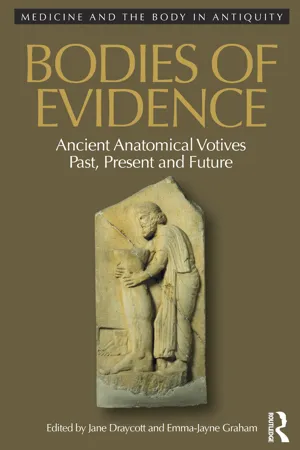
eBook - ePub
Bodies of Evidence
Ancient Anatomical Votives Past, Present and Future
- 344 pages
- English
- ePUB (mobile friendly)
- Available on iOS & Android
eBook - ePub
Bodies of Evidence
Ancient Anatomical Votives Past, Present and Future
About this book
Dedicating objects to the divine was a central component of both Greek and Roman religion. Some of the most conspicuous offerings were shaped like parts of the internal or external human body: so-calledanatomical votives. These archaeological artefacts capture the modern imagination, recalling vividly the physical and fragile bodies of the past whilst posing interpretative challenges in the present. This volume scrutinises this distinctive dedicatory phenomenon, bringing together for the first time a range of methodologically diverse approaches which challenge traditional assumptions and simple categorisations. The chapters presented here ask new questions about what constitutes an anatomical votive, how they were used and manipulated in cultural, cultic and curative contexts and the complex role of anatomical votives in negotiations between humans and gods, the body and its disparate parts, divine and medical healing, ancient assemblages and modern collections and collectors. In seeking to re-contextualise and re-conceptualise anatomical votives this volume uniquely juxtaposes the medical with the religious, the social with the conceptual, the idea of the body in fragments with the body whole and the museum with the sanctuary, crossing the boundaries between studies of ancient religion, medicine, the body and the reception of antiquity.
1 Corpora in connection
Anatomical votives and the confession stelai of Lydia and Phrygia
Justine Potts
Introduction: transgressing boundaries
Scholars of anatomical votives have, on the whole, been far less transgressive than those whose examples of wrongdoing and punishment were written up on stelai in Roman Asia Minor. Although the subject of anatomical votives has interested generations of historians, the most exciting anatomical votives are almost never mentioned in their discussions. These, I suggest, are the confession stelai of Lydia and Phrygia published (and numbered) as a corpus by Petzl in 1994 under their traditional genre-delineation of ‘Beichtinschriften’. The distinctive nature of their inscriptions, characterised by a confession which details wrongdoing or divine punishment or both, has caused the stelai to be circumscribed by their own strangeness. In no other context of Greco-Roman epigraphy are expiatory purposes so apparent. As a result of scholarly preoccupation with the peculiar, subsequent discourse has been constrained at least as much as it has been advanced by adherence to a corpus mentality. The purpose of this chapter is to suggest how by transgressing boundaries and by viewing some confession stelai as anatomical votives, there are significant implications for both corpora of material. On the one hand, the evidence suggests that there was a hierarchy of propitiatory epigraphy available to the transgressor, highlighting a previously underacknowledged expiatory motive behind anatomical votives. On the other, this study hopes to recalibrate our understanding of the confession stelai by showing that they were not the product of an isolated and archaic religious mentality which was distinct from that held by dedicants of what might be deemed ‘conventional’ anatomical votives in the same region. Rather, there seems to have been a shared cultural, material and intellectual milieu among the dedicants of the two corpora. This will suggest, in turn, that the dedication of confession stelai was determined not so much by a distinct, isolated and ‘un-Greco-Roman’ religious inclination, but rather by structural factors such as the circumstances of illness, the nature of the punishment, the conventions of the local sanctuary, financial means and even existential exigencies. Equally, if we accept Ricl’s (1995, p. 68) inference that confession was a Hittite hang-over in this region of Anatolia, the dedicants of anatomical votives may have been party to this inheritance more than is otherwise apparent. The confession stelai call into question the boundaries of the category we delineate as ‘anatomical votives’, demonstrating striking fluidity between two (modern) genres of epigraphic religious expression.
Incorporation
Around AD 235–236 a stele of white marble was inscribed with the narrative of a certain Theodorus. In direct speech he reveals that despite being a temple slave he had intimate assignations not only with a married woman in the temple courtyard, but also, on separate occasions, with two virgin priestesses. The gods’ displeasure at this profaning of the sacred is made clear, as a divine voice in the first person informs the reader that they punished Theodorus in his eyes ‘because of his wrongdoings’ (Petzl 5). Reconciliation seems to have been achieved eventually, as the divine concludes that the once-blinded Theodorus has made good his mistakes by propitiating the gods and erecting a stele on the appointed day. Glaring out at the admonished reader is a representation of a pair of eyes incised on the upper-right side of the stele next to a crescent moon, which is a symbol of the god Men. On another stele, a woman called Glykia declared that she was punished by the goddess Anaitis with an infliction on her bottom. It was as a result of this punishment that she set up the stele on which was carved a relief of a leg and buttock in profile in addition to the inscription (Petzl 75). We find another transgressor in the figure of Ammias who was ‘punished on her breasts because of a wrongdoing’ in the second century AD, and her stele bears two round breasts which represent the afflicted area (Petzl 95). These stelai and a number of similar ones are categorised as confession inscriptions because they conform to the general framework of wrongdoing, divine punishment, statement of transgression and erection of a stele that characterises the corpus, but this chapter will demonstrate that they should also be regarded as anatomical votives: textual elaboration is no grounds for their segregation.
The corpus referred to as the confession inscriptions of Asia Minor now includes around 150 documents, all stelai with two exceptions (a tablet: Petzl 96; a statue of Men: Petzl 67), dating mainly to the second and third centuries AD, with the earliest dated to AD 57–58 (Malay, 2003). The terminology used to refer to the corpus has been the subject of long debate.1 This chapter will continue to follow the convention of ‘confession’ stelai, although it is acknowledged that ‘confession’ is a loaded word, with Christian connotations that should not be imparted to the material. Contrary to terminological revisionists, however, it is my view that confession – by which I mean the verbalised acknowledgement of wrongdoing and culpability – should be emphasised as a central concept in our understanding of the inscriptions at least as much as reconciliation and propitiation have been. The term is not a misleading descriptor of those stelai which lack an explicit statement of the wrongdoing because a declaration of having received divine punishment was tantamount to an acknowledgment of culpability; the relative infrequency of verbs meaning ‘to confess’ in the corpus is no indication that the stelai in general should be regarded as any less concerned with confession (contra Rostad, 2002, p. 151; see Chaniotis, 2009, p. 135).
The majority of the inscriptions come from the Katakekaumene in northeastern Lydia, around the middle-upper Hermus basin, and were set up across a number of sanctuary sites to a range of gods. They have been found in the vicinities of a number of villages in Lydia and Phrygia, including Sardeis, Philadelphia, Tabala, Silandos, Thermai, Maeonia, Collyda, Tripolis, Saittai, Akmonia, Tiberiopolis, Eumeneia and Pergamum, although the precise nature and location of the originating Lydian sanctuaries remain obscure (Mitchell, 1993, p. 193). A significant group of inscriptions originates from the sanctuary of Apollo Lairbenos near Motella in Phrygia. This sanctuary has been partially excavated and is expected to yield yet more additions to the corpus (Ritti et al., 2000; Akıncı Őztűrk and Tanrıver, 2008; 2009; 2010). Events narrated in the confession inscriptions locate the stelai firmly in the context of divine justice familiar from other parts of the Greco-Roman world (Versnel, 1991; Parker, 1996, pp. 235–56; Chaniotis, 1997; 2004; 2009).2 Misfortune, often in the form of a physical malady, is felt to be a punishment from the gods for a transgression. As a key step in the process of propitiation (and thus healing), the transgressor, or their relatives, would erect a stele which commonly narrated the nature of the wrongdoing, the punishment inflicted and, occasionally, a confession of their wrongdoing in direct terms (as in Petzl 100, 106, 111 and 116). However, this was not an entirely autonomous response to physical affliction: some stelai tell us that the gods commanded the transgressors ‘to write up on a stele the powers of the gods’ (στηλογραφειν τὰς δυνάμεις τῶν Θεῶν) (see Petzl 3, 14, 33, 35, 37, 38, 39, 47, 55 and 69).
The act of stelographein was not just a matter of writing up a textual account on a stele; often that text was accompanied by images either incised or carved in relief.3 Although many of the stelai are fragmentary, images survive on roughly half of the corpus. Scholarship has tended to overlook these images and pursue a logocentric approach, attracted by the ‘otherness’ of the stelai’s textual content. 4 As strikingly different as the texts are from epigraphic religious testimonia known elsewhere in the Greco-Roman world, their images show them to be typically Anatolian in appearance and in the language of their iconographical presentation. By acknowledging both text and image on the stelai, a number of inscriptions emerge which can be classified as anatomical votives, albeit accompanied by an informative amount of textual detail that is unusual for anatomical votives as conventionally conceived. It tends to be the case that anatomical votives of the Greco-Roman world, if epigraphic at all, bear a relatively short and simple inscription. Typical Greek formulae include the name of the dedicant followed by the god to whom the votive was offered, accompanied by the word εὐχή (‘vow’, or ‘ex-voto’) in the accusative, although it could suffice to omit the verb ‘to dedicate’ or even to be anepigraphic altogether (such as the terracottas from the Asclepieion in Corinth: Roebuck, 1951, pp. 114–28). Occasionally the inscription might be lengthier if epithets of the gods are included, but detailed narratives of the sort found on the confession stelai are extremely unusual for anatomical votives as we know them. Textual elaboration stating a wrongdoing or the imposition of divine punishment has determined inclusion in the confession corpus. This not only brings into relief the arbitrary nature of modern genre construction, but also calls into question how distinct the intellectual world behind these two categories of inscriptions really was. A certain corpus mentality, together with logocentricity, has caused scholarship to underestimate the potential offered by considerations of epigraphic comparanda.
Although comparative observations between the corpora have been made, they have been of limited scope. Van Straten (1981, pp. 101–2, and nn. 40–8 in the appendix) highlighted a connection between anatomical votives and the confession stelai by including them in his catalogue of votive offerings representing parts of the human body. Belayche (2008, p. 182) also made the association by noting that text and image are combined in these inscriptions, just as they are in ‘les types traditionnels’ – that is, votives – of the area. Chaniotis (1995, p. 325) acknowledged that ‘vows and propitiatory inscriptions are closely related’, and Gordon (2004, p. 181) views them as ‘scarcely distinguishable’. Chaniotis (1995, p. 325) implicitly alludes to the classification of some stelai as ‘anatomical’ and, looking beyond the corpus to other epigraphic material for his study of illness and cures in the area, highlighted that both groups of texts could be dedicated to the same gods and could express similar religious sentiments.5 More recently he has also stated the importance of studying the confession stelai in close connection with dedications and vows, recognising that their appellation has drawn up ‘unnecessary boundaries’ (Chaniotis, 2009, pp. 117–18) and has asserted that complex processes of assimilation and cultural transfer are revealed by their texts (Chaniotis, 2009, p. 143). Nevertheless, the implications for how this might affect our understanding of both genres remain unexplored.
It should be noted that not all confession stelai can be classified unproblematically as anatomical votives. For instance, Petzl 4 is a stele dedicated ‘in thanksgiving’ by the foster daughters of Severus, who forbade the cutting of wreaths, an act which resulted in the god ‘inquiring after the wrongdoing’ (εὐχα- / ριστουσαι (ll. 8–9); ἐ- / πεζήτησεν ὁ θεὸς (ll. 4–5)). It is not made entirely explicit that Severus was punished, although the fact that his daughters are ‘giving thanks’ suggests he was punished and then cured. Moreover, the scene of the relief depicts the act of the wrongdoing: one man appears to prevent another from cutting down branches from a tree. Any anatomical overtones are therefore absent from this stele. Other stelai narrate events in a rather impersonal, factual manner, lacking the names of dedicants or culprits, such as Petzl 3 which is a third-person account of a cloak thief who was punished, returned the cloak and confessed. Stelai such as these, therefore, can less reasonably be categorised as anatomical votives, at least at the level of their presentation, although the following comparison of confession stelai and anatomical votives will prompt a reconsideration of how distinct in terms of function and dedicatory context Severus’s stele really was from that of a votive representing a body part. What is clear, despite sophisticated attempts to identify coherent patterns in the corpus (Gordon, 2004, pp. 177–96; Belayche, 2008), is the extent of variation in presentation among the stelai: there was no set blueprint for how to stelographein, and they appear to have been individually tailored.6 Unlike Severus’s stele, a substantial number are indeed explicitly anatomical in nature: the body part punished is specified in the inscription and/or represented by an accompanying image. It is this group that forms the focus of the present chapter.
The anatomical nature of inscriptions in the corpus of Anatolian confession stelai constitutes a significant point of divergence from the confession inscriptions from ancient South Arabia.7 No inscription of the latter provenance represents an image of the body part punished, despite the fact that the punishment was sometimes considered to take the form of a physical infliction: we hear of illness and death (Arbach and Audouin, 2007, YM 23643; Agostini, 2012, Y.03.B.A.1), and one god even ‘took vengeance’ on a transgressor’s molar teeth (Jamme, 1962, no. 702). The detachment and visual emphasis of a particular part of the body as a locus poenis is therefore, within the genre of confession texts, a peculiarly Anatolian phenomenon.
Comparing corpora and delineating delinquents
With a pair of breasts carved in relief above the inscription, confession stele no. 217 in Malay (1999, p. 176, hereafter Researches ) bears an inscription that reads: ‘Attikilla, who was punished on her breasts, set this up as an ex-voto with thanks to Thea Oline’ (Ἀττικίλλα κολ- / ασθῖσα μαστο- / ὺς Θεᾷ Ὀλινῃ εὐχὴ- / ν ἀνέστησεν). When this stele is compared with an anatomical votive from the Katekekaumene in Diakonoff’s catalogue of dedications to Artemis Anaitis (Diakonoff, 1979, no. 33), the layout and iconography of the two stelai are strikingly similar: the latter reads ‘Alexandra dedicates [this] ex-voto to Artemis Anaitis and Men Tiamou for her breasts’ (Ἀρτέμιδι Ἀναε[ίτι] / καὶ Μηνὶ Τιάμου ᾿Α[λε]- / ξάνδρα ὑπὲρ τῶν / [μ]αστῶν εὐχὴν / ἀνέστησαν), and a pair of breasts carved in relief is located above the inscription. What appears to make the former regarded as a confession inscription and the latter not is the detail that Attikilla evidently considers the physical affliction regarding her breasts to be a punishment. However, the absence of this detail on the ex-voto does not necessarily mean that Alexandra thought about her breast problem in different terms from Attikilla. The malady may nevertheless have been conceived of as a punishment, with Alexandra not expressing it in those terms, but by means of what might be considered a ‘conventional’ ex-voto formula.
A relief carving of a leg from mid-thigh to foot in a square niche is another image common to both anatomical ex-votos and anatomical confession inscriptions where the leg has been the ostensible target of divine punishment. In the corpus of inscriptions to Hosios and Dikaios there is a votive stele dedicated to the gods by Hermes and Meltine for their son Philippikos (Ricl, 1991, no. 8). Above the inscription is a leg in a niche carved in relief. This is almost identical in presentation to an image of a leg in a niche on a confession stele to ‘Zeus from Twin Oaks’ (Malay and Sayar, 2004), as well as to a relief on the confession inscription no. 66 in Herrmann and Malay (2007) and to Petzl 83. As a result the stelai are scarcely distinguishable in appearance from one another. Yet they differ on the textual level: the ex-voto describes itself as a εὐχὴ for the dedicants’ son, whilst the latter three bear detailed accounts of wrongdoing together with the gods’ commands to stelographein. In each case the image makes it clear that a leg has been afflicted with an illness, although none of the texts specify this.
Should some ex-votos, such as Researches no. 215, be set up alongside anatomical confession stelai, they would not seem out of place. Above the inscription of ‘Loukianos and Loukiane dedicated an ex-voto to Thea Meter Olline who is attentive to prayer’ is a relief of a leg from mid-thigh to foot (not in a niche) which resembles closely the representation of a leg on Petzl 70 (Figure 1.1). This confession stele is emphatically anatomical in its iconography: three different body parts are represented despite no punishment being specified in the text. This is one example of a number of stelai for which the image ‘fills in’ the detail and does a significant amount of the narrative work (for example Petzl 70, 78, 83, 90, 99, 102 and 110; New Documents no. 66; Malay and Sayar, 2004). As Belayche (2008, pp. 182–3) has argued, there exist different degrees of engagement with the narrative offered by representations of the body part. Some stelai specify in both text and image the afflicted body part, and so they are mutually supportive on both the visual and textual register (Petzl 5, 16, 50, 75 and 95; Researches no. 217; Akıncı Öztürk and Tanrıver, 2009, no. 2). Others specify in the text the body part punished but not in the image (Petzl 45, 49, 63, 69, 84, 85, 89 and 122; Petzl, 1997, no. 1; New Documents no. 84; Ricl, 1997 = CIG 4142), although in most of these cases the stele is too damaged to conclusively state that there was no accompanying image. However, the image was not there simply for narratological convenience. We should be aware that the representation of a body part was a means of reification, so that the body part itself was dedicated to the god by means of the εὐχὴ (ex-voto). Although to us images might be representation, to the dedicants of the stelai images were ‘presentation’ (Squire, 2009, p. 116; see also ...
Table of contents
- Cover
- Title
- Copyright
- Contents
- List of figures
- Notes on contributors
- Preface
- Abbreviations
- Introduction: Debating the anatomical votive
- 1 Corpora in connection: anatomical votives and the confession stelai of Lydia and Phrygia
- 2 Partible humans and permeable gods: anatomical votives and personhood in the sanctuaries of central Italy
- 3 Anatomical votives (and swaddled babies): from Republican Italy to Roman Gaul
- 4 Hair today, gone tomorrow: the use of real, false and artificial hair as votive offerings
- 5 Demeter as an ophthalmologist? Eye votives and the cult of Demeter and Kore
- 6 Wombs for the gods
- 7 Ritual and meaning: contextualising votive terracotta infants in Hellenistic Italy
- 8 The foot as gnōrisma
- 9 The open man: anatomical votive busts between the history of medicine and archaeology
- 10 Fragmentation and the body's boundaries: reassessing the body in parts
- 11 Votive genitalia in the Wellcome collection: modern receptions of ancient sexual anatomy
- 12 Votive futures: an afterword
- Bibliography
- Index
Trusted by 375,005 students
Access to over 1.5 million titles for a fair monthly price.
Study more efficiently using our study tools.
Frequently asked questions
Yes, you can cancel anytime from the Subscription tab in your account settings on the Perlego website. Your subscription will stay active until the end of your current billing period. Learn how to cancel your subscription
No, books cannot be downloaded as external files, such as PDFs, for use outside of Perlego. However, you can download books within the Perlego app for offline reading on mobile or tablet. Learn how to download books offline
Perlego offers two plans: Essential and Complete
- Essential is ideal for learners and professionals who enjoy exploring a wide range of subjects. Access the Essential Library with 800,000+ trusted titles and best-sellers across business, personal growth, and the humanities. Includes unlimited reading time and Standard Read Aloud voice.
- Complete: Perfect for advanced learners and researchers needing full, unrestricted access. Unlock 1.5M+ books across hundreds of subjects, including academic and specialized titles. The Complete Plan also includes advanced features like Premium Read Aloud and Research Assistant.
We are an online textbook subscription service, where you can get access to an entire online library for less than the price of a single book per month. With over 1.5 million books across 990+ topics, we’ve got you covered! Learn about our mission
Look out for the read-aloud symbol on your next book to see if you can listen to it. The read-aloud tool reads text aloud for you, highlighting the text as it is being read. You can pause it, speed it up and slow it down. Learn more about Read Aloud
Yes! You can use the Perlego app on both iOS and Android devices to read anytime, anywhere — even offline. Perfect for commutes or when you’re on the go.
Please note we cannot support devices running on iOS 13 and Android 7 or earlier. Learn more about using the app
Please note we cannot support devices running on iOS 13 and Android 7 or earlier. Learn more about using the app
Yes, you can access Bodies of Evidence by Jane Draycott, Emma-Jayne Graham, Jane Draycott,Emma-Jayne Graham, Jane Draycott in PDF and/or ePUB format, as well as other popular books in History & World History. We have over 1.5 million books available in our catalogue for you to explore.