- 182 pages
- English
- ePUB (mobile friendly)
- Available on iOS & Android
eBook - ePub
Aspects of British Music of the 1990s
About this book
The 1990s work of six British composers forms the focus of this collection of essays, arising from a conference that took place at University of Surrey Roehampton in February 1999. The composers whose music is discussed are James Dillon, Thomas Ad Harrison Birtwistle, Jonathan Harvey, Edwin Roxburgh and Sebastian Forbes. Reflecting the aims of the conference, this volume brings together composers and musicologists to discuss significant works from the last decade of the twentieth century, and also some of the wider issues surrounding British music. Arnold Whittall and Julian Johnson provide perspectives on the plurality of contemporary British music. Edwin Roxburgh offers a personal account of 'The Artists' Dilemma', whilst the essays that follow explore aspects of musical form and structure in a variety of works. The second half of the book comprises interviews with most of the composers whose music is discussed in Part I, adding a further dimension to our understanding of the preoccupations of British composition at the end of the twentieth century.
Information
PART I
ESSAYS
Chapter 1
James Dillon, Thomas Adès, and the Pleasures of Allusion
Arnold Whittall
The 1990s are still too recent for all but the most self-assured critic or musicologist to offer a confident assessment of compositional profit and loss. Talk of a decade which sustained or even enhanced the typically late-modern pluralism of the twentieth century’s last quarter may therefore be both premature and bland, but it is not necessarily misguided. For many close followers of the British scene, their most potent memories will be of a diversity vividly realized in the consolidation of three particular reputations: in order of age, Harrison Birtwistle, John Tavener and Mark-Anthony Turnage. The suggestion here of two wings and a centre can easily be fleshed out with other names – composers who can be made to fit into the avant-garde, minimalist and mainstream pigeonholes respectively. The outcome is a sense of a well-balanced variety, the extremes set off against the middle. But to deem this a healthy state of affairs is to risk accusations of complacency from those who think differently.
Musicologists with aspirations to double as cultural historians have long since latched on to the notion of the steady state, a circumstance in which late-modern pluralism waxes and wanes as various fashions come and go. The obvious dangers of steady states are predictability and monotony: and with late-modernism well established from at least the 1970s, it is not difficult to contrast what some will characterize as the wearily unnaughty 1990s with those deliciously naughty 1890s. Any attempt to argue that the 1990s was actually a rather satisfying and even an exciting decade can easily meet with derision from those with other axes to grind. But the supporters of a status quo expect to be derided as complacent or even corrupt by those who are passionately committed to an alternative attitude; and if you genuinely believe that the past is another country, the present boring and the future bleak, no composer and no commentator can prove you right or wrong. What composers and commentators can do is to use their narrower perspectives to explore different, less grandly synoptic or ideologically fraught agendas; and my agenda here is to explore two satisfying, even exciting British works for string quartet from the 1990s – the third quartet (1998) by James Dillon (b. 1950), and Arcadiana (1994) by Thomas Adès (b. 1971) – by means of a blend of formalist and hermeneutic interpretative strategies. These particular works may fret against the artificial boundaries of the well-balanced three-part model outlined in my first paragraph, but this need not require outright rejection of that schema. If it becomes a notional background rather than an all-determining foreground, its value might even be enhanced.
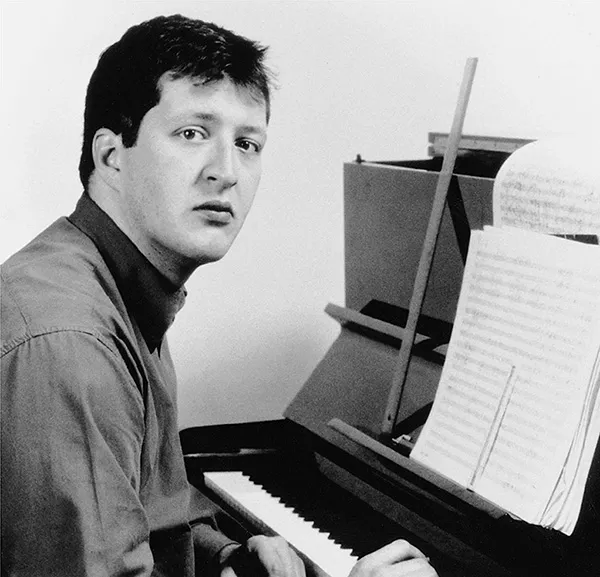
1 Thomas Adès
One important musicologist with her finger on the pulse of contemporary cultural practice, Rose Rosengard Subotnik, has commented on the recent tendency of musicology to move away from what she calls ‘technical descriptions and analyses toward images and analogies and ideas’, as part of ‘a massive process of western self-criticism’ whose ‘immediate target was not music; it was reason’.1 But many of us are perfectly happy to move self-critically towards ‘images, analogies and ideas’ as long as we can bring an element of technical description and analysis with us. It is not so much a matter of moving away from something as of placing that ‘something’ in a wider context, and this is one reason why the second part of my title is not, for example, ‘and the resonance of tonal models’.
Readers ‘in the know’ will suspect that reference to ‘the pleasures of allusion’ involves an element of ideological confrontation with ‘the anxiety of influence’. One of my objects is certainly to take issue with attempts, like those of the American musicologist Joseph Straus, to contextualize music analysis by reference to Harold Bloom’s neo-Freudian ideas about indebtedness, guilt and fear – or at least with attempts to replace all other interpretative strategies with just this, Bloomian, one:2 and I am aligning myself with the most rigorous and persuasive critique of that strategy yet published, by Richard Taruskin.3
Straus, following Bloom, defines ‘the anxiety of influence’ as ‘the ambivalence a poet may feel toward an overwhelming and potentially stultifying tradition’ – ‘a fear of being swallowed up or annihilated by one’s towering predecessors’.4 Put like this, the tone is indeed that of bargain-basement Freud, and Straus moves all too easily from the general to the particular, in which various kinds of references and allusions – for example, to Bach by Berg in his Violin Concerto – are characterized as ‘misreadings’. Taruskin’s view is not that Bloom’s theories and analytical techniques are a bad thing – rather that they are misrepresented, misread, in Straus’s work. Taruskin believes that the kind of overt modelling examined by Straus in the Berg example is a displacement of the true ‘anxiety of influence’, and he feels that Straus is a more convincing Bloomian when, for example, he considers Stravinsky’s veiled appropriation of aspects of Chopin’s second Ballade in the first movement of the Serenade in A.
My problem with this is my problem with all ideas about influences as things which can be definitively identified, the layers of deceptive originality stripped away to reveal the naked, shivering model beneath. If, as Taruskin declares, ‘a strong misreader irrepressibly represses the old to produce the new’,5 that process of repression involves the composer in such an intimate and intricate relationship with the past that direct representations of materials from the past will be notable for their absence, and ultimately inaccessible to analysis. Of course, we can indulge in as much informed speculation about sources and influences as we like, and it seems to me that far too much valuable musicological time is devoted to doing just that.
Taruskin also objects that Straus’s misreading of Bloom leads him to propose an essentially ‘decorous model’ of influence, ‘centering not on uncontrollable belligerent contest’ as Bloom argues, ‘but on voluntary, benign submission, described by T.S. Eliot as the poet’s “surrender of himself ... to something which is more valuable”’.6 It might appear that what I am calling the pleasure of allusion is precisely this more decorous model of influence. But that is not quite the case. My own view is that, when Thomas Adès alludes to Mozart, Schubert and, possibly, Elgar in the movement titles of his Arcadiana, he is not ‘doing an Eliot’ and surrendering himself to something he sees as more valuable, more venerable, than his own creativity. In my judgement (Adès might tell us differently, of course) he makes these references, these allusions, without any hang-ups, because he finds it pleasurable to do so; and (I presume) he hopes that listeners will share that pleasure. Anxiety, fear, guilt or even reverence, have nothing to do with it; nor do I believe that Adès is allowing certain associations to be evident the more deviously to suppress the ones which really matter. Similarly, the possible – and possibly ironic – allusions in Dillon’s third quartet to the multi-movement ‘symphonic’ tradition of the genre which culminated in Bartók can be deemed both playful and aggressive, but guilt or fear in face of such hallowed but redundant traditions play no part in Dillon’s virtuosic ‘misreading’.
Bloomians cannot escape the simplistic binary oppositions that stem from their hero’s thinking. What, for example, are we to make of the assertion that ‘to read is to be dominated; to misread is to assert one’s own priority’?7 It seems to me that composers are far more likely to be motivated by a mixture of contrasting and competing impulses, and while anxiety may certainly be a part of the creative process – concern about what certain things will actually sound like, whether they will work, whether the audience will get the point – the predominant reason for composing is that it satisfies the desire for communication through self-expression. Without wishing to yield totally to the aura of Roland Barthes and those who concern themselves with ‘the pleasure of the text’,8 it must surely be conceded that creating a text satisfies desire and causes pleasure – to the creator, if to no one else? I should add at this point that I myself take pleasure in not using the term ‘allusion’ in its narrowest, most precise sense as ‘passing or indirect reference’. As I use it here, ‘allusion’ stands for a rich range of procedures from passing, elusive hints, to explicit, extended references and even quotations. What links these procedures is the multivalence of their reception, the probability that they will mean different things to everyone who is aware of them.
Neither James Dillon nor Thomas Adès can exactly be accused of favouring essentially English rather than more cosmopolitan musical aesthetics. But this does not mean that concepts involving nationality are irrelevant to their work. Dillon was born and educated (partly) in Scotland, and earlier commentators duly accorded him ‘outsider’ status, noting the element of ‘sheer aggression’ as well as ‘a sense of struggle, of wrestling with intractable material’ which suggests Varése and even Beethoven as ‘obvious’ ancestors.9 In his characteristically penetrating discussion Richard Toop does not pursue the modernist/classical dialectic implied by this comparison, but hints instead at a distinction between Northern intransigence and the ‘unusually Mediterranean opulence’ of helle Nacht (1986–87).10 This is especially resonant, given the way in which Toop’s dialogue with Dillon moves on to identify the absence of ‘mediation’ – the ‘abruption’ – they admire in Xenakis.11 Eventually, this idea transmutes into ‘this kind of moment when things are between order and disorder’, another elementally modernist perception, ultimately deriving from ‘this whole problem, that we grapple with in music, between difference and invariance’.12 The tension between tendencies not only to promote synthesis but also to reject it might therefore be one of the defining factors of the way in which Überschreiten (1986) reflects its Rilke-inspired preoccupation with ‘fusion of the organic and the transcendental’ alongside that ‘dissident ... excess, rebellion and transgression in the face of order’ which are no less salient.13
Such matters are the common currency of critical attempts to place a composer who struggles with ‘this notion of cohesion’,14 and who acknowledges essential aspects of tradition only to challenge them: thus, in the first quartet (1983) ‘I wanted to create a kind of notion of directionality in terms of discontinuities ... I was maintaining the notion of a traditional narrative, but ... through disruption rather than through continuity’.15 Another version of the same concept appears in Dillon’s unpublished notes on Introitus (1989–90), one of the Nine rivers pieces, which draws attention to the opposition between ‘river’ as something that flows and ‘river’ as someone who disrupts. That the alternative dialectic involving the modernist/classical (Varése/Beethoven) opposition might nevertheless remain relevant is suggested by Dillon’s preference for textures dominated by homogeneities which ‘may be resisted, but ... are ultimately reinforced’.16 However, such reinforcement has little or nothing to do with classical notions of resolution, just as Dillon’s acknowledgement of nationality has little or nothing to do with quoting folk or folk-like material. It all comes down to persistent instability. As Dillon has said, ‘if you live on the west coast of Scotland, it is impossible to have a rosy view of nature: it’s forever in flux’.17 Dillon’s music shuns the kind of unmediated references to Scottish musical topics found in such Scottish or Scotland-based composers as James MacMillan and Peter Maxwell Davies. What can be found – in the case of the third string quartet, in particular – is music whose arsenal of allusion is less explicit, but, I would argue, no less fundamental, and can be traced at core to a kind of confrontation between cultivated and popu...
Table of contents
- Cover Page
- Half title
- Title Page
- Copyright
- Contents
- List of Figures
- List of Illustrations
- List of Music Examples
- Notes on Contributors
- Acknowledgements
- Introduction
- PART I: ESSAYS
- PART II: INTERVIEWS
- Index
Trusted by 375,005 students
Access to over 1.5 million titles for a fair monthly price.
Study more efficiently using our study tools.
Frequently asked questions
Yes, you can cancel anytime from the Subscription tab in your account settings on the Perlego website. Your subscription will stay active until the end of your current billing period. Learn how to cancel your subscription
No, books cannot be downloaded as external files, such as PDFs, for use outside of Perlego. However, you can download books within the Perlego app for offline reading on mobile or tablet. Learn how to download books offline
Perlego offers two plans: Essential and Complete
- Essential is ideal for learners and professionals who enjoy exploring a wide range of subjects. Access the Essential Library with 800,000+ trusted titles and best-sellers across business, personal growth, and the humanities. Includes unlimited reading time and Standard Read Aloud voice.
- Complete: Perfect for advanced learners and researchers needing full, unrestricted access. Unlock 1.5M+ books across hundreds of subjects, including academic and specialized titles. The Complete Plan also includes advanced features like Premium Read Aloud and Research Assistant.
We are an online textbook subscription service, where you can get access to an entire online library for less than the price of a single book per month. With over 1.5 million books across 990+ topics, we’ve got you covered! Learn about our mission
Look out for the read-aloud symbol on your next book to see if you can listen to it. The read-aloud tool reads text aloud for you, highlighting the text as it is being read. You can pause it, speed it up and slow it down. Learn more about Read Aloud
Yes! You can use the Perlego app on both iOS and Android devices to read anytime, anywhere — even offline. Perfect for commutes or when you’re on the go.
Please note we cannot support devices running on iOS 13 and Android 7 or earlier. Learn more about using the app
Please note we cannot support devices running on iOS 13 and Android 7 or earlier. Learn more about using the app
Yes, you can access Aspects of British Music of the 1990s by Peter O'Hagan in PDF and/or ePUB format, as well as other popular books in Media & Performing Arts & Music. We have over 1.5 million books available in our catalogue for you to explore.