- 119 pages
- English
- ePUB (mobile friendly)
- Available on iOS & Android
eBook - ePub
About this book
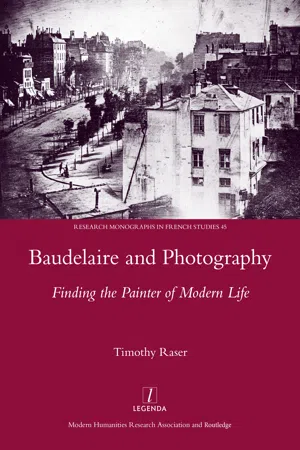
While Baudelaire's 'Le Peintre de la vie moderne' is often cited as the first expression of our theory of modernism, his choice of Constantin Guys as that painter has caused consternation from the moment of the essay's publication in 1863. Worse still, in his 'Salon de 1859', Baudelaire had also chosen to condemn photography in terms that echo to this day. Why did the excellent critic choose a mere reporter and illustrator as the painter of modern life? How could he have overlooked photography as the painting of modern life? In this study of modernity and photography in Baudelaire's writing, Timothy Raser, who has written on the art criticism of Baudelaire, Proust, Claudel and Sartre, shows how these two aberrations of critical judgment are related, and how they underlie current discussions of both photography and modernism. Timothy Raser is Professor of French at the University of Georgia (USA).
Information
CHAPTER 1
Introduction
How could Baudelaire have been so wrong? The question is a silly one, even a stupid one, but it comes back persistently in different forms for readers of his art criticism. If Baudelaire’s art criticism is read today, it is above all for his late essay, Le Peintre de la vie moderne, published in 1863. There he elaborates a concept of modernity that has elicited discussion for a century and a half, and it has even been said that Baudelaire’s essay defines modernity. Baudelaire chose however to refer in his essay to the works of a ‘M. G.’, an initial that in earlier versions of the essay as well as within the published essay points to Constantin Guys, a draughtsman for the Illustrated London News. The reference has caused consternation ever since the essay was published: why did Baudelaire choose an unknown artist working for an English publication, whose works were visible mainly as engravings in the paper; why did he choose Guys as his ‘painter of modern life?’ The question arises in many forms. It comes up when Timothy Clark entitles his study of the Impressionists The Painting of Modern Life; it occurs when Paul de Man reads Baudelaire’s essay as an allegory of writing, and again when the editors of a collection of Walter Benjamin’s essays use the title The Writer of Modern Life. All of these responses push Constantin Guys into the background. Other writers simply replace Guys with other, ‘better’ artists, and here Édouard Manet is the favorite: Anne Coffin Hanson applies Baudelaire’s definition of modernity to Manet’s works, while Pierre-Georges Castex goes as far as to correct the poet’s mistake:
Le peintre complet de la vie moderne ne saurait s’identifier à un interprète de mode, même heureusement inspiré. Sans doute Baudelaire aurait-il pu trouver une matière plus riche, sinon pour une analyse de la modernité au sens où il entendait cette notion, du moins pour une analyse du génie moderne en peinture, dans les œuvres d’Édouard Manet.1
[The complete painter of modern life cannot be identified with a fashion-artist, even an inspired one. Certainly Baudelaire could have found richer material, if not for an analysis of modernity in the meaning which he grants to this notion, at least for an analysis of the modern genius in painting, in the works of Édouard Manet.]
So Baudelaire erred by naming Guys ‘le peintre de la vie moderne’, as well as by failing to recognize Manet as a more worthy bearer of that title. Is that all? As it happens, Baudelaire also missed the development of photography, which was going to fill Guys’s job in the decades after his death. But not simply did Baudelaire fail to see that photography was going to do what Guys was doing — recording modern life as it happened — he condemned the medium in terms that make his very few comments on it anthology-pieces found in histories of photography as evidence of the hostile reaction that the new process encountered in the first decades of its existence. The overlap between his praise of Guys and his condemnation of photography shows up occasionally, when acute readers of Baudelaire place the latter in the former essay, or vice versa. This is the case, for example, of Gisèle Freund, a friend of Walter Benjamin’s who cites Baudelaire’s Le Peintre de la vie moderne but refers her citation to the Salon de 1859 as if that were the source.2 Likewise, Antoine Compagnon in his Baudelaire l’irréductible speaks of ‘le chapitre sur la photographie du Peintre de la vie moderne’ [the chapter on photography from Le Peintre de la vie moderne].3
More generally, there now exists an overlap between photography and flânerie, the former abhorred by Baudelaire, the latter adored. In On Photography, for instance, Susan Sontag cites the Baudelairian figure of the flâneur as a model for the photographer: ‘The flâneur is not attracted to the city’s official realities but to its dark seamy corners, its neglected populations — an unofficial reality behind the façade of bourgeois life that the photographer “apprehends”, as a detective apprehends a criminal’.4 The flâneur is indeed a prototypical figure for the poet, but when he appears at length, discovering the seamy side of the Second Empire’s bourgeois dream, it is in Le Peintre de la vie moderne,5 and this conflation of him with photographers overlooks Baudelaire’s explicit link of flânerie with engraving: ‘Delâtre me prie de faire un texte pour l’album [of Meryon’s etchings]. Bon! voilà une occasion d’écrire [...] les rêveries philosophiques d’un flâneur parisien’6 [Delâtre is asking me to do a text for an album (of Meryon’s etchings). Great! Here’s an occasion to write...the philosophical reveries of a Parisian flâneur]. More recently still, and still further from Baudelaire, Edmund White takes Eugène Atget as the very model of the flâneur, even if he ‘carried his tripod, view camera and glass plates everywhere with him’,7 a load that makes flânerie a rather strenuous activity.
This study is a response to these two ‘errors’: Baudelaire’s designation of Constantin Guys as the painter of modern life, and his condemnation of photography. Both are from 1859, the year James R. Lawler has designated as the poet’s ‘miracle year’.8 The condemnation of photography is to be found in his Salon de 1859, and Le Peintre de la vie moderne, although only published in 1863, was first conceived in 1859 and its composition could have occurred at any point between those two dates.
What does it mean to say that Baudelaire erred? First and foremost, it means that his judgements are central to his art criticism, and that theories and descriptions are secondary. So to say that Baudelaire got it wrong is to say that someone else — Baudelaire’s critic, presumably — got it right, and that despite the fact that, as Kant so nicely put it, a judgement in matters of aesthetics ‘has often enough to put up with a rude dismissal of its claims to universal validity’.9 To fault Baudelaire is thus to take his aesthetic judgements seriously, too seriously, perhaps, and likewise to take our own without the grain of salt that opposing opinions provide. At the very least, the argument about the true subject of Le Peintre de la vie moderne should warn of the perils of aesthetic judgement.
Baudelaire however did take such judgements seriously and his readers cannot ignore them. What one can do, given the opposition his endorsements and exclusions have created, is ask why he chose to write art criticism, and what he wanted to accomplish by writing it. From the very first of his art-critical essays, Baudelaire sought to do something that bears little resemblance to the assertions of one’s taste over someone else’s: discover an artist — a painter — around whom he could elaborate a theory not of beauty, but of modernity. From his first essays on, Baudelaire is interested in painters who seize the moment, whose work is more like discovery than representation, who show something unknown and perhaps unknowable.
It is hardly novel to say that Baudelaire’s writings exhibit a tension between two poles: his art criticism nonetheless, which began as a search for beauty, finishes as an articulation of modernity, over a trajectory where the poet’s concern with beauty declines as his interest in modernity grows. It is clear though that something happened in 1859 that caused him to rethink his search for beauty: this is the year during which he sees Charles Meryon’s engravings; the year when he sends three magnificent poems to Victor Hugo, dedicating them to him, but also sends him a page of his art criticism, the one describing Meryon’s etchings. Later in that year, he talks of meeting Constantin Guys.
It must not be forgotten that both Guys’s and Meryon’s works used mechanical means of reproduction, and in that are opposed to the one-of-a-kind pieces that commanded large sums at the yearly Salon. Perhaps he has become convinced that cheaper, printed images are the way of the future; perhaps he sees for images what happened to words with the invention of the printing press: durability ensured by multiplicity, not solidity. Whatever the case, though, his Salon de 1859 is where he advances his theory of the imagination, and it is also where he condemns photography. Very broadly, the value he finds in imagination is projective, forward-moving and anticipatory, while the defect of photography is that it is static and repetitive.
His characterization of photography will touch discussions for more than a hundred years: well into the second half of the twentieth century, arguments have surrounded photographs asserting, very broadly again, either that photographs are like paintings — single works, one-offs — or that they are like printed words — indefinitely repeatable, having no special relation with what they designate. Baudelaire clings to the second of these views, and further, sees it as a failing.
Beyond Baudelaire’s ‘error’ in assessing the value of photography, what calls out for comment is the ferocity of his denunciation of the process: he reverts to a religious discourse, and pronounces it anathema, like a pontiff excluding a sinner from the fold of the faithful. The binary structure of his condemnation invites comparison to other extreme reactions, and it appears here that Baudelaire’s reaction is hostile because photography does exactly what his new poetics would have him do: create ‘Tableaux parisiens’.
Why hasn’t this subject been studied? In fact, it has, but unlike other topics to which Baudelaire put his hand, the very few pages that he wrote on photography have been read as though their meaning were clear and simple.10 There are several reasons for this. In the years following the publication of his Salon de 1859, his comments were similar in their content and their tone to many other writers on the subject, for whom photography was a way of producing bad images, but more seriously, a way of meddling in God’s monopoly on exact likenesses. As photography came to be recognized as an art, it became expedient to dismiss Baudelaire’s thoughts on it as an embarrassing faux pas. Here the motivation is twofold: if the passages consist above all in a judgement, and if that judgement is wrong, it is best to ignore them, for to say that Baudelaire could be wrong in his judgements would also imply that we could be wrong in ours, and that would not do. To say that he was right, on the other hand, or that he was prescient, would be to deny the fact of photography’s success, and that would not do either. Better then to ignore what Baudelaire said, especially if, as it is the case, the Salon de 1859 offers something that can be glossed at length, namely his theory of imagination.
The list of readers who saw in Baudelaire’s comments only condemnation of photography is an illustrious one: Walter Benjamin opposes Baudelaire to the forgotten Antoine Wiertz, who for his part predicted that photography would change the world.11 At the same time as Benjamin’s Short History of Photography, Eni...
Table of contents
- Cover Page
- Title Page
- Copyright Page
- Contents
- Acknowledgements
- List of Illustrations
- List of Abbreviations
- Prologue: Baudelaire before Neyt
- 1 Introduction
- 2 Catlin and Baudelaire: Another World
- 3 The Concept of Imagination in Baudelaire’s Salon de 1859
- 4 The Appeal of Absence: Meryon and Hugo
- 5 The Status of Modernity in Baudelaire’s Art Criticism
- 6 Modernity as the Way Out of Baudelaire’s Impasse
- 7 Introduction
- 8 The Blindness of Reference
- 9 Baudelaire’s Photographic Legacy
- Epilogue A Photograph of His Mother
- Appendices
- Bibliography
- Index
Trusted by 375,005 students
Access to over 1.5 million titles for a fair monthly price.
Study more efficiently using our study tools.
Frequently asked questions
Yes, you can cancel anytime from the Subscription tab in your account settings on the Perlego website. Your subscription will stay active until the end of your current billing period. Learn how to cancel your subscription
No, books cannot be downloaded as external files, such as PDFs, for use outside of Perlego. However, you can download books within the Perlego app for offline reading on mobile or tablet. Learn how to download books offline
Perlego offers two plans: Essential and Complete
- Essential is ideal for learners and professionals who enjoy exploring a wide range of subjects. Access the Essential Library with 800,000+ trusted titles and best-sellers across business, personal growth, and the humanities. Includes unlimited reading time and Standard Read Aloud voice.
- Complete: Perfect for advanced learners and researchers needing full, unrestricted access. Unlock 1.5M+ books across hundreds of subjects, including academic and specialized titles. The Complete Plan also includes advanced features like Premium Read Aloud and Research Assistant.
We are an online textbook subscription service, where you can get access to an entire online library for less than the price of a single book per month. With over 1.5 million books across 990+ topics, we’ve got you covered! Learn about our mission
Look out for the read-aloud symbol on your next book to see if you can listen to it. The read-aloud tool reads text aloud for you, highlighting the text as it is being read. You can pause it, speed it up and slow it down. Learn more about Read Aloud
Yes! You can use the Perlego app on both iOS and Android devices to read anytime, anywhere — even offline. Perfect for commutes or when you’re on the go.
Please note we cannot support devices running on iOS 13 and Android 7 or earlier. Learn more about using the app
Please note we cannot support devices running on iOS 13 and Android 7 or earlier. Learn more about using the app
Yes, you can access Baudelaire and Photography by Timothy Raser in PDF and/or ePUB format, as well as other popular books in Languages & Linguistics & Languages. We have over 1.5 million books available in our catalogue for you to explore.