eBook - ePub
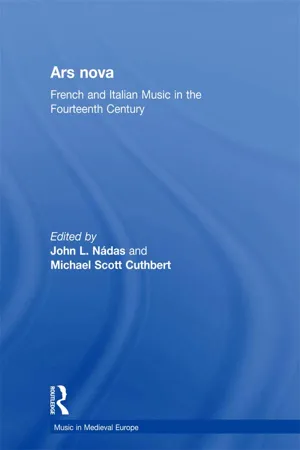
Ars nova
French and Italian Music in the Fourteenth Century
- 594 pages
- English
- ePUB (mobile friendly)
- Available on iOS & Android
eBook - ePub
About this book
In the early fourteenth century, musicians in France and later Italy established new traditions of secular and sacred polyphony. This ars nova, or "new art," popularized by theorists such as Philippe de Vitry and Johannes de Muris was the among the first of many later movements to establish the music of the present as a clean break from the past. The rich music of this period, by composers such as Guillaume de Machaut and Francesco Landini, is not only beautiful, but also rewards deep study and analysis. Yet contradictions and gaps abound in the ars nova of the fourteenth and early fifteenth centuries-how do we read this music? how do we perform this music? what was the cultural context of these performances? These problems are well met by the ingenuity of approaches and solutions found by scholars in this volume. The twenty-seven articles brought together reflect the broad methodological and chronological range of scholarly inquiry on the ars nova.
Information
Part I
Periodization and Boundaries
[1]
Novelty and Renewal in Italy, 1300–1600*
The New Star
Words change their meaning according to the different goals at which they are aimed and the different contexts in which they are used. I wonder what “tradition” means when applied to a short-lived phenomenon for which neither direct antecedent nor direct consequence is known? The music of the Italian Ars nova (I have not given up that expression) appears to have been the equivalent of a nova in the historical firmament: a sudden flash, a short period of brilliance, and a sudden decline. Watching it from light-years of historical distance, we are left to guess what may have been in the darkness before and after that flamboyance.
Tradition derives from tradere, we have been recently reminded, yet it is most often used to designate not the action of the verb but its object—whatever is handed down by an older generation and selectively received by a younger one (although such abstractions as “generations” or “layers” of tradition should not be taken too much for granted). I do not object to this transfer of meaning, which is a common procedure of language, but I find it more expedient, in dealing with the Italian Ars nova, to focus on the act itself of tradere.
The music of the Ars nova was bound, by its polyphonic nature, to rely on a written tradition, of which six major manuscripts have reached us, plus a number of fragments.1 Without trying to give them more precise dates (a subject on which I do not always agree with some of my colleagues), it is safe to say that only one large source (represented by the Vatican and Ostiglia fragments) belongs to the fourteenth century. Two others (the so-called Reina and Panciatichi codices) originated about the end of that century. The rest all belong to the first two or three (or even four) decades of the fifteenth century, the final phase of the Ars nova. Geographically, the sources are clearly divided into a Florentine group and a group from northern Italy.
The beauty, size, and numerical predominance of the Florentine group, essentially represented by four complete and meticulously preserved manuscripts, induced the scholars who first dealt with the Ars nova to assign to Florence a leading role, a role I have tried to deny, only to revert in recent years to a more cautious and qualified recognition of Florentine merits. Indeed, the numerical predominance of the Florentine sources has been eroded and finally erased by new findings. As of now the northern representation has been enlarged by a host of fragments, some of which outline the profile of at least three large disbanded sources to be added to the two collections already known (the Reina and Modena manuscripts). More important, Florentine music is practically ignored by the northern sources, with the exception of a few works apparently composed in northern Italy by such migrant Florentines as Giovanni da Firenze and Francesco Landini; on the other hand, all Florentine sources are generous in giving place to the leading composers in the north, Iacopo da Bologna and Bartolino da Padova. These facts explain how I may have been tempted to see a strictly local phenomenon in the Florentine polyphony. They do not, however, tell the whole story; other elements need to be taken into consideration before passing judgment on the relative merits of the two branches of the Ars nova tradition.
The northern sources include both secular and sacred pieces, and works with Latin and vernacular texts. They appear to have been formed by accumulation over a relatively short period of time, collecting works of immediate interest to the scribes or owners either for performance or as models. That is to say, they are repertories reflecting the interests of a certain place at a certain time. The Florentine manuscripts, on the other hand, contain almost exclusively secular pieces with vernacular texts and strive in varying degree toward a pattern of organization grouping their contents by composers and, in a way, by genres. In spite of inconsistencies in the realization, their plan usually gives precedence to the older genres of the madrigal and caccia, represented by works of the two older masters (Iacopo da Bologna and Giovanni da Firenze) and of a slightly younger group (Gherardello, Lorenzo, Donato, all Florentines); then the composers are entered who also practiced the younger genre of the polyphonic ballata, and finally those (including Landini) who were mainly known for their polyphonic ballata.2 With growing clarity and thoroughness, the Florentines aimed to give a retrospective view of music and of poesia per musica between roughly 1340 and 1415. For the sake of completeness they included the major northern masters, while the northern scribes included Florentine works in their manuscripts only for pragmatic reasons of immediate relevance. Neither branch of the written tradition, however, tells us anything about the origins of the Ars nova, because even the history-minded Florentines were interested only in its ripest fruit.
Older theoretical writings, documents, and sparse polyphonic samples (all of which have been reviewed and increased by Kurt von Fischer) indicate that Italy very early adopted the time-honored practice of church polyphony. As early as the first half of the thirteenth century, we also have lively descriptions of Franciscan friars entertaining themselves with the singing of polyphonic pieces which must have resembled French conductus; according to the same source, the chronicle of Salimbene de Adam, secular clergy indulged in similar amusements. Conductus style seems to have left its mark in the strong tendency of Italian Ars nova polyphony toward all-vocal performance and simultaneous delivery of text in the two (seldom three) parts. Yet the possibility exists of a concomitant derivation from organal clausulae: a clausula, provided with words, became the matrix of a song, called after it a carmen matricale. Whether or not these conjectures are correct, the practice from which the Ars nova derived must have existed long before the fourteenth century; already at the beginning of that century the madrigal (matriale in Tuscany, maregal or madregal in the Venetian region) had become an independent composition on vernacular text, and the original meaning of its name had been completely forgotten. Furthermore, a special system of notation (related to, but somewhat different from the contemporary French usage) had been developed, which gave equal status to binary and ternary rhythms independently of the theories of Vitry and Muris; it was described by Marchettus de Padua in his “Pomerium,” circa 1320.
We begin to understand the bias of the later Florentine scribes when we see that the earliest references to the madrigal are tinged with contempt. Francesco da Barberino describes it (circa 1313) as rudium inordinatum continuum; as a literary man he may have objected to the poetry, humble in content (pastoral?) and lacking a definite metrical rule.3 A few years later a treatise on vernacular poetry (circa 1332) by the Paduan judge Antonio da Tempo explained that the “mandrigal” (taking its name from mandria) was formerly a shepherd’s song, ennobled only recently by courtly polyphonic practice. However, the examples of madrigal texts offered by da Tempo had not yet attained the metrical form which later came to prevail; nor is it possible to recognize any formal or metrical rule unifying the pieces in the oldest known source of Ars nova music—the above-mentioned Vatican and Ostiglia fragments—a source in which a practice connected with the court of the Scaligeri of Verona is reflected. Such works or their contemporaries do not appear in the late Florentine sources, and similarly excluded are those of a Maestro Piero, who seems to have been the main creator of the genre of the caccia, a derivation from and specialization of the madrigal form.4
We begin also to realize the fallacy of a unilateral approach based on our experience of music and poetry as independent activities that converge only occasionally. Literature may have provided the impetus which raised the music of a private clerical entertainment to the status of a new art. I have come to think that the rise of the Ars nova was favored by the trends of the dolce stil novo—not, of course, by the “tragic” style assigned by Dante to the canzone (which rapidly became a purely literary form), but by the “mediocre” style of the ballata, enhanced by the poets with all sorts of refinements, to which a similar demand for musical refinement must have corresponded. Most influential (at the time and for the future) was the acknowledgment by Petrarch of the madrigal as an art form; the four madrigals he included in his Canzoniere are models of artful variety in the order of rhymes. For one of them we have the music set by lacopo da Bologna, who was active in Milan from the late 1330s to the 1350s, during which period Petrarch had strong ties with the Milanese court and sojourned in Parma and Milan.5 A personal relationship is highly probable, but Petrarch’s influence was also strongly felt in Florence by poets like Soldanieri, Boccaccio, and Sacchetti, who all contributed texts for the Ars nova composers.
Nor were the musicians merely passive. For one thing, they must have been the authors of many of the texts they set to music (as poets such as Petrarch and Sacchetti are known to have had musical gifts). More important, the earliest-known composers, lacopo and Giovanni, highly deserved the distinction of being singled out as the “classics” of the Ars nova. lacopo’s skillful control of polyphonic devices and his contrapuntal lines, sharpened with great variety of detail, embody the taste of the northern polyphonists for figuration and contrast.6 Even lacopo, however, seems to have derived the overall design of his works from Florentine examples, accessible to him through his personal contacts with Giovanni in Verona and possibly also in Milan. With softer, placidly flowing lines, Giovanni and the Florentines placed the accent on clear definition of each musical phrase (corresponding to a line of text) and on its relationship to the overall musical design. They thus arrived at a balanced strophic structure, based on the optimum number of three phrase-lines, and sealed, after two or three repetitions, by a two-line ritornello, in which the real thrust of the short poem found its expression. Most often this heightened meaning was stressed in the music of the ritornello with a sudden change of rhythm and tonality. It is thus apparent that t...
Table of contents
- Cover
- Half Title
- Title Page
- Copyright Page
- Table of Contents
- Acknowledgements
- Series Preface
- Introduction
- Part I Periodization and Boundaries
- Part II Sources
- Part III Music Theory
- Part IV Composers
- Part V Literary Studies
- Part VI Secular Song
- Part VII Sacred Music
- Part VIII Motets
- Part IX Performance Practice
- Index
Trusted by 375,005 students
Access to over 1.5 million titles for a fair monthly price.
Study more efficiently using our study tools.
Frequently asked questions
Yes, you can cancel anytime from the Subscription tab in your account settings on the Perlego website. Your subscription will stay active until the end of your current billing period. Learn how to cancel your subscription
No, books cannot be downloaded as external files, such as PDFs, for use outside of Perlego. However, you can download books within the Perlego app for offline reading on mobile or tablet. Learn how to download books offline
Perlego offers two plans: Essential and Complete
- Essential is ideal for learners and professionals who enjoy exploring a wide range of subjects. Access the Essential Library with 800,000+ trusted titles and best-sellers across business, personal growth, and the humanities. Includes unlimited reading time and Standard Read Aloud voice.
- Complete: Perfect for advanced learners and researchers needing full, unrestricted access. Unlock 1.5M+ books across hundreds of subjects, including academic and specialized titles. The Complete Plan also includes advanced features like Premium Read Aloud and Research Assistant.
We are an online textbook subscription service, where you can get access to an entire online library for less than the price of a single book per month. With over 1.5 million books across 990+ topics, we’ve got you covered! Learn about our mission
Look out for the read-aloud symbol on your next book to see if you can listen to it. The read-aloud tool reads text aloud for you, highlighting the text as it is being read. You can pause it, speed it up and slow it down. Learn more about Read Aloud
Yes! You can use the Perlego app on both iOS and Android devices to read anytime, anywhere — even offline. Perfect for commutes or when you’re on the go.
Please note we cannot support devices running on iOS 13 and Android 7 or earlier. Learn more about using the app
Please note we cannot support devices running on iOS 13 and Android 7 or earlier. Learn more about using the app
Yes, you can access Ars nova by John L. Nádas,Michael Scott Cuthbert in PDF and/or ePUB format, as well as other popular books in Media & Performing Arts & World History. We have over 1.5 million books available in our catalogue for you to explore.