- 452 pages
- English
- ePUB (mobile friendly)
- Available on iOS & Android
eBook - ePub
Aspects of the Secular Cantata in Late Baroque Italy
About this book
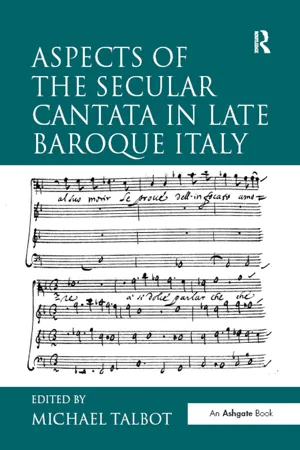
As shown by the ever-increasing volume of recordings, editions and performances of the vast repertory of secular cantatas for solo voice produced, primarily in Italy, in the second half of the seventeenth century and the first half of the eighteenth century, this long neglected genre has at last 'come of age'. However, scholarly interest is currently lagging behind musical practice: incredibly, there has been no general study of the Baroque cantata since Eugen Schmitz's handbook of 1914, and although many academic theses have examined microscopically the cantatas of individual composers, there has been little opportunity to view these against the broader canvas of the genre as a whole. The contributors in this volume choose aspects of the cantata relevant to their special interests in order to say new things about the works, whether historical, analytical, bibliographical, discographical or performance-based. The prime focus is on Italian-born composers working between 1650 and 1750 (thus not Handel), but the opportunity is also taken in one chapter (by Graham Sadler) to compare the French cantata tradition with its Italian parent in association with a startling new claim regarding the intended instrumentation. Many key figures are considered, among them Tomaso Albinoni, Giovanni Bononcini, Giovanni Legrenzi, Benedetto Marcello, Alessandro Scarlatti, Alessandro Stradella, Leonardo Vinci and Antonio Vivaldi. The poetic texts of the cantatas, all too often treated as being of little intrinsic interest, are given their due weight. Space is also found for discussions of the history of Baroque solo cantatas on disc and of the realization of the continuo in cantata arias - a topic more complex and contentious than may at first be apparent. The book aims to stimulate interest in, and to win converts to, this genre, which in its day equalled the instrumental sonata in importance, and in which more than a few composers invested a major part of their creativity.
Information
Chapter 1
The When and How of Arioso in Stradella’s Cantatas
To understand Stradella’s cantatas, one must first know his unusual – for a musician – background. The Stradellas, besides being nobles, were a cultured family, and several of their members held noteworthy official posts.1 Matteo Stradella, a citizen of Fivizzano but the son of Giovanni Marco Stradella of Borgo Tarro, was a party to the section of the agreement of 1475 whereby Fivizzano agreed to be ruled by Florence in exchange for its protection – an arrangement that assured Fivizzano of a privileged position during the rule of the Medici dynasty: it was accordingly laid down that a ‘foreign’ captain (capitano) should reside there; that public and private schools should be established in the city; that theatres and academies should be founded; and that artisans concerned with printing and the making of musical instruments should be permitted to work there to their personal financial advantage. Matteo Stradella’s sixteenth-century descendants continued to occupy positions of importance: Ciro, an imperial and Florentine notary, was involved in local politics; Caterina became the second wife of Romulo Malaspina; Giovanbattista, a lawyer, became governor of various cities in the Papal States and had a hand in making changes to the statutes of Fivizzano; Giannettino was appointed governor of Melfi in the Kingdom of Naples; Fulvio became chancellor to Prince Doria of Melfi; and another Matteo was the same prince’s doctor for at least thirty years. Still more important, however, was yet another member of the family: Alessio Stradella.2
Ordained in the Augustinian seminary of Genoa around 1530, Alessio acquired a reputation as an intellectual and responsible clergyman. A gifted orator, he was invited to preach at the installation of Giovanni Angelo Medici as Pope Pius IV in 1559, as well as at the Council of Trent on 30 May 1562, and again in 1566 in the presence of Maria of Austria; a volume of his sermons was published in 1567. Alessio was also a teacher, first at the Augustinian seminary of Milan and later in that of Bologna – today, the site of the Conservatorio di Musica (Museo Internazionale e Biblioteca della Musica di Bologna). In 1570 and 1575 he was made procurator of his order, and during the same period he taught theology in Rome, where Philip Neri was one of his pupils. Although it was not common for a member of a religious order to assume an important ecclesiastical position, Alessio was consecrated Bishop of Sutri and Nepi on 20 July 1575 by Pope Gregory XIII, Ugo Boncompagni. He established his seat in Nepi, bringing his brothers Giovanbattista, Matteo and Fulvio with him. A few years later, in 1580, Alessio died while on a diplomatic mission, representing the pope, to Charles of Austria.
In this same year a son was born to Fulvio Stradella: Marc’Antonio, the future father of the composer Alessandro. After the death of Fulvio in 1587 or 1588 his widow married Domenico Balada, former secretary to the bishop. At Nepi, belonging to the Papal States, Marc’Antonio would have drawn educational advantage not only from his uncles and stepfather but also from the men who had studied in the seminary founded by Alessio. Already in 1601 he was able to enter into a financial venture with Balada, and in 1603, having reached the legal age of majority, twenty-five, he began to handle such affairs on his own, buying and selling property and assuming political responsabilities as a member of the General Council of Nepi and, later, of the Council of Eight. In addition, for several years he managed the properties of Duke Pietro Altemps in Gallese and in Rome. During the War of Castro he was made Vice-Marquis of Vignola by Ugo Boncompagni, whose dukedom lay in the region of Modena. Marc’Antonio’s intelligence and his financial and political astuteness emerge in these several positions, but his musical culture, too, is attested in the assembly and publication of Johannes Hieronymus Kapsberger’s Libro primo de madrigali a cinque voci that he financed in Rome in 1609 (at the age of twenty-eight or twenty-nine).3
It was into this family of professionals, of men engaged in activities requiring education and intelligence, that Alessandro Stradella was born in 1639. Among his closest living relatives, two aunts became vicars in their nunnery, and a stepbrother was an Augustinian who held positions of importance in the order. His maternal grandfather was Simone Bartoli of Bagnoreggio (although the Bartoli were a noble family originally from Florence), a lawyer and governor of various cities in the Papal States who was married to Isabella Alberi from an illustrious family of Orvieto. It was their daughter Vittoria who married Marc’Antonio after his first wife died. It is possible that for some years Alessandro studied not only in Nepi but also in Bologna; certainly, at least eight of his adolescent years (1653–61) were spent at the Roman court of Duke Ippolito Lante, where – after the death of Marc’Antonio – his mother moved with two of her sons, assuming the position of ‘lady to the duchess’.
Palazzo Lante is situated in the Piazza de’ Caprettari in the parish of Sant’Eustachio in the centre of Rome. As remarked earlier, Marc’Antonio managed the properties of Pietro Altemps, Duke of Galese, who, at the death of his first wife, Angelica de’ Medici, married Isabella Lante della Rovere: the relationship between the Stradella and Lante families must therefore have been formed through their common earlier connection with the Altemps. In addition to this noble connection, the Lantes were related to the grand dukes of Tuscany, the dukes of Modena and of Parma, the princess of Rossana (Olimpia Aldobrandini Pamphilj), Duke Caffarelli, Marquis Marino of Genoa and Cardinal Boncompagni of Bologna. The fact that many of these figures later became patrons of the composer suggests that the youth had been introduced to them by the Lantes. As well as offering him contacts with these and the many other nobles to whom the Lantes were related, the connection gave him access to writers, theologians, artists and musicians with whom they were involved. Without doubt, the eight years that Alessandro spent as a member of the Lante household (initially as a page) would have served to foster his intellectual enrichment, his general education befitting a gentleman and, not least, his musical training.
That Stradella’s general education was excellent is manifested in several ways. The most immediately noticeable is his calligraphy. In a period when not all knew how to read and write – and when among those who did not all regularly exercised the skill of writing – Stradella’s autograph pages reveal that he handled a pen with ease and rapidity, producing a script that was consistently uniform. In short, Stradella was highly accustomed to writing and performed the task in the manner of one who has studied and perfected the art of calligraphy. Moreover, one who writes, however neatly, only according to the perceived sound of the letters can easily commit spelling errors, whereas the absence of such errors in the writing of Stradella confirms that he had learned well the rules of contemporary Italian orthography. Finally, Stradella’s phrases exhibit a clarity and a logic that are not those of someone who is simply intelligent, but belong, rather, to one who is also accustomed to think independently and to formulate ideas.
The composer’s numerous letters4 written to patrons offer yet another element confirming that he was an educated man: this concerns his relationship with these aristocrats. While Stradella is always courteous according to the conventions of the period, he does not express himself with the exaggerated obsequiousness typical of one who considers himself inferior or who works under the heel of another. Rather, he recounts with easy friendliness his successes and his problems, and any favours requested are solicited in the same vein, without the embarrassment of begging. It was in fact on account of his scholarly and social education, coupled with the self-assurance – neither rudely egotistic nor falsely humble – acquired through these endowments that he attained the status of a true ‘gentleman of letters’. As such, and because of the keen interest taken among the educated classes of seventeenth-century Italy in literature and in poesia per musica, he was encouraged to write texts for music himself as well as to modify without hesitation – in fact, with authority – those of other poets.5
Proof of the former activity is found in four of his extant Latin motets: Care Jesu suavissime – joyous lines in honor of Philip Neri; Dixit angelis suis iratus Deus – filled with God’s anger towards sin and ending with a plea from Mary for humankind to be forgiven; Exultate in Deo, fideles – with its promise of peace at Christmas; and O vos omnes, qui transitis – an intensely religious prayer possibly intended for a girl’s investiture as a nun. The texts for all of these are directly attributed, on their scores, to Stradella.6
As for his modification of texts provided him by others, there is the documented example of his 1674 cantata Il duello (which begins ‘Vola, vola in altri petti’), where Stradella intervened eleven times, most often with radical cuts or with the insertion of a substantial number of additional lines.7 The author of the original text was Sebastiano Baldini, a well-known and highly respected poet of verses for music that were set by almost every composer operating in Rome at the time (and by many elsewhere).8 Baldini complained bitterly about Stradella’s changes – but to no avail.9 Similar treatment was given by Stradella to another Baldini text, this time that of the serenata Lo schiavo liberato, a reworking for music of an episode from Tasso’s epic poem Gerusalemme liberata. Here, Stradella made nine cuts of lines as well as adding numerous lines of his own.10 Because of these known literary proclivities, the otherwise fairly inexplicable second versions of both text and music for the serenatas La forza delle stelle (text again originally by Baldini)11
and La Circe (by Giovan Filippo Apolloni) may possibly also be laid at Stradella’s door.12 Certainly, the mad scenes for his opera La forza dell’amor paterno, added to Nicolò Minato’s libretto for performances in Genoa in 1678 and to which no other poet can be linked, were quite likely by Stradella.13
From what has been asserted so far, it will come as no surprise to learn that the music Stradella composed for voice was tied intimately, in style and structure, to its text. This was true of all his vocal music, including his many extant cantatas. It is therefore important to establish the point at which Italian poetry for music had arrived by the time Stradella began to compose. As one knows, Italian poets originally wrote in Latin, the language of the educated, and only gradually began to adopt their native tongue, Dante providing indelible proof of how fine poetry written in the vernacular could be. Because it is a harmonious metre offering rhythmic variety, he and other writers opted for regular lines of eleven syllables (endecasillabi), such as had been employed by classical writers including Horace; this metre therefore came with the sanction of poetic tradition. In fact, even some later writers used exclusively eleven-syllable lines, as did Ludovico Ariosto (1474–1533) in his epic poem Orlando furioso and in his series of dialogues entitled Satire. In his epic poem Gerusalemme liberata Torquato Tasso (1544–95) likewise relied entirely on hendecasyllables for narration, description, reported speech and direct speech alike.
However, occasional signs of change are evident in early plays in which the poet knew that vocal music was to be included, as did Agnolo Ambrosini, known as Poliziano (1454–94), in La favola d’Orfeo, the first Italian-language play on a secular subject (1471). Here, a mixture of eleven-syllable and seven-syllable lines (settenari) is encountered, and stanzas of six or eight lines are formed using either or both of these metres. Tasso, alongside others, experimented similarly with mixed-metre lines, which in his case were generally left unrhymed or at least were not rhymed according to a consistent pattern: in Italian, these are called versi sciolti (meaning lines ‘not bound’ to a poetic scheme), a concept that one could liken to blank verse in English. Tasso’s most famous play, L’Aminta, on a pastoral subject, is made up almost entirely of versi sciolti. For his play Il pastor fido Giambattista Guarini (1538–1612) adopted versi sciolti but included also rhyming, strophic canzonas for the choruses; in addition, for the chorus ‘Cieco Amor, non ti cred’io’ Guarini used lines of variously five, seven, eight and eleven syllables, explaining (excusing?) his departure from previous practice by saying that this chorus was also to be danced.
A fine example of how poets worked contemporaneously in the older and the newer styles is offered by Giambattista Marino (1569–1625). In Part I of Marino’s Rime, a collection of sonnets, each poem is constructed from fourteen hendecasyllabic lines; in Part II, however, there are single-stanza madrigals and strophic canzonas of varia...
Table of contents
- Cover
- Half Title
- Title Page
- Copyright Page
- Dedication
- Table of Contents
- List of Figures
- List of Music Examples
- List of Tables
- List of RISM Sigla
- Notes on Contributors
- Preface
- 1 The When and How of Arioso in Stradella’s Cantatas
- 2 A Lost Volume of Cantatas and Serenatas from the ‘Original Stradella Collection’
- 3 Narration, Mimesis and the Question of Genre: Dramatic Approaches in Giovanni Legrenzi’s Solo Cantatas, Opp. 12 and 14
- 4 A Tale of Two Cities: Cantata Publication in Bologna and Venice, c.1650–1700
- 5 ‘Al tavolino medesimo del Compositor della Musica’: Notes on Text and Context in Alessandro Scarlatti’s
- 6 Bononcini’s ‘agreable and easie style, and those fine inventions in his basses (to which he was led by an instrument upon which he excells)’
- 7 The ‘Humble’ and ‘Sublime’ Genres, the Pastoral and Heroic Styles: Rhetorical Metamorphoses in Benedetto Marcello’s Cantatas
- 8 Investigations into the Cantata in Naples During the First Half of the Eighteenth Century: The Cantatas by Leonardo Vinci Contained in a ‘Neapolitan’ Manuscript
- 9 The Orchestral French Cantata (1706–30): Performance, Edition and Classification of a Neglected Repertory
- 10 Patterns and Strategies of Modulation in Cantata Recitatives
- 11 ‘Imitando l’Arietta, ò altro allegro, cantato di fresco’: Keyboard Realization in Italian Continuo Arias
- 12 The Revival of the Italian Chamber Cantata on Disc: Models and Trends
- Bibliography
- Index of Vocal Works
- General Index
Trusted by 375,005 students
Access to over 1.5 million titles for a fair monthly price.
Study more efficiently using our study tools.
Frequently asked questions
Yes, you can cancel anytime from the Subscription tab in your account settings on the Perlego website. Your subscription will stay active until the end of your current billing period. Learn how to cancel your subscription
No, books cannot be downloaded as external files, such as PDFs, for use outside of Perlego. However, you can download books within the Perlego app for offline reading on mobile or tablet. Learn how to download books offline
Perlego offers two plans: Essential and Complete
- Essential is ideal for learners and professionals who enjoy exploring a wide range of subjects. Access the Essential Library with 800,000+ trusted titles and best-sellers across business, personal growth, and the humanities. Includes unlimited reading time and Standard Read Aloud voice.
- Complete: Perfect for advanced learners and researchers needing full, unrestricted access. Unlock 1.5M+ books across hundreds of subjects, including academic and specialized titles. The Complete Plan also includes advanced features like Premium Read Aloud and Research Assistant.
We are an online textbook subscription service, where you can get access to an entire online library for less than the price of a single book per month. With over 1.5 million books across 990+ topics, we’ve got you covered! Learn about our mission
Look out for the read-aloud symbol on your next book to see if you can listen to it. The read-aloud tool reads text aloud for you, highlighting the text as it is being read. You can pause it, speed it up and slow it down. Learn more about Read Aloud
Yes! You can use the Perlego app on both iOS and Android devices to read anytime, anywhere — even offline. Perfect for commutes or when you’re on the go.
Please note we cannot support devices running on iOS 13 and Android 7 or earlier. Learn more about using the app
Please note we cannot support devices running on iOS 13 and Android 7 or earlier. Learn more about using the app
Yes, you can access Aspects of the Secular Cantata in Late Baroque Italy by Michael Talbot in PDF and/or ePUB format, as well as other popular books in Media & Performing Arts & Music. We have over 1.5 million books available in our catalogue for you to explore.