eBook - ePub
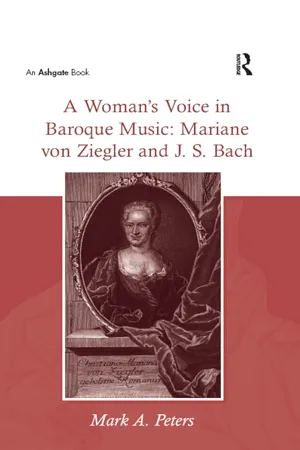
A Woman's Voice in Baroque Music: Mariane von Ziegler and J.S. Bach
- 210 pages
- English
- ePUB (mobile friendly)
- Available on iOS & Android
eBook - ePub
A Woman's Voice in Baroque Music: Mariane von Ziegler and J.S. Bach
About this book
At the end of his second year in Leipzig, J.S. Bach composed nine sacred cantatas to texts by Leipzig poet Mariane von Ziegler (1695-1760). Despite the fact that these cantatas are Bach's only compositions to texts by a female poet, the works have been largely ignored in the Bach literature. Ziegler was Germany's first female poet laureate, and the book highlights her significance in early eighteenth-century Germany and her commitment to advancing women's rights of self-expression. Peters enriches and enlivens the account with extracts from Ziegler's four published volumes of poetry and prose, and analyses her approach to cantata text composition by arguing that her distinctive conception of the cantata as a genre encouraged Bach's creative musical realizations. In considering Bach's settings of Ziegler's texts, Peters argues that Bach was here pursuing a number of compositional procedures not common in his other sacred cantatas, including experimentation with the order of movements within a cantata, with formal considerations in arias and recitatives, and with the use of instruments, as well as innovative approaches to Vox Christi texts and to texts dealing with speech and silence. A Woman's Voice in Baroque Music is the first book to deal in depth with issues of women in music in relation to Bach, and one of the few comprehensive studies of a specific repertory of Bach's sacred cantatas. It therefore provides a significant new perspective on both Ziegler as poet and cantata librettist and Bach as cantata composer.
Information
Chapter 1
Woman’s Voice: Mariane von Ziegler as Poet
Itzo wird es mir erlaubet seyn, für mich und die wenigen meines Geschlechtes zu reden. (Even so it will be allowed for me, and for the least of my gender, to speak.)
Christiane Mariane von Ziegler, Vermischete Schriften (1739)
In her Moralische und vermischte Send-Schreiben of 1731, Christiane Mariane von Ziegler (1695–1760) stated—in opposition to the norms of early eighteenth-century German society—that learning was not a difficult task for a woman. Women, Ziegler argued, possessed the same patience and diligence on which men prided themselves, and if a woman studied from her youth she could achieve the same levels of learning as a man. Ziegler presented “three learned heroines” as illustrating her point: the Dutch poet, artist, philosopher, and scholar of ancient and modern languages, Anna Maria van Schurman (1607–78); the French novelist and salon hostess, Madeleine de Scudéry (1607–1701); and the French author, editor, and translator, Anne Dacier (1651–1720).1
Ziegler could have mentioned other learned women in German-speaking lands, as well, such as Maria Sibylla Merian (1647–1717), who published and illustrated several books in the field of natural history; and Maria Winkelmann Kirch (1670–1720), an astronomer who discovered a comet in 1702 and published several of her writings, including an essay on the conjunction of Jupiter and Saturn (1712). Indeed, a number of women in seventeenth- and eighteenth-century Europe were notable for achieving erudition and making significant contributions in both the arts and sciences. Such women, however, were exceptions to established gender norms. They generally came from elite or noble families, often with an intellectual father who encouraged his daughter’s learning or with tutors hired for a brother’s education. And even so, such women were criticized for what was considered a “transgression” into the field of male learning.
Hence Ziegler’s argument for better, and more widespread, education of women and her assertion of women’s educability. Ziegler herself had the advantage of a solid education in the home, as well as the leisure to pursue intellectual interests afforded to her as the member of a wealthy, upper-class family. Even so, her accomplishments in the field of literature were remarkable, as was her continued defense of women’s rights to be educated and to publish their literary works.
This chapter presents an account of Ziegler’s life and works within the context of women’s rights to self-expression in early eighteenth-century Germany. After providing context on gender norms, particularly as they related to women’s education and writing, the chapter continues with a chronological overview of Ziegler’s life within the context of her published writings (for an annotated list of Ziegler’s works, see Appendix A). The detailed discussion of Ziegler’s works focuses particularly on her treatment of women’s issues and her defenses of women’s rights. This biography illuminates our understanding both of Ziegler and of women in German society by detailing the life and works of yet another “learned heroine” of the early eighteenth century.
Women and Men in Eighteenth-Century Germany Society
In contrast to learned women such as van Schurman, Merian, Kirch, and Ziegler, the public life of most women in early eighteenth-century Germany was one of silence. Society allowed women little opportunity for public expression, with public life being the domain of men, domestic life the domain of women, and little communication between the two. The association of women with silence took as its basis the writings of Martin Luther, who did not allow women to speak in the church.2 But it went further and denied women any public voice, either in speech or in writing.
Eighteenth-century German society was indeed defined by clear-cut gender norms. Men were viewed as being by nature active, rational, powerful, the bread winner, the public figure; women, on the other hand, were perceived as being by nature passive, emotional, weak, and dependent.3 A man’s social position was associated with his productive role in the community, his ability to provide materially for his wife and family. A woman’s social position, on the other hand, was determined by her marital status and her domestic roles. As the eighteenth century progressed, more authors spoke in terms of a female “profession” in the home as wife, mother, and housekeeper, thus reinforcing the exclusion of women from public and professional roles outside the home.4
While Enlightenment thinkers in early eighteenth-century Germany promoted women’s equality with men, such equality lacked practical application. The Enlightenment revolutionized western intellectual life by establishing the (male) individual as the source and purpose of knowledge. Women, however, became the “other” to this male “self.” Enlightenment thinkers exalted women above the cultural and political world of men, relegating them to the “higher” sphere of morality and intuition. All women were grouped together under the idea of “woman,” the opposite of man. Men of the Enlightenment insisted that treating women with courtesy, decency, and respect was a hallmark of a civilized society. But rather than facilitating equal opportunity, insistence on women’s special kind of excellence reinforced their limited social roles.5
The field of learning served to enforce the gendered separation of society by excluding women from academic institutions and insisting upon a different type of learning for women. Initially the Enlightenment contributed favorably to women’s learning, as women benefited from the belief that their intellectual faculties equaled those of men and from a general focus on improved education. More women were taught to read and write, as literacy rates increased dramatically in the seventeenth and eighteenth centuries. Enlightenment thinkers believed that education was the key to the creation of a new social (male) being, devoid of old prejudices and saturated in new reason. Women were seen as having an important role as the educators of these new men during the impressionable years in which their minds would be shaped.6 Women were, therefore, to have some level of education in order to prepare them to be better mothers and educators for their children, as well as to be more intellectually stimulating partners for their husbands.7
But while Enlightenment ideals served to improve education for women, they also enforced a double standard for men’s and women’s learning. When applied to a man, the adjective “gelehrt” (learned) indicated participation in a scholarly occupation, professional or academic, for which the subject possessed an academic degree. But the term “gelehrt” was used much more loosely for women, being applied to any woman who possessed an unusually high level of education. A “gelehrt” woman was certainly not expected to possess an academic degree or to participate in the same fields or levels of scholarship as a “gelehrt” man:
Women and girls should not really be learned; they should only taste the fruits of the useful and beautiful subjects and not be at all concerned with the “strict,” the “higher” sciences. The female “learning” … therefore relates to only a portion of knowledge and is also there differentiated from the nature and intensity of men’s learning.8
Education for most women was not academic, but rather centered in the home and focused on practical affairs and domestic responsibilities, things that a girl could learn from her mother. Outside of reading and writing, what women were allowed to study was closely scrutinized, with subjects thought to be too abstract—such as classical languages, rhetoric, theology, and philosophy—being excluded.9 A good example of stipulations placed on German women’s learning is the Frauenzimmerlexikon of 1715 by Gottlieb Siegmund Corvinus (“Amaranthes”).10 In the foreword to this compendium of popularized and easily accessible information designed for women, Corvinus listed subjects on which women should not spend much time: “mathematics, philosophy, the sciences, government, criticism, philology, poetry, languages, higher theology, law, and medicine.”11 Unlike men, women were not expected to engage in serious study or to delve too deeply into any one subject area.
Lack of in-depth education for most women contributed to the silencing of their voices in the public sphere. Not only were they excluded from speaking through public office, the church, and the university, but they were also discouraged from formal literary pursuits. Although many eighteenth-century German women enjoyed a good literary education, writing was intended solely as a domestic pastime. Women were neither expected nor encouraged to publish their writings. They were, therefore, not taught the mastery of rhetoric and grammar or the rules of poetry that were generally passed on through the study of Latin. Furthermore, much of the German poetry published in the eighteenth century was philosophical and didactic, dependent to a large extent on a level of intell...
Table of contents
- Cover
- Half Title
- Title Page
- Copyright Page
- Dedication
- List of Figures
- List of Tables
- List of Music Examples
- Acknowledgements
- List of Abbreviations
- Introduction: Mariane von Ziegler and J. S. Bach
- 1 Woman’s Voice: Mariane von Ziegler as Poet
- 2 Anonymous Voice: Mariane von Ziegler’s Sacred Cantata Texts
- 3 Divine Voice: The Significance of the Vox Christi for Ziegler and for Bach
- 4 The Composer’s Voice: Bach’s Compositional Procedures in the Ziegler Cantatas
- 5 Woman’s Voice Restored: The Reception of the Ziegler Cantatas and their Significance in Bach’s Output
- Appendices
- Select Bibliography
- Index of Bach’s Compositions
- General Index
Trusted by 375,005 students
Access to over 1.5 million titles for a fair monthly price.
Study more efficiently using our study tools.
Frequently asked questions
Yes, you can cancel anytime from the Subscription tab in your account settings on the Perlego website. Your subscription will stay active until the end of your current billing period. Learn how to cancel your subscription
No, books cannot be downloaded as external files, such as PDFs, for use outside of Perlego. However, you can download books within the Perlego app for offline reading on mobile or tablet. Learn how to download books offline
Perlego offers two plans: Essential and Complete
- Essential is ideal for learners and professionals who enjoy exploring a wide range of subjects. Access the Essential Library with 800,000+ trusted titles and best-sellers across business, personal growth, and the humanities. Includes unlimited reading time and Standard Read Aloud voice.
- Complete: Perfect for advanced learners and researchers needing full, unrestricted access. Unlock 1.5M+ books across hundreds of subjects, including academic and specialized titles. The Complete Plan also includes advanced features like Premium Read Aloud and Research Assistant.
We are an online textbook subscription service, where you can get access to an entire online library for less than the price of a single book per month. With over 1.5 million books across 990+ topics, we’ve got you covered! Learn about our mission
Look out for the read-aloud symbol on your next book to see if you can listen to it. The read-aloud tool reads text aloud for you, highlighting the text as it is being read. You can pause it, speed it up and slow it down. Learn more about Read Aloud
Yes! You can use the Perlego app on both iOS and Android devices to read anytime, anywhere — even offline. Perfect for commutes or when you’re on the go.
Please note we cannot support devices running on iOS 13 and Android 7 or earlier. Learn more about using the app
Please note we cannot support devices running on iOS 13 and Android 7 or earlier. Learn more about using the app
Yes, you can access A Woman's Voice in Baroque Music: Mariane von Ziegler and J.S. Bach by MarkA. Peters,Mark A. Peters in PDF and/or ePUB format, as well as other popular books in Mezzi di comunicazione e arti performative & Musica. We have over 1.5 million books available in our catalogue for you to explore.