- 308 pages
- English
- ePUB (mobile friendly)
- Available on iOS & Android
eBook - ePub
About this book
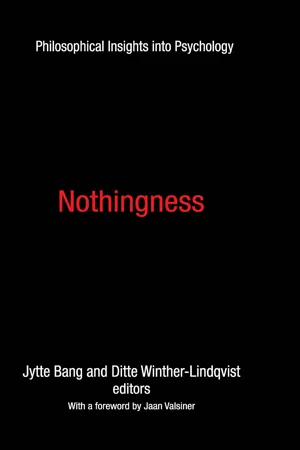
This book addresses nothingness as not only the intangible presence of an emotional, cultural, social, or even political void that is felt on an existential level, but has some solid foundations in reality. The death of a loved one, the social isolation of an individual, or the culture shock one may experience in another country are examples of situations in which an external sense of absence mirrors an internal psychological and philosophical sense of nothingness.Not much has been explicitly written on nothingness in the history of psychology. On the other hand, nothingness seems to be implicitly embedded in many scholars' work. This duality of explicitly and implicitly expressed ideas about nothingness reveals how psychology finds inspiration in philosophy, and vice versa. The book aims to illustrate how the concept of the presence of absence nothingness fills a void in contemporary psychological theorizing.
Information
1
Nothingness—Philosophical Insights into Psychology
Jytte Bang and Ditte Winther-Lindqvist
The origin of this book goes back to the fall of 2012 when Jaan Valsiner visited Department of Psychology at the University of Copenhagen. At a research meeting with Jaan and scholars from different local universities the idea of publishing a book about nothingness grew out of the animated discussions. One of the editors, Jytte Bang, was already on track of theorizing developmental history from a cultural–ecological point of view in which she proposed nothingness as the core concept for the presence of the absent in meaning making (see Bang 2009a, 2009b). In this work she argues that nothingness should be considered an inescapable dimension of human transformations of their cultural being and becoming. The chapters collected in this volume all substantiate this claim further.
In the natural sciences nothingness and nothing is more of a recognized “matter” than in mainstream psychology, which came to our knowledge early in the process of putting this volume together. The other editor of this book, Ditte Winther-Lindqvist was browsing Amsterdam Airport at Christmas 2013, and her eyes popped out when the title “Nothing”—From absolute zero to cosmic oblivion—amazing insights into nothingness” caught her attention from the top of a pile of bestsellers in a bookshop. Jeremy Webb’s edited book (2013) contains chapters about the number Zero, placebo, big bang, blackholes, and many other fascinating phenomena of “nothing”—But what is nothingness in a psychological context? And how can nothingness be of importance to psychology?
We will mention a few examples of what we mean by nothingness just for the purpose of highlighting what we are thinking about, and then present a (far from comprehensive, although tentative) reading of some of the insights into the theorizing of nothingness phenomena already available in psychology (primarily existential phenomenology and psychoanalysis).
The Presence of the Absence
The phenomenon of silence; remaining silent in a conversation or listening to the pause in a piece of music are examples of the presence of silence rather than of the absence of sounds; of the meaning and significant role that silence plays. In numerous ways, silence is an important and active part of human activities—it is an example of what is present exactly by not being present. Or we may take death as an example; it can be psychologically present in important ways both in relation to specific situations and in the event of death—however also as a backcloth of human time, as a person’s ongoing relation-to-death throughout ontogenesis, as Heidegger has suggested. Further, history is a phenomenon along the same lines; in some temporally abrupt way, history is all that once was, the moment that passed just now or the moment that passed long time ago, something that once was. However, there is no materiality, human praxis or activity, and no individuals or groups of individuals that leave the past behind only in such temporally disintegrated way. On the contrary, the personal history of people is the history of what they are now and the materiality of human life is the history of reifications which express human needs and desires. Also, history is not just about the construction of things and of doing things in changing orders. It also is about removing things and by doing so trying to change the course of development and of life. In short, history may be viewed as presence of the absent or that which is there in the now of people’s lives. When considering the status of that which is not-present, the naming of “it” seems central. When a phenomenon is given a name, for example, “silence,” “death,” “history,” it is given an existence—so in what ways can we say that there is nonpresence altogether? We suggest the concept of nothingness to cover those examples (and many more), when we try to grasp what is there by not being there, and encourage a further exploration of this conceptualization. Nothingness, is not simply “nothing,” it is the presence of the absence.
We realize that psychology has a long tradition for given name to that which is not tangibly present, and to contribute to its theorization (for instance psychoanalysis occupied with human desire, dreams, anxiety, etc. and the concept of psychic reality developed to allow for transcending naïve- materialism and give primacy to experiential qualities). Already in 1890, William James, placed nothingness as a central human experience related to all kinds of losses regarding the constituents of our empirical selves. During a life course indeed, but also in smaller time scales a person experiences (more or less permanently) losses with regard to his/her body, immediate family, home, work, and possessions, and as intrinsic to ourselves these losses represent “a shrinkage of our personality, a partial conversion of ourselves to nothingness, which is a psychological phenomenon by itself” (James 1890, 1). However, often insights regarding nothingness—are formulated from the edges of psychology—serving one such example by Karen Barad (2012) in “what is the measure of Nothingness? Infinity, virtuality Justice” argues that vacuum is particles “of void on the razor edge of non/being. The void is a lively tension, a desiring orientation toward being/becoming” (Barad 2012, 13). This characteristic may serve as metaphor for subjectivity, and thus enter the sphere of interest for psychologists (see Tine Jensen, 2015, this volume, for a psychological analysis of forgetting through applying Barad’s ideas).
The question is not why publish a book on nothingness but why not and why has nothingness as both a phenomenon and a concept gained so little interest in psychology so far?
On Sensationalism in Psychology
Concerning the last questions, there may be more answers, of course. One answer may be found in the history of psychology itself and in some of the basic assumptions on which much psychology relies. It seems that the ironic invisibility of nothingness in psychology is related to psychology’s struggle with itself concerning what psychology is about. Over the years, attempts have been made to ground psychology on process ontology and real-life events rather than on epistemology and individual mindmatter. An early example of these attempts can be seen in Dewey’s (1896) critique of the reflex arc and of the mechanistic relation between stimulus, processing, and response. This mechanistic scheme for psychology turned out to assume human passivity according to which any organism, including humans, must passively await stimuli from the immediate surroundings to (re)act. The potentials for theoretical change implied in Dewey’s critique was great since the mechanistic as well as the epistemological trend in psychology has its roots in the influential empiricism end sensationalism of John Locke and David Hume. According to Locke (1961), simple ideas are received passively by consciousness on the basis of sensations and in consciousness these ideas can be combined into complex ideas, ideas which are brought into relation to each other and ideas which are general and abstract. Psychological processes are such mental operations with idea elements received from the world and along this theoretical line psychology becomes almost identical with cognition and the mental processing of ideas. At the same time, a gap is being introduced between the outer world which is the origin of sensations, on the one hand, and the inner mental processing generating ideas, on the other hand. The general as an ontological quality of the world becomes nonexistent; only what can hit the organisms as “sensations” for mental processing has a “reality”; that is, in an abstract sense. This theoretical position is problematic at least in two important senses. Firstly, it shows no interest in real-life processes other than in abstract ways as “sensations.” This is an important hindrance for psychology to approach a process ontology. Secondly, it reduces psychology to mental processing of ideas creating an unproductive gap between the individual organism and its environmental life-processes. Such an abstract understanding of how the individual connects to the world falls short when it comes to understanding processes of change—it cannot see the mutuality and the transactional relationship of the individual with the world when putting a focus on immediately sensational particularities. Not only Dewey has criticized such a view. Along the same lines, Leontjev (1977) has argued against sensationalism and against what he calls the postulate of immediacy in psychology; a postulate which lies at the core of the S–R paradigm. James Gibson’s (1966, 1986) theory of direct perception serves as another important example of theorists trying to overcome the problems caused in psychology by sensationalism.
Obviously, nothingness literally means nothing in the theoretical realm of sensationalism. Therefore, one answer to the question of why psychology has paid so little attention to nothingness both as a phenomenon and a concept lies in the fact of its history with sensationalism. Nothing does not cause any sensations, hence, has no reality neither in the world nor in the individual. The present book appears out of the suspicion that the whole sensualist paradigm misses something important which deserves some attention. In this sense, the book is one step to pick up the concept and see what comes out of it when different scholars try to relate the concept to their own research.
In this introduction we can only scratch the surface of some of the few (however comprehensive) steps taken toward a theorizing of nothingness in the history of psychology and philosophy, and we further recommend, Chapter 5 in this volume, “Nothingness as the dark side of social representations,” by Alicia Barreiro and José Antonio Castorina for a brilliant overview of three different ways that nothingness has been dealt with in psychology, so far.
W. F. Kraft “A Psychology of Nothingness”
In our initial search, we came across William F. Kraft’s (1974) book A Psychology of Nothingness in which he wrote about the phenomena of loneliness, depression, anxiety, boredom, and frustrations which, though unpleasant, may be necessary for an individual to become an authentic and happy person. In his motivation for the book he says:
I began to direct myself to the language of nothingness – loneliness, aloneness, depression, anxiety, guilt, frustration, anger, boredom, apathy, and anguish. I proposed and explained that certain forms of these experiences are not necessarily symptoms of unhealthiness; they can also be symptoms of health. (Kraft 1974, 9)
In his attempt to outline a psychology of nothingness, Kraft talked with people who experienced these emotional states and he tried to help them take a new look at themselves. He also worked through the professional literature about these psychological experiences and concepts, but he had to listen to spiritual writers, poets, novelists, philosophers, and theologians to learn more about nothingness. Based on all of this empirical and theoretical work, Kraft’s book stands out as an example of how a psychology of nothingness may look like from a phenomenological-existential and a life-course perspective. Following his thought, nothingness is an ontological reality of life and indeed it has great importance. In some sense, nothingness becomes the essential concept which refers to the openness and the potentialities of becoming—suffering may lead to new possibilities along the way and nothingness therefore is for each individual to relate to if one wishes to live a meaningful and authentic life. Contrary to the psychology of sensationalism, nothingness becomes an important phenomenon which everyone needs to deal with in life—not as a particular sensation but as a field of potentialities and possibilities.
It is probably no great coincidence that William Kraft’s psychology of nothingness is also a psychology of potentialities, of choice, and of becoming. In existential-phenomenological philosophy, like Sartre’s, nothingness is a core concept. Along these theoretical lines nothingness, both as a phenomenon and as a concept, has the potentials to become an important psychological concept.
Hegel’s Negative
Both Kierkegaard and Sartre (as well as Marx) were influenced by Hegel’s dialectical philosophy and discussed it critically from their own positions. By articulating the idea of the “negative,” Hegel (1812/1969) became influential as a theorist of dialectics that is, of development and change. Nothingness seems theoretically related to processes very relevant in psychology—development and change—but it is mostly dealt with in philosophical terms and within philosophical agendas (not just in Western philosophical traditions, but also, and even more so in Eastern philosophy and religion where nothingness plays a most central role (Chai 2014; Nowak 1997). Therefore, even though there may be more theoretical lines of thought which conceive nothingness (if only implicitly), Hegel’s dialectics certainly can be identified as one of them as well as its influence on parts of philosophy. Contrary to Hume, who separated reasoning from experience, Hegel was interested in how reason is realized in the world (talked about as the self-struggle of the Geist) (Bernstein 1971). Dialectics is a dynamic process in which certain negativity in the self-struggle and the conflicts of the moment gives rise to transcendence of the moment into new moments in which earlier moments are being “aufgehoben” and new negativities arise. There may be limitations or obstacles to be overcome and through this self-struggle, the dialectical process with its negativities (otherness) is renewed and transformed. In this dialectical logic, development— including history—takes place as a kind of self-destruction. Struggle and transcendence leads to new moments of “aufhebung” of the past into new forms which both refers to, and is different from, its origins. These dialectical developments imply that “negativity” is a very active process (Bernstein 1971). It is something embedded into practical life and human relationships. His famous analysis of the master and the slave (Hegel 1809) serves to illustrate this power of the “negative” as dialectical self-realization. The master has the power to dominate the slave and to consume the objects which he produces. However, due to the irony of dialectics, the master fails the more he strives to become an independent self-consciousness and a true master. In this process, he actually enslaves himself and makes himself dependent on the slave because he acts as the master. This makes the slave the essential condition by which the master becomes the master. As a consequence, when the master tries to achieve full developed mastership, he will fail. The slave, on the other hand, has the function to produce (for the master). In the process of production, he, so to speak, externalizes himself into the product of his labor. Through this process, he comes to think of himself as someone who exists in his own right. Herein lies the potentials for freedom. The dialectic of the slave’s relationship to the master means that he (the slave) comes to realize his own freedom on the basis of his labor for another. In other words, “negation” is essential in dialectical processes of self-realization. Things are what they are not.
Hegel’s dialectic and the concept of the “negative” influenced others in different ways, hence initiated nothingness as an articulated philosophical theme.
Marx’ Concept of Alienation
In Marx, the concept of “alienation” can be read as a continuation of Hegel’s analysis of the master and the slave (Bernstein 1971). According to Marx, alienation is a social category (not a psychological category in the first place) in that alienation is an objective condition related to societal production. Alienation occurs under certain conditions when a product is both an expression of the producer and not an expression of the producer (like the slave who is and is not his product). The product is the producer as it is a result of his activity; but at the same time, it is not himself in a society where the product gains an independent status which tends to dehumanize the producer. This implies that in an alienating society, a product is both an objectification of the producer’s labor and an alienation of the same. This is the condition of certain societies and as a result, objects gain a certain power over the producer. It threatens to master him and dehumanize him—the essential process of alienation (Bernstein 1971). One may read Marx’s concept of alienation as a concept of the important role of the “negative.” Similar to the slave, the producer is free in that he is not free; he is dehumanized through the power of the products and therefore he has the potentials to humanize himself. Quite parallel to Hegel’s master and slave analysis, there are certain conflictual double moves going on in the process of real life as well as in thought and it is through dialectical self-realization of conflictual character of the moments that development as “Aufhebung” takes pla...
Table of contents
- Cover Page
- title
- copy
- Contents
- Series Editor’s Foreword, Jaan Valsiner
- 1 Nothingness—Philosophical Insights into Psychology
- 2 Is Future Perception Possible?
- 3 The Color of Nothingness
- 4 The Nothingness of Developmental Situations
- 5 Nothingness as the Dark Side of Social Representations
- 6 The Gift of a Rock: A Case Study in the Emergence and Dissolution of Meaning
- 7 The Nothing That Is: Making Meaning Out of Nothing at All
- 8 Nothingness and the Forgotten: A Post-human Thought Experiment
- 9 Time Together—Time Apart: Nothingness and Hope in Teenagers
- 10 Nothingness: Imprisoned in Existence—Excluded From Society
- 11 When Links Are Missing: Children and Post Divorce Family Life
- 12 Silent Nothings: Undisciplined Language
- 13 Is There No Sense in Nonsense? Co-transforming the Apparently Nonsensical
- 14 Numbers: User-Driven Standards and Manageable Nothingness
- Contributors
- Index
Trusted by 375,005 students
Access to over 1.5 million titles for a fair monthly price.
Study more efficiently using our study tools.
Frequently asked questions
Yes, you can cancel anytime from the Subscription tab in your account settings on the Perlego website. Your subscription will stay active until the end of your current billing period. Learn how to cancel your subscription
No, books cannot be downloaded as external files, such as PDFs, for use outside of Perlego. However, you can download books within the Perlego app for offline reading on mobile or tablet. Learn how to download books offline
Perlego offers two plans: Essential and Complete
- Essential is ideal for learners and professionals who enjoy exploring a wide range of subjects. Access the Essential Library with 800,000+ trusted titles and best-sellers across business, personal growth, and the humanities. Includes unlimited reading time and Standard Read Aloud voice.
- Complete: Perfect for advanced learners and researchers needing full, unrestricted access. Unlock 1.5M+ books across hundreds of subjects, including academic and specialized titles. The Complete Plan also includes advanced features like Premium Read Aloud and Research Assistant.
We are an online textbook subscription service, where you can get access to an entire online library for less than the price of a single book per month. With over 1.5 million books across 990+ topics, we’ve got you covered! Learn about our mission
Look out for the read-aloud symbol on your next book to see if you can listen to it. The read-aloud tool reads text aloud for you, highlighting the text as it is being read. You can pause it, speed it up and slow it down. Learn more about Read Aloud
Yes! You can use the Perlego app on both iOS and Android devices to read anytime, anywhere — even offline. Perfect for commutes or when you’re on the go.
Please note we cannot support devices running on iOS 13 and Android 7 or earlier. Learn more about using the app
Please note we cannot support devices running on iOS 13 and Android 7 or earlier. Learn more about using the app
Yes, you can access Nothingness by Jytte Bang in PDF and/or ePUB format, as well as other popular books in Psychology & History & Theory in Psychology. We have over 1.5 million books available in our catalogue for you to explore.