- 402 pages
- English
- ePUB (mobile friendly)
- Available on iOS & Android
eBook - ePub
About this book
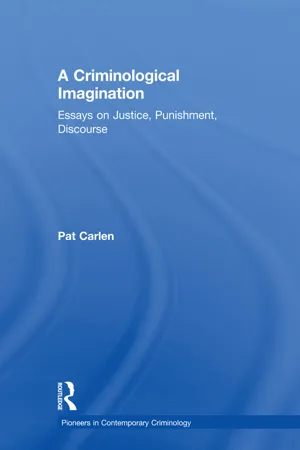
A Criminological Imagination contains a selection of key articles from Pat Carlen's research studies of magistrates' courts and women's imprisonment together with a range of other articles on social control, discourse analysis, ideology, punishment, criminology and critique. They are all informed by an assumption that while criminal justice must remain imaginary in societies based upon unequal and exploitative social relations, one task of a criminological imagination might be to suggest why this is so, and how things could be otherwise. This is an invaluable collection for anyone interested in crime, justice and injustice and the social, political and academic contexts in which knowledge of them is constructed.
Information
Part I
Discourse/Ideology/Social Control
[1]
The Staging of Magistrates’ Justice
METAPHORIC critiques of judicial proceedings have been done by mainly American writers: Garfinkel (1956), Emerson (1967) and Blumberg (1967), for instance, have all used dramaturgical or game imagery in analyses of courtroom interaction. In England, on the other hand the concern has been different, and largely reformative. Analyses of sentencing patterns (Hood, 1962; King, 1972), surveys of the availability of legal aid (Patterson, 1971) and assessment of bailing procedures (Bottomley, 1970; Dell, 1970)—all have contributed to the current concern with improving, mainly by increasing the availability of legal aid, the quality of justice in general and the quality of magistrates’ justice in particular.
Difficult though it would be to deny the immense contributions of the aforementioned studies, both the American theorists and the English investigators have tended either to ignore or to take for granted other, equally consequential, dimensions of socio-legal control: the coercive structures of dread, awe and uncertainty depicted by Camus and Kafka; the coercive structures of resentment, frustration and absurdity depicted by Lewis Carroll and N. F. Simpson. That the masterly descriptions of a Kafka or a Camus are unlikely to be bettered by sociologists is obvious. The idea, however, that such surrealism and psychic coercion properly belong to the world of the French novel, rather than to the local magistrates’ court in the High Street, is erroneous. In this paper, based on two years’ observation of the Metropolitan magistrates’ courts, I shall argue that the staging of magistrates’ justice in itself infuses the proceedings with a surrealism which atrophies defendants’ ability to participate in them.
The Magistrates’ Court as a Theatre of the Absurd
Traditionally and situationally, judicial proceedings are dramatic. Aristotle noted the importance of forensic oratory as a special device of legal rhetoric; playwrights as diverse as Shakespeare and Shaw appreciated the dramatic value of a trial scene; lawyers have always been cognisant of rhetorical presentations.
In 1950, nine years before Goffman’s The Presentation of Self in Everyday Life, a lawyer, Jerome Frank, discussed the conventional ascription of character which occurs in law courts and which is dependent upon the tacit dimensions of interpersonal knowledge. Such analyses are nowadays the familiar stuff of the dramaturgical perspectives in sociology. Yet people do not only ascribe character to each other. Furniture, stage-props, scenic devices, tacit scheduling programmes, etiquettes of ritual address and reference—in short, all the paraphernalia of social occasions—are, both immediately and documentarily, indexed with consequential social meanings (Mannheim, 1952; Schutz, 1970). These meanings can be set up as being either mundane (i.e. constitutive of and reflecting everyday realities) or puzzling (i.e. constitutive of and reflecting alternative realities) or, less often, as being both mundane and puzzling (i.e. surrealistic). In hierarchically organised social institutions, however, certain people can monopolise and manipulate the scenic and scheduling arrangements of the most important public settings so that a coercive control, often spurious to the professed aims of the institution, can be maintained.
Within the courtrooms of the magistrates’ courts tacit control of their spatial and temporal properties is the monopoly of the police and the judicial personnel. In practice both the staging and the prosecution of the criminal business becomes the responsibility of the police. This renders absurd the judicial rhetoric of an adversary justice, where, so the story goes, both prosecution and defence stand as equals before the law. Indeed, within the courtrooms of the magistrates’ courts the ideal of adversary justice is subjugated to an organisational efficiency in whose service body-movement and body-presentation are carefully circumscribed and regulated, bewilderment and embarrassment are openly fostered and aggravated, and uncertainty is callously observed and manipulated. Human creativity is there, certainly, but it is celebrated as much in the covert deployment of tacit control techniques as it is in the innovative judicial action. Whereas, therefore, Goffman’s dramaturgical analyses have focused on the everyday realities of the cinéma vérité, these notes on the staging of magistrates’ justice will focus on the surrealist dimensions of the theatre of the absurd.
Staging the Absurd
Though structurally opposed, the theatre of the absurd and the court of law have several phenomenological features in common. Their central divergence inheres in their opposed structural functions. Thus, whereas dramatists of the absurd intentionally and overtly utilise the plausible and the mundane to construct the overtly senseless and absurd, the mandarins of justice intentionally and covertly utilise the plausible and mundane to construct the covertly senseless and absurd.
In magistrates’ courts, as in the theatre of the absurd, mundane and conventional ways of organising and communicating the operative meanings of social occasions are simultaneously exploited and denied. Yet their outcomes are situationally authenticated and the intermeshed structures of surrealism and psychic coercion are difficult to locate. This is because police and judicial personnel systematically present their coercive devices as being nothing more than the traditional, conventional and commonsensical ways of organising and synchronising judicial proceedings.
Space
The spacing and placing of people on public occasions is strategic to their ability to participate effectively in them. Even upon informal social occasions temporary spacing arrangements will at least decide which conversations can be heard by whom. On the most formal social occasions spacing arrangements, being more rigid, will, in addition to determining the mode and range of verbal interaction, emphasise the relative status of the people present. On ritual occasions, the rules of spacing and placing will, additionally, define the specific territorial rights and duties of those designated as occupiers of particular social space.
A magistrates’ court is a very formal and ritualistic social setting; in it social space is pre-formed and distributed by the fixtures and fittings which comprise its definitive physical dimensions. The conditional essence of formality is the maintenance of existing social forms; the raison d’être of the criminal law is an assumption of the vulnerability of existing social forms. It is not surprising, therefore, to find that, in the courts, not even the usually implicit rules of spacing and placing are left to chance interpretation. Instead, judicial violation of the mundane expectations which usually enable fully adult people to cope with unfamiliar situations, judicial tolerance of flawed communication systems, and a judicial perversion of the accepted modes of conversational practice, realise a structure of tacit coercion which makes nonsense of recent claims that judicial proceedings are loaded in favour of the defendant (CLRC, 1972; Mark, 1973).
In the courtroom spatial dominance is achieved by structural elevation and the magistrate sits raised up from the rest of the court. The defendant is also raised up to public view but the dock is set lower than the magisterial seat, whilst the rails surrounding it are symbolic of the defendant’s captive state. Of all the main protagonists the defendant is the one who is placed farthest away from the magistrate. Between the defendant and the magistrate sit clerk, solicitors, probation officers, social workers, press reporters, police, and any others deemed to be assisting the court in the discharge of its duties. Spatial arrangements, however, which might signify to the onlooker a guarantee of an orderly display of justice, are too often experienced by participants as being generative of a kind of theatrical autism with all the actors talking past each other.
Difficulties of hearing are endemic to magistrates’ courts. At one court where microphones are used they distort voices so badly that most people in the courtroom laughingly wince when they are turned on, and visibly sympathise with the lady magistrate who always has them turned off because “they make us sound like Donald Duck”. At other courts they have microphones but do not use them. Magistrates and clerks can go to elaborate lengths to explain the meaning of legal phraseology to defendants who either do not hear them and say “Pardon, sir?” or who nod in the “dazed” or “blank” way noted by so many policemen and probation officers. Acoustics, however, cannot bear total responsibility for the chronic breakdown of communication in magistrates’ courts. The placing and spacing of people within the courtroom is a further cause of the series of “pardons” and “blank stares” which characterise and punctuate judicial proceedings.
It has already been stressed that, in the courtroom, defendants and magistrates are set well apart from each other. Distances between bench and dock vary from court to court but in all courts such distances are certainly greater than those usually, and voluntarily, chosen for the disclosure of intimate details of sexual habits, personal relationships and financial affairs. Certain communications, as Edward Hall has stressed, are conventionally presented as intimate communications, and both their timing and situating are delicately arranged. Indeed, “there are certain things which are difficult to talk about unless one is within the proper conversational zone” (Hall, 1959).
In magistrates’ courts, where the vast majority of defendants do not have a solicitor as a “mouthpiece”, defendants are set up in a guarded dock and then, at a distance artificially stretched beyond the familiar boundaries of face-to-face communication, are asked to describe or comment on intimate details of their lives; details which do not in themselves constitute infractions of any law but which are open to public investigation once a person has been accused of breaking the law.
Further, during such sequences of interrogation, defendants’ embarrassed stuttering is often aggravated by judicial violation of another taken-for-granted conversational practice. For in conventional social practice the chain-rule of question-answer sequence (Sacks, 1967; Schegloff, 1972) is also accompanied by the assumption that it is the interrogator who demands an answer. In magistrates’ courts, however, defendants often find that they are continually rebuked, either for not addressing their answers to the magistrate, or for directing their answers to their interrogators in such a way that the magistrate cannot hear them. As a result, defendants are often in the position of having to synchronise their answers and stances in a way quite divorced from the conventions of everyday life outside the courtroom.
For defendants who often do not immediately distinguish between magistrate and clerk, for defendants who do not comprehend the separate symbolic functions of dock and witness-box, for defendants who may have already spent up to three hours waiting around the squalid environs of the courtroom—the surrealistic dimensions of meaning, emanating from judicial exploitation of courtroom placing and spacing, can have a paralysing effect. A senior probation officer summed up the present situation in the Metropolitan magistrates’ courts very well when she commented: “Many of them don’t even go into the witness-box because they can’t face walking round there. They’re too nervous.”
Time
Though it is unlikely that absolute control of the situation can be obtained in a cramped courtroom which may have 30 to 40 people in its main area, and over that number in its public gallery, officials, as I have already argued, appear to be well aware of how to facilitate control through exploitation of the courtroom’s physical dimensions. Courtroom ceremony is maintained partly to facilitate physical control of defendants and any others who may step out of place, and partly to refurbish the historically sacred meanings at...
Table of contents
- Cover
- Half Title
- Title Page
- Copyright Page
- Table of Contents
- Acknowledgements
- Introduction
- Published Writings
- Part I Discourse/Ideology/Social Control
- Part II Women/Prisons/Punishment
- Part III Feminism/Criminology/Critique
- Index
Trusted by 375,005 students
Access to over 1.5 million titles for a fair monthly price.
Study more efficiently using our study tools.
Frequently asked questions
Yes, you can cancel anytime from the Subscription tab in your account settings on the Perlego website. Your subscription will stay active until the end of your current billing period. Learn how to cancel your subscription
No, books cannot be downloaded as external files, such as PDFs, for use outside of Perlego. However, you can download books within the Perlego app for offline reading on mobile or tablet. Learn how to download books offline
Perlego offers two plans: Essential and Complete
- Essential is ideal for learners and professionals who enjoy exploring a wide range of subjects. Access the Essential Library with 800,000+ trusted titles and best-sellers across business, personal growth, and the humanities. Includes unlimited reading time and Standard Read Aloud voice.
- Complete: Perfect for advanced learners and researchers needing full, unrestricted access. Unlock 1.5M+ books across hundreds of subjects, including academic and specialized titles. The Complete Plan also includes advanced features like Premium Read Aloud and Research Assistant.
We are an online textbook subscription service, where you can get access to an entire online library for less than the price of a single book per month. With over 1.5 million books across 990+ topics, we’ve got you covered! Learn about our mission
Look out for the read-aloud symbol on your next book to see if you can listen to it. The read-aloud tool reads text aloud for you, highlighting the text as it is being read. You can pause it, speed it up and slow it down. Learn more about Read Aloud
Yes! You can use the Perlego app on both iOS and Android devices to read anytime, anywhere — even offline. Perfect for commutes or when you’re on the go.
Please note we cannot support devices running on iOS 13 and Android 7 or earlier. Learn more about using the app
Please note we cannot support devices running on iOS 13 and Android 7 or earlier. Learn more about using the app
Yes, you can access A Criminological Imagination by Pat Carlen in PDF and/or ePUB format, as well as other popular books in Social Sciences & World History. We have over 1.5 million books available in our catalogue for you to explore.