- 206 pages
- English
- ePUB (mobile friendly)
- Available on iOS & Android
eBook - ePub
The Democratic Spirit of Law
About this book
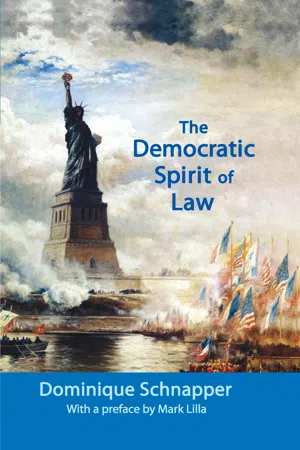
In this major new work, Dominique Schnapper continues her investigation into changes in contemporary democracy. Although she concentrates on the French example, The Democratic Spirit of Law concerns all democratic societies.Schnapper warns against the danger of corrupting the "principles," as defined by Montesquieu, on which democracy is based. If democracy becomes "extreme," all its founding principles risk being corrupted. Respect for institutions is necessary for freedom to be effective. Furthermore, if democrats cease to distinguish between facts and values, religion and politics, politics and the judiciary, knowledge and opinion, and knowledge and intuition, they will sink into absolute relativism or a nihilism that threatens the very values on which democratic society is based.By pointing out the danger of corruption inherent in the democratic promise of freedom, equality, and happiness, the author provides intellectual weapons not only to understand, but also to defend democracy, the only system in history, despite its limits and failures, that has humanely organized human societies. Democracy's future depends on citizens' preservation of the founding spirit of the democratic order: recognition of others, and free, reasonable, and controlled criticism of legitimate institutions.
Information
1
The Temptation of the Unlimited
As a political project bearing within it a utopia or an illusion born of the requirements of autonomy and equality, democracy has no intrinsic limits. The revolutionary birth of political modernity in France bears witness to this. The ideals of the French Revolution that foundered in the Terror are an extreme and tragic illustration of the dangers involved in founding a “New Man” defined as tabula rasa, by his autonomy and his reason, and denying the heritage and constraints of collective life. By extending itself beyond the political domain, the democratic spirit under the influence of egalitarian passion transforms all relationships between men, between men and women, from the most political to the most intimate.
Democratic dynamics strengthens two great principles of the modern world, both of which reject the very idea of limits that, at the same time, is reinforced by them: scientific progress and capitalism.
Homo democraticus believes in mastering nature through science. The critical spirit at the basis of scientific study is founded on the conviction that there is no intrinsic limit to acquiring knowledge, that nature does not impose constraints on human minds that limit the desire for understanding. Scholars work to continually extend the frontiers of the unknown. They deny that this has any greater limits than the power it confers. Recent scientific and technical progress, by giving humanity far greater possibilities of action, may also give the illusion of omnipotence, to the extent of even denying the existence of those limits being linked to the human condition, and to the finite condition of human destiny.
Democracy is also strengthened by a capitalism based on a drive to produce ever more goods and services more and more efficiently, thus more and more rapidly. By destroying those goods and services that become obsolete, and by creating new goods and new services according to the formula of creative destruction put forward by Schumpeter, capitalism is carried forward in an endless movement to increase the number of its goods and services by improving and speeding up production. This carries the risk of excess and dislocations, in particular that of commercializing all social relations. This would occur if the means—production—gradually replaced the ultimate end of improving the living conditions and the collective fortunes of human beings.
Given its own dynamics and its reciprocal relationship with science and capitalism, if democracy became “extreme,” it could challenge its own “principles” and eliminate the distinction between the citizen’s autonomy—condition of freedom and the basis of political modernity—and the individual’s independence.
From Autonomy to the Rejection of All Dependence
Autonomy and Independence
Autonomy implies the ability to reflect and to determine oneself, to deliberate, to act by choosing among several possible actions. The principle of autonomy founds a project of emancipation; its aim is to free the individual from hierarchies, institutions, traditions, and the sense of belonging to family, community, or neighborhood. This is the promise made to everyone to enable them to adopt the aims, values, and practices of a good life as independently as possible from outside pressures and limits. The legitimacy of the community of citizens is based on the autonomy of free and rational individuals.
The citizen’s autonomy makes him normally and legitimately critical. Criticism is at the heart of democratic order since the society of citizens accepts no outside standard and intends to construct itself by itself. Leaders’ actions can be immediately and at any time challenged. Such criticism is exercised by citizens through the institutions that organize the limits that a “well-regulated” democracy imposes on itself. Law controls relations between individuals and institutions. At regular intervals, citizens are empowered by elections whose transparent process is controlled by independent judges. Political oppositions and, eventually, political and ethnic minorities, have legal status and protection. A minority opposition can always become the majority. Between elections, citizens can express themselves freely thanks to various media and to freedom of association and demonstration that guarantee the concrete and constant exercise of political liberty. Judges are independent of political power. In France the right to strike is inscribed in the preamble to the Constitution; the law grants the right of trade union representatives to defend wage earners and the methods to be used for these claims. Counter-powers are a condition of exercising citizenship. The provisions guaranteeing their legitimacy imply recognition of the diversity and even the opposition of different social groups’ interests. It is because democracy admits its own errors and its own deficiencies—thus recognizing the finite nature of the human condition—that it gives citizens the power to correct their previous choices, and to contest the decisions made by those they have elected. It has renounced striving for an absolute Good, and acknowledges the complexity of human relations and the limits of its own principles.
Citizens’ autonomy is not only political; it is also a condition of interpersonal relations founded on the idea and the ideal of free and equal relations between all individuals. It implies that each one acknowledges the qualities of the other and the other’s ability to develop his or her own competence; that the value of negotiating between persons and groups be privileged as the way to resolve the problems of life in common, which requires recognizing the legitimacy of the other’s viewpoint. Autonomy means that the relationship with the Other—the Other as radically different while, at the same time, fundamentally equal to oneself—is the social condition as such.
Yet autonomy does not mean rejecting all dependence and constraint. We must return to the distinction inscribed in the philosophical tradition and recently reformulated by Alain Renaut, between autonomy, foundation of the legitimacy of a community of citizens, and independence or, in other words, between the subject and the individual. Independence, the capacity to do what is dictated by caprice and momentary interests, is different from autonomy, i.e., the subject’s will to be the master of his action in the name of universal standards and principles, which are to be all the more respected in that they are freely developed and criticized. “For autonomy is indeed in one sense a dependence, but in the sense in which enhancing the value of autonomy consists in making the human being himself the foundation or the source of his own standards and laws, insofar as he receives them neither from the nature of things, as did our ancient ancestors, nor from God, as in the Judeo-Christian tradition.1 It is nonetheless true that, dependence with regard to self-founded human laws, autonomy is also, in a way, a form of independence . . . but its independence is only in relation to a radical Otherness dictated to me by the law . . . In the autonomous ideal, I remain dependent on standards and on laws, providing I accept them freely. This means that enhancing the value of autonomy, accepting the idea of law or of rules, one can certainly accept the principle of a limitation of the self, by submission to a common law. This also means that the value of autonomy is integral to the democratic idea,” whereas independence “for the individual would signify freedom from all hindrances and, as a result, the sole concern for, and making the most of, self-sufficiency, and the weakening of any social dimension.”2
Independence, as distinguished from autonomy, implies the absence of any concern for others and for institutions. Now, philosophers have taught since the Greeks that human liberty is exercised within common rules; it supposes the awareness of each one that his or her own liberty is limited by that of others and by the inevitable restraints of collective life. Human societies are characterized by prohibitions and rules, “For the Rule of rules, the general Law of laws, is that each should observe those of the place wherein he lives” wrote Montaigne.3 This was the concept developed by Locke, according to whom “where there is no law, there is no freedom”; by Rousseau who clearly declared himself “against freedom without rules”; Montesquieu claiming that “political freedom in no way consists in doing what one wants” since “one must bear in mind what is independence and what is freedom”; or again Kant who distinguished “savage” freedom from that of the civilized individual by his dependence and his participation in a whole. The thinkers of political liberalism believed in the necessary role of law in relationship to freedom. From their reflections, one can retain that the danger of “corruption” is actualized if people consider that being free means “do what you want,” “do what you like,” or even, in the current situation, “enjoy without hindrance” (to repeat a slogan that symbolized the May ’68 movement); if they perceive the freedom of others as an obstacle to their own freedom; if all obligation linked to life in common is seen not as an inevitable and legitimate feature of the human condition, but as an oppression and an exploitation; if law is ignored or systematically challenged whatever its content; if legitimate institutions are no longer respected; if the right to rebel becomes a value in itself, not justified by rebellion against dictatorial regimes, but against all regimes, including democracies. In these cases, one falls into the excesses that risk “corrupting” well-regulated democracy.
Concretely, there exists a danger of “corruption” if citizens neglect or disdain the institutional forms that organize legitimate criticism. “Elections, a trap for idiots,” the formula in vogue at one time, challenges the legitimacy of democratic order since it is the free choice of those who govern by the governed that is its source. It is true that the institutionalization of criticism places limits on its expression. One must respect the rules of institutions responsible for opposition, whether they be trade unions, courts, political parties, or electoral procedures. One must wait for the end of an elected person’s term of office for the negative judgment of voters to replace him. This lapse of time may seem scandalous when all social practices are character-ized by speed, if not immediacy, thanks to the New Technologies of Information and Communication (NTIC). Nonetheless, respect for political dates is a condition of legitimacy. More generally, it is the respect for institutions themselves that establishes democratic order. When the United States Supreme Court decided by a majority of five judges against four to authorize the interruption of the recounting of votes obtained in November 2000 by the candidates in the presidential election, thereby allowing the election of George W. Bush, it was Albert Gore, the candidate whom many thought had been unfairly overruled, who asked his supporters not to attack the court’s legitimacy. Public opinion, both democrats and republicans, respected that decision. The respect for institutions, and thereby of democracy—if not of equity— had triumphed.
Nowadays, during the great social conflicts in France with regard to education, employment, or retirement pensions, nobody mentions the fact that these statutes were legitimately adopted by a legitimate government, put in place by free elections. This signals the weakening of our institutions as such. It is also the sign of a possible “corruption”: to conclude from the autonomy of the individual, by exchange or dialogue with others, to the rejection of all interdependence or, in other words, to conclude from the citizen to the individual preoccupied before all else by his personal and immediate interests—the economic actor or the rights claimant—ignoring his commitments to others, regardless of the political dimension of collective life. If this evolution goes further, the idea of emancipation of human beings ushered by political modernity, founded on the exercise of reason and autonomous judgment, would be challenged.
If the individual subscribes only to his own caprice and for his own short-term interest, he will overturn the objective trust that constitutes a basic given of all societal life. For if people “had no trust in a general way, they would not even be able to get up in the morning.”4 In all societies, social exchanges rely on the trust that human beings have in each other; they must be confident that institutions will answer to their requests with tolerable fairness and will protect them if they are to share in projects for their common future. Neither the practices of economic life nor political legitimacy, in other words the social order, could be maintained without that minimal trust between individuals, and between individuals and institutions. In his criticism of bolshevism, published in 1923, Marcel Mauss denounced the fact that this new regime ended by dissolving the “numerous invisible bonds,” meaning the implicit or formal exchanges that unite people and each day weave the bonds that maintain society as such. In the same spirit, on this day-to-day social fabric, Georg Simmel spoke of “microscopic molecular processes.” Legal security, thanks to which individuals can “expect” their behavior to be accepted and possibly approved, makes it possible to stabilize people’s behavior and to predict it, thus to reduce the complexity and instability of social life. This “expectation” is the “very definition of any collective act” (Mauss). Locke based the passage from the state of nature to civil society on the establishment of confidence or trust between the people and the political authority. For him, as for us, kings, ministers, and elected assemblies were but the custodians of the temporary confidence accorded them by the people.
Democratic societies, like the market economy, do not escape this condition. Opinion polls regularly indicate that the confidence between members of a society varies in the same way as their confidence in institutions. The respect for the procedures by which governments are chosen and controlled—by means of fair elections and the free criticism of decisions— founds political legitimacy. More than in any society, social order depends first of all on the Rule of Law, abstract by definition, and on institutions; the personal qualities of individuals should be less and less relevant. “Democratic power is empty,” to quote the expression made famous by Claude Lefort, meaning that it is not linked to individual people. It does not depend on the quality of those who govern, but on the legitimacy that individual citizens recognize in the legal standards and political institutions. The more the Rule of Law is confirmed at the expense of custom and tradition, the more institutional legitimacy relies on the confidence of individuals. This legitimacy must lead them to respect the institutions in themselves, whatever the weaknesses and deficiencies of those who occupy and “personify” them temporarily. Even if the president of the Republic is disdained and his actions condemned, his function must be respected because respect for the institution is the foundation of democratic order. Citizens must obey the laws before having confidence (and, eventually, lacking confidence) in those who embody them for the moment.
Autonomy and Collective Constraints
The principle of autonomy does not prevent democratic individuals, as historical individuals, from being concretely faced with a number of constraints arising from the necessary respect for the Rule of Law. They must conform to the regulations of life in common and to the multiple norms governing behavior in different social spheres.
Furthermore, the constant intervention of the welfare state multiplies the number of regulations imposed on individuals in a necessarily bureaucratic form. Long before the start of the welfare state, Tocqueville wrote that in democracy “It is the State that has undertaken almost alone to give bread to those who are hungry, relief and a refuge to the sick, work to those without it; it has made itself the almost unique repairer of all miseries. Education, as well as charity, has become a national affair among most of the peoples of today. The state receives and often takes the child from the arms of its mother in o...
Table of contents
- Cover Page
- Title Page
- Copyright Page
- Table of Contents
- Acknowledgments
- Preface
- 1 The Temptation of the Unlimited
- 2 From Liberty to License
- 3 From Equality to Indistinction
- 4 Criticism of Criticism
- Conclusion
- Bibliography
- Index
Trusted by 375,005 students
Access to over 1.5 million titles for a fair monthly price.
Study more efficiently using our study tools.
Frequently asked questions
Yes, you can cancel anytime from the Subscription tab in your account settings on the Perlego website. Your subscription will stay active until the end of your current billing period. Learn how to cancel your subscription
No, books cannot be downloaded as external files, such as PDFs, for use outside of Perlego. However, you can download books within the Perlego app for offline reading on mobile or tablet. Learn how to download books offline
Perlego offers two plans: Essential and Complete
- Essential is ideal for learners and professionals who enjoy exploring a wide range of subjects. Access the Essential Library with 800,000+ trusted titles and best-sellers across business, personal growth, and the humanities. Includes unlimited reading time and Standard Read Aloud voice.
- Complete: Perfect for advanced learners and researchers needing full, unrestricted access. Unlock 1.5M+ books across hundreds of subjects, including academic and specialized titles. The Complete Plan also includes advanced features like Premium Read Aloud and Research Assistant.
We are an online textbook subscription service, where you can get access to an entire online library for less than the price of a single book per month. With over 1.5 million books across 990+ topics, we’ve got you covered! Learn about our mission
Look out for the read-aloud symbol on your next book to see if you can listen to it. The read-aloud tool reads text aloud for you, highlighting the text as it is being read. You can pause it, speed it up and slow it down. Learn more about Read Aloud
Yes! You can use the Perlego app on both iOS and Android devices to read anytime, anywhere — even offline. Perfect for commutes or when you’re on the go.
Please note we cannot support devices running on iOS 13 and Android 7 or earlier. Learn more about using the app
Please note we cannot support devices running on iOS 13 and Android 7 or earlier. Learn more about using the app
Yes, you can access The Democratic Spirit of Law by Dominique Schnapper in PDF and/or ePUB format, as well as other popular books in Politics & International Relations & Democracy. We have over 1.5 million books available in our catalogue for you to explore.