- 234 pages
- English
- ePUB (mobile friendly)
- Available on iOS & Android
eBook - ePub
About this book
Until recently, the story of African film was marked by a series of truncated histories: many outstanding films from earlier decades were virtually inaccessible and thus often excluded from critical accounts. However, various conservation projects since the turn of the century have now begun to make many of these films available to critics and audiences in a way that was unimaginable just a decade ago. In this accessible and lively collection of essays, Lizelle Bisschoff and David Murphy draw together the best scholarship on the diverse and fragmented strands of African film history. Their volume recovers over 30 'lost' African classic films from 1920-2010 in order to provide a more complex genealogy and begin to trace new histories of African filmmaking: from 1920s Egyptian melodramas through lost gems from apartheid South Africa to neglected works by great Francophone directors, the full diversity of African cinema will be revealed.
Information
PART I
Lost Histories 1924–69
1 The Birth of North African Cinema
Several months after the Lumière brothers’ first film projection in France, in 1895, the cinema made its first appearance in Tunisia and Egypt: film as a transnational phenomenon that embraced Africa became an immediate reality. The Lumière brothers trained technicians to project their movies and to scour the world for new topics and places to shoot. Ever since, cinema has explored the world with impressive results. In 1897, in Tunisia, two young fans of technology, Albert Samama Chikly and the photographer Soler, organized the first film projections, beginning with public screenings and then continuing within private circles. As well as overseeing these screenings, Samama Chikly owned copies of the movies projected. He was thus a pivotal figure in the development of film in North Africa. Samama Chikly was born into a Tunisian Jewish family. He always had an interest in news and movies and he turned out to be a pioneering reporter. For his stage name, he chose the name of a Tunisian island, Chikly, which belonged to his father. He tirelessly travelled around the world, and photographed the different places he visited, attempting to capture their specific atmosphere. He soon became an expert with the camera and received international acclaim: in 1894, he received the ‘Diplôme d’honneur de l’Exposition Impériale’ in St Petersburg; in 1900, at the Universal Exposition in Paris, he won the bronze medal for his contribution. In addition to this artistic recognition, Samama Chikly also received academic acclaim with three university degrees. Finally, in 1926, he received the ‘Brevet d’officier d’Académie de l’instruction publique et des Beaux-Arts’ from the French government (Mansour 2000: 43).
In 1909, Samama Chikly organized a ‘balloon-race’ and filmed a short movie, composed entirely of aerial views shot from an altitude of 1200 m above Tunis, Hammam-Lif, and Grombalia. The success of this venture was related in an article in the newspaper La Dépêche Tunisienne, on 23 April 1909 (Mansour 2000: 32). Samama Chikly was the first Tunisian to shoot aerial views of his country. He would later shoot aerial views of Paris and declared proudly in La Dépêche Tunisienne: ‘I could shoot a movie above Paris […]. Since the beginning of the cinema, nobody has ever had the idea to do so’ (cited in Khlifi 1970: 27). In 1910, always looking for new and original locations and means of shooting a movie, he boarded a small submarine ‘Bou-Korn’ and shot some sequences through the windows at a depth of 40 m.
The emergence of films produced by Samama Chikly created a growing interest in North Africa for silent movies, particularly those made locally, and which related ‘local’ stories. With the films, Zohra (1922) and Ain El Ghezal (The Girl from Carthage, 1924), Chikly made his mark in Arab and African cinema history with the first films made entirely by Tunisians. Samama Chikly created the film Zohra with his daughter Haydée acting both as the star of the movie and as the screenwriter. With this movie, Haydée Chikly Tamzali became the first movie actress and screenwriter in Tunisia, and most likely on the African continent as a whole. Zohra might be considered the first African movie and it tells the story of a young French girl shipwrecked on the North African coast of Tunisia. The girl is rescued by a Bedouin family who take her in and show her their way of life. After Zohra, Haydée Chikly Tamzali played a part in The Arab, by the famous Hollywood director Rex Ingram, starring Ramon Navarro. Soon after she played in her father’s second movie, The Girl from Carthage. Although the 1920s saw the emergence of the cinematic diva who promoted a self-consciously dramatic and extravagant on-screen persona, the performance of Haydée Chikly in these two movies were marked by the ‘fresh young spontaneity’ of a seventeen-year-old newcomer to the silver screen (Jandelli 2006: 45).
Fig. 2
Haydée Chikly
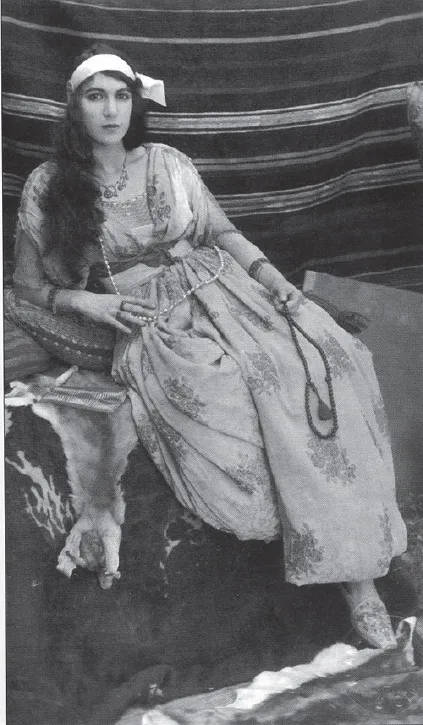
(Copyright: Albert Samama Chikly)
Ain El Ghezal/The Girl from Carthage (1924)
Samama Chikly’s talent continued to develop with his second movie Ain El Ghezal (although commonly known as The Girl from Carthage, the literal translation from the Arabic is ‘the eyes of a gazelle’). He began working on this movie in 1923 and completed it the following year. The film enjoyed moderate success at the time of its first public screening in Tunis. It relates the story of the eponymous Ain El Ghezal and her father Caid Bou Hanifa, a famous politician who wants to marry his daughter off to a rich Sheik. This forced marriage, arranged by the family, leads the girl to escape with the man she loves, a local teacher, Taleb: she commits suicide after her lover is tragically killed. When presenting Ain El Ghezal to the audience, the movie introduces a political angle as her father is cast as a powerful man through the first intertitle: ‘Ain-el-Ghezal, the daughter of Caid, leader of the country’. The marriage between Caid Bou Hanifa’s daughter and the son of the Sheik demonstrates an alliance between power and politics.
In the scene where the marriage arrangement between the two fathers takes place, the intertitle reads: ‘For Bou Hanifa to give away his daughter, Saada will give him twice as much money as is normal’. The preference of the father for money, and the acceptance of the agreement by the rich landowner, conflict with the daughter’s true feelings, as she is in love with the school teacher. The marriage depicts the struggle between knowledge and financial power, as Taleb represents the symbolic capital of knowledge, while the landowner’s son Bou Saada represents economic capital.
The film shoot took place in and around Bey hall, the King’s palace in Carthage, a fact acknowledged in the first intertitle: ‘This film with great authenticity was created partly in the palace and the gardens of Marsa official residence of the Bey: Sidi Mohamed Habib El Pacha, with his special authorization and his assistance’. Filming took place in the rooms and the gardens of the King’s palace. We are given an initial panoramic view of the house seen from the outside, surrounded by a large garden, inviting the viewer to participate in the story. The following scene introduces the protagonist in the natural environment, as we see her playing with her pet gazelle in the garden.
The film is not solely set in luxurious locations, but also looks to depict more everyday areas of the city, for instance in the scenes that follow in the Islamic school where Taleb is teaching.1 A reference to Islam and to praying is introduced in the first scene where Ain El Ghezal and Taleb are presented together. Taleb, who represents religious knowledge, is at the top of the mosque calling for prayer, while in front of him we see Ain El Ghezal, on the roof of a house, staring at him. The mosque and the actors are gradually revealed to the viewers. Later in the movie there is a long scene, divided into two parts, which is set in the Islamic school named ‘Koutab’. When watching the movie today, it is evident that this division into two scenes happened more recently, most likely during the restoration work carried out on the original print in France in 1990: this division introduces inconsistency within the narrative and highlights some of the dangers involved when attempting to salvage lost film classics.
In the movie, the intertitle refers to the Islamic school as: ‘A very modern Islamic school taught in the outdoors’. The ‘Koutab’ does not aim to offer a full education or to be a modern school.2 The Islamic teacher has as his only goal the teaching of verses from the Koran to his pupils without encouraging commentary or discussion. Taleb, the teacher and the lover of Ain El Ghezal, is given a symbolic name, for a ‘taleb’ is a seeker of science and knowledge. This is not the only name in this movie that has a double meaning: for example, the name Saada (as in the character Bou Saada) is a name which in Arabic means happiness and joy, while in Hebrew it means help and assistance. In popular belief Bou Saada refers to a type of knife and the character is linked to brutality and violence: he is introduced in the intertitle as ‘Saada, the son of the regional Sheik […] authoritarian and brutal’.
The conscious choice of the characters’ names by Chikly is most evident in the choice of the name of the main character: Ain El Ghazel evokes the beauty of a gazelle, an elegant animal typically found in desert countries. In Arabic culture, one traditionally uses the image of a gazelle’s eyes as a metaphor for great beauty, but Ain El Ghazel is not a common name in Tunisia. The title is thus a clear reference to the beauty of Haydée Chikly Tamzali, situating her movie star quality within a concept of beauty located within the North African tradition. Ain el Ghezal is dressed in a very simple and traditional Tunisian female habit. These are often sleeveless tunics made of wool, cotton, or silk, depending on the circumstances: ‘Silver threads, sequins and stranded golden threads are the ornaments of all the women’s clothes composed of: Kmajja (Shirts), Farmla (Vest), Jebba and Kadrûn (dress), Takrita (scarf), Koufiya (Hat), Kmâm (Sleeves) and Kmajja El Kabira (wedding dress)’ (Gargouri 2005: 21).
Since the traditional dress is characterized by a variety of specific types of embroidery that vary from one region to another, the dress of the main character indicates her Tunisian origin in general and not necessarily her specific region. In fact, closer scrutiny of her costume reveals a number of anachronistic details compared to the way that North African woman dressed in the 1920s, especially in Tunisia. This choice of clothes for the movie may in part be explained by the restricted budget that Samama Chikly had at his disposal at the time: in this context, it should be noted that the same dress was used twice in both The Girl from Carthage and Zohra. This practical decision also underlines that we are dealing with a fictional movie that is not overly concerned with verisimilitude, an aesthetic choice that would underpin much North African cinema of the following decades.
A similar approach underpins the use of jewellery, which represented the necessary complement of women’s clothes. The headscarves are highly decorated with silk embroidery, silver pearls, and golden jewels. Ain el Ghezal is filmed laden with jewels, but this does not correspond to a local girl’s appearance in real life. In Chikly’s film, the jewels represent ‘codes, and bear reference to various communities. They serve as signs of ethnic identity, they are often passed from mother to daughter to ensure continuity between the living and the dead’ (Milet 2008: 164). The jewels worn by Haydée Chikly Tamzali in fact seem to be a reflection of the jewels usually worn by Jewish women. Samama Chikly as director equally seems to favour the style of clothing and make-up preferred by the Jewish community. He intentionally uses a mixture of traditional objects to reflect the melting pot of different cultures living together in North Africa.
This hypothesis is supported by the drawing (tattoo) of a scorpion on Ain El Ghezal’s forehead. The scorpion is a symbol of evil in Jewish culture, and in this case it is used to protect the individual against the evil eye.3 In terms of beliefs and traditions, there are two esoteric, traditional characters in the movie, Marabout and the Degaza. In Arab Islamic culture, the Marabout is a saint who, in his lifetime, was known to be a miracle worker.4 The Degaza is equally an important figure in the culture of North Africa and ubiquitous in the lives of Arabic and Jewish women:
The Degaza occupies an important place in the life of the Jews. When a Jew falls ill, or when a young girl cannot find a husband, or even when somebody is given to drinking bukha (whiskey) excessively, the blame is put on a jun (evil spirit). The Degaza is then called in, and casts a spell using coal. (Slouschz 1927: 283)
In the movie, the Degaza offers to tell Ain El Ghezal her future in which her marriage is foretold as we see her surrounded by numerous ladies and laden with jewels. Essentially, this ‘flash forward’ is used by the director to suggest a potential future for the young girl, but it is one that does not come to pass, for in the end she chooses to take her own life, thereby challenging the authority of her father, which is not limited solely to the family, but also represents political authority. In this situation, she opposes patriarchal power and her actions constitute a rebellion against the political power of that period. Samama Chikly criticizes the contemporary political situation through this romance. Originally the movie ended with the death of the two main characters, Taleb and Ain El Ghezal; however due to the misplacement of the original footage, the sole existing copy of the movie ends with a meeting where they greet each other. Many books and movies depicts the impossible love story — e.g. Romeo and Juliet, Kais and Leila, Antar and Abla, Tristan and Isolde, Abelar and Eloise — and with this movie, Albert Samama Chikly created another classic with the impossible love story between Ain el Ghezal and Taleb.
Many years later, the topic of the arranged marriage, treated in this movie, would be reworked in a series of movies directed by Tunisian women, who would denounce the troubles associated with such relationships. In fact, from our historical vantage point, this movie appears as a pioneering work, anticipating the Tunisian feminist movement that started later in the 1930s with Tahar Haddad.5 As for his depiction of Tunisia, Albert Samama Chikly’s movie highlighted the most beautiful places in the country, which he filmed in a luxurious, picture-postcard style. Critics might claim that Chikly was perpetuating an Orientalist vision of North Africa but, on the contrary, I would argue that he was attempting to create a cinema that would engage with local myths and cultures in ways meaningful to his local audiences. An indigenous North African cinema was born.
The Birth of Egyptian Cinema
In 1923, in Egypt, Victor Rosito directed the movie Fi Bilad Tout Ankh Amoun (In the Land of Tutankhamun, 1923) in a style very similar to Chikly’s movie. This Egyptian film sought to represent ‘the Egyptian people, highlighting their nobility, hospitality and their willingness to help people in need. It also showed the reaction of Egyptians in front of the archaeologist who discovered the tomb of Tutankhamun’ (Bazzoli 2000: 57). News of the projection of In the Land of Tutankhamon was announced for the first time in the newspaper Al Ahram:
The professor Victor Rosito invited...
Table of contents
- Cover Page
- Title Page
- Copyright Page
- Contents
- Moving Image
- Notes on the Contributors
- Acknowledgements
- Notes on the Contributors
- Foreword: If I’m Wrong, I’m Right Mark Cousins
- Introduction: Revising the Classics: Opening Up the Archives of African Cinema Lizelle Bisschoff and David Murphy
- PART I. LOST HISTORIES 1924-69
- 1 The Birth of North African Cinema Ouissal Mejri
- 2 ‘Lost Classics’ in Context: Film Production in South Africa, 1920–1960 Jacqueline Maingard
- 3 Francophone West African Cinema, 1955–1969: False starts and new beginnings David Murphy
- PART II. NORTH AFRICA
- 4 Forgotten Women, Lost Histories: Selma Baccar’s (1978) and Assia Djebar’s (1978) Stefanie Van de Peer
- 5 Naked Nation: Youth, Masculinity, and the Coming Revolution in (Nouri Bouzid, 1986) Jamal Bahmad
- 6 Postcolonialism at Sea: The Tragic Ends of History in (Mohamed A. Tazi, 1989) Jamal Bahmad
- 7 Al Masir/Destiny (Youssef Chahine, 1997): ‘a luta continua’ Patrick Williams
- PART III. SOUTH AFRICA
- 8 Jannie Totsiens (Jans Rautenbach, 1970): Of Love, Loss, and Lunacy Lesley Marx
- 9 Boesman and Lena (Ross Devenish, 1973): The Politics of Place and Performance Lesley Marx
- 10 The Stick (Darrell Roodt, 1987): A Mental State Ian-Malcolm Rijsdijk
- 11 (Ramadan Suleman, 1997): or, the importance of being able to tell ‘messy’ stories at the ‘wrong’ time Lindiwe Dovey
- PART IV. FRANCOPHONE AFRICA
- 12Toads and Cowboys: Tracing a Popular African Cinema in Moustapha Alassane’s (1966) and (1966) Sada Niang
- 13 (Med Hondo, 1969): ‘They cannot represent themselves …’ Patrick Williams
- 14 (Djibril Diop Mambéty, 1970): Intertextuality, Gangster Movies, and the Language of African Film Sada Niang
- 15 Cinema and Nation-Building: (Jean-Pierre Dikongué-Pipa, 1975) Alexie Tcheuyap
- PART V. ANGLOPHONE WEST AFRICA
- 16 (Jean-Pierre Bekolo, 1997): A refusal to ‘find’ African cinema? Alexander Fisher
- 17 (Kwaw Ansah, 1983): A Cinema of Political Violence Onookome Okome
- 18 A Nollywood Classic: (Kenneth Nnebue, 1992/1993) Onookome Okome
- 19 Lost in Music? Race, Culture, and Identity in (Newton I. Aduaka, 2000) David Murphy
- PART VI. LUSOPHONE AFRICA
- 20The Birth of Fiction: On (Ruy Guerra, 1979) Raquel Schefer
- 21 (Flora Gomes, 1992): Lost Dreams/Lost in Dreams? Patrick Williams
- PART VII. EAST AFRICA
- 22 (Haile Gerima, 1976): A Revolutionary Ethiopian Film Michael W. Thomas
- 23Women’s Stories and Struggles in (Flora M’mbugu-Schelling, 1992) Lizelle Bisschoff
- Bibliography
- Filmography
- Index
Trusted by 375,005 students
Access to over 1.5 million titles for a fair monthly price.
Study more efficiently using our study tools.
Frequently asked questions
Yes, you can cancel anytime from the Subscription tab in your account settings on the Perlego website. Your subscription will stay active until the end of your current billing period. Learn how to cancel your subscription
No, books cannot be downloaded as external files, such as PDFs, for use outside of Perlego. However, you can download books within the Perlego app for offline reading on mobile or tablet. Learn how to download books offline
Perlego offers two plans: Essential and Complete
- Essential is ideal for learners and professionals who enjoy exploring a wide range of subjects. Access the Essential Library with 800,000+ trusted titles and best-sellers across business, personal growth, and the humanities. Includes unlimited reading time and Standard Read Aloud voice.
- Complete: Perfect for advanced learners and researchers needing full, unrestricted access. Unlock 1.5M+ books across hundreds of subjects, including academic and specialized titles. The Complete Plan also includes advanced features like Premium Read Aloud and Research Assistant.
We are an online textbook subscription service, where you can get access to an entire online library for less than the price of a single book per month. With over 1.5 million books across 990+ topics, we’ve got you covered! Learn about our mission
Look out for the read-aloud symbol on your next book to see if you can listen to it. The read-aloud tool reads text aloud for you, highlighting the text as it is being read. You can pause it, speed it up and slow it down. Learn more about Read Aloud
Yes! You can use the Perlego app on both iOS and Android devices to read anytime, anywhere — even offline. Perfect for commutes or when you’re on the go.
Please note we cannot support devices running on iOS 13 and Android 7 or earlier. Learn more about using the app
Please note we cannot support devices running on iOS 13 and Android 7 or earlier. Learn more about using the app
Yes, you can access Africa's Lost Classics by Lizelle Bisschoff in PDF and/or ePUB format, as well as other popular books in Languages & Linguistics & Languages. We have over 1.5 million books available in our catalogue for you to explore.