- 196 pages
- English
- ePUB (mobile friendly)
- Available on iOS & Android
eBook - ePub
About this book
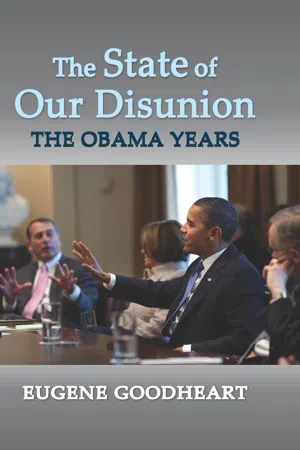
The US Constitution resists centralizing authority by granting equal power to the three branches of government, as well as the individual states. The risk inherent in the separation of powers is that the absence of a spirit of compromise can lead to the disintegration of the union. Eugene Good heart argues that the current union is in peril due to an unwillingness to cooperate on the part of contending parties. He explains how and why it has reached this point, while identifying common ground between thoughtful liberals and conservatives.Ironically, President Barack Obama, who from the outset affirmed the spirit of compromise and union, has governed in a time marked by apparently irreconcilable conflict between and within parties, and the branches of the government. Those on the extremes of the political spectrum view compromise as weakness and a lack of conviction, while those in the middle view it as necessary. Good heart argues that principle and compromise are not antagonists. He also describes the media's role in shaping and distorting public perception of political realities.Many themes that preoccupy our politics and will doubtless continue to do so in the future are addressed in this work, including gross income inequality, governmental regulation of the market, the US's role as superpower, and the relationship between liberty and equality. This book will be of interest to those concerned about contemporary political life.
Information
1
The President and His Base
I
In Holding the Center (2013), I argued that Obama, like his predecessors, in particular his Democratic predecessors, doesn’t see himself as automatically beholden to his base—either in principle or in the pragmatic exercise of his presidency. As the candidate of a party, he represents constituencies; as president he governs in the interests of the nation as a whole. How he manages the tension between part and whole is a matter determined by gift and circumstance. In a parliamentary system, the leader and his base are closely aligned; since there is no separation of powers or possibility of a divided government, the leader of the government, who is also leader of the parliamentary majority, has simply to put forth his program, confident that his party will prevail. If there are compromises that have to be made, the party leader has only his party or coalition partners to worry about and, of course, public opinion. Even if the president’s party is the majority party in both Houses of Congress, the President is not the leader in either house. He is president of all the people, including those who voted against him. The leaders are members of the houses of Congress elected by their colleagues, whose main responsibility is to their constituencies. Moreover, in order to enact major legislative initiatives in our system, having a majority is not enough. The Senate requires a super majority of 60 votes to enact most legislation and 67 votes to overcome a presidential veto. So the minority party can prevail in blocking legislation. That is why presidents with rare exception (that is, when the president has had overwhelming majorities in both houses) have necessarily, with more or less success, been compromisers. It means that a president may find himself at odds with the significant portion of his base that eschews compromise.
Bill Clinton and Jimmy Carter, Obama’s Democratic predecessors in the last four decades, perfectly illustrate, in varying degrees of success and failure, the on and off base relationship of a president to his own party. Carter had to contend with Ted Kennedy, who embodied the liberal wing of the party, Clinton with those on the left of his party, who became disaffected when he bought into the Republican call for welfare reform. In another context, we can debate the virtues or vices of the positions that Clinton or Carter took. Here my focus is on what seems to me a feature of our political system. The view that it is a desirable feature that the president not be confined to his base depends on an assumption that it is better to have more than one view of what has to be done; indeed, the multiplicity of views works against the excesses of the party spirit. It also assumes that the president, the leader of the party, has a larger understanding of what needs to be done than the rank and file representatives. These are assumptions that do not always have their basis in reality. The leader above the fray may become isolated in the bubble of his leadership and out of touch with the diverse constituencies that compose the electorate. The vitality and rationality of democratic governance may require pressure from below—as, for instance, in the ending of a destructive and unwinnable war, or insuring the preservation and strengthening of a safety net in a time of economic crisis. Pressure from below is not always salutary: see, for instance, the Tea Party’s obliviousness to the disastrous consequences of a government default in the event that the debt ceiling is not raised so that what our government already owes can be paid.
Successful governance in our system entails compromises both within and between parties. We adversely judge a compromise when it has prematurely given away too much to the other side, endangering what is essential to one’s own side: that has been the complaint about Obama. In the view of critics on the left, he begins too often in the center, the place where the compromise might legitimately wind up, and as a consequence moves further to the right than he has to. Is this true of his signature legislation, health care reform? Some critics on the left fault him for not beginning as an advocate of a single payer. During his campaign for president, he spoke of his preference for a single payer, but saw it as politically impossible. He viewed its implementation, even if its realization was possible, as extremely disruptive to the economy at a time when so much else was falling apart in the system. Even critics on the left like Robert Reich viewed the single payer as a non-starter. Should Obama then have drawn a line in the sand on a public option as a competitive alternative to private insurance, a bold though less radical reform than a single payer? Perhaps, if he had his own party united behind it. That was not the case; he could only with the greatest difficulty bring his own party to endorse a universal mandate for enrolling in health insurance (which did become his bottom line) without a single vote from the opposing party. He confronted a similar problem in his advocacy of an economic stimulus package, receiving with difficulty only three votes from Republican senators, which were indispensable for its passage. There have been instances when Obama may have prematurely compromised to the legitimate dismay of this base. In The Promise: President Obama, Year One, Jonathan Alter writes of his “playing bad poker on the stimulus” in having “offered more than $300 billion in tax cuts at the front end of the process, nearly three weeks before taking office” (116). The idea that Obama simply and always caves into his adversaries, however, is not borne out by the facts, at least in Alter’s detailed account of the first year of his presidency. (Drew Weston’s invidious contrast between Obama’s conflict averse compromises and FDR’s bold liberalism in his article, “What Happened to Obama” (NY Times) simply ignores the checkered history of Roosevelt’s presidency as well as the facts of Obama’s presidency.)
In the debt ceiling showdown, Obama has been faulted for not standing his ground and be willing to threaten the use of the Fourteenth Amendment to raise the debt ceiling by executive authority. Obama had good reason to believe that the Fourteenth Amendment, which affirms “the validity of the public debt,” does not give him the right to ignore the Congress in the matter of the debt ceiling. His teacher at Harvard, the liberal Constitutional scholar, Lawrence Tribe, made a compelling legal argument that The Fourteenth Amendment does not give the president the authority to raise the debt ceiling. Imagine the mess we would be in if Obama ignored Tribe’s advice and that of other legal advisors: not only a time and money consuming and distracting legal battle that would be decided in the Supreme Court in which the majority (conservative as well as liberal) would almost certainly take Tribe’s side, but also a strong possibility that impeachment proceedings against Obama would be initiated in the House of Representatives.
It may in fact be the case that Obama’s reputation suffers from a misunderstanding of how he negotiates with others. He is not a compromiser in the traditional political sense, someone who begins from a hard left or hard right position and works toward the middle. In characterizing him as professor-in-chief, admirers and critics view him as a university lecturer instructing the public on the subject of his policies. As it turns out, he is not particularly successful as an explainer of or arouser of public support for his policies. The preeminent explainer is Bill Clinton. Superb speechmaker and experienced teacher, Obama has, surprisingly to many, not found a consistently persuasive voice in making his case for his policies to the public. (We need, however, to be reminded from time to time how historical memory differs from historical fact. As Mario Cuomo reminds us in a recently replayed interview of him on the Diane Reims’s show (Jan. 20, 2015) at the time of Clinton’s candidacy for president, Clinton was not always the gifted explainer. His explanations were excessively informed with the complications of the thought that went into the formulation of policy.) As “professor-in-chief,” Obama’s greatest skill lies not in the lecture hall, but rather in the seminar room, which means that he is always open to all views before committing himself to a strong view on a subject, at which point he is decisive in taking a position. The seminar discussion is a learning experience for him as well as his students, in this instance his political colleagues (allies and adversaries). Such is the picture of him that emerges in Alter’s account of his conduct of cabinet meetings. The trouble is that the political arena is a not a seminar room, a place where rational and open-minded participants congregate. Politics is hardball in which hard-edged assertion and counter assertion, often impervious to the view of the other, prevails. Much as one may admire (I do) Obama’s civility and analytical open mindedness, they are not sufficient in the rough and tumble of American politics. A successful leader must be continuously forceful and persuasive in advocacy of policies, particularly in a time of crisis. Between the two models of presidential leadership, Roosevelt’s welcoming of the hatred of bankers and Lincoln’s “malice toward none,” Obama’s preference is clearly for that of Lincoln. What is lacking, however, in Obama’s speeches is the resonance of deeply felt conviction that Lincoln displayed and that Obama showed as a candidate and only occasionally as president.
The seminar analogy, I believe, provides an insight into what some critics view as an enigmatic presidency. What does he stand for? Does he know his own mind in addressing the problems that confront the nation? The seminar leader may enter the room with a view of a subject, an idea of what has to be done, but he is not absolutely committed to it. If he were, there would be no point in conducting the seminar. One of the seminar leader’s gifts is that of a listener (it is Obama’s gift), responsive to the thoughtful ideas of others, ideas that may reshape the view he had when he entered the room, indeed, that may even convert him to a view that he did not originally hold. This may explain positions that Obama has taken that seem to his critics on the left as betrayals, let alone compromises. The starkest example is Obama’s apparent conversion to significant deficit reduction and his advocacy of “the grand bargain” in which he proposed a “balanced” package of large deficit reductions (4 trillion dollars) and increased revenues or taxes (a hardly balanced ratio of 3 to 1 in cuts and taxes). The Republican victory in the election of 2010 supplanted the Democratic agenda of spending to stimulate the economy and reduce unemployment with the Republican agenda of deficit reduction. Whether Obama liked it or not, he was forced on to Republican terrain. But that does not fully account for his advocacy of “the grand bargain.” His own proposal is very much in the spirit of the “balanced” proposal of spending cuts and increased revenue of the bipartisan Bowles/Simpson Commission that Obama created as well as the proposal of the bipartisan group of senators, including the very conservative Tom Coburn and Saxby Chambliss. “The grand bargain” he proposed is not that of a compromiser. He seems to have arrived at a version of the conservative position by thinking his way to it. He had not explained to the public, which includes his liberal base, the how and why of his arrival. The Republican refusal to consider tax increases in cutting the deficit exposed their lack of seriousness about deficit reduction. What they have been serious about is preventing Obama’s reelection in 2012. Those on the left, who think focusing on deficit reduction now is a bad idea, were upset. In any event, negotiations failed. In the seventh year of his presidency, having already seen a significant reduction in the deficit, he sees no reason for reviving a consideration of “the grand bargain.”
As a non-economist, I have no way of knowing the tipping point for taking on the long-term problem of debt reduction that everyone on the political spectrum agrees exists. I trust economists such as Paul Krugman and Joseph Stiglitz when they assert that our unemployment problem requires government investment, but they have little to say about when or how sovereign debt should be handled, a political as well as economic question. The unemployment problem and stagnating wages (is it only short term?), on the one hand, and the debt problem (is it only long term?), on the other, are conflicting demands. It is almost a taboo on the left to address the debt problem now, for fear that to do so would distract attention from the urgency of reducing unemployment and increasing wages. Given political reality, I don’t see how the president can avoid the debt problem and its possible solutions. (The Administration has not received the credit it deserves for its reduction of the deficit.) What Obama needs to do is to explain what has to be done on two fronts (“growing” the economy/reducing unemployment and debt reduction) in a way that the public can understand.
The most cogent effort made in that direction that I have found is in the writing of the excellent Times columnist, David Leonhardt. He notes, “Germany has succeeded in important ways that the US has not.” The unemployment rate in Germany is 6 ½ percent with a strong safety net, in contrast 9 ½ percent in the United States with a relatively weak safety net. (The US unemployment rate has since been reduced to below 6 percent, but there is still a large component of temporarily unemployed and stagnating wages.) “The lessons [to be drawn] are not simply liberal or conservative. They are both. . . . The brief story is that despite its reputation for austerity, Germany has been more willing than the US to use the power of government to help its economy. Yet it has also been more ruthless about cutting wasteful parts of government.” Here are examples: Germany avoided the housing bubble by requiring a down payment of 40 percent. “The role starts with regulation. American regulators stood idle as the housing bubble inflated.” Government incentives encourage able bodied people who haven’t worked for years to work. According to Leonhardt, “ [T]he Social Security disability program, which is one reason nearly 20 percent of working-age American are not working, would benefit from German-like reforms. So would public sector pensions that encourage people to retire at 55 or 60.” He contrasts the negative American attitude toward labor unions with that of the Germans. “German laws and regulators have . . . prevented the decimations of their labor unions. The clout of German unions, at individual companies and in the political system, is one reason the middle class there has fared decently in recent decades. In fact, middle class pay has risen at roughly the same rate as top incomes.” He notes that “German industrial relations are characterized by a higher degree of employee participation in the managing of companies.” (“The German Example,” NY Times, June 7, 2011). Leonhardt goes on to challenge the claim that increasing consumer demand is the solution to our economic woes. One of the culprits of our economic crisis is “a fizzling of the great consumer bubble that was decades in the making.” Again the German model figures in his critique. “The notion that the US needs to begin moving away from its consumer economy—toward more of an investment and production economy with rising exports, expanding factories and more good paying service jobs—has become so commonplace that it’s practically a cliché. It’s also true. And the consumer bust shows why the old consumer economy is gone, and it’s not coming back” (“We’re Spent,” NY Times, July 18, 2011). To repeat, “the lessons [to be drawn from the German example] are not simply liberal or conservative.”
This should not mean that liberal economists such as Paul Krugman and Joseph Stiglitz are wrong to argue for the importance of government spending to reduce unemployment and increase consumer demand. It does mean that such action may not be sufficient in making necessary structural changes in the economy: for instance, in education and entitlements. It would be good to hear from Krugman and Stiglitz how they understand the economy beyond its immediate need for stimulus. We might learn from the German model, which combines fiscal discipline and government intervention. Given our nativist American exceptionalism, however, any appeal to a European model provokes vehement resistance, particularly from the hard right. (Stiglitz is in fact an admirer of European social democracies.) There would be nothing reprehensible, no “surrender” in Krugman’s tendentious characterization, in Obama’s taking seriously a good faith conservative view, which Leonhardt endorses, of what needs to be done about deficits and debt. (The qualification “good faith” is meant to distinguish it from a “conservative” view that dogmatically resists any and all increases in taxation, indeed that advocates tax cutting for the wealthy, the effect of which would be to increase the deficit and the debt.) The creative challenge for leadership is to formulate, to forcefully explain to the public, and to help enact the kind of balanced approach of government investment and fiscal discipline, at once liberal and conservative, exemplified by Germany, in an idiom that appeals to the American public. Whether our political system is up to the task of solving its problems is the as yet unanswered question.
The debate between liberals, who call for government spending to stimulate the economy and create jobs, and conservatives, who advocate fiscal austerity to reduce deficit and debt is at once economic and moral. If the debate were confined to the question of what is economically sounder, the answer would be decided by statistics, that is, by a cost-benefit analysis of spending, on the one hand, austerity, on the other. The evidence strongly favors the spenders in a time of economic crisis. But the austerians in both Europe and America introduce a puritan influenced consideration: a responsible person or family saves and spends wisely and does not incur large debts. Their Shakespearean hero is Polonius, who advises his son Laertes, “neither a lender nor a borrower be.” Krugman forcefully argues on economic grounds that the analogy between family and federal government is false and ultimately destructive. It weakens the economy and thwarts job creation. The austerians response to crisis is not very persuasive on economic grounds as the experience of austerity in the Eurozone has shown, but the austerity advocate’s conviction may have less to do with economics than with morality or a particular conception of morality. Paying debts on the individual, family, and government level reflects the character of a nation, its sense of personal, social, and national responsibility. My own sympathy is with the liberals on economic grounds. If austerity is economically unsound in times of economic crisis, then the counsel of Polonius will be counterproductive where government economic policy is concerned. (It may also be viewed as immoral if its consequence is the increased suffering of the poor.) One should, however, understand and not dismiss with contempt a layman’s resistance to the counter-intuitive view that austerity is not called for when the economy is weak and deficits and debt large. The concern with debt is part of our puritan culture along with habits of profligacy, and should not simply be viewed as callousness to the poor. Moreover, our long term debt is an economic problem, as even liberal economists acknowledge. The issue is then how to address it, a ground on which thoughtful liberals and thoughtful conservatives should be able to meet. Fiscal responsibility is a virtue and especially appealing when it goes along with a virtually full employed population and a strong safety net—as it does in Germany. (Leonhardt’s glowing portrait of the German economy and my endorsement of it were composed before austerity took hold of the Eurozone under pressure from Germany. I don’t think, however, it undermines the model that Leonhardt describes.)
II
Obama is the target of opposing critiques of his performance as president. On the one hand, he is a compromiser without strong principles and convictions. On the other, he lacks the politician’s touch in knowing how to negotiate with adversaries. If he takes a strong liberal position and sticks to it through thick and thin, he becomes a polarizing figure in the eyes of those on the right. If he presents himself as a willing compromiser, he is vulnerable to the charge of caving in by his liberal base. Every politician worth his salt has to have both principled convictions and the willingness and capacity for compromise. At any moment they are contradictory capacities, but each capacity has its time to be paramount or subordinate. FDR, who invited the hatred of the bankers and took strong stands on economic and financial reform, told advisors who proposed conflicting farm bills to find a way of weaving them together. He refrained from supporting an anti-lynching bill in the Senate, because he didn’t want to alienate Southern senators who supported his economic policies. Obama has both conviction and the capacity for compromise. The question is whether he holds firm in advocating his policies, compromising only when necessary. In one conception of compromise there is the experience of some loss on both sides, necessary loss to resolve conflict. But in another conception of compromise, there may be gain for one or both sides. If the lessons to be learned, as Leonardt believes, are neither exclusively liberal nor conservative, the common good may gain. In being willing to enter into a grand bargain with the Republicans on taxes and spending, Obama rightly or wrongly may have seen a gain for the common good, which went beyond the simple need to resolve conflict. We will never know what might have been achieved, since the bargain was never realized.
The Republican victory ...
Table of contents
- Cover
- Title Page
- Copyright Page
- Dedication
- Contents
- Acknowledgements
- Introduction
- 1 The President and His Base
- 2 The Principle of Political Compromise
- 3 Media Narratives and Their Narrators
- 4 Presidential Debates and the Media
- 5 Obama’s Executive Action on Immigration
- 6 The Constitution: Dead or Alive
- 7 Between Liberty and Equality
- 8 Does the Past Repeat Itself?
- 9 The Uncertainty Principle
- 10 On Progress
- Coda
- Index
Trusted by 375,005 students
Access to over 1.5 million titles for a fair monthly price.
Study more efficiently using our study tools.
Frequently asked questions
Yes, you can cancel anytime from the Subscription tab in your account settings on the Perlego website. Your subscription will stay active until the end of your current billing period. Learn how to cancel your subscription
No, books cannot be downloaded as external files, such as PDFs, for use outside of Perlego. However, you can download books within the Perlego app for offline reading on mobile or tablet. Learn how to download books offline
Perlego offers two plans: Essential and Complete
- Essential is ideal for learners and professionals who enjoy exploring a wide range of subjects. Access the Essential Library with 800,000+ trusted titles and best-sellers across business, personal growth, and the humanities. Includes unlimited reading time and Standard Read Aloud voice.
- Complete: Perfect for advanced learners and researchers needing full, unrestricted access. Unlock 1.5M+ books across hundreds of subjects, including academic and specialized titles. The Complete Plan also includes advanced features like Premium Read Aloud and Research Assistant.
We are an online textbook subscription service, where you can get access to an entire online library for less than the price of a single book per month. With over 1.5 million books across 990+ topics, we’ve got you covered! Learn about our mission
Look out for the read-aloud symbol on your next book to see if you can listen to it. The read-aloud tool reads text aloud for you, highlighting the text as it is being read. You can pause it, speed it up and slow it down. Learn more about Read Aloud
Yes! You can use the Perlego app on both iOS and Android devices to read anytime, anywhere — even offline. Perfect for commutes or when you’re on the go.
Please note we cannot support devices running on iOS 13 and Android 7 or earlier. Learn more about using the app
Please note we cannot support devices running on iOS 13 and Android 7 or earlier. Learn more about using the app
Yes, you can access The State of Our Disunion by Eugene Goodheart in PDF and/or ePUB format, as well as other popular books in Politics & International Relations & Politics. We have over 1.5 million books available in our catalogue for you to explore.