eBook - ePub
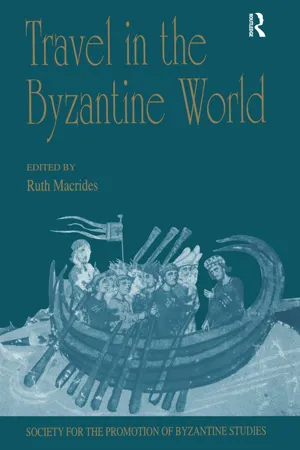
Travel in the Byzantine World
Papers from the Thirty-Fourth Spring Symposium of Byzantine Studies, Birmingham, April 2000
- 316 pages
- English
- ePUB (mobile friendly)
- Available on iOS & Android
eBook - ePub
Travel in the Byzantine World
Papers from the Thirty-Fourth Spring Symposium of Byzantine Studies, Birmingham, April 2000
About this book
The contributions to this volume have been selected from the papers delivered at the 34th Spring Symposium of Byzantine Studies at Birmingham, in April 2000. Travellers to and in the Byzantine world have long been a subject of interest but travel and communications in the medieval period have more recently attracted scholarly attention. This book is the first to bring together these two lines of enquiry. Four aspects of travel in the Byzantine world, from the sixth to the fifteenth century, are examined here: technicalities of travel on land and sea, purposes of travel, foreign visitors' perceptions of Constantinople, and the representation of the travel experience in images and in written accounts. Sources used to illuminate these four aspects include descriptions of journeys, pilot books, bilingual word lists, shipwrecks, monastic documents, but as the opening paper shows the range of such sources can be far wider than generally supposed. The contributors highlight road and travel conditions for horses and humans, types of ships and speed of sea journeys, the nature of trade in the Mediterranean, the continuity of pilgrimage to the Holy Land, attitudes toward travel. Patterns of communication in the Mediterranean are revealed through distribution of ceramic finds, letter collections, and the spread of the plague. Together, these papers make a notable contribution to our understanding both of the evidence for travel, and of the realities and perceptions of communications in the Byzantine world. Travel in the Byzantine World is volume 10 in the series published by Ashgate/Variorum on behalf of the Society for the Promotion of Byzantine Studies.
Section I
Going there — the technicalities of travel
2. Types of ships and their performance capabilities*
J. H. Pryor
Sailing ships
At the end of his Histories, Theophylaktos Simokattes (late 6th century-post 641) recounted a story of a calligrapher in Alexandria who saw in a vision the statues of the emperor Maurice and his family coming alive and creeping down from their pedestals in Constantinople.1 Nine days later a messenger bringing news of the murder of Maurice by Phokas on 23 November 602 reached Alexandria. Supposedly, a ship covered the minimum distance of around 1030 miles from Constantinople to Alexandria, at the onset of winter, in 8-8.5 days, an average speed of around 4.4 knots if sailing around the clock. But no one in their right mind would try to sail the Dardanelles or the east coast of the Aegean by night in winter. They would obviously have to do so from Rhodes to Alexandria, but that is only about 450 miles. For the rest, at that time of the year they would have a maximum of around ten hours of daylight. The actual average speed under way would therefore have had to have been an incredible 6.5 knots.
Theophylaktos's story was a 'miraculous narrative' as he wrote, and no doubt he intended his audience to recognise it for what it was. At the beginning of the seventh century no ship could reach Alexandria from Constantinople at the end of November in nine days, not even the fastest imperial dromon. To put the story in perspective, in 1798 Nelson sailed from Syracuse in pursuit of Napoleon at top speed in midsummer on 25 July with the best ships that Lord St. Vincent had been able to give him. He reached Alexandria via Korone on 1 August in 7-7.5 days: 1000 miles at an average speed of around 5.0 knots. We are asked by Theophylaktos to believe that a seventh-century ship could outperform what was the finest squadron in the British Mediterranean fleet in 1798.
According to Pliny the Elder, the senator Valerius Marianus (or Marinus) reached Alexandria from Pozzuoli in summer on the ninth day (in 8-8.5 days) 'with a very gentle breeze (... lenissumo flatu)': 1200 miles at an average speed of 5.25 knots, even if the shortest high-seas route was taken. Two imperial prefects of Egypt, Galerius (Gaius Galerius, prefect under Tiberius) and Balbillus (Claudius Balbillus, prefect in 55 A.D.) did even better. They made Alexandria from the straits of Messina in 6-6.5 and 5-5.5 days respectively: 1000 miles at 5.8 and 9.15 knots respectively.2 To put this in perspective again, Cutty Sark reached Sydney from London in 1885 in 78 days: 15,000 miles at an average speed of around 7.25 knots. Pliny asks us to believe that Roman ships could match or better the performance of one of the fastest nineteenth-century clipper ships ever built, even though the latter's average speed was greatly increased because she drove for days through the Roaring Forties at up to 15 knots.
One must be careful about accepting such data, as has been done so often. Historians are too credulous of narrative sources. Pliny's purpose in recounting such voyage times was to show what a 'marvel' (miraculum was his word) was the flax plant, used to make linen for sails.
We actually know precious little about Byzantine sailing ships. We do have the evidence of the seventh-century Yassi Ada ship,3 and we have a good reconstruction of its hull. However, since we have no idea of its sail plan, it is impossible to make any conjectures about its performance. We do not even know whether it had only one mast, since no mast step was found. How well would such a ship with an overall length of 20.52 m and a beam of around 5 m perform with only a single mast and sail? It would probably have tended to luff up into the wind badly when tacking. Can we even be confident that it had lateen rather than square sails? It probably did, but the sixth-seventh-century evidence on that issue is ambiguous.
After that we have little until the Serçe Limani ship of c. 1025, another small coaster of around 15.36 m overall length and 5.12 m beam, which may or may not have been Byzantine built. She was smaller and stubbier and flatter in the floor than the seventh-century Yassi Ada ship.4 We do now have the ship found near Bozburun on the mainland opposite Rhodes which is tentatively dated to the late ninth or early tenth centuries. Certain things are known about it; for example, that there is no evidence of mortise-and-tenon edge joining of planks, that it was probably built frame first, and that there was driven caulking between the planks. All of this is important but there is as yet no reconstruction, and no mast step or indication of the location of a mast has been found.5
Illustrations of ships exist in three manuscripts, the Khludov Psalter (Moscow, Historical Museum, MS. 129 D, fol. 88r), dated to 843-47, the Paris, Bibliothèque Nationale manuscript of the Sermons of Gregory of Nazianzus (MS. Gr. 510, esp. fol. 367v) of c. 879-82, and its contemporary the Sacra Parallela attributed to St. John of Damascus (Paris, Bibliotheque Nationale, MS. Gr. 923, fol. 207). The third depicts ships with two masts.6 But apart from these, we have only a very few and very arguable literary sources.
Can we know anything about the performance characteristics of such small coasting vessels of the empire? Much has been made of evidence from the late Roman empire, including such sources as Mark the Deacon's Life of Porphyrios of Gaza (composed after 420); however, such polemical sources should be distrusted.
Table 2.1 Durations and speeds of voyages of Porphyrios of Gaza according to Mark the Deacon7
| Reference: Date of voyage: | From: To:Distance: | Prevailing Winds: | Duration: Average speed in knots |
|---|---|---|---|
| § 6 (p. 6): ante 392 | Askalon: Thessalonike: 1180 miles/1900 km | adverse (‘a happy crossing’) | 13 days: 3.30 knots |
| §6 (p. 6): ante 392: | Thessalonike: Askalon: 1180 miles/1900 km | favourable: | 12 days: 3.60 knots |
| §26 (p. 23): 398: | Gaza: Constantinople: 1230 miles/1980 km | adverse: | 20 days: 2.20 knots |
| § 27 (p. 23): 398: | Constantinople: Gaza: 1230 miles/1980 km | favourable: | 10 days: 4.45 knots |
| § 34 (p. 29): 23 Sept. - 2 Oct. 400 | Caesarea (Palestine): Rhodes: 570 miles/920 km | adverse (‘a good voyage’): | 10 days: 2.05 knots |
| §37 (p. 31): October 400: | Rhodes: Constantinople: 580 miles/935 km | adverse: | 10 days: 2.10 knots |
| §§ 54-5 (p. 45): 18-22 April 402: | Constantinople: Rhodes 580 miles/935 km | favourable: | 5 days: 4.20 knots |
| §§ 56-7 (pp. 45-47): 22-28 April 402: | Rhodes: Gaza: 650 miles/1045 km | favourable (but hit by storm): | 6.5 days: 3.60 knots |
These records of voyage durations by Mark the Deacon are extremely unlikely to have been those of voyages actually made by Porphyrios of Gaza. They are much more likely to represent what his biographer considered to be normal durations of voyages between such destinations. And, for the most part, they sound as though he was reckoning only what could normally be achieved when under sail at sea, discounting lay-overs by night. They read as though they are about two-thirds to double what could reasonably be expected if taking into account layovers by night. An average of around four knots for voyages before the prevailing winds of summer, and of a half of that for voyages against prevailing winds, is too high, given that most of these voyages involved coastal navigation and no one would run along the coast of Asia Minor by night except in the most dire circumstances. The reported voyage from Askalon to Thessalonike in 13 days would have been impossible, except in the most extraordinarily favourable weather conditions.
The pilgrim Saewulf almost certainly travelled on a Byzantine coaster from Chalkis to Jaffa on his pilgrimage in 1102. One could wish that he was more generous with his chronology; however, he did write that Patara was a day's voyage from Rhodes. The distance is around 58 miles and although the current was adverse it was slight and his ship was driven into Patara by evening by a storm. In midsummer there should have been around 14 hours of daylight, so the boat made around 3.6 knots: good sailing. Against this, leaving Cape Chelidonia the crossing of a mere 145 miles to Paphos took three days, a slow passage at only around 2.0 knots, even counting only the daylight hours on the first and third days.
Saewulf's return voyage is ...
Table of contents
- Cover
- Half Title
- Title
- Copyright
- Contents
- Editor's Preface
- List of Abbreviations
- List of Figures and Tables
- Introduction
- Section 1: Going there — the technicalities of travel
- Section II: Getting around — the purposes of travel
- Section III: Being there
- Section IV: Going over it — representations of travel and space
- Index
Trusted by 375,005 students
Access to over 1.5 million titles for a fair monthly price.
Study more efficiently using our study tools.
Frequently asked questions
Yes, you can cancel anytime from the Subscription tab in your account settings on the Perlego website. Your subscription will stay active until the end of your current billing period. Learn how to cancel your subscription
No, books cannot be downloaded as external files, such as PDFs, for use outside of Perlego. However, you can download books within the Perlego app for offline reading on mobile or tablet. Learn how to download books offline
Perlego offers two plans: Essential and Complete
- Essential is ideal for learners and professionals who enjoy exploring a wide range of subjects. Access the Essential Library with 800,000+ trusted titles and best-sellers across business, personal growth, and the humanities. Includes unlimited reading time and Standard Read Aloud voice.
- Complete: Perfect for advanced learners and researchers needing full, unrestricted access. Unlock 1.5M+ books across hundreds of subjects, including academic and specialized titles. The Complete Plan also includes advanced features like Premium Read Aloud and Research Assistant.
We are an online textbook subscription service, where you can get access to an entire online library for less than the price of a single book per month. With over 1.5 million books across 990+ topics, we’ve got you covered! Learn about our mission
Look out for the read-aloud symbol on your next book to see if you can listen to it. The read-aloud tool reads text aloud for you, highlighting the text as it is being read. You can pause it, speed it up and slow it down. Learn more about Read Aloud
Yes! You can use the Perlego app on both iOS and Android devices to read anytime, anywhere — even offline. Perfect for commutes or when you’re on the go.
Please note we cannot support devices running on iOS 13 and Android 7 or earlier. Learn more about using the app
Please note we cannot support devices running on iOS 13 and Android 7 or earlier. Learn more about using the app
Yes, you can access Travel in the Byzantine World by Ruth Macrides in PDF and/or ePUB format, as well as other popular books in History & World History. We have over 1.5 million books available in our catalogue for you to explore.