- 268 pages
- English
- ePUB (mobile friendly)
- Available on iOS & Android
eBook - ePub
About this book
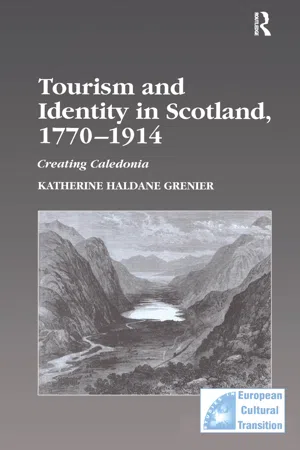
In the late eighteenth and nineteenth centuries, legions of English citizens headed north. Why and how did Scotland, once avoided by travelers, become a popular site for English tourists? In Tourism and Identity in Scotland, 1770-1914, Katherine Haldane Grenier uses published and unpublished travel accounts, guidebooks, and the popular press to examine the evolution of the idea of Scotland. Though her primary subject is the cultural significance of Scotland for English tourists, in demonstrating how this region came to occupy a central role in the Victorian imagination, Grenier also sheds light on middle-class popular culture, including anxieties over industrialization, urbanization, and political change; attitudes towards nature; nostalgia for the past; and racial and gender constructions of the "other." Late eighteenth-century visitors to Scotland may have lauded the momentum of modernization in Scotland, but as the pace of economic, social, and political transformations intensified in England during the nineteenth century, English tourists came to imagine their northern neighbor as a place immune to change. Grenier analyzes the rhetoric of tourism that allowed visitors to adopt a false view of Scotland as untouched by the several transformations of the nineteenth century, making journeys there antidotes to the uneasiness of modern life. While this view was pervasive in Victorian society and culture, and deeply marked the modern Scottish national identity, Grenier demonstrates that it was not hegemonic. Rather, the variety of ways that Scotland and the Scots spoke for themselves often challenged tourists' expectations.
Chapter 1
Mapping North Britain, 1770-1810
We are all Britons from the land’s end to the Orkneys, have all the same boasted constitution, the same laws, liberties and Christian religion to defend; and God forbid that names or sounds, affectation, illiberality or prejudice should prevent the natives of Kirkwall and Penzance from regarding each other, as Britons and fellow citizens.1
So mused John Lettice during a 1792 trip to Scotland, contemplating a report that ‘younger travelers from the south’ were ridiculing the Scottish brogue. His sentiments illustrate that although anti-Scottish sentiment continued to be prevalent in the eighteenth and early nineteenth centuries, a sense of pride in a shared British nation was also developing.2 To Lettice and others like him, trips to North Britain were opportunities to learn more about a region which was both foreign and part of the same nation, and to help put an end to prejudice by promoting a vision of Scots as patriotic contributors to the Union.
The eighteenth century was a crucial period in the development of both British and Scottish national identities after the parliamentary union of 1707. Long two separate, and frequently antagonistic, countries, Scotland and England were to be one nation. As Scots sought ways to define themselves after the loss of political independence, the long series of wars against France, Great Britain’s distinctive pattern of commercial development, and the expansion of the overseas empire encouraged the English, Scots, and Welsh to define themselves against ‘the Other’ overseas.3 The new fashion for travel in Scotland was a key ingredient in this process of nation building, showing visitors that, although in many ways still foreign, Scotland had much to offer the new nation.4 Through the now tamed and obedient Highlanders, the lavish country houses, the intriguing antiquities, the sublime and picturesque landscape, and the flourishing industries in the Lowlands, Scotland provided evidence of the benefits of the British constitution, examples of British history, specimens of a domestic landscape that rivaled classical scenery, and proof of the superiority of the British economy and social system. Travel accounts testify that one of Scotland’s central attractions in this period was the idea of North Britain as a dynamic place in the process of modernization. In many ways Scotland’s image was more progressive in the eighteenth century than anytime since. Even the Highlands, long understood as the very antithesis of Britishness, could be incorporated into this picture of economic and social progress. There, one could witness the transition from a savage, near-feudal, and poor society into a peaceful, loyal, and soon to be productive region.
The growing interest in travel in Scotland also provided a means by which Scots could both retain a sense of native pride, and at the same time promote themselves as enthusiastic citizens of the new nation. John Stoddart, an Englishman who visited Scotland in 1799 and 1800 with an artist friend, observed all across the land an ‘anxious desire to recommend the country to the affections of an Englishman.’5 Scots, too, were sightseers, and energetically publicized their country to themselves and to others by publishing their own travel accounts and writing guidebooks.6 Scotsman Tobias Smollett’s The Expedition of Humphry Clinker (1771) used a fictional tour of Scotland to argue against negative stereotypes and to call on South Britons to be more open minded towards their northern neighbors. Robert Heron, a Scot who published two guidebooks of Scotland (one for Scots and one for the English) and an account of his own travels, believed that touring one’s native country was a stimulus to patriotism. After viewing the scenery of his or her homeland, examining the character and condition of its inhabitants, and beholding the improvements made by industry, a traveler’s national pride was strengthened, and a stronger desire to make a contribution to one’s country was evoked.7 To middle- and upper-class Scots, the promotion of themselves as patriotic Britons and the assertion of their active contributions to a wider political and cultural community was one solution to their quest for a viable self-definition.
Thus, while Scotland had once been considered a place to avoid at all costs, a steady trickle of visitors began to make their way around North Britain in the third quarter of the eighteenth century, often publishing their travel journals or letters, and thereby feeding interest in the northern part of the kingdom. As early as 1759 Lord Breadalbane found that Tt has been the fashion this year to travel into the Highlands.’8 Bishop Richard Pococke, a well-traveled antiquarian known to contemporaries as ‘Pococke the traveler’ because of his trip to Egypt and the Holy Land, spent six months examining Scottish ruins and antiquities in 1760. Elizabeth Montague, well-known ‘bluestocking’ and businesswoman, enjoyed Scottish scenery and society for four weeks in 1766.9 Thomas Pennant, a naturalist, member of the Royal Academy, and experienced traveler, visited much of the mainland in 1769 and returned to explore the west coast and inner Hebrides in 1772. His 1769 A Tour in Scotland, the fullest travel account of Scotland to that point, was a comprehensive discussion of Scotland’s scenery, economy, natural history, and local customs. It was a popular success, going through five editions between 1769-1790 and was republished in 1790 with an additional volume based on the second trip.
Pennant was soon followed by Samuel Johnson and James Boswell, who roamed Scotland for three months in 1773 and published accounts of their exploits in 1775 and 1786 respectively. Their numerous adventures and Johnson’s opinionated reflections inspired an open-ended discussion about the merits of Scotland, and motivated many others to follow in their footsteps.10 Meanwhile William Gilpin assessed Scotland’s picturesque qualities in 1776 (though not publishing until 1789), and John Knox toured under the auspices of the British Society for Extending the Fisheries in 1786. By the time Lettice reached Scotland in the 1790s, enough men and women were making the trek to speak of the foundations of a tourist industry: prescribed routes sometimes followed by rote, designated sights marked off by viewing platforms, guidebooks, and a slowly evolving industry of inns, professional guides, boat and coach rental.11
Many motives lured Englishmen and women across the border: an interest in Scotland’s scenery and history, the desire to participate in what was becoming a fashionable trend, the fact that the Continent was closed to travel during the 1790s and early 1800s. Mingled with these aspirations lay a deep curiosity about their northern neighbors. As they traveled, most felt a sense of pride in the spread of British civilization and the British constitution, finding commonalties as well as differences across the border. National prejudices and superstitions were daily wearing out, said Lettice, noticing as did others that Highland dress was giving way to ‘British dress’.12 The author of Scotland Delineated rejoiced that intolerance was gradually losing ground on both sides: ‘In short, the happy era seems not so very distant, when the ENGLISH and SCOTS shall be, in every sense of the word, ONE NATION’.13
Getting to know Scotland was an act of British patriotism for eighteenth-and early nineteenth-century travelers and tourists, many of whom seemed chagrined to know so little of a place that was now part of their own nation. Often travel accounts were as much geography texts as remembrances of one’s experiences. A botanical expert and an authority on Highland customs accompanied Pennant on his second trip. Travel writers discoursed on the topography, history, economy, demography, customs, urban environment, and social structure of Scotland. Concerned to provide as accurate information as possible, many writers supplemented their observations with other research, such as Sir John Sinclair’s Statistical Account of Scotland.14 However, this ‘British’ patriotism did not exclude an Anglocentric bias. English visitors, and many Lowlanders, tended to naturalize the centrality of union with England in Scotland’s development. Many travelers and tourists conflated ‘British’ with ‘English’ pride, implying that Scotland’s role in the Union was to become more like England. By portraying themselves as ‘explor...
Table of contents
- Cover Page
- Title Page
- Copyright Page
- Contents
- General Editors’ Preface
- Acknowledgements
- List of Abbreviations
- List of Illustrations
- Introduction
- 1 Mapping North Britain, 1770-1810
- 2 The Development of Mass Tourism, 1810-1914
- 3 Land of the Mountain and the Flood: Tourists and the Natural World
- 4 ‘Free of one’s century’: Tourism and the Scottish Past
- 5 ‘A Fountain of Renovating Life’: Tourists and Highlanders
- Postscript
- Bibliography
- Index
Trusted by 375,005 students
Access to over 1.5 million titles for a fair monthly price.
Study more efficiently using our study tools.
Frequently asked questions
Yes, you can cancel anytime from the Subscription tab in your account settings on the Perlego website. Your subscription will stay active until the end of your current billing period. Learn how to cancel your subscription
No, books cannot be downloaded as external files, such as PDFs, for use outside of Perlego. However, you can download books within the Perlego app for offline reading on mobile or tablet. Learn how to download books offline
Perlego offers two plans: Essential and Complete
- Essential is ideal for learners and professionals who enjoy exploring a wide range of subjects. Access the Essential Library with 800,000+ trusted titles and best-sellers across business, personal growth, and the humanities. Includes unlimited reading time and Standard Read Aloud voice.
- Complete: Perfect for advanced learners and researchers needing full, unrestricted access. Unlock 1.5M+ books across hundreds of subjects, including academic and specialized titles. The Complete Plan also includes advanced features like Premium Read Aloud and Research Assistant.
We are an online textbook subscription service, where you can get access to an entire online library for less than the price of a single book per month. With over 1.5 million books across 990+ topics, we’ve got you covered! Learn about our mission
Look out for the read-aloud symbol on your next book to see if you can listen to it. The read-aloud tool reads text aloud for you, highlighting the text as it is being read. You can pause it, speed it up and slow it down. Learn more about Read Aloud
Yes! You can use the Perlego app on both iOS and Android devices to read anytime, anywhere — even offline. Perfect for commutes or when you’re on the go.
Please note we cannot support devices running on iOS 13 and Android 7 or earlier. Learn more about using the app
Please note we cannot support devices running on iOS 13 and Android 7 or earlier. Learn more about using the app
Yes, you can access Tourism and Identity in Scotland, 1770–1914 by Katherine Haldane Grenier in PDF and/or ePUB format, as well as other popular books in History & World History. We have over 1.5 million books available in our catalogue for you to explore.