First Published in 2017. This book was created as a result of the anger the author when he first encountered the arguments of a school of economic historians who claim that there was no Great Depression in Britain between the wars. Broadly, they suggest that while some traditional industries were badly affected, new ones like man-made fibres and electricity supply rose to prosperity. The gross national product increased over the period, and many people became steadily more affluent. Radio sets, seaside holidays, even family cars, became commonplace.
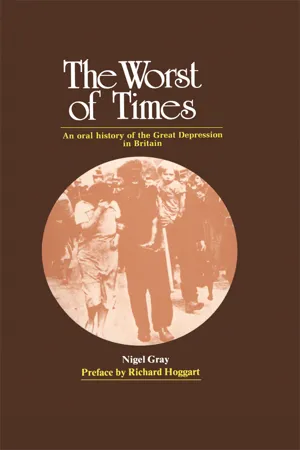
- 220 pages
- English
- ePUB (mobile friendly)
- Available on iOS & Android
eBook - ePub
South Shields
I was born in 1916 in South Shields, County Durham. Most working class children went to school and played in their bare feet, or in sixpenny rope slippers made in Japan. In extreme cases some children would be lucky enough to have what we called ‘police boots’. According to the circumstances of the family (widows etc.), children would be allowed to go to the police station and be fitted with boots. Both boots would be punctured at the top with three holes to stop parents pawning the children’s boots.
Those who were lucky enough to have boots or shoes used tacks or studs to make them last longer. I went to school one day and lots of the studs were strewn all over the playground, and I was unlucky enough to have one of these go through my foot—I was barefooted. This caused blood poisoning and my foot swelled and I had to go to the clinic. At the same time my mother had slipped from a high kerb and had broken her leg and was in hospital. I had to hop to the clinic which was about quarter of a mile away. I remember the swelling being opened and the poison pushed out. A neighbour, who had been a nurse in the T4—18 war, was good enough to dress it.
The soles of our feet were like leather. Those who survived were tough. I was as strong as a bull. We used to damage our feet, stubbing them and that, but we were always running, playing. We just took it as natural.
Some of us would be bare-footed even in winter. In the snow. But we were hard. We’d go out and start with a snowball and roll it up till it was big enough to carve it out and play inside like an igloo. We had rough old pieces of wood for a sledge and pulled each other round the streets. The old chestnut man used to stand outside the billiard halls in the winter, selling chestnuts and hot spuds.
My mother became widowed when I was seven years of age, and there were seven of us in the family. She had compensation of five shillings per child until they left school and about twelve shillings for herself We were fairly well off compared to other big families whose father wasn’t working and who were dependent on the Assistance Board. My father was in the Merchant Navy and he fell from

‘We had a stand-up in the old tin bath. One after the other.’

Back on the surface: miners from Bedwas Colliery stayed down the pit for four days and nights in protest against the corruption of the ‘owners’ union’ – ‘the first sit-in ever in this country’.


‘So these were the hunger marchers. Just ordinary people, but drafted into an army not through conscription or patriotism, but sheer necessity.’

No matter how squalid the inside of the house, keeping up appearances was all-important;

Social relaxation: draughts in a workingmen’s club.

‘My father would come home in his dirt - all sweaty clothes to be dried out.’

‘Some of the old property was plagued with bugs’: fumigating bedding before a family could move into a new council flat;

The ‘hungry thirties’: men at a Salvation Army soup kitchen.

A ‘Tommy Talker’ band: ‘they’d go round the streets collecting funds. Then they bought flour and potatoes and issued them to the people on strike’;

‘For some reason or other we were turned out of our house’: an agricultural worker and his wife, evicted from their tied cottage.
a ship’s side into the dry dock in Australia. The accident was on the Christmas Eve and he died on the New Year’s Eve. I only remember seeing my father about four times. He was always at sea. They’d take a cargo to Africa, say, and load up there with oranges. Then while they were at sea they’d get a cable, dump those oranges at sea, thousands of boxes, and go to another port because there was a better trade. They used to come from Brazil and they used to burn thousands of tons of coffee beans as fuel instead of coal to keep the world prices up. Less and less people were drinking coffee because as people got poorer it became a luxury. My brother was on a tramp steamer and once they had nothing to eat for three days except pancakes. They only had flour. Conditions got worse and worse because people would cut each others’ throats to get a job. And the employers knew it.
My mother cried when we heard he had died. All I remember is him coming home with a parrot and a huge sack of peanuts. They used to burn peanuts as well. And use them for packing.
When my father died we were in a flat: a small kitchen, a room that would be the parents’ bedroom, and then the small bedroom. There was Sally, Lily, John, Walter, Eleanor and me. Six of us in the same room. In those times I’ve heard of a brother seducing the sister etc. There were youths of about eighteen years of age in the same room with girls of fifteen, fourteen, thirteen, and so on. Overcrowded, because they couldn’t afford the rent of more rooms.
There were a lot of moonlight flits. There was one big stable where they loaned out horses and carts, or long flat barrows. Usually two loads of that would move a family. You’d borrow a barrow for sixpence a day, or 7/6d the week, if you wanted to go round collecting rags, bones, bottles or jam jars, or selling firewood. They did a roaring trade, hiring barrows.
My sister had just one attic room with two children and with only a gas ring. She couldn’t cook an economical dinner. Parents would make soup with a bone, some cabbage, a few turnips and so on. But usually we had a slice of bread in the morning. For dinner a penn’orth of each, that’s a penn’orth of fish and a penn’orth of chips; and probably a couple of slices of bread at night. That was the staple diet of the average person. It might be changed now and then with a penn’orth of pease pudding and a saveloy from the local German pork butcher’s. I was a prisoner of war for two-and-a-half years and I think I got through pretty easy because it was similar in a sense.
We weren’t entitled to school dinners. There was people in a much worse plight than we. I remember going into the cafe to buy pie and peas. It was an ordinary cafe and they used to get a ticket to go there and get a twopenny pie and a penn’orth of peas, and that was the school dinner.
My mother was pretty harassed. She did her best with what she had. There wasn’t much attention for us kids individually because there were seven of us. When it was possible there was a meal and a fire but many times we had to sit with a candle because we couldn’t afford a penny in the light. Most people went to bed very early. Especially in the winter because in the North East it gets bitterly cold. A lot of people who had electricity couldn’t afford to pay it so they used to bypass the meter with electric wires. I remember sitting one night with the light on. I was the only one at home. And these two six-foot chaps came to the door and straight in, pushed me out the way, straight to the meter box. The electricity company were allowed to employ private detectives who could enter your house without a warrant.
My mother remarried. My stepfather was a miner. A skilled face worker. Before they closed the pit he used to have to walk about a mile to the ferry, about four miles to the pit, and when he got down the pit, three miles under the sea. The Rising Sun Colliery. And it was only when he got to the face that he started getting paid. There’s one mine there under the sea that flooded. There’s 300 bodies still there. When they closed that mine the owner went bankrupt and his brother-in-law sank a shaft somewhere else and they went on getting the coal.
My mother played the piano. We had a piano at first in one rosy period when my stepfather was working.
My stepfather was good, honest, and hard working when he could work. But I saw him going downhill. He became 90% blind in the end. That was through working on the buildings. On certain buildings they use a lot of lime, and he was sifting it, shovelling it through a huge screen, and the dust blowing into his eyes and it does peel your eyes. He wasn’t fully aware of the danger from the lime. But even if he had been, he was desperate to get a job. He got the job from a builder who was an old school friend of his. He just worked on the one site until the job was finished and then he was out of work for the rest of his life. He never got bitter about going blind. Like most people who were injured in the mines or anything, they just accepted it because it was like flogging a dead horse if you tried to fight it.
He went without any luxury himself. If food was short he’d go short himself, and my mother too. He never drank and he wouldn’t even play pitch and toss. He liked his pipe and he smoked tealeaves. A lot of people did go to the billiard halls and the public libraries but a terrible lot of them just sat in their chair and were afraid to go out. My stepfather got to that stage. He’d just sit at home.. I’ve seen chaps with their nails curled right over through lack of use. Men became just like cabbages.
I was about thirteen when my mother married again. We were living in two rooms. Then after a while we moved into this haunted house. I never did see anything. There was two basements with railings outside. There was an old boy who used to sell boot laces, polishes and that kind of thing, and he used to travel all over. He was a clean old chap. And one time he asked my mother if she would let him have a room because he was getting old. One night about three o’clock there’s this terrible screaming and breaking of glass. My mother and stepfather went down and he said someone was chasing him down there and he’d smashed the glass trying to beat this chap off. He left that place and he wouldn’t go back there.
This place had been unoccupied for a year and before that it was only occupied for a fortnight at a time, but my mother didn’t believe in ghosts. Then we let the basement to a young married couple with a child and she went mad. She woke up and there was two blokes chasing her and her husband was trying to control her but he couldn’t. She was put in a mental hospital. Another couple who lived upstairs moved out because this woman had woke up and seen a head on the sideboard. My mother moved into that room because it was a nice room and she woke up in the middle of the night and she saw this chap walking across the room and through the wall, and she was absolutely paralysed. When the paralysis had stopped she woke Pop up, sweating like anything, and said what had happened. He said, ‘Ah, you’ve been eating cheese or something. Get to sleep.’ About three nights later the same thing happened and she did wake him up but he didn’t see anything. But she saw the man walk across the room again and disappear through the wall. Anyway they were decorating a couple of weeks later and they found that there had been a door leading from the next house but it had been boarded over.
My Uncle Willie was a ship’s bosun. He’d been round the world a dozen times. Tough as anything. Slept anywhere. My mother always put him up if she possibly could whenever he came ashore. This time he was ashore about three months and she put him in the top room. First night 3 o’clock in the morning he woke my mum. He said, ‘I wouldn’t sleep in that room for a thousand pounds. I’ve been round the world. I’ve been drunk and I know when I’m drunk but I wasn’t drunk last night and somebody bent over me then.’ And off he went.
My mother had the reception of her second marriage in the basement of this house. There was a couple of grey hens of beer. And they’d got a bit of a brass band down there made up of friends. It was a proper do with cheese and coffee.
My mother left the house because those who promised to share the rent left and those who came in fell behind with the rent. But it was all laid at my mother’s door. She couldn’t pay the rent or the rates. So she had to get a small place. There were seven of us in three rooms then. My sisters slept in one room, which would be the dining room, in a fold-up wardrobe bed. Then my mother and father in one room and the brothers in the other. That led to a lot of consumption and so on, that type of living.
Every grocer’s shop sold 7 and 14 lb. bags of flour, and women baked on a Sunday. Most of the children would be out collecting orange boxes to stoke the fire. It was a great day, Sunday, because there was plenty of bread, and oven bottom cakes, and scones and so on. We used to buy rusty cans of jam cheap in the market. A housewife would go any distance to save a halfpenny. A halfpenny was a candle and that was four or five hours of light. We were lucky in that we had a distant relative of my stepfather who was a butcher and he used to let us have some offcuts of meat on a weekend. Usually sausages was the nearest the average working class got to meat. One of the favourite meals, because of the gas ring, was pan-haggerty. You slice potatoes, put a layer in the flying pan. Put scraps of bacon in the middle then a layer of sliced potatoes again and fill it with water and just boil it away. Or corned beef in the middle. Meat was scarce. I don’t ever remember having cheese except for weddings and funerals. And fresh milk was absolutely out of the question. It was mainly condensed milk.
Pawn shops were as common as betting shops are today. In almost every street there was the old woman who offered her services as messenger for those people who were too proud to be seen going into a pawn shop. She was well known to the pawnbroker and could be trusted. She would get say a pound loan, the pawn shop would charge twopence per week until the pledge was redeemed. The messenger would get threepence or sixpence from the housewife. At first the pawn shops would be taking watches, jewellery etc., but as the slump became worse and people were unable to redeem the articles the old man’s suit would be in on Tuesday, out on Thursday until it was too worn out to be pawned. The old messenger, however, had her regular customers who could be trusted and was able to take a parcel of rags to pawn for a pound. This parcel would never be opened, the pawn shop charged twopence per week. It was just a way of getting round the law of money lending. The pawn shop was the bank.
Old Mrs King, she was the one in our street. If you were really desperate and you had a watch, she’d know exactly how much to get. She’d get the best price for you, so it was worth her services. The ordinary green person would be fobbed off with ten shillings for a watch that was worth ten pound. Where people were desperate the pawnbroker invariably made sure that if it wasn’t redeemed he’d have a huge profit.
I remember her husband, Mr King. He was interested in numbers. Quite clever. He used to get in the billiard hall, played billiards, watched billiards, especially winter when it was really cold and there was no fire at home. And we started noticing things about this chap. He was a very excitable man. One day he came into the billiard hall and he was telling everybody, including me, ‘See these hairs?’ He said, ‘I swallowed two orange pips three weeks ago and they’re beginning to take root.’ He couldn’t get it out of his mind. He was desperate about this tree growing out of his neck. He was a clever bloke before that. They put him away for six or seven weeks to get treatment and every year he got some other obsession like that. Otherwise he was quite harmless. Eventually he got down to studying horses, like a lot of them did. He was so clever mathematically, he’d very seldom lose at horses. He was like these professionals. He would pick out about six or nine horses, the lowest prices imaginable, ten to one on. You could have halfpenny bets then. He’d pick nine horses out. He’d double them, treble them, accumulator, and so on. And he’d probably lay out about fourpence ha’penny on all those horses, and he was really happy at the end of the day if he had ninepence to pick up or sevenpence. Because you could buy ten cigarettes for threepence ha’penny at the cut-price shop. He used to spend every spare minute studying horses. But he always came out with twopence or threepence profit per day which was his cigarette money. He never bought a newspaper, he was shrewd. The newspapers would come out at two o’clock with the one o’clock winner in it. And the newspaper boys would be dashing about the streets, and then they’d dash back and have the two o’clock race winner stamped on them, and so on, until all the races were stamped on or they all were sold. He’d ask the chaps in the billiard hall, ‘What won the one o’clock?’ And these chaps decided to play a trick on him. They knew what he’d backed. They said White Plains. He said, ‘Cor!’ and he used to jump right up in the air if he got a winner. Two o’clock. ‘What won it?’ Brown John. ‘Cor!’ And so on. Six horses. They all come up. He’s working it out because he would have won a fortune. Then he went and bought a newspaper. Well that sent him madder than ever, poor blighter. He went right down. He had to go in every year after that. But there was quite a few did go round the bend because of the hopelessness.
When I was at school we lived opposite the railway station and lots of men used to be standing there waiting for trains to come in with posh people coming for their holidays. The rich were really rich. Your old taste buds started when you passed the hotels and restaurants and you could smell the food. But the men used to stand there with these flat barrows waiting. The boys like myself wouldn’t be allowed there. ‘Geroff!’ But we’d get there when the season finished. It wasn’t worth the men hanging about but now and again one or two people would come in with their suitcases. I remember one day a huge suitcase as big as myself. I said, ‘Carry your bag, madam?’ ‘Yes.’ ‘Where to?’ And this was one of these big ...
Table of contents
- Cover
- Half Title
- Title
- Dedication
- Contents
- Acknowledgements
- Preface
- Introduction
- Manchester
- Caerphilly
- London
- Ashton under Lyne
- South Shields
- Bonnybridge and Salford
- Barnsley
- Leicestershire
- Rochdale
- Aberdeen
- Forest of Dean
- Lancaster
- Voices
Trusted by 375,005 students
Access to over 1.5 million titles for a fair monthly price.
Study more efficiently using our study tools.
Frequently asked questions
Yes, you can cancel anytime from the Subscription tab in your account settings on the Perlego website. Your subscription will stay active until the end of your current billing period. Learn how to cancel your subscription
No, books cannot be downloaded as external files, such as PDFs, for use outside of Perlego. However, you can download books within the Perlego app for offline reading on mobile or tablet. Learn how to download books offline
Perlego offers two plans: Essential and Complete
- Essential is ideal for learners and professionals who enjoy exploring a wide range of subjects. Access the Essential Library with 800,000+ trusted titles and best-sellers across business, personal growth, and the humanities. Includes unlimited reading time and Standard Read Aloud voice.
- Complete: Perfect for advanced learners and researchers needing full, unrestricted access. Unlock 1.5M+ books across hundreds of subjects, including academic and specialized titles. The Complete Plan also includes advanced features like Premium Read Aloud and Research Assistant.
We are an online textbook subscription service, where you can get access to an entire online library for less than the price of a single book per month. With over 1.5 million books across 990+ topics, we’ve got you covered! Learn about our mission
Look out for the read-aloud symbol on your next book to see if you can listen to it. The read-aloud tool reads text aloud for you, highlighting the text as it is being read. You can pause it, speed it up and slow it down. Learn more about Read Aloud
Yes! You can use the Perlego app on both iOS and Android devices to read anytime, anywhere — even offline. Perfect for commutes or when you’re on the go.
Please note we cannot support devices running on iOS 13 and Android 7 or earlier. Learn more about using the app
Please note we cannot support devices running on iOS 13 and Android 7 or earlier. Learn more about using the app
Yes, you can access The Worst of Times by Nigel Gray in PDF and/or ePUB format, as well as other popular books in History & World History. We have over 1.5 million books available in our catalogue for you to explore.