- 198 pages
- English
- ePUB (mobile friendly)
- Available on iOS & Android
eBook - ePub
About this book
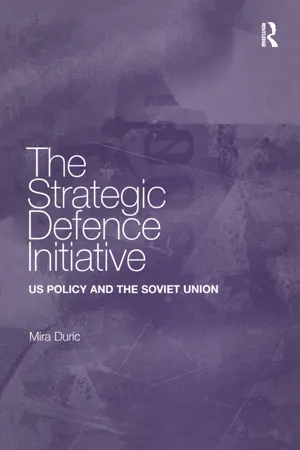
Central to US foreign policy, the Strategic Defence Initiative (SDI) was launched by Ronald Reagan in 1983. While the Reagan administration failed to deploy the SDI system, it featured prominently in the relationship between the US and the Soviet Union. This insightful book examines SDI and the Reagan administration through an evaluation of the role of the SDI in the end of the Cold War. Presenting an extensive range of primary and secondary material together with interviews, the book will be welcomed by academics and upper level students interested in politics and history.
Information
Chapter 1
The Strategic Defence Initiative
Introduction
Addressing the nation on 23 March 1983, President Ronald Reagan launched the Strategic Defence Initiative (SDI), a defensive system which would make nuclear weapons ‘impotent and obsolete’.1 The system would form a space-based defensive shield – a kind of an invisible astrodome – using the high technology of futuristic space and ground-based laser weapons, and particle beams. Providing a layered defence, the objective of SDI would be to protect the US from nuclear attack by intercepting incoming missiles at various points along the missile trajectory high above the earth.2 SDI was dubbed ‘Star Wars’ by critics.
The Evolution of Ideas
History of SDI
Defence against ballistic missiles started in the late 1940s, and early 1950s. By the mid-1950s, work on the actual systems was substantially underway.3 The origin of ballistic missile development could be traced back to Adolf Hitler’s Germany and the September 1944 launch of the V-2 ballistic missile against London, England. Research by the German physicists eventually led to work on anti-ballistic missiles (ABM) in the US in the 1960s. The origins of this development was the exodus of scientists from Germany in the 1930s. Amongst these was Hungarian Edward Teller, who played a significant role in the origin of the SDI.4 The idea of laser defence emerged out of the ‘Manhattan Project’ on which some of these scientists were working, though Dr Edward Teller continued to insist that the ‘technical initiative for the X-ray laser came from the Soviet Union’.5
The Soviet ABM Development: The Leningrad System and the Moscow ABM System
Anti-ballistic missile (ABM) work (which featured the launching of ground-to-air missiles) benefited from German scientists who perfected the Wasserfall surface-to-air missiles in Germany during the Second World War. The Germans reported that a Soviet ABM program was underway.6 US U-2 confirmation of this, in April 1960, revealed Soviet progress in developing the Sary Shagan (Khazakhstan) test complex for anti-ballistic missiles. Near the Kapustin Yar ballistic missile test range impact area, on the periphery of Lake Balkhash, Siberia, very large phased-array radars were detected which set a precedent in ballistic missile early warning. By the early 1960s, nuclear test chambers at Sary Shagan were constructed. Both the Leningrad system and the Moscow (or ‘Galosh’) system were developed there.7
The Leningrad system was deployed in the early 1960s and removed in 1963. Although debate continues on whether it was an advanced air defence system, whether it had an ABM mission, or had the capability to do both, it was an integral development which led to later ABM systems. The developers of the system continued to work on advanced defensive systems.8 Moscow’s Galosh system – the city’s own mini SDI – was deployed in the early 1960s and continues to remain in operation. Sixty-four above-ground launchers and nuclear-armed interceptors, and several radars were situated at four complexes around a ring forty to fifty miles from the centre of Moscow. Two immense radars south-west of Moscow and larger radars on the periphery of the Soviet Union completed the world’s only operational ballistic missile defence (BMD) system.9 This remains in operation today. On December 18 2002, The Daily Telegraph stated (regarding the Moscow ABM system) that a ‘nuclear defence system remains in use by Russia to defend Moscow’.10
The nuclear power work programme carried out by the Russians was viewed by observers as work having strong relevance to research into particle beams, which were one of the main SDI technologies. Similarly, research into the hydrogen bomb (which scientist Edward Teller wanted to build) was invaluable for some aspects of the SDI. Research into fusion weapons was vital to understanding the behaviour of high energy particles.11
Edward Teller and the US ABM System: From ‘Sentinel’ to ‘Safeguard’
The technology of the SDI was the dream of Edward Teller, who wanted nuclear weapons to stop ballistic missiles in flight. However, his proposal was different to that of the SDI. Teller favoured a defence system powered by a nuclear X-ray laser which would set off explosions in space. The nuclear system would be launched from missiles on submarines. Reagan never liked the idea of using nuclear explosions. He wanted a non-nuclear defence. Teller later revealed that Reagan had a better idea than him. Reagan wanted ‘a defensive screen that could intercept those missiles when they came out of the silos’.12 Teller helped to establish the Lawrence Livermore National Laboratory in Livermore, California, in 1951–52. It was a special research laboratory. On Teller’s affirmation that the USSR could build a shield against nuclear missiles, the government consequently spent millions of dollars on Safeguard, the US ABM system.13
During John F. Kennedy’s presidency, Teller’s campaign for research into nuclear anti-missile systems led to Operation Starfish; on July 9 1962, the US detonated a nuclear bomb in space from a missile launched from Johnston Atoll in the Pacific. The explosion, according to David Baker, marked the beginning of the secret work on the SDI.14 In the Lyndon B. Johnson administration (in the late 1960s), the US was proceeding with its own ABM system, known as the ‘Sentinel’, as protection against a possible Chinese intercontinental ballistic missile (ICBM) attack. President Richard Nixon transformed Sentinel to the ‘Safeguard’ system. The ABM system was deployed in 1973 to protect missile silos at Grand Forks, North Dakota. It was deactivated months later.15
US deployment of the Safeguard ABM system alarmed the Soviets (who had their own Galosh ABM system) about American technology. Negotiations proceeded to insist on a limitation on ABM systems, which resulted in the 1972 ABM Treaty. Official historian of the Strategic Defense Initiative Organization (SDIO), Donald R. Baucom, states that the ‘use of Safeguard as a bargaining chip was the principal US strategy in the 30 months of SALT talks that culminated in May 1972 with the signing of the ABM Treaty’.16 President Nixon insisted there would be no treaty unless the Soviets agreed to limitations on offensive forces, a condition which the Soviets disliked. However, their eagerness for the 1972 Treaty forced them to accept the Interim Agreement on Offensive Missiles.17 Strong public and Congressional opposition to ABMs of any kind compelled the Nixon administration to reach an accord.18 The precedent for the Sentinel and Safeguard system was the US Army’s 1960s anti-ballistic missile called NIKE-ZEUS.19
The Political Will: Ronald Reagan
The Pentagon needed to protect its missiles and this provided Edward Teller with the military interest in ballistic weapons research and development. All that was needed was a political commitment, and for this, Teller gathered a gr...
Table of contents
- Cover
- Half Title
- Dedication
- Title Page
- Copyright Page
- Table of Contents
- Acknowledgements
- Introduction
- 1 The Strategic Defence Initiative
- 2 The Soviet Reaction to the SDI
- 3 The Reykjavik Summit: October 11–12 1986
- 4 US–Soviet Relations after the Reykjavik Summit
- 5 Strategic Defence: The Post-Cold War and Post-September 11 World
- Conclusion
- Selective Bibliography
- Index
Trusted by 375,005 students
Access to over 1.5 million titles for a fair monthly price.
Study more efficiently using our study tools.
Frequently asked questions
Yes, you can cancel anytime from the Subscription tab in your account settings on the Perlego website. Your subscription will stay active until the end of your current billing period. Learn how to cancel your subscription
No, books cannot be downloaded as external files, such as PDFs, for use outside of Perlego. However, you can download books within the Perlego app for offline reading on mobile or tablet. Learn how to download books offline
Perlego offers two plans: Essential and Complete
- Essential is ideal for learners and professionals who enjoy exploring a wide range of subjects. Access the Essential Library with 800,000+ trusted titles and best-sellers across business, personal growth, and the humanities. Includes unlimited reading time and Standard Read Aloud voice.
- Complete: Perfect for advanced learners and researchers needing full, unrestricted access. Unlock 1.5M+ books across hundreds of subjects, including academic and specialized titles. The Complete Plan also includes advanced features like Premium Read Aloud and Research Assistant.
We are an online textbook subscription service, where you can get access to an entire online library for less than the price of a single book per month. With over 1.5 million books across 990+ topics, we’ve got you covered! Learn about our mission
Look out for the read-aloud symbol on your next book to see if you can listen to it. The read-aloud tool reads text aloud for you, highlighting the text as it is being read. You can pause it, speed it up and slow it down. Learn more about Read Aloud
Yes! You can use the Perlego app on both iOS and Android devices to read anytime, anywhere — even offline. Perfect for commutes or when you’re on the go.
Please note we cannot support devices running on iOS 13 and Android 7 or earlier. Learn more about using the app
Please note we cannot support devices running on iOS 13 and Android 7 or earlier. Learn more about using the app
Yes, you can access The Strategic Defence Initiative by Mira Duric in PDF and/or ePUB format, as well as other popular books in Politics & International Relations & International Relations. We have over 1.5 million books available in our catalogue for you to explore.