- 338 pages
- English
- ePUB (mobile friendly)
- Available on iOS & Android
eBook - ePub
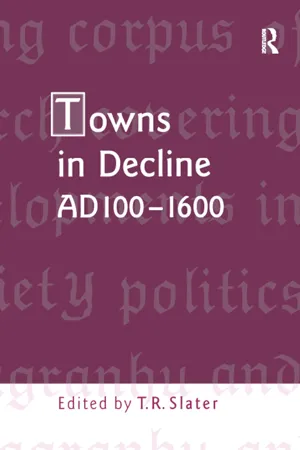
Towns in Decline, AD100–1600
About this book
Many European towns have experienced loss of population, degradation of physical structure and profound economic change at least once since the height of the Roman Empire. This volume is an examination of the various causes of these changes, the results which flowed from them and the reasons why some urban centres survived, revived and eventually flourished again while others failed and died. The contributors bring to bear the techniques of history and archaeology, the perspectives of economics, agronomy, medicine, architecture and planning, geography and law, to the study. The result is a synthesis which connects the Decline of the Roman Empire to the effects of the Black Death and the economic transformation of Renaissance Florence.
CHAPTER ONE
What is urban decline: desolation, decay and destruction, or an opportunity?
A careful consideration of, and sensitivity to, the language of urban decline was one of the first consequences of the conference from which this book derives. Much of the interest in premodern urban decline comes from the debate generated in the late 1970s and 1980s over the extent of urban economic decline in late-medieval England, following the ravages of the Black Death on urban populations in the period after 1348.1 The way in which this debate was limited to the economy and population of towns, and frequently of particular towns, produced a model which envisioned three types of consequences. First, there were the effects on urban population, for which the estimates of reduction usually coalesced at about half to two-thirds of those pertaining in the second half of the thirteenth century. Secondly, there were the consequences for the urban economy of this dramatic decline in both the urban craft workforce and the agricultural workforce producing food for the urban population. Thirdly, there was the physical decline of the urban fabric with decayed tenements and grass-grown streets, which included the removal altogether of some small urban centres. These ‘D’ words: decline, decay and destruction, however, are not necessarily the irrevocable outcomes of periods of urban change marked by smaller numbers of people living and working in towns. For some people, such periods could be times of opportunity and, though the community might be smaller, living standards of individuals could be enhanced.
This sensitivity to language is also necessary in the interdisciplinary and international exchange of ideas. Different disciplines discuss towns in very different ways, and ideas which might be commonplace in one often need to be explained with considerable care if assumptions and evidence which support idea, method or theory are used in another discipline. In much the same way, groups of scholars in different language realms also carry intellectual baggage, which can seem either stimulatingly new or stultifyingly old-fashioned to researchers in another language realm who are asking different questions in a different cultural context. Explaining these contexts is often a necessary preliminary to academic debate. Cohn draws attention to the differences between British and Italian urban historians in Chapter 13. In the same way, Dietrich Denecke, a historical geographer from the University of Göttingen in Germany, stimulated a discussion of considerable vigour in his keynote address opening the conference. In examining ‘Processes of decline and stagnation in the towns of central Europe’, he made much use of legal burghal rights in defining his sample of towns. Such definitions are anathema to British medieval historians, who have long ignored these legal niceties for socio-economic bases of the definition of what constitutes a town. However, in central Europe the legal definition of a town was an essential urban attribute well into the Early-Modern period and using it as one of the essentials of urban definition is both acceptable and necessary.
The broad historiographical context in which the debate about decline and growth in late-medieval towns has taken place, and with which this review begins, has been provided by the seminal contributions of Postan,2 the original pessimist, and their refutation by Bridbury, the original and controversial optimist.3 The period with which this debate is concerned stretches from the initial impact of the great plagues of 1348, 1361 and 1369, through to the 1530s, by which time the evidence of demographic and economic recovery had become widely evident and a sustainable ecological regime re-established in Britain.4 Viewed from a biocultural perspective this period was one of inherent instability, since the incidences of bubonic plague were recurrent throughout and, indeed, remained endemic in Britain until 1665, and in Europe until 1707.5 The massive exogenous shock that the initial and subsequent experiences of catastrophic mortality entailed required the establishment of a new equilibrium between European populations and their natural and built environments. This inevitably affected the urban sector of every European society; indeed, it was urban society that was at greatest risk to renewed outbreaks of plague, the only effective protection being to leave town as quickly as possible.6
The development of urban history as a discipline in its own right in the 1950s and 1960s added to the flow of published material from traditional history and economic history. The result of this distinctively urban perspective was to shift the positive view taken of the late-medieval period in the 1960s towards a distinctly more negative outlook in the 1970s. The cumulative historical gloom generated by Clark and Slack7 culminated with Phythian-Adams’s Desolation of a City, a study of late-medieval Coventry.8 In the late 1970s and 1980s, the arguments about urban growth or decline in the later medieval period erupted into a great debate as numerous detailed studies of particular towns were completed, using an increasingly wide range of data and increasingly sophisticated statistical methods.9 Part of the debate was occasioned by the tendency of different authors to use either population growth or urban wealth as their principal measure of urban growth. As Susan Reynolds has pointed out, it is easy to confuse the evidence of population and prosperity, and the use of taxation records invites such confusion.10 In the 1520s, Lavenham was the thirteenth richest place in England, but had less than 1,000 inhabitants. It was a town, but it was a very small one and had a particular and distinctive economy which brought great wealth to a small group of privileged clothiers. The debate was rejoined by Bridbury in 1981, in a lively restatement of the optimist case,11 and the course of the debate was summarized by Palliser in a general survey at the end of the decade.12
This book, reflecting the conference, revisits this classic period of the urban-decline debate only in one chapter, that by Alan Dyer (Chapter 12), who himself criticized the debate as ‘blinkered and distorted’. Most of the book is concerned to examine particular periods, or particular regions, from a broader perspective and over a longer time period than has been the norm in the debate so far. There are studies of Wales, and Ireland, and central Europe, over the whole later-medieval period, and of Tuscany over a rather shorter period, so that these questions of growth and decline in the urban economy overall, the characteristics of the building fabric, the cultural response of urban societies, and the prosperity of particular individuals within towns can be examined from a broader point of view. More distinctively still, the debate about urban decline is just as pertinent to the late-Roman and early-medieval centuries as it is to the late medieval, but for these times the debate has hardly been joined. The material available for studying these periods is very different from that of the late-medieval centuries, being dominated by archaeologically derived data and artefacts, but the questions are the same. Indeed, urbanization in high and late-medieval Europe was intimately coupled with the processes of territorial expansion and contraction, as it was in Roman times. Towns were the means whereby aristocratic élites, in the diaspora which began in the eleventh century, could establish their hegemony over conquered territories.13 Thus, the central Danube region, Ireland and Wales were all frontier territories in the process of the making of modern Europe. In this they were little different from the colonial empire-building project of the Romans, who also secured and administered their rapidly expanding territory by means of newly founded and newly planned towns.14 The process of colonization, in both Roman and medieval times, inevitably led to some failures; towns founded in the wrong places and unable to gain a place even on the lowest rung of the urban economic ladder are not, therefore, evidence of urban decline, but of the failure of urban planning. It is instructive to compare the medieval colonization of Wales and Ireland by the Normans in total, since the former was largely successful, the latter largely a failure; consequently, medieval towns in Ireland had little success and much of the system had to be refounded in the seventeenth century. In widening the agenda of the debate on urban decline chronologically, conceptually and geographically, the more specifically English experience, which has been its focus hitherto, can itself be enlightened by insights which add some rigour to the terminological sloppiness with which words like ‘crisis’, ‘decline’, ‘decay’ and ‘desolation’ have been employed. Also, by extending consideration of the issues back in time from a limited late-medieval perspective, the debate can be placed within the long-term development of the European urban system.
Late-Roman and early-medieval decline
Part I of this book examines evidence for urban decline from the late-Roman period, through the Dark Age or Migration period, and on to the tenth century in Europe; it uses both historical and archaeological evidence. Neil Faulkner begins (Chapter 2) by suggesting the way in which debate on this period has also been polarized between two extreme views which have tended to reflect the times in which authors were living. In the 1930s, the picture presented was one of economic crisis and physical decay, from the third century onwards, in most of the towns of the western Roman empire, including Britain; whereas, in the post-1945 period, Frere painted a picture of Romano-British prosperity well into the fifth century.15 Both theses, Faulkner suggests, were erected upon equally impressionistic and anecdotal evidence. Faulkner himself uses both the totality of the vast increase in Roman urban archaeological excavations since the 1960s and the power of modern computer-based statistical methodologies. These techniques have already been used on the enormous archaeological archive from London excavations to suggest that that city, in fact, began to decline quite substantially from c.AD 150. Thus far, London has been argued as a special case, but here Faulkner analyses the evidence for construction work in sixteen of the largest cities in Roman Britain. In total, this chapter uses some 1,400 buildings from 300 excavation sites in the sixteen towns in the analysis. He begins with an analysis of the number of rooms in use in the building sample through time. This shows a steady increase to the early third century, nearly a century of stability and then a very steep decline after AD 300. By 400 the number of rooms in use was only 10 per cent of the peak number. Examination of some of those towns with large samples of evidence shows variations in the pattern. Especially notable is the fact that St Albans was not a town which was in any way exceptional in its period of decline and is not therefore a place which can be argued for late-Roman to early-medieval urban continuity as others have suggested. By way of contrast, Lincoln is shown to be a place where the late-Roman city’s population declined exceptionally slowly compared with other places.
A second theme is then developed by Faulkner to investigate the proportions of high- and low-status private buildings, and four groups of official public buildings in the sample cities. This analysis shows the type of building activity that was taking place in towns over the whole Roman period. In particular, it demonstrates that despite population decline, Roman towns in the late-third/early-fourth, and the late-fourth centuries respectively underwent construction booms in which large houses, official buildings and town defences were the main components. In other words, Roman towns were very much the administrative, tax-collecting and military centres of the late-Roman empire in Britain, with a few people making a good living from these functions. Trade and manufacturing had declined absolutely and these places were therefore very different from their second-century predecessors. However, says Faulkner, they were very definitely towns and, given the circumstances of the times, they were successful ones.
Neil Christie, using historical and archaeological sources, widens these perspectives to the whole late-Roman western empire in Chapter 3, but he concentrates particularly on the heartland of empire in Italy itself. There were two major changes which remodelled the late-Roman townscape: the military necessity for defences, and the removal or conversion of pagan temples into Christian churches. The steady militarization of the empire, and of its towns, and the new state religion meant that the successor Germanic states strove to retain this effective administrative system, thereby explaining the continuity of living in so many Roman towns through into the medieval period. The construction of late-Roman defences, Christie believes, was only rarely undertaken in panic and in response to a direct threat. More usually they were built over extended periods and with considerable pride on the part of the town’s inhabitants. Obviously, they involved much clearance work in suburbs, cemeteries and approach roads, and their defensive capabilities were undoubted compared with their imperial predecessors. However, parts of demolished temples, gravestones from cemeteries on the suburban approach roads, and inscriptions from cleared buildings were often carefully used in the lower parts of the new walls as features of display; remembrances of the past. At the same time, suburban residents were enabled to remove inside defence circuits and build themselves new homes because of generally lower town populations.
Christie has no doubts that these late-Roman towns were also decaying physically in many respects. Public buildings were no longer properly maintained and were too large for smaller populations, so that they too became sites which could be taken for other purposes, including industry or residence, in much the same way as was to happen following the dissolution of the monasteries in 1530s’ England and Wales, whilst cheaper timber-framed building began to predominate over stone buildings. Constantly renewed laws trying to prevent decay, illegal occupation and deliberate destruction of buildings was a feature of urban governance at this time, and is something that was to be repeated in fifteenth-century Coventry in similar circumstances of economic crisis (see Chapter 11). The water supply and sewage disposal systems also began to break down, but people adapted to the situation by digging wells and building privies. Not surprisingly, the rich moved to the countryside, where life was healthier, giving further analogies with post-Black Death Europe. In doing so, another opportunity opened up for poorer people to subdivide grand houses in town for multi-occupation and to cultivate garden ground for foodstuffs. It was in these very greatly changed late-Roman towns where, increasingly, the Christian Church began to be the most significant organizational institution.
It is the emergence of that institution in late-Roman Gaul and its early-medieval successor states which is the subject of historian Stephen Loseby’s Chapter 4. In Gaul, most civitas capitals of the late-Roman period were also the seats of bishops of the Christian Church, because the administration of the state religion came closely to parallel that of the civil powers. Most of these places retained that religious administrative function through into the Merovingian period and thereby remained distinctive, and probably proto-urban, in terms of monumental building complexes and the service and administrative functions required by the Church. Some places ceased to be diocesan centres; however, rather more smaller secondary centres were promoted to see towns than were demoted, so that the area of dioceses got progressively smaller in some parts of Gaul, both in the late-antique and early-medieval periods. Cities continued to be the centres from which the Franks administered their territory, taxed people and mustered soldiery until the seventh century. Only around the outer fringes of Gaul, in Brittany, in southern Aquitaine, in Belgica and the Rhineland did the Roman network of diocesan centres begin to break down as the Franks failed to maintain their administrative grip in these areas. In the heartland of their territory, it was only in the southern part of the Massif Central that diocesan, and therefore urban, failure is readily apparent in three adjoining dioceses, where the see centre was moved to more flourishing settlements than the original very small Roman civitates. Over most of Gaul, Roman towns were to re-emerge as towns in the early medieval period.
In Britain, the assiduous reporting of the long-running archaeological excavations by Graham Webster and Philip Barker of sites in the abandoned Roman civitas capital of Wroxeter means that their findings are already well-known. However, the very recent publication of the final excavation reports means that it is now possible to review the whole in a more reflective light.16 Roger White has been involved with these excavations over a long period, as well as codirecting the recent Wroxeter Hinterlands Project, which has sou...
Table of contents
- Cover
- Half Title
- Title Page
- Copyright Page
- Table of Contents
- List of tables and figures
- Notes on contributors
- Preface
- 1 What is urban decline: desolation, decay and destruction, or an opportunity?
- Part I Late-Roman and Early-Medieval Urban Decline
- Part II Late-Medieval Urban Decline
- Index
Trusted by 375,005 students
Access to over 1.5 million titles for a fair monthly price.
Study more efficiently using our study tools.
Frequently asked questions
Yes, you can cancel anytime from the Subscription tab in your account settings on the Perlego website. Your subscription will stay active until the end of your current billing period. Learn how to cancel your subscription
No, books cannot be downloaded as external files, such as PDFs, for use outside of Perlego. However, you can download books within the Perlego app for offline reading on mobile or tablet. Learn how to download books offline
Perlego offers two plans: Essential and Complete
- Essential is ideal for learners and professionals who enjoy exploring a wide range of subjects. Access the Essential Library with 800,000+ trusted titles and best-sellers across business, personal growth, and the humanities. Includes unlimited reading time and Standard Read Aloud voice.
- Complete: Perfect for advanced learners and researchers needing full, unrestricted access. Unlock 1.5M+ books across hundreds of subjects, including academic and specialized titles. The Complete Plan also includes advanced features like Premium Read Aloud and Research Assistant.
We are an online textbook subscription service, where you can get access to an entire online library for less than the price of a single book per month. With over 1.5 million books across 990+ topics, we’ve got you covered! Learn about our mission
Look out for the read-aloud symbol on your next book to see if you can listen to it. The read-aloud tool reads text aloud for you, highlighting the text as it is being read. You can pause it, speed it up and slow it down. Learn more about Read Aloud
Yes! You can use the Perlego app on both iOS and Android devices to read anytime, anywhere — even offline. Perfect for commutes or when you’re on the go.
Please note we cannot support devices running on iOS 13 and Android 7 or earlier. Learn more about using the app
Please note we cannot support devices running on iOS 13 and Android 7 or earlier. Learn more about using the app
Yes, you can access Towns in Decline, AD100–1600 by Terry Slater in PDF and/or ePUB format, as well as other popular books in History & World History. We have over 1.5 million books available in our catalogue for you to explore.