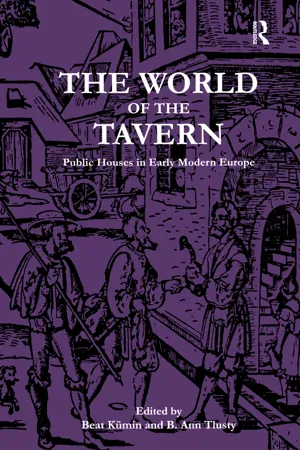
- 264 pages
- English
- ePUB (mobile friendly)
- Available on iOS & Android
eBook - ePub
About this book
The subject of drink received a great deal of attention from early modern Europeans. Preachers, physicians, authorities, artists and travellers all addressed it from a range of different perspectives. At the same time, inns, taverns and alehouses served as multifunctional centres in towns and villages throughout Europe. This combination resulted in a wealth of sources, both institutional and cultural, which are only now beginning to be explored. This anthology features new research on public houses in England, Russia and the German lands. In a series of general, thematic and regional studies, contributors engage with broader debates in early modern history, shedding light on such key issues as consumption, travel and communication, state building, confessional identity, fiscal practice, gender and household relations, and the use of public spaces. The result is a volume that should appeal to anybody with an interest in early modern cultural history.
Information
Preface
As much as we would like to claim that the idea for this collection emerged while drinking in a historic public house, it actually originated like most academic projects these days: through electronic contact of two historians working on related themes. When the editors finally met in person, however, it was in the congenial environment of a Munich beer garden. We are grateful to all contributors for responding to our invitation and for their patience in dealing with our enquiries. We would also like to thank the staffs of all the record repositories and institutions that provided assistance and granted copyright clearance for the reproductions in this volume.
Warwick and Lewisburg,
Spring 2002
Spring 2002
B. K. AND A. T.
The World of the Tavern: An Introduction
Beat Kümin and B. Ann Tlusty
From the earliest studies of the topic right through to the essays featured in this volume, scholars have acknowledged the multifunctionality of public houses and their importance as social centres. Innumerable authors refer to the phenomenon in more or less detail, from Antiquity and the Middle Ages to modern times,1 in areas ranging from the Indian subcontinent to the American frontier.2 As yet, however, there has been no attempt at a synthesis for early modern Europe. This is in spite of the fact that the subject of drink received a great deal of attention from early modern writers, who left the modern scholar with a wealth of sources for exploitation.
The very versatility of this ubiquitous institution may have discouraged comparative approaches, not least because it straddles many different disciplines, Should public houses be discussed by economic historians? Obviously, but in fact they make only scant appearances in specialized textbooks, not fully belonging to any of the pre-modern economic sectors and often combining farming, trading and catering services all under one roof.3 Could the topic be suitably examined from a social perspective? Yes, but the publican's profession rarely dominates the social landscape sufficiently to stand out in general quantitative analyses. Recent endeavours to develop a 'new' cultural history, perhaps, offer the best prospects of tackling such a heterogeneous and multidimensional topic. According to its ambitious remit, aspects as diverse as political contexts and individual mentalities need to be integrated into a comprehensive picture.4
As it happens, we owe the first long-term surveys of commercial hospitality and drinking customs to the more anecdotal and less theoretically charged 'old' cultural history, which flourished in German-speaking Europe in the late nineteenth and early twentieth century.5 There was at that time also plenty of interest in individual establishments, normative frameworks and inn signs imagery.6 Architectural historians then pointed to the potential of material evidence,7 followed by the ascent of social and economic approaches from the 1970s, with English scholars like Alan Everitt and Peter Clark making influential contributions.8 In Continental Europe, public houses featured in the debate on popular culture and Robert Muchembled's acculturation thesis;9 and recent years saw a fresh series of comprehensive local and regional studies of the trade in Central Europe.10 Comparative analysis of this vastly heterogeneous work was pioneered by the Swiss medievalist Hans Conrad Peyer in his examination of the origins of the trade.11 Over the last two decades, hand in hand with the differentiation of historical sub-disciplines, scholarship on public houses has proliferated, albeit in a fractionalized and scattered manner. Among the most productive fields are studies on travel and trade infrastructure,12 sociability and communication,13 the social and cultural history of alcohol,14 early modern crime,15 gender,16 and even popular religion.17
By the final decade of the twentieth century, then, the study of inns and taverns had moved beyond the history of 'daily life' and begun to challenge aspects of the major historical debates that define early modern Europe as a field. Public houses, drinking practices, and the controls placed upon them are related to the centralizing of government attending the rise of absolutism; con fessionalization and social disciplining; modes of suppression of the body; and delineation of public and private realms. Most of the scholars currently examining early modern inns and taverns, however, are involved in in-depth local studies that make the best use of archival evidence. This fact has often left researchers working in isolation, with little opportunity for either regional or topical comparisons. The desire to offer a first survey of the state of research and to provide a forum for comparative approaches to the topic prompted the compilation of this collection.
Not surprisingly, problems of terminology became apparent from early on. All contributors used vastly heterogeneous definitions for their establishments, reflecting very real legal, regional and linguistic varieties. In German, for instance, sources refer to hosts as Wirte, Gastgeben, Brauer, Zäpfler, Bier- or Weinschenke, often without clear demarcations. In order to enable comparative analysis, some common frame of reference was needed. Given the language of this collection, British conventions have been adopted. 'Public house' thus serves as the umbrella term for all relevant establishments (corresponding to the German Wirtshäuser), while 'publican' provides the general expression for all hosts. As for common subcategories, 'inn' refers to a fully privileged house entitled to offer alcoholic drinks, hot food, accommodation, stables and catering for large parties, while 'tavern' designates an establishment with more limited rights, selling mainly wine and cold food, but not normally providing hot meals or accommodation. 'Ale'-, 'beer'-, 'brandy'- and 'ginhouse' are used for outlets with similar restrictions, but specializing in particular drinks.18 In essence, the common denominator of all these institutions is the regular sale of alcohol for consumption on publicly accessible premises, which means that coffee houses and salons remain largely outside the scope of this definition/19 Establishments not adequately covered by any of these categories are introduced with the local vernacular term, defined with a view to the range of services on offer and then referred to by the vernacular throughout the respective essay.
The early modern period provides a distinct and coherent time span for the study of public houses. By the late Middle Ages, a dense network of inns and taverns had come into existence, which continued to operate under parameters not fundamentally altered until the revolutions of the late eighteenth century. The essays in this volume thus range from the late Middle Ages - Heiss and Pennington finding thirteenth-century evidence - to the period around 1800 the time of industrialization and early tourism featured, for example, in Chartres and Kumin. As for geographical scope, 'Europe' cannot be comprehensively covered by a limited number of studies. The focus of the present volume lies on three main regions: German-speaking areas, including presentday Austria, Germany and Switzerland; England; and Russia. France has attracted a fair amount of attention elsewhere,20 while eastern, northern.21 and particularly southern Europe remain darker corners, not least due to practical barriers for scholars unfamiliar with the local languages. Contemporaries, at least, saw Spain and Italy as lagging behind Central and Northern Europe with regard to density and quality of provision.22
The essays in this volume are arranged in three parts. The first, introductory section begins with general examinations of conflicting pressures affecting publicans (Michael Frank) and the social and gender profile of patrons (Beat Kiirnin). Part Two is dedicated to thematic approaches, including the legal framework (Judith Hunter for England), confessional tensions (Fabian Brandle with reference to the Swiss region of Toggenburg), visual sources (Alison Stewart on works by the Beham brothers), record linkage (Janet Pennington for the English county of West Sussex) and military aspects (Ann Tlusty with regard to the free imperial city of Augsburg). The third and final part offers a range of local, regional and national case studies, each with a distinct profile: the transit region of Tyrol in Austria (Hans Heiss), noble estates in a rural area of the Swiss Confederation (Felix Müller), the highly centralized state of Muscovy (George E. Snow), and England during a phase of rapid economic change (John Chartres).
A first point to note is the multiplicity of sources, each posmg peculiar methodical challenges. On top of numerous types of written evidence - which include acts and statutes, official registers of public houses and licensees, tax lists, leases, craft and guild documents, court records, petitions, chronicles, sermons, church protocols, military records, inventories and insurance papers there are countless literary, visual and material sources. Travel reports offer welcome, if highly subjective glimpses into daily routine; woodcuts, engravings and paintings invite decoding of ambiguous imagery; while the physical examination of surviving buildings uncovers the 'heritage' dimension of public houses and points to the existence of extensive supporting infrastructure like barns, stables and sometimes baking, slaughter, and bathing facilities.
In terms of subject matter, the essays inevitably produce a complex blend of similarities and contrasts. Only a few general impressions will be highlighted here. Among common themes, perhaps the most startling insight is the enormous economic importance of public houses. Not only did they provide livelihoods for publicans and employees, but inns and taverns contributed massive financial rewards to lords, cities and princes. At the same time, public houses were indispensable facilitators of economic exchange, by offering marketand meeting-places, storage space, auctioning facilities and transport infrastructure.23
A second shared feature of many essays is attention to the early and comprehensive legislation aimed at controlling public houses. Lords, cities, princes, parliaments and churches all issued floods of mandates, decrees and ordinances to regulate numbers, licensing conditions, the duties of publicans and the moral behaviour of patrons.24 The high levels of income from marketing agricultural produce, gathering licensing fees and raising excise taxes, on the other hand, must have tempted many not to enforce restrictive legislation too harshly.25 A closer look at actual pract...
Table of contents
- Cover
- Half Title
- Title
- Copyright
- Contents
- List of Figures, Graphs and Tables
- List of Contributors
- Preface
- Index
Trusted by 375,005 students
Access to over 1.5 million titles for a fair monthly price.
Study more efficiently using our study tools.
Frequently asked questions
Yes, you can cancel anytime from the Subscription tab in your account settings on the Perlego website. Your subscription will stay active until the end of your current billing period. Learn how to cancel your subscription
No, books cannot be downloaded as external files, such as PDFs, for use outside of Perlego. However, you can download books within the Perlego app for offline reading on mobile or tablet. Learn how to download books offline
Perlego offers two plans: Essential and Complete
- Essential is ideal for learners and professionals who enjoy exploring a wide range of subjects. Access the Essential Library with 800,000+ trusted titles and best-sellers across business, personal growth, and the humanities. Includes unlimited reading time and Standard Read Aloud voice.
- Complete: Perfect for advanced learners and researchers needing full, unrestricted access. Unlock 1.5M+ books across hundreds of subjects, including academic and specialized titles. The Complete Plan also includes advanced features like Premium Read Aloud and Research Assistant.
We are an online textbook subscription service, where you can get access to an entire online library for less than the price of a single book per month. With over 1.5 million books across 990+ topics, we’ve got you covered! Learn about our mission
Look out for the read-aloud symbol on your next book to see if you can listen to it. The read-aloud tool reads text aloud for you, highlighting the text as it is being read. You can pause it, speed it up and slow it down. Learn more about Read Aloud
Yes! You can use the Perlego app on both iOS and Android devices to read anytime, anywhere — even offline. Perfect for commutes or when you’re on the go.
Please note we cannot support devices running on iOS 13 and Android 7 or earlier. Learn more about using the app
Please note we cannot support devices running on iOS 13 and Android 7 or earlier. Learn more about using the app
Yes, you can access The World of the Tavern by Beat Kümin,B. Ann Tlusty in PDF and/or ePUB format, as well as other popular books in Histoire & Histoire du monde. We have over 1.5 million books available in our catalogue for you to explore.