eBook - ePub
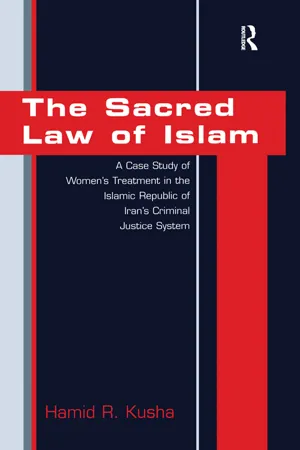
The Sacred Law of Islam
A Case Study of Women's Treatment in the Islamic Republic of Iran's Criminal Justice System
- 326 pages
- English
- ePUB (mobile friendly)
- Available on iOS & Android
eBook - ePub
The Sacred Law of Islam
A Case Study of Women's Treatment in the Islamic Republic of Iran's Criminal Justice System
About this book
Islam's Sacred Law is one of the most complex, detailed and comprehensive legal theories that Islam, as a Western religion, has produced in its capacity as a doctrine of social justice. However, few available texts have dealt with the treatment of women under the actual system of justice that adheres to Islam's Sacred Law. This book fills this void by providing a much needed comprehensive study of the application of the Sacred Law to women under the Islamic Republic of Iran's justice system. It will be a fascinating guide to all those interested in comparative law, criminal justice and the sociology of law.
1 Introduction
The Sacred Law of Islam, commonly known by its Arabic name as the Sharia, is a complex and intertwined admixture of principles of law (qaanun), justice (adala, qist), and morality (akhlaaq). Until very recent times, the Sharia constituted the base of the legal system and social relations in Islamic societies. At present, only two Middle Eastern states, the Islamic Republic of Iran and the Kingdom of Saudi Arabia, adhere to a Sharia-based legal system. Other Islamic societies have adopted secular laws and systems. The Sharia, however, is a very important constituent of the tradition-based social relations in many Islamic societies, and a call to a return to the Sharia has become an integral part of the Islamic revivalist movements since the 1980s.
The Etymology of the Sharia
The term sharia stems from the Arabic root word shar which means “the road to the watering place, the clear road to be followed, as a technical term, the canon law of Islam….”1 Other variations are shari (based on the Sharia) and mashru (legitimated by the sharia), all of which connote a premise and legitimated status within the Sacred Law. The technical field that has historically concerned itself with the study of the Sharia is known as the science of jurisprudence (ilm al-fiqh, usui al-fiqh), which will be dealt with later in this study.
The Sources of the Classical Sharia Law
In the formation of what a number of Muslim and Western scholars have characterized as the “classical theory of Islamic jurisprudence which has dominated all the orthodox schools of law since the third century of the Muslim era,”2 four principal sources can be enumerated as follows:
(1) The Qur‘an Kitaab, or the “Book” in jurisprudential vernacular
(2) The Sunna traditions of the Prophet Muhammad
(3) The Ijma consensus of the community; and interpreted in some quarters as the consensus among Muslim Jurists
(4) The Qiyaas analogical deductions from these three sources concerning a jurisprudential issue.
In Shii Islam, besides the first two principal sources (Qur’an and Sunna), the so-called News (Akhbaar, s. khabar) pertaining to the lives and deeds of the Shii Imams has played a significant role in the formation and canonization of the Shii version of the Sharia Law. In essence, the two versions are identical to each other except for procedural differences that separate the Sunni version of the Sharia Law from its Shii version. Below, a short description of each source is provided. In addition, the significance of human rationality and interpretation to the study of the Classical Sharia Law will become a focus of these investigations.
The Qur’an
The Qur’an is the most important source of the Sharia Law for the text is believed to represent the verbatim word of God gradually revealed to the Prophet Muhammad within a period of twenty-three years (610–632 CE). The revelation (wahy) of the Qur’an is a cardinal belief in Islam, begun in 610 CE on Mount Hira, near Macca, and concluded in 632 CE. The Prophet died in the summer of the same year in the City of Madina. There are one hundred and fourteen chapters in the Qur’an. Each chapter, known as a surah, consists of a number of rhyming verses (known as the ayah). Some chapters are very short (e.g., cxiv which has 6 verses; cxi which has 5 verses etc.), and some are very long (e.g., ii which has 286 verses; iii which has 200 verses; or iv which has 176 verse etc.). As a general rule, the shorter verses belong to the Maccan, and the longer ones to the Madinan, periods of the Prophet’s life. The content of the Qur’an, the text itself maintains, has been inscribed in a Heavenly Protected Source (Luh Mahfuz) implying that the Qur’an is a divine text. It is a cardinal belief in Islam that the Qur’an is not a human-created collection of words of wisdom; neither is it a collection of poetry or soothsaying. It is the word of the living God (Kalam Allah), revealed for guidance, salvation and for peace of mind in this world and the next to come. Naturally, it contains what is known as God’s Commandments (Ahkam Allah) and God’s Boundaries and Punishments (Hudud Allah). Together, the Ahkam and the Hudud comprise one-third of the Qur’an, which together have given a complex and detailed system of law, justice and morality. This system includes the Qur’anic view that some acts are evil in themselves, the so-called mala in se. Next to these, the Qur’an has provided a mechanism for dealing with acts known as the mala prohibita in Western criminology. These are acts deemed anti-social or of a law-infracting nature that run against the prevailing norms of society. Altogether, the Commandments, the Boundaries and the Punishments in the Qur’an historically provide the bases for the Sharia’s notion of penology as well as the principles from which a Sharia-based legal theory has been extrapolated. The field of study that has historically concerned itself with the Qur’an is known as the “science” of the Qur’anic Interpretation (Ilm al-Tafsir al-Qur’an), and the field that has concerned itself with the Islamic notions of law, justice and punishment (penology) is known as the “science of Judgement” (Ilm al-qaza, or qizaawat). I shall specifically deal with various aspects of the Qur’an with regard to the formation of the Sharia Law in Chapters 2 and 3 of this study.
The Sunna: The Tradition of the Prophet Muhammad
The Tradition (the Sunna) of the Prophet Muhammad constitutes the second most important source of the Sharia (and therefore of classical theory of Islamic jurisprudence). These traditions are composed of: (1) the authentic Prophetic utterances, as well as those utterances that later generations of Muslim writers of Hadith attributed to him; and (2) the authentic Prophetic deeds as well as those that later generations of writers attributed to him. Both are grouped under the term Sunna. Naturally, from the time of the Prophet to the present, the question as to what constitutes an authentic Hadith has required a methodology by means of which those involved in the study of the Tradition could answer this important question. This methodology, known as the authentication of evidence (isnaad), gradually emerged in the post-Muhammad period (632–661 CE) and played a significant role in the formation of the classical view of the Sharia Law, for authentication had to follow a certain interpretive-deductive method of reasoning with regard to the issue of the Qur’anic Commandments and Prohibitions. Therefore, the Islamic Sharia Law has been open to a certain degree of purge and re-positioning. These changes have occurred despite the contentions of scholars who argue that by the tenth century CE the four Sunni orthodox schools of jurisprudence had reached their established format. The schools became closed to interpretive process through what is known as the “Closure of the Gates of Interpretation”. This closure implies that Sunni Jurisprudence reached its fundamental format by the tenth century CE and, since then, no Sunni jurist has been able to point to a jurisprudential issue that needs reinterpretation. This premise, of course, is a Western view. Muslim legal scholars argue that the Sharia Law has never become a closed system.
The situation of Shii Islam is to some extent different, for although the Sixth Shii Imam, Jafar as-Sadiq (699–765), as most scholars agree, systemized the Shii principles of jurisprudence, the Shii notion of the Sharia Law has never been subjected to the closure process in the manner of the Sunni schools. Not only did other Shii Imams, who followed As-Sadiq, build further upon the Shii juristic thought, so did a number of prominent medieval and even Safavid Shii jurists. The field of study that has historically concerned itself with the Prophet Muhammad’s and Shii Imami Traditions is known as the Science of Tradition (Ilm as-Sunna/al-Hadith/al-Khabar).
The Ijma: The Communal/and or Juristic Consensus
The communal and/or juristic consensus on jurisprudential matters constitutes the third source in the construction of Sharia Law. The rationale for utilizing this source stems from a Hadith attributed to the Prophet: “My community (umma) will not agree on an error.” C. Snouk Hurgronje has taken this Hadith as to mean that “…whatever my community agrees on, is the truth.”3 Whether this meaning was intended by the Prophet or not, what is certain is that with the passage of time, the communal consensus ought to have been replaced by a consensus among the learned men of the law (the fuqaha) because Sharia Law underwent an elaborate and sophisticated process of canonization making it a far too specialized field of knowledge on which the community could reach consensus. In the course of this process, a much needed juristic esprit de corps evolved among jurists as they felt the need to set themselves as the only legitimate corporate body who had the requisite knowledge and methodology to interpret, and authenticate the evolving Sharia as the Law of God; this process has helped them to defend themselves and their professions against the charges of heresy, innovation and falsification.
Qiyaas: The Analogical Reasoning
Based on inductive reasoning, qiyaas means analogy, a term in daily usage in both Persian and Arabic. David Santillana takes this term to mean the exact opposite of the ijma in so far as the fallibility of human judgment is concerned, whereas qiyaas, according to Santillana “…is not the purely personal judgement, the application of personal opinion, but an inductive process governed by the rules of logic.”4 The importance of analogy as a juristic device stems from the fact that a jurist may not find in the Qur’an and the Sunna the requisites for a decision concerning a case. In such cases, the jurist, writes Santillana, “…has to search whether a rule cannot be deducted…from what has been decided in similar cases.”5
Why Study the Sharia Law?
The Sacred Law of Islam, as I shall explore briefly in this study, emerged gradually as primordial Islam reached the status of a world religion during the first three centuries of Islam (650–950 CE). The Sharia Law itself was an evolutionary process in which the two primary sources of the Law, the Qur’an and the Tradition of the Prophet Muhammad, were utilized, first by the Prophet’s Deputies (the Caliphs) and, subsequently, by a cadre of learned men of Islam in the canonization of the Law’s principles. This complex and historical process, which entailed a gradual prohibition of old Arab bedouin norms and their replacement by Islamic ones, came to its maturity by the tenth century of the Christian Era (CE); it led to the formation of four orthodox Sunni and three mainstream Shii, jurisprudential schools. From this time until the middle of the nineteenth century, the Sharia Law has been adhered to in its capacity to regulate family, tort, contract and criminal matters throughout the Islamic world. The study of Sharia Law, as complex as it is, gives us a much needed background for understanding the turmoil that many Islamic countries face as they enter the twenty-first century.
Another important reason for studying Sharia Law has a lot to do with the issues of democracy, human rights, and improvement in women’s social and legal status in many Islamic societies. This is especially important in the face of the profound challenges that Islamic societies face as our world becomes what some sociologists term a “global village”. The world of Islam, composed of approximately one billion people, is one of the important constituents of this global village; Islam is a dynamic religion and is finding many new converts in Europe, Africa and the Americas. For these new converts, Islam is an attractive religion in the face of the moral decay that some conservative Western thinkers are now attributing to Western civilization. Accordingly, the Western crisis of civilization and culture has both economic and moral bases to its development and propagation. The enormous differences that separate the northern hemisphere from the southern hemisphere where most Islamic societies are located, have given this urgent feeling that something has to be done to bridge the gap between the two. Does post-industrial Western civilization have the moral strength to bridge this gap? There are those on the both sides of the aisle who doubt this and are now looking elsewhere for this moral strength.
Can a new and democratic version of Islam provide this much sought-after model of morality? If so, could a better understanding of the Sharia Law help to better assess the strengths and weaknesses of Islam? It is no exaggeration to suggest that, from the mid-nineteenth century to present, a powerful Western modernist challenge has been directed against Islam’s Sacred Law with regard to its relevance as a rational system of conflict resolution. Many Islamic societies have gradually modernized their society and economy in the course of which they have been forced to adopt modern, semi-secular man-made laws and systems of conflict resolution and, therefore, they have shoved aside the Sharia-based legal system. This said, it should be remembered that Islam’s Sacred Law has traditionally been regarded as more than just a code of law and morality. The Sharia has been looked upon as an integral part of a way of life, of one’s faith, as a route to the Faithful’s peace of mind and tranquillity, and as a moral and just way of living in this world and, finally, as a means to eternal salvation. Whereas most Islamic societies have desired social progress and economic development, these processes have confronted a bulwark of Islamic traditions that are represented by the Sharia Law. The profound power of these traditions stems from the fact that they permeate the core of social structures in most Islamic societies, providing epistemological meaning to a wide range of social actions based on the Sharia Law.
To give an example of this epistemological meaning, take the power of daily prayer in Islam. The prayer gives to the average believer a personal eschatological connection to Allah Who has given meaning to the Islamic notion of tavakkul, a concept that has a very powerful Qur’anic connotation: pray to Allah, and ask Allah’s guidance only for your moral and social needs, for it is only Allah Who is the Kindest of all; it is Allah who gives you strength in the face of life’s calamities; have faith in Allah and ask only for Allah’s pity on you against despair and fright; have confidence in Allah. All these mean having tavakkul in Allah! At the same time, however, the Qur’an reminds us that every believer should do their personal utmost to achieve their legitimate (mashru) goals for Allah does not help those who do not strive. In other words, besides tavakkul in Allah, a true believer should work hard for his/her legitimate goals in this life and in the next world to come. The Sharia Law facilitates one’s achievement of these goals provided that one is not striving for illegitimate ones. In other words, the Sharia Law ought not be utilized as an instrument of power for illegitimate, but for legitimate, goals and for their eventuation.
The Qu...
Table of contents
- Cover
- Half Title
- Title Page
- Copyright Page
- Table of Contents
- List of Tables
- Preface
- Acknowledgements
- 1 Introduction
- 2 The Sharia Law’s Genesis: A Brief History
- 3 The Legal Theory of the Sharia Law
- 4 Women’s Legal Status in the Sharia Law
- 5 Iran’s Criminal Justice System: From Secular to Sharia
- 6 The Criminogenic Impacts of the Sharia-Based Criminal Justice System in Iran, 1979-1999
- 7 Feminine Crime under the Sharia-Based System in Iran
- 8 The Sharia Law and Female Victimization in Iran
- 9 Conclusion
- Index
Trusted by 375,005 students
Access to over 1.5 million titles for a fair monthly price.
Study more efficiently using our study tools.
Frequently asked questions
Yes, you can cancel anytime from the Subscription tab in your account settings on the Perlego website. Your subscription will stay active until the end of your current billing period. Learn how to cancel your subscription
No, books cannot be downloaded as external files, such as PDFs, for use outside of Perlego. However, you can download books within the Perlego app for offline reading on mobile or tablet. Learn how to download books offline
Perlego offers two plans: Essential and Complete
- Essential is ideal for learners and professionals who enjoy exploring a wide range of subjects. Access the Essential Library with 800,000+ trusted titles and best-sellers across business, personal growth, and the humanities. Includes unlimited reading time and Standard Read Aloud voice.
- Complete: Perfect for advanced learners and researchers needing full, unrestricted access. Unlock 1.5M+ books across hundreds of subjects, including academic and specialized titles. The Complete Plan also includes advanced features like Premium Read Aloud and Research Assistant.
We are an online textbook subscription service, where you can get access to an entire online library for less than the price of a single book per month. With over 1.5 million books across 990+ topics, we’ve got you covered! Learn about our mission
Look out for the read-aloud symbol on your next book to see if you can listen to it. The read-aloud tool reads text aloud for you, highlighting the text as it is being read. You can pause it, speed it up and slow it down. Learn more about Read Aloud
Yes! You can use the Perlego app on both iOS and Android devices to read anytime, anywhere — even offline. Perfect for commutes or when you’re on the go.
Please note we cannot support devices running on iOS 13 and Android 7 or earlier. Learn more about using the app
Please note we cannot support devices running on iOS 13 and Android 7 or earlier. Learn more about using the app
Yes, you can access The Sacred Law of Islam by Hamid R. Kusha in PDF and/or ePUB format, as well as other popular books in Law & Law Theory & Practice. We have over 1.5 million books available in our catalogue for you to explore.