- 240 pages
- English
- ePUB (mobile friendly)
- Available on iOS & Android
eBook - ePub
About this book
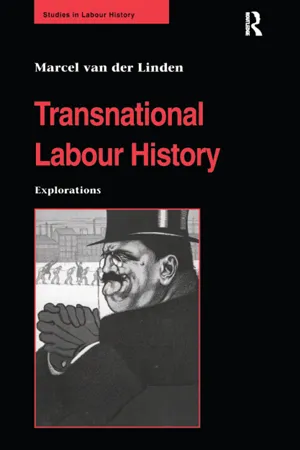
There has been a growing recognition amongst scholars that labour historians need to look beyond national borders in order to place the history of the working classes into a much broader context than has hitherto been the case. Whilst studies focused on individual countries are essential, it is only by comparing and contrasting the experiences across time and space that a true understanding of the subject can be attempted. Professor Marcel van der Linden, has contributed much to the debate on cross-border processes and comparisons. This volume makes available in English a collection of twelve of his most important essays on the theme of transnational labour history. Previously published in a range of journals and volumes, with two original contributions, Transnational Labour History brings them together in a single convenient collection, together with a new introduction. This work will undoubtedly provide an invaluable resource for all students of European labour history.
Chapter 1
Introduction
Labour history is a small discipline facing big challenges. At one time, several decades ago, labour historians in most countries knew fairly exactly what they were doing. They were studying the organized workers’ movement, its leaders, actions and ideas. They knew which research methods they were supposed to use and had little doubt about the appropriate framework for interpretation. True, the dominant approaches varied from one country to the next, but almost everyone seemed to have his or her own ‘synthesis’. They all had one thing in common: they focused on the institutional aspects of labour history, such as organizational structure, congresses, leaders, debates, strikes and elections. Classical labour history consisted of the application of the approaches, methods, formats and styles of the traditional historiography of ideas and politics to the field of labour history. In so far as it addressed ‘social issues’, it was an offshoot of economics and economic history; in so far as it discussed the movement itself and its organizations, leaders and ideas, it was an offshoot of political or intellectual history. The classical approach ‘tended to produce both a model and an accepted version of history, both national and international, which ranged from an informal but not very flexible to a formal and highly inflexible orthodoxy’.1
These old syntheses began to be undermined in the 1950s and 1960s – a process that continued with even greater force in the following decades. In Britain, Asa Briggs, Eric Hobsbawm, Edward Thompson and others tried to contextualize workers’ struggles. As Hobsbawm wrote in 1964, these historians highlighted ‘the working classes as such [… and] the economic and technical conditions that allowed labour movements to be effective, or which prevented them from being effective’.2 Similar trends became apparent somewhat later in other countries. In the United States, Ira Berlin, David Brody, Herbert Gutman and David Montgomery among others were pioneers. In France, followers of the Annales School, whose structural and serial historiography had largely left people out, had long opposed writers of ‘event-centred’ (événementiel) labour movement history. Especially after 1968 some rapprochement was apparent, although this was a slow process. Michelle Perrot felt impelled to remark in 1979, ‘[In French historiography] the study of the workers’ movement has polarized historians for a long time and eclipsed other problems, such as the development of the working class and its culture. However, this is changing rapidly.’3 In Germany Strukturgeschichte, founded in the 1950s by Werner Conze and others, had incorporated some elements of National Socialist Volksgeschichte, including its focus on the ‘structured totality’ of the social ‘order’. From the late 1960s onwards, Hans-Ulrich Wehler, Jürgen Kocka and others modified and transformed it into a modern approach combining Weberian and Marxian elements.4
This second phase reached its peak during the 1970s, when former student activists began to write labour history theses and books. Their productivity was immense and impressive – perhaps there will never again be so much labour history written in so few years.5 But this peak period did not last long. Most importantly, the organizing categories of the second phase were increasingly called into doubt, partly because they contained continuities with the first phase. Often the teleology of the first phase had simply been reversed. While the ‘classic’ labour historians had been inspired by an optimistic perspective, celebrating the emergence of mass organization and stressing the dynamics of unity and organization, the new generation tended to ask what had gone wrong with the movement. From a methodological point of view an ‘epistemology of absence’ (in Margaret Somers’ words) became predominant. ‘Rather than seeking to explain the presence of radically varying dispositions and practices, [labour historians] have concentrated disproportionately on explaining the absence of an expected outcome, namely the emergence of a revolutionary class consciousness among the Western working class.’6
Ever since, many labour historians have viewed the state of their discipline as a protracted crisis. First, the emerging paradigms of women’s and ethnic history showed that there had been giant blank spots on labour history’s map, and that filling in these blanks made a complete rewriting of the old narratives unavoidable. Second, the unilinear conception of class-consciousness that had long been dominant came into question.
Once it was established that class was a construction and not a predetermined consequence of structural forces, then the notion that it could be seen as the product of an autonomous culture reacting to certain political and economic circumstances ultimately had to be rethought. Class and class action, it became apparent, could work in many different and contradictory ways.7
As a result of growing uncertainty about its organizing categories, labour history is beginning to lose its character as a ‘discipline’. On the one hand, the distinction between labour history and contiguous disciplines, such as women’s studies, ethnic studies, anthropology, institutional economics, sociology and social psychology, is beginning to dissolve. On the other hand, both conceptual difficulties and political disappointments have stimulated postmodern approaches.8
In North America and Western Europe, including Britain, debates among labour historians are thus dominated by a paradigmatic crisis – a crisis that has apparently not always greatly reduced the output of the ‘older generation’ of labour historians, as it happens, but has often led to diminished interest among students. In Eastern Europe and the former Soviet Union the problems are even more serious. The collapse of so-called ‘socialism’ has led to the almost complete demise of classical labour historiography, since the latter is, with reason, perceived as an element of the old dictatorships;9 Communist regimes generally used a distorted, ‘official’ history of their national workers’ movements as part of their legitimating ideology.
At the same time, exciting new developments are taking place, especially in Asia. A group of Indian intellectuals had already published a series of very innovative collections of essays on the social history of ‘subaltern’ classes, focusing especially on peasants.10 Now a new generation of sophisticated Indian labour historians has emerged. In December 1996 this led to the foundation of the Association of Indian Labour Historians, which has already organized several successful conferences. This initiative was the first of its kind in Asia; but interest in working-class history is increasing in other countries of the continent as well (Pakistan, Indonesia and South Korea, for instance). In Latin America a real ‘labour studies boom’ has taken place in recent years.11 Interest in working-class history has also been growing in a few African countries (such as South Africa and Nigeria), parallel with the emergence of large groups of new wage labourers. These new labour historians are grappling to some extent with the same conceptual questions as their colleagues in developed countries, but this is not hindering intense research activity on their part.
Also visible is another trend in labour history, beyond and linked to its uneven geographical development – the increasingly strongly felt need to work across national boundaries. The more we know about the history of the working classes, in more and more countries, the more tempting it is to place the various national developments in a broader context. Two basic reasons for this can be put forward.
In the first place, we can only discover what is specific and what is general in our own history by looking beyond national borders. Since the late nineteenth century scholars have tried better to understand national peculiarities through comparisons with other countries. One famous example was the German economist and historian Werner Sombart, who almost 100 years ago, inspired by the considerable difference in social democratic parties’ popularity in Germany and the USA, asked the question, ‘Why is there no socialism in the United States?’12 Such attempts at comparison may be intended to highlight contrasts (what is ‘normal’ in one country is anything but normal in another), but they can also be more ambitious and used to explain national differences and similarities.
A second important reason for crossing national borders is that borders are not very relevant to the object of study. Working-class formation and restructuring are not neatly contained within particular national borders; they are processes on which voluntary and forced immigration and emigration have a great deal of influence. Dramatic developments in one country may cause turbulence in other countries; strike waves often have a transnational character; new forms of campaigning are imitated elsewhere; national labour movements communicate with each other, learn from each other and create international organizations.13
Since the 1970s the growing need for studies that look beyond national borders has resulted in a tremendous growth in the number of contributions to transnational labour history – that is, labour history that focuses on cross-border processes and comparisons.14 The essays in this collection are part of this trend. In order to understand them better it may be useful for readers to know more about the institutional context in which they were written. Since late 1983 I have worked for the International Institute of Social History (IISH) in Amsterdam. This is the largest institutional archive in the world in the field of labour relations and social movements. The papers of radical intellectuals such as Mikhail Bakunin, Karl Marx and Emma Goldman are to be found there, together with the archives of organizations such as the International Confederation of Free Trade Unions and Amnesty International, as well as very extensive materials on labour and social protest.15 During the first 50 years after the IISH’s foundation in 1935, its staffs activities were above all (though never exclusively) directed at collecting, making accessible and managing archives of European origin.
From the 1980s onwards this began to change, in two respects. First, more attention was devoted over time to scholarly research. The IISH’s archivists, curators and librarians increasingly worked alongside a growing number of historians writing books and articles on a broad range of topics in social history. Second, the IISH’s original, overwhelmingly Eurocentric approach was replaced in the 1990s by a far broader approach. Not only were archives and materials built up relating to the Middle East, China and Central, South and South-east Asia, but its research projects, too, were much more broadly conceived. Contacts were made everywhere around the globe, and the IISH began systematically to organize scholarly workshops in other parts of the world.
Against this backdrop it was only to be expected that researchers at the IISH would turn to studying cross-border influences and transnational comparisons. In doing so they joined in the more general trends in social history described above. I was involved in all these changes, and their influence is accordingly visible in the essays assembled here. The texts brought together in this book deal with workers’ movements and organizations, their interactions and varying national contexts.
The first contribution (and the one that came first for me personally) is a brief essay about the International Working Men’s Association, 1864–1876 – later called the First International (Chapter 2). In the past, this organization’s short lifespan has often been explained as the result of conflicts between prominent individuals (Marx and Bakunin) and of contingent events such as the defeat of the Paris Commune in 1871. Without denying the importance of such factors, I maintain in this essay that there was also a structural dimension. The First International can be seen as the organizational expression of a very specific historical conjuncture – namely, the transition from pre-national to national labour movements in Europe and North America.16
The ‘nationalization’ of European labour movements at the end of the nineteenth century is the subject of Chapter 3. Here, too, I argue that structural influences played an essential role in integrating working classes into nation-states. By comparing developments in five countries (Britain, France, Germany, Italy and Russia) in the period 1871–1914, I try to make the case that a cluster of interrelated factors can explain why integration was more advanced in some countries than in others. Among these factors are national characteristics of the process of capital accumulation, interregional communication and transportation, national prestige, education, suffrage, military service, fiscal pressure, and social security provisions.17
Chapters 4 and 5 discuss a current in the labour movement that existed on several continents during the first decades of the twentieth century and tried to constitute a counterweight to processes of national integration – revolutionary syndicalism. Chapter 4 was originally written in the late 1980s as an introduction to a volume of essays on syndicalist movements in 12 countries edited by the Canadian historian Wayne Thorpe and myself.18 Starting from the observation that revolutionary syndicalism had its greatest worldwide impact in the half-century from roughly 1890 to the outbreak of the Second World War, Thorpe and I try to identify the structural factors that can explain this current’s rise and fall. The text concludes with the proposition that changes in advanced capitalism and the rise of welfare states placed these movements before an unavoidable ‘trilemma’: dissolution, moderation or marginalization. Just as in the case of the First International, the structural manoeuvring room enjoyed by this kind of movement occupies a central place in this essay. Of course, concrete analyses of the development of particular movements will have to devote considerable attention to contingent facto...
Table of contents
- Cover
- Half Title
- Title Page
- Copyright Page
- Table of Contents
- Studies in Labour History General Editor’s Preface
- List of Tables and Figures
- List of Abbreviations
- Acknowledgements
- 1 Introduction
- 2 The First International (1864–1876): A Reinterpretation
- 3 The National Integration of European Working Classes (1871–1914): Exploring the Causal Configuration
- 4 The Rise and Fall of Revolutionary Syndicalism (1890–1940)
- 5 Second Thoughts on Revolutionary Syndicalism
- 6 Communist Parties: The First Generation (1918–1923)
- 7 Metamorphoses of European Social Democracy (1870–2000)
- 8 The Aftermath of ‘1968’: Interactions of Workers’, Youth and Women’s Movements
- 9 Crossing the Borders of US–American Labour History
- 10 International Trade Unionism: A Long View
- 11 Doing Comparative Labour History: Some Preliminaries
- 12 How Normal is the ‘Normal’ Employment Relationship?
- 13 The Historical Limit of Workers’ Protest
- Index
Trusted by 375,005 students
Access to over 1.5 million titles for a fair monthly price.
Study more efficiently using our study tools.
Frequently asked questions
Yes, you can cancel anytime from the Subscription tab in your account settings on the Perlego website. Your subscription will stay active until the end of your current billing period. Learn how to cancel your subscription
No, books cannot be downloaded as external files, such as PDFs, for use outside of Perlego. However, you can download books within the Perlego app for offline reading on mobile or tablet. Learn how to download books offline
Perlego offers two plans: Essential and Complete
- Essential is ideal for learners and professionals who enjoy exploring a wide range of subjects. Access the Essential Library with 800,000+ trusted titles and best-sellers across business, personal growth, and the humanities. Includes unlimited reading time and Standard Read Aloud voice.
- Complete: Perfect for advanced learners and researchers needing full, unrestricted access. Unlock 1.5M+ books across hundreds of subjects, including academic and specialized titles. The Complete Plan also includes advanced features like Premium Read Aloud and Research Assistant.
We are an online textbook subscription service, where you can get access to an entire online library for less than the price of a single book per month. With over 1.5 million books across 990+ topics, we’ve got you covered! Learn about our mission
Look out for the read-aloud symbol on your next book to see if you can listen to it. The read-aloud tool reads text aloud for you, highlighting the text as it is being read. You can pause it, speed it up and slow it down. Learn more about Read Aloud
Yes! You can use the Perlego app on both iOS and Android devices to read anytime, anywhere — even offline. Perfect for commutes or when you’re on the go.
Please note we cannot support devices running on iOS 13 and Android 7 or earlier. Learn more about using the app
Please note we cannot support devices running on iOS 13 and Android 7 or earlier. Learn more about using the app
Yes, you can access Transnational Labour History by Marcel van der Linden in PDF and/or ePUB format, as well as other popular books in History & World History. We have over 1.5 million books available in our catalogue for you to explore.