- 280 pages
- English
- ePUB (mobile friendly)
- Available on iOS & Android
eBook - ePub
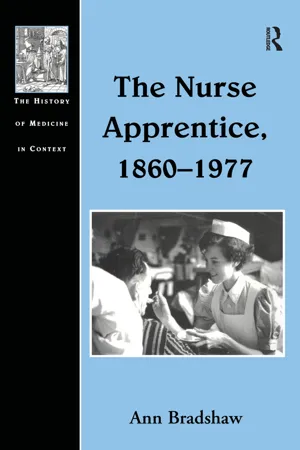
The Nurse Apprentice, 1860–1977
About this book
The British apprenticeship model of nurse training, developed under Florence Nightingale's influence from 1860 at St Thomas's Hospital, gained national and world-wide recognition. Its end was heralded with the publication of the last national syllabus from the General Nursing Council for England and Wales in 1977. This apprenticeship model, a crucial part of the history of British health care for over a century, is the subject of this book. Primary evidence, much of it original, is gained from Parliamentary debates and reports, syllabuses, long neglected nursing textbooks, major governmental and professional reports, and the voices of nurses themselves expressed through their professional journals. Primary sources are systematically re-examined and contextually interpreted in the light of new evidence. The study in particular interprets the contemporary attitudes and moral values underpinning the apprenticeship system, especially the place of vocation. The reasons for the ending of this system, arising in part from the cultural shifts of the 1960s, are explained in relation to this historical moral context. The reader sees how the self-understanding of the profession shifts, with much tension and disagreement, as mores change. The book fills a major gap in the history of nurse training, by giving a sustained account of the apprenticeship model of nursing in context, and charting changing values away from the historic vocational tradition. Its copious use of primary sources will make this a key text for nurses, historians and policy makers.
Chapter 1
The principles and practices of nursing in historical context: the Nightingale tradition of nursing, 1860—1896
From 1860 until 1977 nurses were inducted into an apprenticeship tradition of care. This tradition, which rested on a vocational ideal of service to humanity as the primary Christian virtue, originated with religious orders and was remodelled and rearticulated by Florence Nightingale to make it acceptable to her contemporary context. This chapter will examine Nightingale's principles of nursing, and seek to understand to what extent they formed the self-understanding of the nursing profession as it developed at St Thomas's Hospital. The analysis will take account of modern revisionist interpretations which have questioned the influence of Nightingale's training school, her own motives, and the effectiveness of nursing reforms.
Nightingale's influence on the development of modern nursing
In 1939 the eminent historian Lord Elton, in a BBC radio talk printed in Nursing Times, described Florence Nightingale as the creator of the profession of nursing, and even of the Army Medical Service.1 To both the public and the profession the perception was clearly that Nightingale was responsible for the development and ethos of modern nursing. According to a recent historian of the Nightingale Training School, Roy Wake, Nightingale's work in 'inventing nursing' as a secular and organised profession needs careful scrutiny and modification.2 In medieval Europe, religious orders were responsible for Christian charity, nursing the sick and giving alms to the poor. After the Reformation this became the obligation of secular Protestant philanthropy. In England, the religious revival of the nineteenth century led to the foundation of several nursing orders by High Church, as well as evangelical, Christian movements, that pre-dated Nightingale. Elizabeth Fry, for example, a Quaker, founded an Institute of Nursing in 1840.3 Both Elizabeth Fry and Florence Nightingale were deeply influenced by their visits to a Lutheran religious foundation, Kaiserswerth, for the care of the sick.4 What Nightingale may have found lacking amongst the religiously motivated, that is a scientific system,5 she brought together with their vital moral tone. Nightingale made nursing a synthesis of both art and science.6
The question at issue is the extent to which this vision of Nightingale's influenced the development of nursing, particularly in her training school at St Thomas's Hospital. In appraising the evidence, Wake has taken account of the seminal work conducted by Monica Baly,7 whom he describes as the first major revisionist.8 Wake thinks there is some justification for Baly's argument that in its first ten years the Nightingale School achieved very little, but he believes that the early years of famous institutions have a tendency to show mistakes and fluctuations.9 Yet, there is ample evidence, according to Wake, of Nightingale's continued, 'real but uneven', interest and concern in her training school.10 This involved not only 'intrigue and plotting' but a close scrutiny of the registers and report books completed by ward sisters on the performances of probationers as well as the diaries kept by the probationer nurses themselves. Her unshakeable view that patients came first and last and were 'honoured guests' remained in the perceptions of nurses trained at her school for over a century.11
Often the real does not reflect the ideal; and it may be, as Baly argues, that training at the Nightingale School became too often inadequate and erratic, because ward sisters rarely had time to be good teachers.12 This does not, however, diminish the ideal which future generations of nurses and their leaders would constantly strive to live up to. Nightingale's principles did not only affect the Nightingale School. Through the school's far-reaching influence, they would form the shared self-understanding and perception of the nursing profession in Britain for a century, as the evidence in the following chapters will reveal. Whatever Nightingale's actual influence really was, the principles that she articulated would become normative for the nursing profession.
The Nightingale ideal: fitting the nurse for her purpose
Nightingale had a strong Christian faith, although her technical theology was amateur and less than coherent.13 As Quinn and Prest have written: 'Florence Nightingale's life was predicated upon her faith in God.'14 There can be little doubt that Nightingale's work was shaped by her religious faith and her conviction that nursing must be more than an occupation. It had to be a calling: 'Like it or not, the clear analogy with religious Orders [sic] is inescapable; to take up nursing was the equivalent of a religious vow. Nursing was an art and required vision and idealism, making it among the most exalted vocations.' Nursing, which involved important scientific attributes, had to be based on this moral foundation.15 It should be concerned with principle rather than personality: the principles of character formation, efficient management, hygiene and sanitation, which required organised obedience and discipline.16
Nightingale's approach to nursing began to take shape in 1851, when she worked at a Kaiserswerth. There she realised that the demanding work of nursing depended for its quality and standards on moral motives: love rather than money. This conviction would underpin her motivation to change the haphazard nursing system in England, where: 'We see the nurses drinking, we see the neglect at night owing to their falling asleep. Where women undertake so toilsome an office, for hire, and not for love, it cannot be otherwise.'17 The spur to Nightingale's later work was the Crimean War. In 1854 The Times reported that there was an absence of reputable, trained, nurses to treat the wounded, sick and dying soldiers, unlike the French army who had nursing nuns. An editorial and correspondence followed. The question was posed: 'Why have we no Sisters of Charity?'18
By 1860 Nightingale had a clear picture of the kind of system she wanted to adopt.19 Women who were nursing the sick at this time were of three types. The active religious orders produced women who, although of unblemished character, were deficient in technical proficiency and theoretical knowledge. Next, there were 'ladies', women with respectable characters but entirely incompetent, having a sentimental view of nursing and eschewing hard work. These were the 'brow-soothers' in the Crimea much disparaged by Nightingale. Lastly, there were the uneducated domestic servant nurses, the usual type of lay nurses in British hospitals, who could be morally weak and had low technical skill. There is some evidence that medical staff were already attempting to give some training to this group in a haphazard and unsystematic way.20
Nightingale set out her principles in two articles for a medical textbook, A Dictionary of Medicine, which was published in three editions from 1882 to 1902. The nature and purpose of nursing and its underpinning principles were clear: the effective, efficient and morally exemplary service of care to the patient. The needs of the patient, be they physical, emotional, social, or, indeed, spiritual, were central. The patient was expected to be the epicentre of all the nurse's thought:
The nurse must have simplicity and a single eye to the patient's good. She must make no demand upon the patient for reciprocation, for acknowledgement or even perception of her services; since the best service a nurse can give is that the patient shall scarcely be aware of any - shall perceive her presence only by perceiving that he has no wants. The nurse must always be kind, but never emotional. The patient must find a real, not forced or 'put on,' centre of calmness in his nurse.21
Because the central purpose of nursing was clear to Nightingale, she assumed that the method of preparing nurses was to fit them for this purpose. The nurse needed to be a certain kind of person, the attributes of which were enshrined in the term 'character': 'A woman cannot be a good and intelligent nurse without being a good and intelligent woman.'22 This was fundamental to her training, a scientific, practical preparation which was also a moral, educative process. As she stated:
Nursing is, above all, a progressive calling. Year by year nurses have to learn new and improved methods, as medicine and surgery and hygiene improve. Year by year nurses are called upon to do more and better than they have done. It is felt to be impossible to have a public register of nurses that is not a delusion. Further, year by year, nursing needs to be more and more of a moral calling.23
The nurse needed to be sober, in spirit as well as drink, temperate in all things. She needed to be honest, not accepting bribes from patients or friends. She should be truthful in attention and observation, in memory and power of expression, in order to report and remember accurately what she observed. She should be trustworthy, carrying out directions intelligently and perfectly, unseen as well as seen. She needed to be chaste, in the sense of the Sermon on the Mount, because as Nightingale pointed out, 'Remember this great and dangerous peculiarity of nursing, and especially of hospital-nursing, namely, that it is the only case, queens not excepted, where a woman is really in charge of men.'24
She should be punctual and orderly, having everything ready and prepared before beginning a dressing on a patient: 'Punctual to a second, and orderly to a hair ... Quiet, yet quick; quick without hurry; gentle without slowness; discreet without self-importance, no gossip.' She should be cheerful, hopeful, not allowing herself or her patient to become discouraged by unfavourable symptoms or anticipation of an unfavourable result. She should be exquisitely clean, neat and ready.25
Nightingale repeated the same ideas in letters to probationers in her training school written from 1873 to 1900: 'It is what she is in herself, and what comes out of herself, out of what she is — that exercises a moral or religious influence over her patients. No set form of words is of any Use.'26 The character of the nurse was self-knowledge, a knowledge and confidence in the creator and the moral order, ex...
Table of contents
- Cover
- Half Title
- Title
- Copyright
- Contents
- Introduction
- 1 The principles and practices of nursing in historical context: the Nightingale tradition of nursing, 1860-1896
- 2 Voices from the Nightingale nursing tradition: views of nurse leaders, 1874-1982
- 3 Nurse registration: rationalising the spirit, 1888-1925
- 4 From registration to the new National Health Service: the age of reports, 1923-1948
- 5 British nursing tradition and the North American influence, 1948-1960
- 6 The turn of the tide, 1960-1972
- 7 Behind the scenes: battle for the soul of nursing, 1960-1978
- 8 The end of the nurse apprentice, 1969-1979
- Conclusion: lessons from history and the significance of the nurse apprentice
- Bibliography
- Index
Trusted by 375,005 students
Access to over 1.5 million titles for a fair monthly price.
Study more efficiently using our study tools.
Frequently asked questions
Yes, you can cancel anytime from the Subscription tab in your account settings on the Perlego website. Your subscription will stay active until the end of your current billing period. Learn how to cancel your subscription
No, books cannot be downloaded as external files, such as PDFs, for use outside of Perlego. However, you can download books within the Perlego app for offline reading on mobile or tablet. Learn how to download books offline
Perlego offers two plans: Essential and Complete
- Essential is ideal for learners and professionals who enjoy exploring a wide range of subjects. Access the Essential Library with 800,000+ trusted titles and best-sellers across business, personal growth, and the humanities. Includes unlimited reading time and Standard Read Aloud voice.
- Complete: Perfect for advanced learners and researchers needing full, unrestricted access. Unlock 1.5M+ books across hundreds of subjects, including academic and specialized titles. The Complete Plan also includes advanced features like Premium Read Aloud and Research Assistant.
We are an online textbook subscription service, where you can get access to an entire online library for less than the price of a single book per month. With over 1.5 million books across 990+ topics, we’ve got you covered! Learn about our mission
Look out for the read-aloud symbol on your next book to see if you can listen to it. The read-aloud tool reads text aloud for you, highlighting the text as it is being read. You can pause it, speed it up and slow it down. Learn more about Read Aloud
Yes! You can use the Perlego app on both iOS and Android devices to read anytime, anywhere — even offline. Perfect for commutes or when you’re on the go.
Please note we cannot support devices running on iOS 13 and Android 7 or earlier. Learn more about using the app
Please note we cannot support devices running on iOS 13 and Android 7 or earlier. Learn more about using the app
Yes, you can access The Nurse Apprentice, 1860–1977 by Ann Bradshaw in PDF and/or ePUB format, as well as other popular books in History & World History. We have over 1.5 million books available in our catalogue for you to explore.