- 226 pages
- English
- ePUB (mobile friendly)
- Available on iOS & Android
eBook - ePub
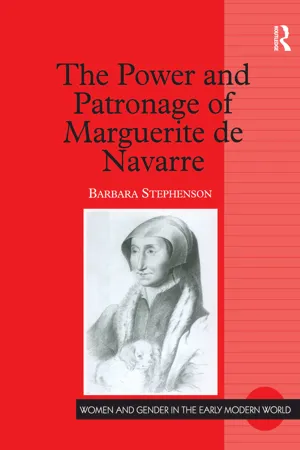
The Power and Patronage of Marguerite de Navarre
About this book
Although Marguerite de Navarre's unique position in sixteenth-century France has long been acknowledged and she is one of the most studied women of the time, until now no study has focused attention on Marguerite's political life. Barbara Stephenson here fills the gap, delineating Marguerite's formal political position and highlighting her actions as a figure with the opportunity to exercise power through both official and unofficial channels. Through Marguerite's surviving correspondence, Stephenson traces the various networks through which this French noblewoman exercised the power available to her to further the careers of political and religious clients, as well as her struggle to protect the interests of her brother the king and those of her own family and household. The analysis of Marguerite's activities sheds light on noble society as a whole.
CHAPTER ONE
"Vostre tres humble subjet et tres obeissant serviteur": Networking and clientage in Marguerite's correspondence
In July of 1525, Marguerite de Navarre received the following letter from Jean de La Barre, who was sharing François I's captivity in Spain:
Madame, s'il appartenoyt à ung povre vostre subjet vous fere remersyment des Iettres qu'il vous a pleu m'escripre, trouveroye que cestuy indine s'en meteroyt en son devoyr. Et quant vous supplyroye jamais n'ajouter foy en subjet vostre, sy cestuy vous failloyt, que vous asseure k peine n'estre jamés dyne de vous pouvoyr faire servyce, par la faulte de sa puysance, mès non par sa volonte, que eternellement vous sera obeysante et subjete. Vous asseurant, Madame, sur sa vye, qu'il ne feret jamés faulte à ce que vous a pleu lui escripre .... Madame, je supplye à Nostre Seigneur bien tost vous amener, et donner trfes bonne vie et longue santé. De Venysolo, le xixe jour de juillet, vostre tres humble subjet et tres obeissant serviteur DE LA BARRE.
Madame, as it is fitting for your poor subject to thank you for the letters which it has pleased you to write to me, one would be found to be unworthy to expend himself in his duty [if he did not thank you]. And with regard to that [if it were the case] you would never be implored to have faith in your subject if ever he failed you, that you are assured of on pain of never being dignified by being of service, through the lack of his power though not of his will, which is to be eternally obedient and subject to you. Be assured, Madame, that for his life, you will never find lacking him to whom you were pleased to write .... Madame, I beseech our Lord that all good will prevail for you, and to give you a good life and lasting health. At Venysolo, the 19th day of July, your most humble subject and most obedient serviteur, DE LA BARRE1
De La Barre's letter reflects the language of devotion typical m letters between patrons and clients in the early sixteenth century. De La Barre and Anne de Montmorency, who were both with the king during his captivity, kept Marguerite informed about her brother's condition and his interactions with Emperor Charles V. Both men routinely signed their letters "your most humble and obedient serviteur," but de La Barre's pledge of faithful service and his reference to himself as Marguerite's "subject" are not found in the letters from Montmorency, who had already established the strong relationship with the king which proved to be his road to advancement. De La Barre, on the other hand, seems to have taken the opportunity of this correspondence to establish a patron-client relationship with Marguerite, and remained her faithful servant until his death in 1534, once even signing himself "vostre treshumble et tres obeyssant serviteur et mylleur sujet DELABARRE [your most humble and obedient serviteur and best subject DELABARRE]."2 De La Barre had been made bailli of Paris in 1523, and sharing Francois' captivity led to him being named first gentleman of the king's chamber in 1525. But he was not the only man to gain a position by sharing the king's captivity, and by establishing his relationship with Marguerite, de La Barre gained her support. His dependence on Marguerite's power as patron was not misplaced; in 1526, he was made comte d'Etampes and he later became prévôt of Paris. This is only one example of how Marguerite de Navarre operated as one of the most powerful patrons, male or female, of the early sixteenth-century French court.
While it has long been acknowledged that women often served as the "power behind the throne," historians have only recently begun to examine just how women held and exercised any political power, official or unofficial, in early modern France.3 Most historians now recognize that all human interactions involve power of one sort or another, and as we become more concerned with uncovering the agency of the groups we study, a key question has been how much self-determination these groups could have exercised. This question is particularly important for the study of those groups, such as women or the lower classes, who did not have an official voice in the political and cultural affairs of the past. Uncovering the agency of these groups in terms of what are traditionally defined as power relationships has been difficult. But part of the difficulty has come from trying to place these groups into pre-existing definitions of power and the official power structure. This chapter will examine one particular form of power relationship, that of clientage,4 and how Marguerite de Navarre was able to use this type of power relationship to exert a significant influence in early sixteenth-century France by establishing wide networks in both the political and religious arenas, despite the inherently patriarchal French power structure. Clientage is based on a vertical, unequal, and reciprocal relationship between a patron who has something to bestow and a client who offers something in exchange, and may or may not be exclusive or long-standing, A broker is someone who brings a potential patron and client together, and may or may not bring something to the exchange, and because brokers often brought together clients and patrons from different geographical places or who were of differing social status, brokers served an important function in the exercise of clientage. Marguerite acted as patron and broker for a wide variety of clients, and also interacted with others who held power to help advance her own causes and those of her clients. This chapter will outline the network of clients and patrons with whom Marguerite corresponded, and will demonstrate her participation in the quasi-official world of noble clientage.
When Marguerite interceded with the king or his network, a high-ranking noble, a court, or other official body on behalf of herself or a member of her own network, she acted as a patron. She was also acting as patron and/or broker when she was petitioned by anyone; if the request was one she could fulfil, she acted as a patron, while if she could not grant the request herself but passed it on, she acted as a broker. When Marguerite made a request of Francois or another member of his network, or of a member of any network but her own, on behalf of another person who was not her client, she acted as a broker. When making a request on her own behalf, she acted as a client, a role she filled only with Francois until his death. Her surviving correspondence offers a rich source of evidence for her clientage activities.5 The bulk of the 886 extant letters to and from Marguerite can be found in her correspondences with Francois I (186 letters); Anne de Montmorency, Grand Master and later Constable of France (206); and Guillaume Briçonnet, Bishop of Meaux (123).6 The remaining 371 letters are to and from 142 correspondents.
Table 1 Total correspondents and clientage correspondents by category
| Total number of correspondents | Number of clientage correspondents | |
|---|---|---|
| Category | ||
| Administrative | 35 | 30 |
| Religious | 41 | 35 |
| Humanist | 8 | 7 |
| Nobility | 55 | 41 |
| Unknown | 3 | 3 |
| Totals | 142 | 116 |
These 142 correspondents can be separated into five rough groups: 1) those who represent or hold some administrative position in France, Navarre, or elsewhere, often in territories under Marguerite's control; 2) those who either represent the Catholic Church in some way or are members of one of the reformist groups in France, Geneva, or elsewhere; 3) those who correspond with Marguerite because of her status as an author and humanist; 4) those who are members of the nobility of France or of other European states; and 5) those whose status is unknown. These 142 correspondents did not all write or receive clientage letters, but 116, the vast majority, did—see Table 1. The high percentages of correspondents from each category who can be seen as clientage contacts indicates that much of Marguerite's correspondence was related to her clientage activities, and that letter writing was used to maintain clientage ties, as Kristen Neuschel has argued.7 The fact that for the majority of Marguerite's clientage correspondents (sixty-eight), only one or two letters were exchanged seems to indicate that it was common for potential clients to solicit one-time acts of favor from potential patrons, without there necessarily being a long-term relationship between patron and client. In other words, rather than clientage relying on long-term relationships between patron and client, common in the seventeenth and eighteenth centuries, early sixteenth-century French nobles often interacted in single exchanges for the diffusion of power and position between networks or individuals.
Historians of early modern France have long debated the nature and extent of patronage in the seventeenth and eighteenth centuries, and some have posited patronage as an important factor in the later sixteenth century, but as J.H.M. Salmon has argued, one of the problems with many discussions of the nature of patronage is that they have focused too much attention on the seventeenth and eighteenth centuries, without examining the sixteenth.8 Part of the focus on the seventeenth and eighteenth centuries is due to the connection seen between patronage and absolutism, and theories of patronage tend to portray the hereditary nobility as threatened by the ties between the crown and the growing noblesse de robe, which, these theories posit, led to antagonism between the noblesse de robe and the noblesse d'épée. The relationship between patron and client in these theories has been discussed by Roland Mousnier, Sharon Kettering, and George Huppert, among others, who have focused their attention on the later centuries, while another group of historians, including Jonathan Dewald, J.H.M. Salmon, J. Russell Major, and Kristen Neuschel, have argued that the seventeenth and eighteenth centuries can only be understood by examining the sixteenth-century roots of patronage.9 The tensions that existed among the nobility in the early sixteenth century, before venality of office became really widespread, arose largely because of the changing nature of the state and of the nobility's role within it. But the early sixteenth century is equally important because the changes in the administration of the realm, begun in the late fifteenth century and continued by François I in the first half of the sixteenth, led to the rapid expansion of the administrative bureaucracy in France, with its concomitant growth of the robe nobility. Along with the growth of the state administration came fundamental changes in the relationship between the crown and the high nobility.
J. Russell Major has argued that the hereditary aristocracy acquired offices not for themselves, but for clients who in turn would favor the nobles' interests.10 Several other historians, in studies of the nobility of both the sword and the robe in various provinces, have reached similar conclusions which challenge the traditional understanding of early modern Fren...
Table of contents
- Cover
- Half Title
- Title
- Copyright
- Dedication
- Contents
- Acknowledgements
- List of Abbreviations
- List of Correspondents
- Map
- Introduction: Marguerite de Navarre: Corps féminin, coeur d'homme, tête d'ange
- 1 "Vostre tres humble subjet et tres obeissant serviteur": Networking and clientage in Marguerite's correspondence
- 2 "Vostre bonne cousine et mauvais mere": Language and fidelity in the correspondence
- 3 "La vrai dame proprietaire": Marguerite's political authority
- 4 "Non comme soeur": The patronage relationship of Marguerite and François I
- 5 "Je vous supplie": Marguerite's religious patronage
- Conclusion
- Bibliography
- Index
Trusted by 375,005 students
Access to over 1.5 million titles for a fair monthly price.
Study more efficiently using our study tools.
Frequently asked questions
Yes, you can cancel anytime from the Subscription tab in your account settings on the Perlego website. Your subscription will stay active until the end of your current billing period. Learn how to cancel your subscription
No, books cannot be downloaded as external files, such as PDFs, for use outside of Perlego. However, you can download books within the Perlego app for offline reading on mobile or tablet. Learn how to download books offline
Perlego offers two plans: Essential and Complete
- Essential is ideal for learners and professionals who enjoy exploring a wide range of subjects. Access the Essential Library with 800,000+ trusted titles and best-sellers across business, personal growth, and the humanities. Includes unlimited reading time and Standard Read Aloud voice.
- Complete: Perfect for advanced learners and researchers needing full, unrestricted access. Unlock 1.5M+ books across hundreds of subjects, including academic and specialized titles. The Complete Plan also includes advanced features like Premium Read Aloud and Research Assistant.
We are an online textbook subscription service, where you can get access to an entire online library for less than the price of a single book per month. With over 1.5 million books across 990+ topics, we’ve got you covered! Learn about our mission
Look out for the read-aloud symbol on your next book to see if you can listen to it. The read-aloud tool reads text aloud for you, highlighting the text as it is being read. You can pause it, speed it up and slow it down. Learn more about Read Aloud
Yes! You can use the Perlego app on both iOS and Android devices to read anytime, anywhere — even offline. Perfect for commutes or when you’re on the go.
Please note we cannot support devices running on iOS 13 and Android 7 or earlier. Learn more about using the app
Please note we cannot support devices running on iOS 13 and Android 7 or earlier. Learn more about using the app
Yes, you can access The Power and Patronage of Marguerite de Navarre by Barbara Stephenson in PDF and/or ePUB format, as well as other popular books in History & World History. We have over 1.5 million books available in our catalogue for you to explore.