eBook - ePub
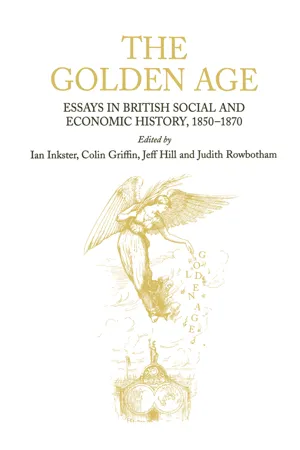
The Golden Age
Essays in British Social and Economic History, 1850–1870
- 304 pages
- English
- ePUB (mobile friendly)
- Available on iOS & Android
eBook - ePub
The Golden Age
Essays in British Social and Economic History, 1850–1870
About this book
In 1850 the Industrial Revolution came to an end. In 1851 the Great Exhibition illustrated to the whole world the supremacy of industrial England. For the next twenty years Britain reigned supreme. From around 1870 Britain began to decline. Britain is now a second rate power with strong memories of its former supremacy. The above five sentences summarise a common view of the sequencing of Britain's rise and relative fall, a stereotype that is challenged and modified in the essays of The Golden Age. By concentrating on central aspects of social and industrial change authors expose the underpinnings of supremacy, its unsung underside, its tarnished gold. Major themes cover industrial and technological change, social institutions and gender relations in a period during which industry and industrialism were equally celebrated and nurtured. Against this background it is difficult to argue for any sudden decline of energy, assets or institution, nor for any significant move from an industrial society to one in which a hearty manufacturing was replaced by commerce and land, sensibility and artifice.
Information
Chapter 1
Introduction: A Lustrous Age?
Ian Inkster
In 1850 the Industrial Revolution came to an end. In 1851 the Great Exhibition illustrated to the whole world the supremacy of industrial England. For the next twenty years Britain reigned supreme. From around 1870 Britain began to decline. Britain is now a second-rate power with strong memories of its former glory.
Such first sentences may read like a passage from Kings and Things or 1066 And All That, but they are not so very unrepresentative of either popular or academic judgement concerning England after its initial forging of the first industrial revolution. It is true that some writers, such as Wiener, seem to date the collapse of Britain as a drawn-out process beginning as early as 1850, whilst a smaller number of historians are sceptical about decline at any time much prior to 1914. Even more confusingly, academic economic historians tend to run the Industrial Revolution itself through to at least 1860.1 Whichever of these somewhat contradictory and seemingly arbitrary positions is adopted, the years from around 1850 to around 1870 tend to be either denied the status of a coherent period, or are unproblematically assumed to be ones of success and dominance, the natural postscript to industrial revolution and technological superiority. By concentrating on central aspects of social and industrial change, the authors of the present volume of essays expose the underpinnings of supremacy, its unsung underside, its tarnished gold. Major themes cover industrial and technological change, social institutions and gender relations in a period during which industry and industrialism were equally celebrated and nurtured. Against this background it is difficult to argue for any sudden decline of energy, assets or institutions, nor for any significant move from an industrial society to one in which a hearty manufacturing was replaced by commerce and land, sensibility and artifice.
Of course, to label is to invite criticism. The 'Mid-Victorian Boom' or 'the Age of Equipoise' titles, do just that,2 but for these particular twenty years we would judge that 'the Golden Age' is a term which might evoke new thoughts yet stall the damage done when, to steal the wonderful phrase coined recently by David Eastwood, 'titular hegemony forecloses interpretative debate'. Because these years have so often been located betwixt and between the supposedly epic conjunctions of industrial revolution on one hand and industrial decline on the other, or incorporated within such seemingly commanding long-terms as 'the age of improvement', they have not been foreclosed by labels so much as relegated to limbo by the successful applications of nomenclatures designed for adjacent conjunctures. We may generally affirm the notion that the years following the commercial depression of the early 1840s and the subsequent Peelite 'resolution of the crisis of early-Victorian Britain' laid something of the attitudinal and institutional foundations of a new beginning, a confirmation of 'Britain's future as an urban, manufacturing nation' based on hard-earned understandings of the frictions and the heat generated by both the machinery of industry and the partialities of good governance.3 But if this was a Britain whose new confidence was based on a proven commercial supremacy, this was not because industrial culture now delivered its rewards more adequately, but because the social problems which suffused the era - as in Harold Perkin's due warnings - were now seen as residuals of the recent past rather than as harbingers of an imminent future. From Mill to Jevons,4 these years witnessed the growth to certitude of modernist social, economic and political thinking, as well as innovations in literary form and the dissemination of information by urban association and the printed word. This was the time when British commercial and technological supremacy coalesced in the establishment of 'respectable society', a system of non-centralized adjustment to new industrial and urban processes and institutions. New concerns demanded new legal solutions to such problems as prostitution or juvenile crime or for reducing such inefficiencies and frictions as drunkenness at work, as part of a range of modern mechanisms devised to cope with a complexity of site and agency not yet reached by other industrializing systems.
Nowhere was this any better seen than in London during the year of the Great Exhibition. Over six million visitors were recorded between May and October, a maximum of 28,000 entering the main building in one hour.5 As Sue Barton shows below in her apposite account of the provincial organization of such metropolitan visits, much good work and preparation was involved. Many celebrations emphasized good order, civility and sobriety. Less attention was paid to the very substantial additional policing arrangements which had been put into place at an early stage.6 In a year during which Benjamin Disraeli could preach of 'general prosperity and particular distress', in which riots might occur at the closure of a workhouse gate, in which the Unitarian MP for Oldham, William Johnson Fox was advocating education of the people as a superior instrument of 'police', so too Lord Brougham addressed the House of Lords to the effect that two million had attended the Exhibition without major mishap by early July, one quarter of whom were foreigners, 'the rest being, for the most part, the tradesmen and operatives of this metropolis, and those too, not of the lowest classes'.7 Indeed, the Great Exhibition represented one outstanding venue wherein technicians mixed relatively freely with savants, and both moved easily from sites of elite culture to places of practice. 1851 saw a particular combination of technological display with social mixing and association in such large and public venues as Exeter Hall and the Whittinghton Club and Metropolitan Athenaeum (Arundel Street). Joseph Hume MP, the Scots radical politician and anti-corn law advocate, used both these metropolitan venues to address large audiences on franchise and tax reform, and as principal public platforms of the National Reform Association.8 When, in 1852, the House of Commons debated the fixture utility of the Crystal Palace, ushering in 'one of the most dangerous and serious divisions that could agitate this country', Hume used meetings at Exeter Hall to press for a retention of the building and its conversion into a centre of technical education for the masses, a far cry from ancient universities or grand scientific associations, (although he was, it might be noted, an FRS).9 Where conservative interests saw the Crystal Palace as an all too clear threat to a gentler, garden metropolis, an institution in which the people were 'trepanned, seduced, ensnared and humbugged', Hume and the London technicians argued with ebullience for the maintenance of the new site, symbol of both industrial progress and social change.10
For the great number of the skilled artizans and tradesmen whose journals, associations and civic activities were growing most healthily throughout these years, this was the period when their energies, knowledge, expertise and competitiveness had resulted in a successful challenge to big capital. Thus, the artizans took Professor Thorold Rogers of Oxford to task for his advocation of a removal of special protection for technical innovation, on the grounds that it was precisely the inventive technicians who effectively fought the great capitalist manufacturers, who utilized their patents to 'break down the monopoly of capital by a short-lived monopoly, which immediately stimulates others to invent other improvements'. If the preceding years had been ones of 'industrial capital', those following the 1851 exhibition were to be the years of 'artizan intellect'.11 This was not a position so very different from that of the liberal intelligentsia, many of whom now, and perhaps for the first time in such numbers, believed that good governance had at its basis 'a consistent union in the nation'. As elaborated by Walter Bagehot, such a union was to be formed of a newly-increased intelligence and responsibility, which would yield a harmony of opinion in the midst of great variance of 'social circumstances and social habits'. The earlier 'democratic theory of government' was natural to a phase of great industrial and urban change, the years 1832 to 1860, but could only be superseded in an 'age of political intellect' by a wider franchise based on a nice combination of property and political intelligence.12
Perhaps, then, a novel attribute of the Golden Age was the impact of artizanal culture on middle-class liberalism through the spread of machinofacture and its desiderata of efficiency, good order, exact measurement and reproducibility. Manchester's civic centre was not merely formed of merchant capitalism, but of the artizanal business and comings and goings of St Ann's Square, the Victoria Buildings, Manchester Chambers and Deansgate. It was in such venues that Bagehot's 'civilities' were spread and verified. The conversion of the intellectual radicalism of the 1820s and 1830s into the municipal communalism of the Golden Age took place within just such specific sites, guided by common interests and expertise, fired by Nonconformism, embodied in both T.H. Huxley and, later, Joseph Chamberlain. In his famous 'Duties of the State' lecture before members of the Birmingham and Midland Institute in 1871, Huxley answered the laissez-faire of his friend Herbert Spencer through a focus on the civic role of technique, expertise and formal knowledge systems, and the need for expert interventions at the local level in such mundane areas as vaccination, roadmending and sanitation programmes, as opposed to the violent alternatives of European contemporaries. This was the stuff of Walter Bagehot's 'unconscious imitation', by far 'the main force which moulds and fashions men in society'. Thus, Coleridge's earlier fears that the extended franchise would open the political system to the sway of 'fools and knaves' seemed, amongst the many spokesmen of the public sphere, to belong firmly in the past.
In this volume of essays we treat these years as a coherent era in the history of industrial Britain, as a Golden Age in which free trade and the gold standard at most times spelt British success, and in which social and political advances were accepted as the rewards due to an early industrial modernity. The starting point is Britain's position as the foremost economy exploiting global expansion, new ideas and institutional changes. In these years exports to India increased five-fold, to Australia fifteen-fold. A rapid rise in capital exports towards the £1 billion mark carried with it an empire of railway building, and income receipts from such investments rose from an average of around £12 million at the outset of the Golden Age to some £50 million at its end. But advance was not measured only in commercial terms. Britain's economic position was linked to significant developments in the character of her social institutions and relations. The essays in this volume go beyond a celebration of success into the construction of an interpretation of industrial Britain which emphasizes social explanation as well as social effects and which unravels linkages between institutions, industries and technologies. The Golden Age project was interdisciplinary, involving historians and lawyers at Nottingham Trent University and historians of science, technology, gender relations and social change from a variety of academic institutions in a series of seminars during 1997-99. The five parts of the volume are devoted to an overall picture of the nation, a study of individual industries, examination of technological change, analysis of social institutions, and of gender relations.
From the outset, Harold Perkin is insistent concerning the social lacunae and contradictions of these years, and provides several of the arguments which have induced the question mark of our title. In terms of competitive commercial and technological performance, riding on the back of the speedily emerging international economy and gold standard, Britain experienced the greatest success. For the great numbers of the commercial and professional middle classes, for many landowners and farmers, for those tens of thousands of literate engineers, mechanics and clerks who gained the material rewards due to their talents and energies, these were golden years. Higher incomes could be spent on a far greater range of products than in the earlier years of the century, and for many the printed word, sources of information, new forms of association and greater opportunities for gainful instruction were all obtainable at falling rather than rising prices. For these same groups, local political power was beginning to move into their hands from 1835, when the Municipal Reform Act introduced into boroughs rate-payer control and permitted the emergence to civic authority of a range of business, professional and industrial interests and Dissenting groups.
The four editorial introductions to each part of this volume clearly show that the industrial and commercial gains were substantial, were increasingly shared by new groups and localities, but were always at once tenuous and exclusive a raw material famine might bring a locale or an industry to quick ruination, systematic legislation might exclude an entire gender from entry onto the paths of individual achievement. Thus, there was much furore concerning Nonconformist entry to the ancient universities, but little was heard there of the matriculation or graduation of women, an omission hardly rectified by the reluctant allowances of the London colleges or of Durham, or of the otherwise liberal, civic traditions of Scottish higher education. There is much in this volume to suggest that in this period and in the following years, the major problem of British industrialism was not so much any overarching 'anti-industrial' culture, but rather a persistence and increased subtlety in the processes and mechanisms whereby vital energies, skills and ideas were systematically excluded from crucial areas of industry, commerce and knowledge production.
Much has been made of the supposed anti-industrialism of the years following the Great Exhibition, and something more has been made of Victorian non-industrialism. Neither label can stick, especially if we at once note the 'pre-industrialism' of German bourgeois culture or the 'aristocratic aspirations' of the American business magnates, or the very similar arguments given for the supposed retardation of French industry...
Table of contents
- Cover
- Half Title
- Dedication
- Title
- Copyright
- Contents
- List of Tables and Charts
- Notes on Contributors
- Events of the Golden Age
- Preface and Acknowledgements
- 1 Introduction: A Lustrous Age?
- 2 'Nor all that Glisters ...': The Not So Golden Age
- Part I Industry
- Part II Technology
- Part III Social Institutions
- Part IV Gender
- Index
Trusted by 375,005 students
Access to over 1.5 million titles for a fair monthly price.
Study more efficiently using our study tools.
Frequently asked questions
Yes, you can cancel anytime from the Subscription tab in your account settings on the Perlego website. Your subscription will stay active until the end of your current billing period. Learn how to cancel your subscription
No, books cannot be downloaded as external files, such as PDFs, for use outside of Perlego. However, you can download books within the Perlego app for offline reading on mobile or tablet. Learn how to download books offline
Perlego offers two plans: Essential and Complete
- Essential is ideal for learners and professionals who enjoy exploring a wide range of subjects. Access the Essential Library with 800,000+ trusted titles and best-sellers across business, personal growth, and the humanities. Includes unlimited reading time and Standard Read Aloud voice.
- Complete: Perfect for advanced learners and researchers needing full, unrestricted access. Unlock 1.5M+ books across hundreds of subjects, including academic and specialized titles. The Complete Plan also includes advanced features like Premium Read Aloud and Research Assistant.
We are an online textbook subscription service, where you can get access to an entire online library for less than the price of a single book per month. With over 1.5 million books across 990+ topics, we’ve got you covered! Learn about our mission
Look out for the read-aloud symbol on your next book to see if you can listen to it. The read-aloud tool reads text aloud for you, highlighting the text as it is being read. You can pause it, speed it up and slow it down. Learn more about Read Aloud
Yes! You can use the Perlego app on both iOS and Android devices to read anytime, anywhere — even offline. Perfect for commutes or when you’re on the go.
Please note we cannot support devices running on iOS 13 and Android 7 or earlier. Learn more about using the app
Please note we cannot support devices running on iOS 13 and Android 7 or earlier. Learn more about using the app
Yes, you can access The Golden Age by Ian Inkster,Colin Griffin,Judith Rowbotham in PDF and/or ePUB format, as well as other popular books in Histoire & Histoire du monde. We have over 1.5 million books available in our catalogue for you to explore.