eBook - ePub
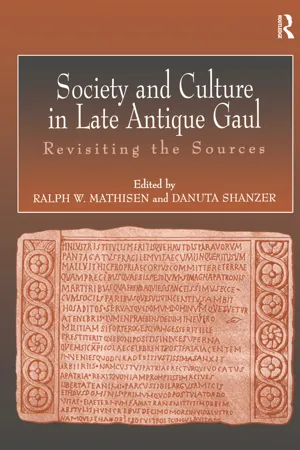
Society and Culture in Late Antique Gaul
Revisiting the Sources
- 342 pages
- English
- ePUB (mobile friendly)
- Available on iOS & Android
eBook - ePub
About this book
Late Roman Gaul is often seen either from a classical Roman perspective as an imperial province in decay and under constant threat from barbarian invasion or settlement, or from the medieval one, as the cradle of modern France and Germany. Standard texts and "moments" have emerged and been canonized in the scholarship on the period, be it Gaul aflame in 407 or the much-disputed baptism of Clovis in 496/508. This volume avoids such stereotypes. It brings together state-of-the-art work in archaeology, literary, social, and religious history, philology, philosophy, epigraphy, and numismatics not only to examine under-used and new sources for the period, but also critically to reexamine a few of the old standards. This will provide a fresh view of various more unusual aspects of late Roman Gaul, and also, it is hoped, serve as a model for ways of interpreting the late Roman sources for other areas, times, and contexts.
Part I
From Roman to Barbarian Gaul
1. The Visigothic Settlement in Aquitania: Chronology and Archaeology
Andreas Schwarcz
One of the most striking puzzles of Visigothic archeology is the fact that, apart from a handful of fibulas, combs, and a few other artifacts,1 practically no material remains attest the Visigothic presence in Gaul in the first half of the fifth century,2 whereas there is abundant evidence in Spain and Septimania from the late fifth century onward. This study will propose a historical explanation for this phenomenon by scrutinizing the relations between the Visigoths and the Goths who remained under the domination of the Huns and later became the Ostrogoths. Doing so also will permit several open questions regarding the Visigothic settlement in Aquitania and Spain to be elucidated.
The Date of the Visigothic Settlement: 418 or 419?
The first problem concerns the date of the Visigothic settlement in Aquitania following Vallia's campaigns in Spain. Two sources, Hydatius and Prosper Tiro, discuss it. Their accounts generally are seen as offering two different dates. According to the Spaniard Hydatius, bishop of Aquae Flaviae (Chaves):
The Goths, after the campaign that they had been carrying out was broken off, were recalled to Gaul by Constantius and received territory in Aquitania from Toulouse to the Atlantic Ocean. After the death of Vallia, Theoderic succeeded to the kingdom.3
Ever since Mommsen edited the chronicle, this passage has been dated to 418 CE.4 Prosper's account of these same events, however, is dated to 419. He states, "The patrician Constantius concluded a peace with Vallia; Aquitania was given to him for habitation along with several cities of neighboring provinces."5 This apparent discrepancy has led to endless discussions about the correct date of the settlement, and many ingenuous solutions to reconcile the accounts have been proposed.6 The reality, however, is quite simple: Mommsen made a mistake. This can be proven by looking at events in Hydatius that can be dated from other sources.
As the basis of his chronological structure, Hydatius primarily used imperial regnal years and Olympiads.7 Like Eusebius and Jerome, he attempted to give the names of the bishops of Rome, Alexandria, Jerusalem, Antioch, and other important Christian sees, but this information is often faulty and has great gaps. This even applies to the bishops of Rome, whose names he regularly tried to cite.8 Hydatius also liked to mention natural events and prodigies, in particular solar eclipses, and earthquakes.9 Such dated events can provide a chronological framework for information placed between them, and several are cited as occurring at roughly the same time as the Visigothic settlement, viz.
- 64. XXIIII. Solis facta defectio die XIIII kal.Aug., qui fuit quinta feria ["An eclipse of the sun occurred on 19, which was a Thursday"].
- 65. Romanae ecclesiae post Theofilum XXXVIIII praesidet episcopus Eulalius ["After Theophilus, Eulalius presided as the thirty-ninth bishop of the Roman church"].
- 69. [Settlement of the Visigoths].
- 70. [Death of Vallia].
- 71a. Durante episcopo quo supra, gravissimo terrae motu sancta in Hierosolymis loca quassatur et cetera, de quibus ita gestis eiusdem episcopi scripta declarant ["During the tenure of the above bishop, the holy places in Jerusalem and elsewhere are stricken by a most serious earthquake, regarding which events the letters of the same bishop speak"].
Mommsen's dating of Hydatius places the solar eclipse on 19 July 417. But all other sources put it in 418, for example:
1. Excerpta Sangallensia 542, s.a.418 (MGH AA 9.300): Honorio XII et Theodosio VIII conss. Sol eclipsim fecit XIII kl.Aug. et a parte Orientis apparuit Stella ardens per dies XXX.
2. Marcellinus Comes, Chron. s.a.418,2 (MGH AA 11.74): Solis defectio facta est.10
3. The Chronicon Paschale, R720, s.a. 6926 AM (418 CE) (CSHB 7.2.5749), locates the eclipse in the the twelfth consulship of Honorius and the eighth of Theodosius II, in the first indiction, fourteen days before the Kalends of August, and the sixth day of the week, that is, in 418 CE. This date is confirmed by modern astronomical calculations, and has been used by later editors of Hydatius.11 Hydatius' only apparent error was in placing the eclipse on the fifth day of the week, Thursday, rather than on Friday.123
The next event recorded by Hydatius is the schism in the Roman church a...
Table of contents
- Cover
- Half Title
- Dedication
- Title
- Copyright
- Contents
- Figures
- Contributors
- Preface
- Abbreviations
- Map of Late Antique Gaul
- Introduction
- Part I From Roman to Barbarian Gaul
- Part II Religion and Society
- Part III Intellectual Life
- Index
Trusted by 375,005 students
Access to over 1.5 million titles for a fair monthly price.
Study more efficiently using our study tools.
Frequently asked questions
Yes, you can cancel anytime from the Subscription tab in your account settings on the Perlego website. Your subscription will stay active until the end of your current billing period. Learn how to cancel your subscription
No, books cannot be downloaded as external files, such as PDFs, for use outside of Perlego. However, you can download books within the Perlego app for offline reading on mobile or tablet. Learn how to download books offline
Perlego offers two plans: Essential and Complete
- Essential is ideal for learners and professionals who enjoy exploring a wide range of subjects. Access the Essential Library with 800,000+ trusted titles and best-sellers across business, personal growth, and the humanities. Includes unlimited reading time and Standard Read Aloud voice.
- Complete: Perfect for advanced learners and researchers needing full, unrestricted access. Unlock 1.5M+ books across hundreds of subjects, including academic and specialized titles. The Complete Plan also includes advanced features like Premium Read Aloud and Research Assistant.
We are an online textbook subscription service, where you can get access to an entire online library for less than the price of a single book per month. With over 1.5 million books across 990+ topics, we’ve got you covered! Learn about our mission
Look out for the read-aloud symbol on your next book to see if you can listen to it. The read-aloud tool reads text aloud for you, highlighting the text as it is being read. You can pause it, speed it up and slow it down. Learn more about Read Aloud
Yes! You can use the Perlego app on both iOS and Android devices to read anytime, anywhere — even offline. Perfect for commutes or when you’re on the go.
Please note we cannot support devices running on iOS 13 and Android 7 or earlier. Learn more about using the app
Please note we cannot support devices running on iOS 13 and Android 7 or earlier. Learn more about using the app
Yes, you can access Society and Culture in Late Antique Gaul by Ralph Mathisen,Danuta Shanzer in PDF and/or ePUB format, as well as other popular books in History & Ancient History. We have over 1.5 million books available in our catalogue for you to explore.