eBook - ePub
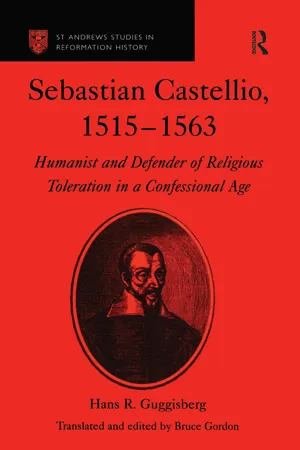
Sebastian Castellio, 1515-1563
Humanist and Defender of Religious Toleration in a Confessional Age
- 320 pages
- English
- ePUB (mobile friendly)
- Available on iOS & Android
eBook - ePub
Sebastian Castellio, 1515-1563
Humanist and Defender of Religious Toleration in a Confessional Age
About this book
Sebastian Castellio, linguist, humanist and religious reformer, is one of the most remarkable figures of the Reformation. Attracted by Calvin's reforms, Castellio moved to Geneva in the 1540s, where he wrote his influential work on educational reform. Ironically, it was Castellio's work as a scholar in Geneva, which was to lead to his falling out with Calvin, and ultimately his forced departure from Geneva and his resettlement in Basle. Exiled from Geneva, Castellio soon attracted a circle of like-minded reformers who opposed the intolerant attitude of Calvin, exemplified by the execution of the heretical Michael Servetus. It is Castellio's residence in Basle, where he developed his 'liberal' humanist approach to religious toleration in opposition to Calvin's dogmatic othodoxy, which forms the core of this study. It explores what toleration meant and how both sides argued their case. Much attention is paid to Castellio's most important work 'On Heretics', in which he argues against the execution of those who err in the faith. By telling the fascinating tale of Castellio's life, this work illuminates the furious debate which he unleashed and how it marked a crucial stage in the development of Protestant thought.
CHAPTER ONE
Family Origins, Early Life and Education
Very little is known about Sebastian Castellio’s family background and his early life. The few details left to posterity are taken from several brief and relatively casual comments which Castellio included in his own later writings; individual pointers can also be gleaned from personal entries in official documentation drawn up in Geneva and in Basle. He remained silent throughout his life on the subject of his youth, relating little about his earlier experiences. Unlike many of his scholarly contemporaries, Castellio produced no autobiographical writings. His only comments on his past were designed to counter false conjecture, malevolent attacks and slanderous imputations, and even in these circumstances he remained circumspect, concentrating simply on the essential facts. Castellio can certainly not be reproached for excessive self-promotion in his own writings. The historian wishing to examine Castellio’s early years can only rue that the subject was himself so reticent. Not only did he record little or nothing about his past in his writing, but he also appears to have mentioned it infrequently in conversation with friends and confidants. The comments of his contemporaries and the first biographical accounts of his life, written after his death, serve only to demonstrate the strikingly fragmentary nature of information about Castellio’s early life.1
Savoy
The meagre facts available can be quickly recounted. The man who would become a scholar and champion of religious toleration was born the son of a peasant in 1515 – it is not possible to establish the date more precisely – in the village of Saint-Martin-du Fresne which lay in the western borderlands of the dukedom of Savoy.2 The French form of the family name was Chastillon or Chasteillon – a surname which could still be found in the northern part of the district of Bugey at a much later date. Sebastian or ‘Bastian’ Chastillon came from a large family which included several older brothers and sisters. Castellio’s siblings will occasionally reappear in the account of his later years, primarily as members of his small circle of like-minded friends and supporters in Geneva and Lyon.3 His parents were evidently poor but respectable country-dwellers who had little education but were industrious and God-fearing, devoted members of the Roman Catholic Church. His mother’s name is unknown; his father was called Claude Chastillon. Throughout his life Castellio evidently retained a loving and grateful attachment to his father. This is evident in a work of 1558 where he recorded:
Certainly my father was very ignorant in matters of religion, yet he was a good man who abhorred most of all, and taught us to abhor, theft and lying. As a result throughout my childhood we were well aware of the saying ‘Ou prendre, ou rendre, ou les peines d’enfers attendre’. And therefore from my very earliest years I constantly shrank back from these vices. As witnesses to this I call on all those who ever knew me there [in Geneva] or anywhere else.4
Today the village of Saint-Martin-du-Fresne lies in the French Department of Ain and has just over 700 inhabitants. It lies on the main route between Geneva and Lyon about 7 kilometres beyond the small town of Nantua. The history of this small community reaches back into the high Middle Ages. In the twelfth and early thirteenth centuries Saint-Martin-du-Fresne lay within the jurisdiction of the Cluniacs at Nantua. From 1248 legal jurisdiction was in the hands of the lords of Thoire-Villars who had originally been castellans of the monastery but had gradually taken into their own hands many of the rights originally exercised by the religious house. A fortified castle at Saint-Martin-du-Fresne served to demonstrate and defend their power and authority; the remains of the castle can still be seen today. About 1402 the village became part of the territory of the counts of Savoy and subsequently formed one of the 13 castellian districts of the bailiwick of Bugey. This did not, however, resolve long-standing differences with the monks and burghers of Nantua which continued to determine the history of the district of Bugey into the first decades of the sixteenth century.5
Peasants in this district were well accustomed to defending themselves against the claims of the church. This tradition of rebellion extended beyond material issues. In the thirteenth century the district of Bugey had been a well-known place of refuge for Waldensians who had found security and employment under the protection of the local nobility. The religious traditions which they had brought with them had not died out by the time of the birth of Sebastien Chastellion. Similarly memories of Felix V, Pope at the time of the Council of Basle, remained strong; as Duke Amadeus VIII he had often spent time in the district of Bugey and in the neighbouring district of Bresse. Castellio’s parents may have served Philibert the Handsome as their territorial lord. Philibert is known primarily for the magnificent tomb erected in his memory by his wife Margarete of Austria, granddaughter of Charles the Bold. This burial church in Brou-en-Bresse, decorated by the undisturbed paintings of Konrad Meit of Worms, remains one of the last and most remarkable achievements of the late Gothic period; it also sounded the final notes of medieval architecture, struck as a new age was already dawning in the West. This remarkable work was completed while Castellio, his allegiance to Humanism still in the future, was growing up not far from Brou-en-Bresse. As a boy, he must surely have heard of the building and may even have seen it with his own eyes around the time of its completion.6
The church in Brou was built during a period of decline for the dukedom of Savoy. Philibert’s brother and successor, Charles III, proved incapable of maintaining his position between the greater European powers. When the Reformation crossed his borders it was met with harsh persecution and suppression. The city of Geneva had achieved its independence after a prolonged struggle; all Charles III’s plans to force the city back into subservience to his dukedom came to nothing. His efforts led only to the eventual loss of the Pays de Vaud and additional lands to Berne in early 1536. At the same time the remainder of Savoy was conquered by Francis I and incorporated into the French kingdom. This would remain the situation until the Peace of Cateau-Cambresis.7
From the time of this political disintegration Castellio was legally entitled to call himself a subject of the King of France.8,9 He was not, however, in his homeland when these decisive events took place, for he was already a student in Lyon. Even though little is known about the scholar Castellio’s early years, the social milieu from which he came can be precisely pinpointed. As the child of peasants he grew up in poverty and provincial seclusion. It was only as a young man that he first experienced city life. Yet, although he had received neither education nor urbanity in the house of his parents, he had imbibed a clear moral judgement which would subsequently and constantly dictate both his thoughts and his behaviour. And although Castellio’s intellectual achievements would leave the simplistic attitudes of his father far behind, something of the dogged perseverance of the Savoy peasant would remain with him throughout his life.
Lyon
Castellio studied in Lyon from 1535 to 1540. He had moved from the village of Saint-Martin-du-Fresne into the community of students and teachers at the College of the Trinity. Both his enthusiasm and his particular talents for the study of ancient languages were evident during these years.
He had certainly landed on his feet. In the 1530s Lyon flourished and prospered as never before; it was the highpoint of the history of the city to date. With 50 000 inhabitants Lyon was the second city of France and adopted a role on the European stage as a centre of trade, finance and industry. Uniquely in France, Lyon had successfully defended its ancient urban freedoms and privileges against the centralizing designs of the crown. There were few corporate bodies to restrict trade and industry; only surgeons, goldsmiths and locksmiths were organized in guilds. Lyon’s role in international trade was strengthened by her geographical position and guaranteed by the fairs which took place in the city four times a year. In the years before 1540 the presence of the royal court frequently made Lyon the ‘capitale du royaume’, sometimes for prolonged periods.10
The European wars waged in Italy, relatively close to Lyon, often brought Francis I to the city. In the 1520s, during the regency of Louise of Savoy, Lyon had become the political centre of France. In the period from 1536 to 1538 French foreign policy was again preoccupied with events in the south-east of the country following the invasion of Provence and the Entrevue of Francis I and Charles V in Aigues-Mortes. On several occasions the residents of Lyon would have been able to experience and marvel at the great theatre of court ceremonial; these included the entry of Eleanora of Austria, the second wife of Francis I in 1533, and the visit of James V of Scotland four years later. They would have grown used to welcoming their king and foreign princes and statesmen with the festive ‘entrees’ which proceeded both short and prolonged visits.11 Ecclesiastical and crown office-holders resident in Lyon imitated the great splendour of their princely guests; the wealthy members of the town’s merchant aristocracy joined in with gusto. The political activities and elaborate lifestyles of the leading members of the community had a beneficial impact on the development of trade and industry in the city.
Yet social conflict was frequently a feature of city life. As the example of the ‘Grand Rebeyne’ of 1529 demonstrated, such conflict could be very fierce. The prosperity that Lyon experienced during these years did not avert poverty and oppression. Unrest and internal disputes were frequent. However, revolution on the model of the events of 1529 would not be attempted again until the second half of the century.12
While certain areas in France had suffered as a result of the Italian wars, the town of Lyon had profited. With centuries of conflict with the archiépiscopal authority largely concluded and with the impact of the centralizing politics of Francis I yet to be felt, in these intermediate years the influence of Italy was felt very strongly in Lyon. Italian artisans, merchants and bankers were encouraged to take up residency in the city, influential exiles were given asylum and the city embraced Italian art and literature. In 1536, the year of Francis I’s long residency in the city, the foundations were laid for the subsequent development of the Lyon silk industry. The roots of this initiative can be traced back to the mercantilist plans of Louis XI whose ideas were taken up anew by Etienne Turquet and Barthélémy Naris, entrepreneurs from Piedmont, who with the support of the town magistrate applied for royal permission for the manufacture of silk. The long-term significance for the city of this new area of economic activity can hardly even have been dreamt of in 1536.13
It was not just Italians who had long been attracted to the fairs held in Lyon. Catalonia, Portugal, the Netherlands and Germany provided a significant number of immigrants. The role played by representatives of German banking houses must be acknowledged, but it was German printers who were especially important. Printing would provide Lyon with its worldwide reputation in the first half of the sixteenth century, and it was these German printers who contributed decisively to the foundation and subsequent growth of the printing industry.
The beginnings of the Lyon printing industry can be traced back to the 1470s, when Barthelemy Buyer,a native of Lyon, and Guillaume Le Roy from Liege, who established the first typographical workshop. The first German printers arrived soon afterwards: Nikolaus Philipp from Bensheim, Markus Teinhard from Strasbourg and Martin Husz from Botward in Württemberg were all settled in Lyon by 1480. Over the next two decades the pri...
Table of contents
- Cover Page
- Title Page
- Copyright Page
- Table of Contents
- St Andrews Studies in Reformation History
- Preface
- Translator’s Note
- Abbreviations
- Introduction
- 1 Family Origins, Early Life and Education
- 2 Calvin’s Colleague
- 3 From Geneva to Basle
- 4 The Bible Translations
- 5 The Toleration Debate Begins
- 6 The Toleration Debate after the Publication of
- 7 Broadening of the Conflict
- 8 Professional and Personal Circumstances
- 9 Challenges and Conflicts in the Latter Years
- 10 Castellio’s Theological Thought
- 11 Castellio’s Theological Heritage
- Concluding Remarks
- Select Bibliography
- Index
Trusted by 375,005 students
Access to over 1.5 million titles for a fair monthly price.
Study more efficiently using our study tools.
Frequently asked questions
Yes, you can cancel anytime from the Subscription tab in your account settings on the Perlego website. Your subscription will stay active until the end of your current billing period. Learn how to cancel your subscription
No, books cannot be downloaded as external files, such as PDFs, for use outside of Perlego. However, you can download books within the Perlego app for offline reading on mobile or tablet. Learn how to download books offline
Perlego offers two plans: Essential and Complete
- Essential is ideal for learners and professionals who enjoy exploring a wide range of subjects. Access the Essential Library with 800,000+ trusted titles and best-sellers across business, personal growth, and the humanities. Includes unlimited reading time and Standard Read Aloud voice.
- Complete: Perfect for advanced learners and researchers needing full, unrestricted access. Unlock 1.5M+ books across hundreds of subjects, including academic and specialized titles. The Complete Plan also includes advanced features like Premium Read Aloud and Research Assistant.
We are an online textbook subscription service, where you can get access to an entire online library for less than the price of a single book per month. With over 1.5 million books across 990+ topics, we’ve got you covered! Learn about our mission
Look out for the read-aloud symbol on your next book to see if you can listen to it. The read-aloud tool reads text aloud for you, highlighting the text as it is being read. You can pause it, speed it up and slow it down. Learn more about Read Aloud
Yes! You can use the Perlego app on both iOS and Android devices to read anytime, anywhere — even offline. Perfect for commutes or when you’re on the go.
Please note we cannot support devices running on iOS 13 and Android 7 or earlier. Learn more about using the app
Please note we cannot support devices running on iOS 13 and Android 7 or earlier. Learn more about using the app
Yes, you can access Sebastian Castellio, 1515-1563 by Hans R. Guggisberg,Bruce Gordon in PDF and/or ePUB format, as well as other popular books in History & World History. We have over 1.5 million books available in our catalogue for you to explore.