- 182 pages
- English
- ePUB (mobile friendly)
- Available on iOS & Android
eBook - ePub
About this book
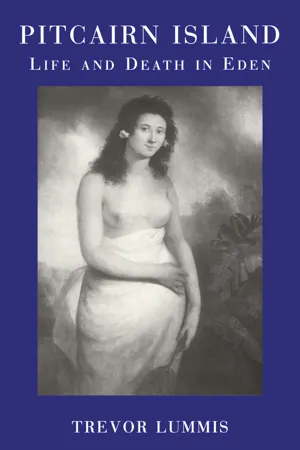
Pitcairn Island was a tiny uninhabited Eden when, in January 1790, Fletcher Christian and eight sailors, together with six Polynesian men, twelve Tahitian women and one baby, landed from HMS Bounty. There they burned their boat, thus eliminating any chance of a voluntary return to the known world. Their disappearance was to remain a mystery for twenty years. This book discusses the purposes of the Bounty's voyage, the mutiny and its consequences, but goes further than any previous publications, to relate the gripping drama of subsequent events on Pitcairn - of the fifteen men who landed on the island, only one was alive when they were discovered, twelve had been brutally murdered by their companions and one had commited suicide. The role of the women in shaping events on the island, and their input into the unique identity of the community, is fully considered for the first time. Their support for the men as rival groups-Tahitians or Europeans-or their concern for individuals largely decided which men lived and died, while the women themselves commited some of the murders. Conflicts over property, race and gender brought this group close to total destruction. But out of the clashes of cultures and individual wills between European mutineers and Pacific islanders came, in a brief space of time, the new community of 'Pitcairn Islanders': a thriving society based on progressive laws relating to sexual equality and the environment, with significant resonances for the reader some two centuries later.
CHAPTER ONE
Preliminaries and the voyage
The drive to greater wealth through increased trade and commerce was the main incentive for Europeans to send ships to far destinations, but European curiosity ensured that the simple urge to explore and scientific inquiry were never entirely absent. From the fifteenth century onwards those voyaging to the Far East went from Europe via the Cape of Good Hope and the Indian ocean to India or China; the Portuguese led the way to be followed by the Dutch, English, French and others. Permanent European trading stations were established. When cast adrift Captain Bligh headed for the Dutch settlements in Timor, Java and Sumatra (now Indonesia), 3 600 miles distant but the nearest place where he could find security and ships returning to Europe. Australia had been discovered but the coast was only partially charted, and the first European settlement came only towards the end of the eighteenth century with the first penal colony at Botany Bay in 1788. Apart from that, and the scattered European presence in the area north of Australia through to the Philippines and China, the vast expanse of the Pacific away to the coasts of North and South America was little known. It was to be explored and exploited by ships which ventured down the East coast of South America and entered the Pacific ocean by rounding Cape Horn.
Although the great Portuguese navigator, Magellan, had pioneered the route in 1519, by the mid-eighteenth century the greater part of the Pacific ocean was largely uncharted and its islands unexplored. Indeed, many scientists and geographers still believed that there must be a large undiscovered land mass in the southern hemisphere to balance the land mass of the northern hemisphere. Exploring and charting this huge expanse was a formidable task. Square-rigged ships could not sail very close to the wind and had to achieve their destinations by following favourable winds, however roundabout the route. Sections of the oceans which had been proved sailable by one ship at a given season were found to be bedevilled by contrary winds, or by calms, by the next ship to attempt to cross that part of the ocean. Knowledge was acquired slowly through hardship and determination. Gradually the circulation of the winds and their seasonal variations became known and ocean currents were charted; landfalls where water, food and fuel could be obtained were established; bays and coves with tides suitable for careening and repairing ships became known. Early voyagers planted fruit trees and a variety of familiar food plants at these places for the benefit of others who might follow them. The few European ships which crossed the Pacific could sail week after week without sighting land. The average voyage from the south of England to Tahiti took about six months provided that the ship stopped only once en route, usually at the Canary Islands for water and fresh food, and then had no landfall save when Horn.
Nevertheless, the fact that the Pacific region was an immense ocean set with comparatively small islands meant that once European sea-powers turned their attention to it, it was rapidly explored. By contrast Africa had been familiar for centuries but very little of its interior was known to Europeans until the nineteenth century, and much of that not until quite late in the century. In Africa land exploration and trade called for immense numbers of porters and guards, and goods for inland trade were often effectively limited to what could be carried on the backs of humans and pack animals – either of which consumed a given quantity of supplies daily. Even more crucially explorers or traders were vulnerable to the power of the local inhabitants so even large expeditions risked being attacked and plundered. It is no accident that one of the main trade goods out of Africa – slaves – were victims of violence and could transport themselves to the coast. A European ship, on the other hand, was a floating fortress virtually immune to the hostility of the local populations. It could carry dry stores for two or more years and was powerful enough to be able to land to trade for, or otherwise to take, fresh supplies from time to time as opportunity offered. Such ships floated away from Europe but carried with them its technology. The Pacific economy had no metal. Ships carried not only cannon and muskets and all the tradesmen’s and domestic implements made of iron, but also a blacksmith’s forge on which metal could be worked. Natives had to fell trees and work the timber slowly and patiently with implements of stone and bone; the sailors felled trees, sawed them into planks and repaired their ships with a full complement of hard-edged carpenter’s tools, and they had knives, swords and bayonets as well as all the metal fittings which were used to build a ship. They were technologically advanced and iron was valued by the natives much as Europeans valued gold: iron made the Europeans wealthy beyond imagination. One could purchase twenty coconuts for a single iron nail.1
Travellers by sea could explore and record in the spirit of scientific progress with a thoroughness and detail which land travellers could not. Ships could carry surveyors to measure, map and chart; artists to record images of the many strange plants, fish, birds and animals; botanists could collect, preserve and store specimens on board and could even bring living plants home. A ship could serve as an institution for the gathering of knowledge. Even the ships’ officers were encouraged to develop their skills as draughtsmen and so be able to sketch an accurate profile of coasts and landfalls, plans of natural harbours, not to mention foreign towns and their fortifications. Drawing was part of the curriculum at the Portsmouth Naval Academy from early in the eighteenth century. As, from the mid-eighteenth century, Britain developed to become the premier maritime power, British sailors were active in exploring and charting these empty wastes. Captain Cook had been the greatest of these, and the two men who were responsible for realising HMS Bounty’s voyage and its operation – Sir Joseph Banks and William Bligh – had both sailed with Cook in the Pacific and both had been to Tahiti.
More that any other place in the world Tahiti (written as Otaheite by the early visitors) was foremost in capturing the imagination and interest of Europe. Its people lived in a land so fertile and fruitful that work seemed scarcely necessary. They enjoyed a delightful climate, they were a well formed, attractive and (usually) friendly people. They struck a chord in contemporary European thought and philosophy by seeming to embody all the freedom and virtues of Rousseau’s ‘noble savage’: they were even compared to the ancient Greeks with all the admiration which European culture had for that ancient civilisation:
Banks claimed that Tahitian women were the most elegant in the world. European ladies outvied them in complexion, but in all else the Tahitians were superior. Their clothes were natural and beautiful, such as were in Europe only upon statues and antique gems, or in the paintings of the great Italians who knew how to clothe their angels and goddesses in loose natural folds.2
A French expedition under the command of Louis de Bougainville on the La Boudeuse visited Tahiti in 1769 called it New Cythera after the Greek island where, according to legend, Aphrodite, goddess of love rose from the waves. For those less imbued with a classical education the image of Tahiti as relayed by European mariners came to epitomise the perfect tropical island of latter-day popular imagination where food was to be had for the picking and people had little else to do but to laze and to make love. At Tahiti the reality was agreeable enough to provide substance for those impressions. But Tahiti was something of an exception; most islanders throughout the Pacific proved to be fierce and warlike, and quite prepared to attack the Europeans in spite of their superior armaments. It was by assuming that the newly discovered Hawaiian islanders would be as friendly or as easily intimidated by muskets as the Tahitians which cost Captain Cook his life. William Bligh was an officer aboard Cook’s ship on that fatal voyage. It was under Cook that Bligh had perfected his considerable skills as a navigator and surveyor. It was because of those skills, and because he knew the natives and had a smattering of their language, that he was chosen to command the Bounty.
The man who initiated the voyage – Sir Joseph Banks – had sailed with Cook on his first voyage to the Pacific and to Tahiti aboard the Endeavour during 1768–71. The ostensible purpose of that voyage was scientific and the ship carried an astronomer to observe the transit of the planet Venus across the sun; its other purpose, contained in secret orders, was to explore the southern Pacific and to discover any new lands which may exist. On this and subsequent voyages Cook was to criss-cross the ocean so thoroughly as to rule out the possibility of any major land mass between New Zealand and South America. Joseph Banks was a wealthy amateur botanist who is said to have contributed £10 000 to the cost of the first expedition and among his personal entourage were artists, botanists and a draughtsman. That voyage made his reputation and he went on to become President of the Royal Society and a person with immense influence over the scientific activities of government. He wielded a great deal of patronage, both by virtue of his personal wealth and of office. He was not only President of the Royal Society, trustee of the British Museum, director of Kew Gardens and a privy councillor, but also a friend and adviser on agricultural and botanical matters to the ‘Farmer King’, George III. It was through his intervention that the project on which HMS Bounty was employed was given Royal support and the services of the Royal Navy. It was he who recommended Bligh for command.
The English were not the only European nation sending ships to the vast expanse of the Pacific but within seven years of George III’s death it had been claimed that:
The reign of George III was illustrated beyond every former era of English history, by mighty and successful efforts in the career of maritime discovery. Under the personal auspices of his Majesty, and with the means furnished by his government, voyages were made to quarters of the globe, and regions, the very existence of which had been unknown to former ages… The pure interests of science, the diffusion among civilised nations of a knowledge of the globe which they inhabited, were the objects held mainly in view, and brilliantly fulfilled… however… nothing could be more laudable than to endeavour to draw from them the means of augmenting the subsistance and accommodations of mankind. The newly discovered islands of the great ocean presented many peculiar forms, both of animal and vegetable existence. Among the latter, the most remarkable and promising was a tree producing food for man, in such easy abundance, as seemed almost to exempt him from the original doom of earning his bread by the sweat of his brow.3
This marvelous plant was the breadfruit tree and the purpose of the voyage of the Bounty which commenced in 1787 was to proceed to Tahiti, there to collect a number of young breadfruit trees and transport them to the West Indies. This was commerce exploiting the earlier voyages of exploration and scientific inquiry, for the idea was that the breadfruit would provide a cheap and reliable source of food for the slaves who worked the plantations. The timing was also apt as the American War of Independence had resulted in the loss of British colonies on the mainland of North America and so the supply of grain and temperate foodstuffs to the West Indies was less certain than it had been. The breadfruit tree captured the imagination and envy of those who saw it growing, which it did with little or no attention or labour, and several visitors to Tahiti, including Captain Cook, made the observation that the Tahitians had escaped the curse of having to ‘eat bread by the sweat of their brow’. The breadfruit could be eaten just as it came from the tree without having to plough and sow, reap and thresh, or grind – but simply pick and bake. If it could be successfully transplanted to the West Indies from halfway around the world it could provide a cheap food for slaves and so greatly increase the profitability of the plantations.
As might be expected it was a committee of West Indian planters who raised the question as to whether it was possible to transport young trees that distance and keep them alive through the rigours of a long voyage in a salt-laden atmosphere. In the opinion of the influential Sir Joseph Banks it could be done. He used his extensive contacts to win support for the project and recommended that the botanist in charge should be David Nelson, who had been on Cook’s third voyage and so knew the conditions and the natives. Banks was also instrumental in laying down adaptations the ship would have to undergo in order to preserve the plants.
William Bligh’s previous experience and skills were such that he was bound to be among those considered for command of the voyage. But it was a period when appointments were more frequently made with a greater regard to an individual’s influence than to his abilities. Bligh was fortunate because an uncle by marriage, Duncan Campbell, was a West Indian planter active in the project and was also a shipowner and had employed his nephew as master on voyages to Jamaica. Bligh was a naval officer and had served full-time in the Royal Navy, but had spent the previous five years as a lieutenant on half-pay (a type of reservist, who could be recalled at need, but was free to seek other employment while drawing his half-pay), when in the summer of 1787 he was appointed to command the expedition which was charged with bringing about 1 000 breadfruit trees from Tahiti to the West Indies. He was thirty-three years old and, although made through patronage, the appointment was an acknowledgement of his high skill as a navigator. He accepted the situation with alacrity as a career in the Royal Navy was his ambition and full-time service was the only path to promotion. But after he had been appointed he expressed a growing resentment. He felt that the position warranted his promotion to captain. The best he could extract from the Admiralty was a promise of promotion on the successful completion of the task. This was not simply a matter of status and climbing the promotion ladder, important although those concerns must have been, it was a question of pay. As a lieutenant he was paid £70 a year (an able seaman received £14.40) and as the Bounty was a small vessel he was also to act as ship’s purser for the same salary. During his years on half-pay he had been captain of one of his uncle’s merchant ships plying to the West Indies earning several times that amount. Thus he took the appointment at a considerable financial loss – although there was little doubt that the West Indian planters would have voted him a considerable purse had he arrived with the trees. Even when the enterprise failed through a mutiny they awarded him 500 guineas.
It was perhaps ungenerous of the navy not to promote him before the voyage, but the ship was not of a size to require a captain to be its master. The Bounty was an ex-merchant ship of 215 tons only 91 feet long, 25 feet at her widest, and her hold was 10 feet deep. She had been specially purchased for the voyage and was adapted for carrying breadfruit trees. The whole after section of the ship where the captain would customarily have had his accommodation had been fitted with a false floor with holes to hold the pots of young trees, and suitable arrangements had been made to supply them with water and light. As a result of this alteration space was at a premium. As captain, Bligh was left with a cabin only six feet by seven feet so the overcrowding for the rest of the crew might be imagined:
Everything but steering and sail handling went on below the flush main deck – cooking, eating, sleeping and the storage of supplies, both alive and dead. This microcosm of self-sufficient life was carried on in virtual darkness and impossible cramp. There were no portholes; fresh air and light came only through the three-foot hatches to the ladderways when conditions were suitable… so thirty nine of the forty five men had to live for months on end with an average space of 30 square feet. The other six were down companionways in even smaller cells on platform decks where headroom was only 5 feet.4
This lack of space was to be fatal to the enterprise for it meant that Bligh had to sail without the usual complement of marines. Marines were placed on board ships partly to provide a trained military force for protection when ashore in hostile circumstances, but also to serve as armed guard to reinforce the authority of the captain against the crew should that be necessary. Also, had he been promoted to captain Bligh would have been given a lieutenant to serve under him, thus providing another commissioned officer to support his authority.
The ship, it might be argued, was too small for the purpose, but it had been purchased and adapted before Bligh was appointed. He joined her at Deptford to superintend the fitting-out, select his crew and take on supplies for eighteen months. Bligh’s experience of the severe weather and sea conditions which circumnavigating the world entailed was instrumental in ensuring that the Bounty was as well prepared as possible for the rigours of the voyage ahead. He ordered that the masts be shortened and took less than half the prescribed amount of iron ballast. Given the battering they were to receive in attempting to round Cape Horn those decisions may well have saved the ship from foundering. He also rejected the twenty-foot long cutter which had been supplied, insisting on having one of twenty-three feet. An extra three feet may not seem much to the non-seaman but it meant a much more substantial and seaworthy craft and as it was to be the one in which he was cast adrift with nineteen men his insistance was in all possibility to be crucial to his, and their, survival.
As was then customary Bligh was responsible for choosing his own officers and crew. This was not of any great importance as far as the common sailors were concerned. At that time there was not the clear distinction between the Royal and Merchant navies which was to develop later: crewmen in particular served indiscriminately in one or the other. But the officers owed their appointments to his patronage. Patronage...
Table of contents
- Cover
- Half Title
- Title Page
- Copyright Page
- Table of Contents
- List of figures
- Prologue
- 1 Preliminaries and the voyage
- 2 Tahiti and the Tahitians
- 3 The mutiny to Pitcairn Island
- 4 Settlement
- 5 Revolt and revenge
- 6 The women
- 7 Discovery
- 8 Children, community and culture
- 9 Pitcairn abandoned
- 10 Pitcairn resettled
- Notes
- Bibliography
- Index
Trusted by 375,005 students
Access to over 1.5 million titles for a fair monthly price.
Study more efficiently using our study tools.
Frequently asked questions
Yes, you can cancel anytime from the Subscription tab in your account settings on the Perlego website. Your subscription will stay active until the end of your current billing period. Learn how to cancel your subscription
No, books cannot be downloaded as external files, such as PDFs, for use outside of Perlego. However, you can download books within the Perlego app for offline reading on mobile or tablet. Learn how to download books offline
Perlego offers two plans: Essential and Complete
- Essential is ideal for learners and professionals who enjoy exploring a wide range of subjects. Access the Essential Library with 800,000+ trusted titles and best-sellers across business, personal growth, and the humanities. Includes unlimited reading time and Standard Read Aloud voice.
- Complete: Perfect for advanced learners and researchers needing full, unrestricted access. Unlock 1.5M+ books across hundreds of subjects, including academic and specialized titles. The Complete Plan also includes advanced features like Premium Read Aloud and Research Assistant.
We are an online textbook subscription service, where you can get access to an entire online library for less than the price of a single book per month. With over 1.5 million books across 990+ topics, we’ve got you covered! Learn about our mission
Look out for the read-aloud symbol on your next book to see if you can listen to it. The read-aloud tool reads text aloud for you, highlighting the text as it is being read. You can pause it, speed it up and slow it down. Learn more about Read Aloud
Yes! You can use the Perlego app on both iOS and Android devices to read anytime, anywhere — even offline. Perfect for commutes or when you’re on the go.
Please note we cannot support devices running on iOS 13 and Android 7 or earlier. Learn more about using the app
Please note we cannot support devices running on iOS 13 and Android 7 or earlier. Learn more about using the app
Yes, you can access Pitcairn Island by Trevor Lummis in PDF and/or ePUB format, as well as other popular books in History & World History. We have over 1.5 million books available in our catalogue for you to explore.