eBook - ePub
Policy Integration for Complex Environmental Problems
The Example of Mediterranean Desertification
- 388 pages
- English
- ePUB (mobile friendly)
- Available on iOS & Android
eBook - ePub
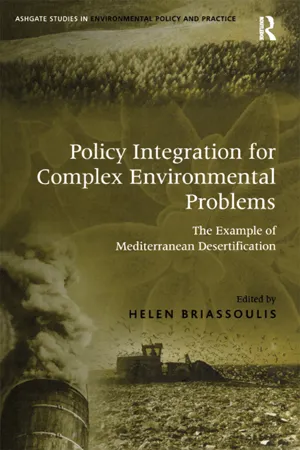
Policy Integration for Complex Environmental Problems
The Example of Mediterranean Desertification
About this book
The quest for policy integration crystallized in the 1990s as awareness was growing that the current supply of narrow, sectoral, and little coordinated, or even overlapping and conflicting, policies could not cope efficiently and effectively with contemporary complex, cross-cutting and interdependent socio-environmental problems. Combining and coordinating policies properly promises to address this institutional misfit, "add value" to policies, support planning at national and sub-national levels, and facilitate the transition to sustainable development more generally. This book proposes a comprehensive conceptualization of policy integration and negotiates pertinent theoretical, methodological and applied issues from the perspective of selected EU policies - rural development, regional development, transport, social, economic, environmental, water resources, and biodiversity policy. Mediterranean desertification, an exceptionally complex socio-environmental problem, is used as an illustrative example as the idea for this book transpired while researching the topic of policy making to combat desertification in the context of MEDACTION, an EU-funded research project.
Information
Chapter 1
Complex Environmental Problems and the Quest for Policy Integration
Introduction
After a long gestation period, two ideas, sustainable development and complexity, matured in the 1990s and moved to the top of political and scientific agendas, stirring multifarious theoretical and methodological discourses on how to better and more effectively deal with pressing contemporary societal problems. The need for integrated, interdisciplinary approaches and policies to holistically address complex, crosscutting, ‘wicked’ socio-environmental problems and the derivative quest for policy integration to promote sustainable development feature prominently among them.
Contemporary socio-environmental problems are multifaceted, involving diverse and intricately related natural and human resources as well as individuals and organizations acting and interacting on multiple spatial and temporal scales. Numerous, frequently single-purpose and little coordinated, sectoral policies concern particular facets of these problems; their direct and spillover effects may either contribute minimally to problem resolution or produce overlaps, conflicts, new problems and waste of resources. After several decades of policy-making experience, it became evident that sectoralized, uni-dimensional, uni-disciplinary and uncoordinated policies do not serve well the cause of sustainable development.
Although interest in policy integration has a long history in several quarters, the recent renaissance of the subject is associated mainly with the environmental repercussions of economic activities that are not properly accounted for (if at all) by the policies impinging on these activities; hence, the proliferation of policy activity and research on environmental policy integration (EPI). The focus on EPI has overshadowed other concerns such as, for example, that, in addition to environmental, sectoral policies have spatial, social, cultural and other repercussions, and that neither environmental policies account adequately for their economic and social impacts nor social policies account for their environmental and economic impacts. The ensuing discussion will argue that EPI is a narrow and limited view compared to a broader conception of policy integration that ensure that policy making better fits the nature of contemporary problems and supports the transition to sustainable development.
The policy market faces the following situation. On the demand side, contemporary problems are complex and interrelated, defying treatment by means either of narrow, sectoral policies or of all-encompassing, super-policies. On the supply side, numerous policies, related to particular aspects of one or more of these problems, exist, making it unnecessary to devise new policies each time a problem arises. Therefore, it might be more prudent to properly combine extant policies to address these problems. Policy integration, in the broadest sense, ‘adds value’ to policies while economizing on resources (Sanderson, 2000).
The discourse on policy integration has met with the common problem of confusion over and differences in the meaning of overtly similar terms, namely ‘policy’, ‘integration’ and ‘policy integration’, in various policy contexts that carry over to differences in their operational expressions, proposed design, and so on. Often the terms are not defined or they are defined loosely, opening the way for multiple interpretations (and mis-interpretations). Proper and consistent analysis of policy integration and the design of policy integration schemes require clear definitions of ‘integration of what, by whom, where, when, why and how’. Only then it can be judged how well policy integration facilitates the resolution of problems and contributes to sustainable development.
This book seeks to contribute to the discourse on policy integration from the perspective of diverse policy fields, focusing on policies of the European Union. The impetus came from EU-funded research,1 concerned with the design of a policy framework for combating desertification, which is an exceptionally complex socio-environmental problem, relevant to the Southern EU member states, for which few (if any) policies are available at present, not only in the EU but also internationally. In the course of the research, policy integration emerged as the only viable approach to desertification-related policy making. Upon reflection, policy integration appeared to call for deeper analysis as it proved to touch on the whole genre of complex socio-environmental problems. The chapters of this book use Mediterranean desertification as an illustrative example of several issues related to the integration of EU policies.
This chapter aims to frame the discussion of the subject and introduce the book chapters. The next section discusses the complexity of socio-environmental problems and offers a concise account of desertification drawing attention to those features that make its combat a complex policy problem. The third section negotiates both Environmental Policy Integration (EPI) and Policy Integration (PI), reviews the evolution of the discourse, defines both concepts, elaborates on their object and dimensions, presents relevant operational expressions and measures proposed to promote EPI and PI, highlights factors affecting the success of EPI and PI and, lastly, argues for the necessity of PI, and not EPI, to promote the transition to sustainable development. The last section introduces the individual contributions.
Complex Socio-Environmental Problems – The Example of Mediterranean Desertification
The Complexity of Socio-Environmental Problems
The diffusion of Complexity and Chaos theory in the Natural, the Social and the Policy Sciences has enriched greatly the study of contemporary socio-environmental problems and has shed light on suitable policy making approaches to address them (Byrne, 1998; Berkes and Folke, 1998; Marion, 1999; True et al., 1999; Zahariadis, 1999). This section highlights the distinguishing characteristics of complex systems, and especially of human-environment systems, that help comprehend and negotiate the complexity of socio-environmental problems and its policy implications.
A voluminous literature documents the complexity of natural and social systems and, more importantly, of human-environment systems (Holling, 1986; Dryzek, 1987; Waldrop, 1992; Berkes and Folke, 1998; Byrne, 1998; Levin, 1999; Science, 1999; Gunderson and Holling, 2002). The present awareness is not new. For a long time now, researchers in diverse contexts, following different theoretical and methodological routes, have opined that the linear, equilibrium-centered view of nature and society does not fit the evidence.2 What is new perhaps is that, after the 1980s, the growing popularity of Complexity and Chaos Theory coincided with and was reinforced by the coming to prominence of pressing socio-environmental problems and the understanding that their study as well as the design of effective policies could not be based on the dominant Newtonian-Cartesian, non-evolutionary scientific tradition that dissociated the environment from people, policies and politics (Berkes and Folke, 1998). Co-evolutionary, interdisciplinary, historical, and comparative systems approaches developed, adopting integrative modes of inquiry and using multiple sources of evidence, to study socio-environmental problems arising in the context of interlinked human-environment systems. Complexity-informed approaches, in particular, aim at characterizing the nature of a system “with reference to its constituent parts in a non-reductionist manner” (Manson, 2001, p.406). Table 1.1 presents selected, important differences between the Newtonian-Cartesian and the Complexity-Chaos approaches.
Table 1.1 Selected differences between the Newtonian-Cartesian and the Complexity-Chaos approaches (*)
Newtonian-Cartesian Approach | Complexity-Chaos approach |
Static, reductionist, based on 19th century Physics; deterministic causality | Dynamic, (co)-evolutionary, holist, living (self-organizing) systems model-based; indeterminate causality |
Complete rationality; perfect knowledge and information | Bounded rationality; limits to knowledge; incomplete information |
Structurally simple systems; linear or quasi-linear relationships among variables | Inherently complex systems; non-linear relationships among variables prevail |
Certainty and predictability | Limited certainty; unpredictability |
Systems tend towards equilibrium through negative feedbacks | Inherently unstable systems; positive feedbacks are more common; multiequilibrium; surprises integral part of anticipated adaptive responses |
Individual differences, externalities and exogenous influences deviating from the norm are considered exceptional and treated as noise | Individual differences and random externalities are considered normal events and the driving forces of variety, adaptation and complexity |
(*) Based on Berkes and Folke (1998); Russell and Faulkner (1999); Geyer (2001); Holling (2001)
Complex systems are difficult to describe succinctly because they are dynamic, indeterminate, characterized by novelty and surprise, and generating new behaviors while maintaining their structure and coherence through adaptation (Batty and Torrens, 2001; Holland, 1995). ‘Complex adaptive systems’ (CAS) is the term commonly used to refer comprehensively to complex systems that are constantly adapting to their environment (Janssen et al., 2000; Finnigan, 2003; Gunderson and Holling, 2002; Holling, 2001). These include weather systems, immune systems, ecosystems, economic systems, social systems, cultures, traffic, and many more.
Like all systems, CAS comprise components, individual, self-interested agents (Levin, 1999)3 with different characteristics; for example, flora and fauna in ecosystems, individuals and organizations in social systems. Human agents, in particular, differ in their socio-economic features, viewpoints, preferences, goals, aspirations, emotions, future outlooks, and amounts of resources they possess4 (Detombe, 2001). Agents interact in parallel, on the basis of simple rules, among them and with their environment through flows of various types of resources in and out of the system boundaries (Levin, 1999; Limburg et al., 2002). In socio-ecological systems, formal and informal institutions govern the multiple, context-specific, frequently unknown interactions among actors and between them and resource systems (Ostrom, 1990; Gunderson and Holling, 2002). The connectivity of a CAS, the particular ways in which its agents connect and relate to one another, is critical to its evolution and survival.
In fact, one of the most prominent features of CAS is that their properties are explained by an understanding of the relationships among their parts than by an understanding of these parts separately (Gallagher and Appenzeller, 1999; Manson, 2001; Limburg et al., 2002). The non-linear nature of the relationships among their components distinguishes complex from simple, linear systems and defines their internal structure, behaviour and mode of change (Manson, 2001). Linear systems have a single equilibrium state and their evolution is smooth and continuous. Small disturbances produce equally small changes in system state attributes because negative feedback mechanisms bring the system back to the initial equilibrium state. On the contrary, non-linear systems possess multiple equilibria states. The transition between them may be abrupt and discontinuous because mutually reinforcing positive feedback mechanisms are at work (White, 2001). These amplify microscopic heterogeneity hidden within complex systems that, consequently, exhibit a characteristic Sensitive Dependence on Initial Conditions (SDIC) (Glasner and Weiss, 1993).5 Minor, random, and sometimes overtly insignificant, changes may precipitate an avalanche of changes that bring the system to a new equilibrium state, a fundamental shift in the structure of the system or a large-scale event; this is popularly known as the ‘butterfly effect’ (Gleick, 1994; Allen, 2001).
The nonlinear nature of natural, social and economic systems6 and the central importance of random, significant or not, historical events in influencing selection among the multiple equilibria of a system and, thus, determining its state and evolution have been frequently pointed out. Holling (1978, 1995) has illustrated how small disturbances, such as pest infestations or fire, can trigger large-scale redistribution of res...
Table of contents
- Cover
- Half Title
- Title Page
- Copyright Page
- Table of Contents
- List of Figures and Tables
- List of Abbreviations
- List of Contributors
- Foreword
- 1 Complex Environmental Problems and the Quest for Policy Integration
- 2 Analysis of Policy Integration: Conceptual and Methodological Considerations
- 3 Policy Integration in the Framework of EU Regional Policy
- 4 EU Rural Development Policy: The Drive for Policy Integration Within the Second Pillar of CAP
- 5 European Union Social Policies: The Conundrum of Policy Integration
- 6 Integration of EU Water and Development Policies: A Plausible Expectation?
- 7 Biodiversity Policies in the European Union: Achieving Synergies with Other Policies?
- 8 Sustainable Forest Management in the European Union: The Policy Integration Question
- 9 Policy Integration: Bringing Space Back In
- 10 Policy Integration: Realistic Expectation or Elusive Goal?
- Index
Trusted by 375,005 students
Access to over 1.5 million titles for a fair monthly price.
Study more efficiently using our study tools.
Frequently asked questions
Yes, you can cancel anytime from the Subscription tab in your account settings on the Perlego website. Your subscription will stay active until the end of your current billing period. Learn how to cancel your subscription
No, books cannot be downloaded as external files, such as PDFs, for use outside of Perlego. However, you can download books within the Perlego app for offline reading on mobile or tablet. Learn how to download books offline
Perlego offers two plans: Essential and Complete
- Essential is ideal for learners and professionals who enjoy exploring a wide range of subjects. Access the Essential Library with 800,000+ trusted titles and best-sellers across business, personal growth, and the humanities. Includes unlimited reading time and Standard Read Aloud voice.
- Complete: Perfect for advanced learners and researchers needing full, unrestricted access. Unlock 1.5M+ books across hundreds of subjects, including academic and specialized titles. The Complete Plan also includes advanced features like Premium Read Aloud and Research Assistant.
We are an online textbook subscription service, where you can get access to an entire online library for less than the price of a single book per month. With over 1.5 million books across 990+ topics, we’ve got you covered! Learn about our mission
Look out for the read-aloud symbol on your next book to see if you can listen to it. The read-aloud tool reads text aloud for you, highlighting the text as it is being read. You can pause it, speed it up and slow it down. Learn more about Read Aloud
Yes! You can use the Perlego app on both iOS and Android devices to read anytime, anywhere — even offline. Perfect for commutes or when you’re on the go.
Please note we cannot support devices running on iOS 13 and Android 7 or earlier. Learn more about using the app
Please note we cannot support devices running on iOS 13 and Android 7 or earlier. Learn more about using the app
Yes, you can access Policy Integration for Complex Environmental Problems by Helen Briassoulis in PDF and/or ePUB format, as well as other popular books in Biological Sciences & Environmental Science. We have over 1.5 million books available in our catalogue for you to explore.