eBook - ePub
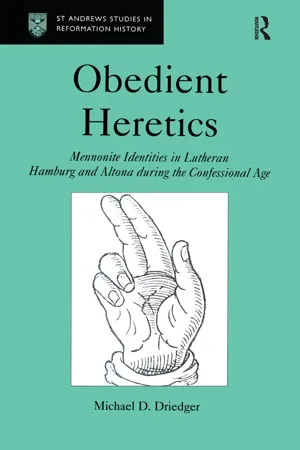
Obedient Heretics
Mennonite Identities in Lutheran Hamburg and Altona During the Confessional Age
- 224 pages
- English
- ePUB (mobile friendly)
- Available on iOS & Android
eBook - ePub
Obedient Heretics
Mennonite Identities in Lutheran Hamburg and Altona During the Confessional Age
About this book
This case study examines the history of the Netherlandic Mennonite community living in and around Hamburg after the Thirty Years War. Based on detailed archival research, it expands the scope of Radical Reformation studies to include the confessional age (c. 1550-1750). During this period Mennonites had to conform politically while trying to preserve many of the nonconformist ideals of their forebears, such as the refusal to baptize children, bear arms and swear solemn oaths. The research presented in Obedient Heretics will, therefore, be of interest to scholars of minority communities in addition to those concerned with the Reformation's legacy, confessionalization and confessional identity.
Chapter One
Confessional Migration: The Dispersion of Anabaptists to Northern Germany
Expulsion and refuge are among the major themes of early modern European history. For example, 1492 is famous not only in connection with Christopher Columbus but also as the date of the expulsion of Jews from Spanish territory. The ecclesiastical and political divisions resulting from the Reformation also led to waves of expulsion. Catholics were forced from Protestant territories, and Protestants were forced from Catholic territories. The situation was especially acute in the territories of the Holy Roman Empire and the Netherlands, where political and ecclesiastical authority was very fragmented and confessional animosities were high. Anabaptists, like early modern Jews, led much more precarious legal existences than most minorities, for they had few co-religionists in positions of political authority anywhere in Europe. Even if these believers did not have to flee their homelands to practise their unique religious rites in peace, they did have to live in host societies that nurtured intolerant attitudes towards their nonconformity.
It is Protestant migration from the Netherlands to northern German territories like Hamburg that is most significant for this study.1 In an instructive book and set of articles, in which he develops the category 'confessional migration', the German historian Heinz Schilling has written about waves of Protestant migration from the Netherlands during a century-long period starting in the 1530s and 1540s.2 It is useful to describe this migration as confessional in character for at least two reasons: persecution, one of the key factors leading to exile, was targeted by governments against particular religious groups; and the experience and memory of exile often contributed to the cohesion of religious groups, shaping most aspects of their collective lives for several generations. Schilling's analysis, while concentrated on Calvanists, does apply well to Anabaptists, for their collective religious, political, social and economic lives were also shaped decisively by experiences of persecution, expulsion and relocation. In many regards, this chapter is an elaboration on Schilling's concept of confessional migration.
The rise of a Mennonite brand of Anabaptism in the sixteenth century
The reasons for Anabaptist persecution and exile were rooted in mainstream Christian attitudes towards baptism and social order. During the early sixteenth century, reform-oriented Christians attacked clerical privileges, the mass, the veneration of saints and the traditional sacramental system, and in so doing they also attacked cornerstones of medieval social, political and religious organization. Few reformers, however, were interested in questioning the practice of child baptism. Child baptism was a ceremony regulated by custom and law in medieval Christian communities, and it remained the practice of an overwhelming majority of Christians after the Reformation. Even the majority of Protestants, who like the Anabaptists were opposed to the old sacramental order and the authority of the Pope, continued to baptize children. In so doing, parents were professing publicly that they would raise their children as orthodox believers and obedient subjects in the parish community. In other words, baptism as a child marked an individual's entry into not merely the religious but also the socio-political community. The campaigns of the early Anabaptists to reconstitute the Christian community based on the ideals of a believers' church challenged the very foundations of this established social, political and religious order. If an individual could choose as an adult whether to join the community of believers, was if not then also possible to choose whether to join the political community? Before the late eighteenth century, governments usually interpreted religious nonconformity of the type advocated by Anabaptist reformers as a form of political nonconformity. In 1529 Wiedertäuferei (rebaptism) was declared a capital offence in Imperial territories. For most of the sixteenth century, the great majority of Protestant and Catholic governments looked upon Anabaptists not simply as nonconformists but also as heretics and criminals.
The propaganda that Anabaptism was socially disruptive was reinforced in the popular imagination by two main sets of events: the Peasants' War of 1524-26 and the short-lived Anabaptist regime in Münster, Westphalia, in the mid-1530s. In southern German-speaking territories, the Anabaptist groups known as the Swiss Brethren and the Hutterites arose amid and in the aftermath of the Peasants' War.3 Adult baptism in northern Germany and the Netherlands began somewhat later, in the early 1530s, with the missionary activity of Melchior Hoffman. The Mennonite tradition grew from the foundations that Hoffman had helped to establish.4 The namesake of the Mennonites, the former Catholic priest Menno Simons, began championing the Anabaptist cause around 1536, shortly after the bloody end to a siege of the Anabaptist-controlled city of Münster.5 In early 1534 an Anabaptist party had won civic elections there. Hundreds of Anabaptists or Anabaptist sympathizers from the surrounding countryside and as far away as the Netherlands travelled to the Westphalian city, which they thought was the New Jerusalem where believers could gather in safety to await the coming End Times. In February 1534, Catholic and Protestant rulers in the region decided to combine their military strength against the Anabaptists. The regional overlords felt it was their duty to defeat the unlawful Anabaptist city, but the attack on the city also provided an opportunity to limit traditional civic freedoms and increase princely authority. The rhetoric and violence used by both sides increased as the siege progressed. To complicate matters, a small number of Dutch sympathizers of Münster's Anabaptist regime protested in a series of dramatic actions in the Low Countries.6 Some of these actions were nonviolent: in 1534 prophets displaying unsheathed swords in the streets of Amsterdam warned of God's impending judgement over the ungodly;7 and in 1535 twelve naked men and women ran along Amsterdam's streets, 'saying that they had been sent from God to communicate the naked truth to the godless'.8 Other actions had a decidedly violent character: in 1535 armed Anabaptist militants captured a cloister in Friesland;9 and a small group of Anabaptists even stormed Amsterdam's city hall.10 The siege of Münster finally ended tragically. In the middle of 1535 the besieging forces broke the city's defences and Münster's Anabaptist Reformation came to an abrupt end. The city was reconverted to Catholicism, and the city's Anabaptist leaders were executed in a public and gruesome fashion. The episode remains today a mythic part of Münster's history and the history of Anabaptism.
Because early modern propagandists throughout Europe used the episode of Anabaptist rule as a key example of fanaticism and crime, Münster marked a serious setback for the Anabaptist cause in northern Europe. Yet despite this setback, several northern European Anabaptist groups remained active after 1535. Each tried to rally support from among the scattered Münsterite remnant. One was a small faction loyal to Jan van Batenburg, whose members resorted to terrorism to exact revenge against the ungodly. Few post-Münsterite Anabaptists shared the Batenburgers' extreme stance. Another group following the spiritualist leader David Joris was more successful in attracting adherents immediately after the fall of Anabaptist Münster. But Joris's pre-eminence lasted for only a few brief years. By the 1540s the most successful Anabaptist leader was Menno Simons.11
For generations after the sixteenth century, Mennonite apologists tried to emphasize that Menno Simons and his followers had no connection whatever with the Münsterite regime,12 while confessional opponents favoured interpretations which portrayed the Mennonites as heretics in the Münsterite mould. Both views are exaggerations. While it is true that Simons himself accepted adult baptism only after the defeat of the Münsterite regime, it is impossible to draw an absolute distinction between the two streams of Anabaptism. Both groups arose out of the same general tradition of northern German and Dutch Anabaptism, and many of Simons's followers had been supporters of the Münsterite regime before its violent end. From 1530 to about 1533, Anabaptists in these regions had looked to Melchior Hoffman as a leader. Besides propagating an enthusiastic but still largely nonviolent form of apocalypticism, Hoffman believed in the doctrine of the celestial flesh: Christ, although born through Mary, was untainted by human weakness. While followers of Simons had dampened the apocalyptic enthusiasm so typical of early Dutch Anabaptists, they continued to believe in the doctrine of the celestial flesh throughout the sixteenth century.13 It is probably because the Mennonites shared these kinds of close connections in personnel and theology with their Melchiorite forebears that Simons reacted so strongly against other aspects of the Mechiorite-Münsterite legacy. He wanted to rescue the Anabaptist cause from what he felt was the criminal and unbiblical character it had acquired under Münsterite leadership.14 In reaction against the violence associated with Münsterite Anabaptism, he and his followers struggled to form communities of self-disciplined Christians 'without spot or wrinkle' (Eph. 5: 27), dedicated to the preservation of God's Word and free from the corruption of the established clergy.15 This was an important intermediate step in the process that James Stayer has called 'the passing of the radical moment in the Radical Reformation'.16
Burdened by the stigma of the Münsterite regime, Mennonites sought refuge from persecution. Anabaptist migration from the Netherlands was never steady, but there were high points. One phase of voluntary and forced migration was naturally enough during the 1530s, when Anabaptism was a new movement growing in prominence and infamy in the shadow of the Münsterite regime. During this early, pre-Mennonite period, Anabaptists were a large percentage of the then small Protestant population in the Netherlands, especially the northern provinces, the historic heartland of northern Anabaptism. Conditions changed by the 1550s to limit (but not eliminate) intolerance against Anabaptists in the northern Netherlands. First, events at Münster, which had been among the major justifications for the persecution, became less of an immediate memory. Furthermore, the much less socially radical Mennonites became the dominant Anabaptist faction. The way in which the small Mennonite community behaved bore little resemblance to the exaggerated image prevalent in polemical literature. Mennonites even helped finance the Dutch campaigns against the Spanish Habsburgs.
The focal point of persecution against Anabaptists after the mid-1550s was the southern Netherlands. There was a small Anabaptist population in the provinces of Flanders and Brabant, but towards the middle of the century, when Calvinism began spreading, it amounted to only a minority of the Protestant population. At that time, the Netherlands was under the control of the Spanish line of the Habsburg Empire. Under the Habsburg monarch Philip II (1556-98), Spain intensified measures to limit local liberties and combat Protestant heresy in the Netherlands. Popular dissatisfaction mounted. In 1566 there were widespread outbursts of public protest and iconoclasm, organized largely by the Calvinist opponents of the Catholic monarchy. To bring the situation under control, Philip II sent a highly effective military commander, the Duke of Alva, to the Netherlands. Alva set up a military dictatorship and used ruthless measures to combat heresy and dissent. At the same time, Calvinist rebels based in the northern Netherlands organized a guerrilla campaign against the Spanish. The Dutch War of Independence, which began in the 1560s, resulted in the provinces of the northern Netherlands declaring their indep...
Table of contents
- Cover
- Half Title
- Dedication
- Title
- Copyright
- Contents
- Preface and Acknowledgements
- Abbreviations
- Introduction
- 1 Confessional Migration: The Dispersion of Anabaptists to Northern Germany
- 2 The Short-lived Ceremonialism of the Dompelaars
- 3 The Confessionalist Strategy of Flemish Leaders
- 4 Mennonite Confessionalization and Beyond: Polemics and the Articulation of a Conformist Ideology
- 5 A Conformist Brand of Non-resistance: Controversies and Silences
- 6 The Non-swearing of Solemn Oaths: Official Accounts versus Everyday Behaviours
- 7 Mixed Marriages and Social Change
- Conclusion
- Appendices
- Bibliography
- Index
Trusted by 375,005 students
Access to over 1.5 million titles for a fair monthly price.
Study more efficiently using our study tools.
Frequently asked questions
Yes, you can cancel anytime from the Subscription tab in your account settings on the Perlego website. Your subscription will stay active until the end of your current billing period. Learn how to cancel your subscription
No, books cannot be downloaded as external files, such as PDFs, for use outside of Perlego. However, you can download books within the Perlego app for offline reading on mobile or tablet. Learn how to download books offline
Perlego offers two plans: Essential and Complete
- Essential is ideal for learners and professionals who enjoy exploring a wide range of subjects. Access the Essential Library with 800,000+ trusted titles and best-sellers across business, personal growth, and the humanities. Includes unlimited reading time and Standard Read Aloud voice.
- Complete: Perfect for advanced learners and researchers needing full, unrestricted access. Unlock 1.5M+ books across hundreds of subjects, including academic and specialized titles. The Complete Plan also includes advanced features like Premium Read Aloud and Research Assistant.
We are an online textbook subscription service, where you can get access to an entire online library for less than the price of a single book per month. With over 1.5 million books across 990+ topics, we’ve got you covered! Learn about our mission
Look out for the read-aloud symbol on your next book to see if you can listen to it. The read-aloud tool reads text aloud for you, highlighting the text as it is being read. You can pause it, speed it up and slow it down. Learn more about Read Aloud
Yes! You can use the Perlego app on both iOS and Android devices to read anytime, anywhere — even offline. Perfect for commutes or when you’re on the go.
Please note we cannot support devices running on iOS 13 and Android 7 or earlier. Learn more about using the app
Please note we cannot support devices running on iOS 13 and Android 7 or earlier. Learn more about using the app
Yes, you can access Obedient Heretics by Michael D. Driedger in PDF and/or ePUB format, as well as other popular books in History & World History. We have over 1.5 million books available in our catalogue for you to explore.