- 342 pages
- English
- ePUB (mobile friendly)
- Available on iOS & Android
eBook - ePub
About this book
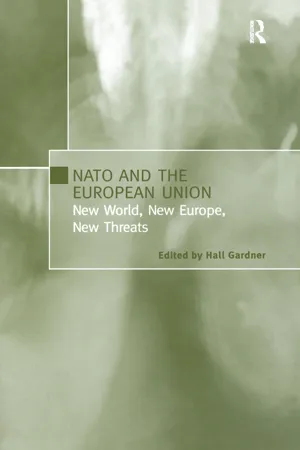
The perspectives of academics and practitioners are brought together in this insightful work, which examines the war on terrorism, the Iraq war and the roles of NATO and the EU. The book analyzes the new threats posed by terrorist strikes and the proliferation of weapons of mass destruction despite the total failure of Cold War conceptions of deterrence. It also delineates the key issues and problems that have arisen from the NATO and EU double enlargement and from the new NATO-Russian relationship. Casting light on the global and regional ramifications of the crisis, as well as the tensions in the transatlantic relationship caused by the war with Iraq, NATO and the European Union addresses the key policy questions that concern the maintenance of global peace and security.
Information
PART I:
THE STRATEGIC IMPACT OF SEPTEMBER 11
Chapter 1
Asymmetrical Conflict: A Critical Assessment
Introduction
In just the last century, two world wars have made nationalism intolerable as a basis for international legitimacy—just as the previous wars of religion finished off religion as the basis of the international order in centuries past. The wars of the nations, from 1914 to 1945, thus killed the nation as an organizing principle for the society of states. World War II, in particular, entirely discredited nationalism; the Cold War then eliminated communism and the idea that the state could play a role as an economic manager.1
The fall of the Berlin wall has finally accelerated an American-led process of globalization, which is reshaping the nature of geo-politics in general and along the North-South division in particular. This process has begun to compromise the sovereignty of states and has led to the emergence of a new “market state.” In the meantime, the globalization process is re-inventing the nature of war and conflict.
The hostility of US-led neo-liberal globalization towards borders and sovereignty will tend to weaken, destabilize or eradicate states in the south, a process that will generate further chaos and fertilize new breeding grounds for new conflicts, wars and acts of terrorism. The ensuing violence will know no national or geographic boundaries, no regulation and possess no ethical standards. It will possess a logic and values of its own that will defy all conventions of war, as well as the UN Charter. The perpetrators of these acts of violence will not fight “fairly;” they will not exclude any body or any place from its targets, and they will completely reject any judiciary authority.
In return, the burgeoning number of asymmetrical threats and actions will further unite northern “liberal democracies” as they appoint themselves as “global governors.” The latter will attempt to use NATO, the European Union, and other alliances or coalitions in order to help expedite the erection of new dividing walls, similar to that which was erected during the Cold War, but between the West and North versus the South. The effort to erect new walls, however, will not contain the resulting tensions and conflict; nor will immigration officers or border police deter the latter. As products of globalization, asymmetrical threats will not be restricted to certain geographic regions; they will be as global as globalization itself.
Eventually, this globalization-produced instability will transform the “liberal democracies” themselves. Contrary to the prediction of the triumph of the liberal free market democracies above all other historical systems as the so-called “end of history” (Francis Fukuyama’s central theme), asymmetrical conflicts and threats, as well as asymmetrical values, could well transform the liberal market economies into very different systems of relations, perhaps making them more centralized and more authoritarian. This is especially true in the so-called “Third World,” where at best illiberal “democracies” could emerge.2
New Fault Lines of Conflict
The process of globalization is transforming the international system in two paradoxical ways: On the one hand, it is connecting people, harmonizing standards (at times at the expense of diversity), universalizing ideas, empowering business, popularizing access to information and weakening geographical borders. On the other hand, it is also erecting new barriers between the world’s centers and peripheries, between its rich, developed, well-connected “northern flanks” and its southern poor, which are divided regions with ever growing populations and underdevelopment.
The center of the world system is developing fast with innovation and dynamism while the periphery is stagnating (with the exception of China) and sinking into deeper poverty and chaos. This is not the direct result of exploitation, as was the case in the colonialist days, but rather because of the indirect manipulation, competition and domination by the sub-centers of the North.
In certain cases, the process of underdevelopment takes place by the mere placing of a country or region far from the center through boycott or containment or the shifting of financial investments. In other cases, as in the example of eastern Europe, fast track development is guaranteed through the process of inclusion into the center of world system, through integration into the European Union (as well as NATO).
Globalization is also a manifestation of “market totalitarianism.” As such, the US-led globalization process has been generating sweeping economic and social processes that are destined to compromise an individual state’s ability to manage and regulate its community’s economic and political affairs, or to guarantee the economic or physical safety and well-being of its citizens.
As a consequence, people tend to find shelter or meaning in pre- or post- state identities such as religion, ethnicity or cults. Ethnicity is making its way to the center of the political discourse as it looks for legitimacy that has been lost by the state as the former authority. At times, this political discourse uses violence as a means by which to galvanize sentiments and obtain legitimacy.
Geopolitics today observes and justifies the struggle for identity against globalization. It activates cultural “identity politics” and not just socio-economic factors. Since the state has failed to provide well-being in its fullest sense for its citizens in the many of the regions of the so-called “developing” world, the struggles have been transferred to a geocultural level that puts “ethnicity” at the top of the list of actors.
Geopolitics has long shown that the ‘map of nations’ is not the same as the ‘map of states’. And as nationality and ethnicity retake the initiative in the face of retreating state sovereignties, geopolitics is influenced as much by ethno-politics, irredentism, as by geography. As globalization united the world into one market place and re-divides along both old/new ethnic lines, the geo-politics of violence is necessarily transformed in the process. Moreover, today’s world is shaped by multinational corporations, religions that are organized across continents, transnational pressure groups, as well as communications satellites, as much as by the voluntary military intervention of individual states.
Like the global market, asymmetrical war sees no state boundaries; it has no national identity, no geographic location or address, and it sees no limits to potential reproduction. Its outreach is that of the market and its instruments are those of globalization; its targets are the soft or weak points of globalization such as confidence, trust, free flow of goods and services, harmony, etc.
French sociologist Alain Joxe has suggested that:
Despite its confusion, our civilization can still be mapped. It is, in spite of its universal dimension, still composed of ‘neighbors’ grouped together on the surface to live on the sphere…At the same time, there is a discreet generalization, a spreading of violence, limits, enclosures, shelters, camps, barbed wire, patrol dogs.3
Since America is the leader in the globalization era, its example is instructive for the future. America’s conventional/symmetrical type war is in the process of retreating in favor of wars against non-state or failed state actors. The 1991 and 2003 wars against the Iraqi regime of Saddam Hussein belonged to the previous era of conventional petrol-military wars. Thanks to its revolution in military affairs (RMA), Washington’s superiority in the conventional warfare will deter any other state leadership from confronting America directly in the battlefield. Saddam’s Iraq did not pose any direct threat to America.
Because of its military superiority, Washington reckons that new types of threats to its global power in the post-Cold War era will emerge from remaining “rogue states” as well as from transnational non-state actors: It is believed that both could resort to weapons of mass destruction (WMD). Those threats to the world economic and geo-political center (the US and its NATO allies) will mostly, but not exclusively, originate from the periphery (the underdeveloped regions) and will spring from both internal domestic, as well as external foreign, sources. America’s superiority in the last Gulf War of March 2003 will deter its traditional state enemies from meeting it in the battlefields of war, but it will consequently push its opponents towards finding new asymmetrical ways of confronting US, European and NATO interests—in down town areas, residential neighborhoods, airports etc.
Asymmetrical conflicts will be exacerbated by the international and domestic fault lines that have been dividing the world’s communities, between north and south as well as within prosperous center and their belts of poverty— the periphery around cosmopolitan cities. These conflicts will also be nourished by a number of sources that are internationalized through the process of globalization, such as domestic and regional criminality, cross border smuggling, and economic disparities. They will be further inflamed by religious and ethnic phobias, among other factors, as well as by ultra-nationalism and religious fundamentalism. Their global outreach will be assisted by easy access to technologies and information systems.
Rethinking War
Since the collapse of the Soviet Union and the end of the essentially bipolar global system, new “unconventional” wars have killed approximately four million people, mostly civilians. Coupled with the spread of apocalyptic and transnational terrorism these conflicts have largely discredited the semi-sacred Clausewitzian theory of war that has, as a whole, become the encompassing paradigm for the understanding of conflict.
After Clausewitz’s disciples failed to explain guerrilla insurgency, nuclear strategy, ethnic conflicts, narco-violence and international terrorism through the lenses of that Prussian strategist, new strategic thinkers emerged soon after the end of the Cold War to offer un-Clausewitzian ways of thinking about war. Some reckon that (1) when we fight, we produce wealth; others argue that (2) we become the way we fight. A third group believes that (3) war is a question of culture.
In regard to the first thesis, in the Transformation of War, Israeli (originally Dutch) historian Martin van Creveld reverses the casual relationship between the actor and the act: how and why people fight, he argues, help to determine their political, economic, and even their social organization.
In regard to the second thesis, the British historian John Keegan tries to study non-European wars in A History of Warfare only to show that Clausewitz was, in fact, a Euro-centric. Much like Van Creveld,4 he begins his book by underscoring his belief that “war is not the continuation of policy by other means.” 5
In the other (but not contradictory) direction, in regard to the third thesis, the futurist American economists Alvin and Heidi Toffler claim in War and Anti-War, that the way we make war “reflects the way we make wealth.”6 The core argument of the Tofflers is that a third historic economic transformation is under way (the first was the invention of agriculture, the second, the industrial revolution). The emergence of “Third Wave” economics “based on knowledge rather than conventional raw materials and physical labor” will pave the way to “niche wars;” that is, the military use of space; robotic combat; nano-technology; non-lethal weapons; and cyberwar. In the process, third wave economics will transform all aspects of human life, including warfare.
There is no doubt that the American Revolution in Military Affairs (RMA) has already begun to produce results in above direction. America’s superior military advantage over all other states, and particularly its competitors in Moscow or Beijing, and vis-à-vis its opponents in the Third World, has reinforced their conviction that there is no conventional military response to America’s global power, and there will not be in the distant future. Enter asymmetry.
Asymmetrical conflicts—domestic, regional and international— have, in fact, proven far more capable of obtaining their strategic objectives than have more traditional forms of conventional warfare. In fact, the latter has proven a failure since the end of the Second World War. The Arab-Israeli conflicts, the Gulf wars, that Argentine-English war over the Malvinas/Falklands, the Pakistani-Indian conflict, and even America’s Korean and Vietnam wars, have, among others, largely proven incapable of fulfilling their political objectives.
By contrast, urban warfare and other forms of unconventional warfare have, however, proved their utility. Whether it has been the Afghani (and Chechen) resistance to the Soviet invasion, or the Lebanese (and Palestinian) resistance of the Israeli invasion and occupation, or the Vietnamese resistance against the American invasion etc, these have all proved capable of winning wars against conventional armies.
If history is any guide, then globalization will further internationalize this form of warfare by non-armies, or else by non-state actors such as guerrillas, mafias, terrorist organizations, narco-drug traffickers, religious fundamentalists and radial nationalists. These organizations are most likely to make their presence manifest in political groupings, but will remain secret in their organization. They will be constructed on charismatic rather than institutional lines, and motivated less by “professionalism” than by fanatical, ideologically-based, or criminal-hierarchical loyalties. New York (9/11), Gaza, South Lebanon, and east Los Angeles and Oklahoma city, Somalia, Afghanistan as well as Sarajevo, Belfast, Colombia, Angola, Congo, represent the new forms of warfare.
Asymmetrical Enemies
Asymmetric wars—especially transnational terrorism and the war on terrorism—have no fixed champ de bataille, as asymmetrical enemies find their home in th...
Table of contents
- Cover
- Half Title
- Title Page
- Copyright Page
- Table of Contents
- List of Contributors
- Preface
- Introduction: Alliances, “War on Terrorism” and Weapons of Mass Destruction
- Part I: The Strategic Impact of September 11
- Part II: The Future of NATO
- Part III: NATO, The EU and the “War on Terrorism”
- PART IV: “War on Terrorism”: Regional and Global Ramifications
- Index
Trusted by 375,005 students
Access to over 1.5 million titles for a fair monthly price.
Study more efficiently using our study tools.
Frequently asked questions
Yes, you can cancel anytime from the Subscription tab in your account settings on the Perlego website. Your subscription will stay active until the end of your current billing period. Learn how to cancel your subscription
No, books cannot be downloaded as external files, such as PDFs, for use outside of Perlego. However, you can download books within the Perlego app for offline reading on mobile or tablet. Learn how to download books offline
Perlego offers two plans: Essential and Complete
- Essential is ideal for learners and professionals who enjoy exploring a wide range of subjects. Access the Essential Library with 800,000+ trusted titles and best-sellers across business, personal growth, and the humanities. Includes unlimited reading time and Standard Read Aloud voice.
- Complete: Perfect for advanced learners and researchers needing full, unrestricted access. Unlock 1.5M+ books across hundreds of subjects, including academic and specialized titles. The Complete Plan also includes advanced features like Premium Read Aloud and Research Assistant.
We are an online textbook subscription service, where you can get access to an entire online library for less than the price of a single book per month. With over 1.5 million books across 990+ topics, we’ve got you covered! Learn about our mission
Look out for the read-aloud symbol on your next book to see if you can listen to it. The read-aloud tool reads text aloud for you, highlighting the text as it is being read. You can pause it, speed it up and slow it down. Learn more about Read Aloud
Yes! You can use the Perlego app on both iOS and Android devices to read anytime, anywhere — even offline. Perfect for commutes or when you’re on the go.
Please note we cannot support devices running on iOS 13 and Android 7 or earlier. Learn more about using the app
Please note we cannot support devices running on iOS 13 and Android 7 or earlier. Learn more about using the app
Yes, you can access NATO and the European Union by Hall Gardner in PDF and/or ePUB format, as well as other popular books in Politics & International Relations & Diplomacy & Treaties. We have over 1.5 million books available in our catalogue for you to explore.