- 168 pages
- English
- ePUB (mobile friendly)
- Available on iOS & Android
eBook - ePub
Marketing Planning for the Pharmaceutical Industry
About this book
Marketing in the pharmaceutical and healthcare sector requires a particular set of skills; its intricacies mean planning is an essential prerequisite. The marketing planning system described in this book has been designed to enable marketing and product executives to produce a plan which serves as a dynamic management tool which will help them to get from where they are now to where they want to be next year and thereafter. Now in its second edition, this bestselling book has become the standard text for all product managers, marketing managers and directors working in this demanding industry. John Lidstone and Janice MacLennan have updated the book to embrace best current practice. A new orientation to external analysis and a reworking of the application of SWOT analysis, along with fresh material on sales forecasting and strategy implementation, bring the book up to date with current thinking and industry trends. Marketing Planning for the Pharmaceutical Industry is based on real life experience built up over many years. Each chapter takes the reader through the sequential stages of planning so that by the end they will be able to produce a practical plan ready for implementation. It is the only book of this type which tailors marketing to those working in the sector and as such is a unique, invaluable and indispensable resource.
1
Introduction
What is meant by the term ‘marketing plan’?
As with so many terms used within the industry, the term ‘marketing plan’ is often misunderstood. That as a statement may come as a surprise. Let us justify it. When someone is asked to produce a marketing plan, what is so often submitted is a document which contains data, accompanied by narrative which explains to people who cannot read data what it is the data is illustrating. This is accompanied by a SWOT analysis, occasionally a positioning statement and an action plan (often described as ‘the strategy’).
What we should see is a clear statement of the goals/objectives, the strategy for achieving the objectives, and a plan that demonstrates how the strategy will be implemented; also, at the outset, a summary of the business situation as we see it, highlighting the issues. This provides the context for strategy for the reader. It also serves as a useful reminder to the author of the plan of the issues which are supporting the strategic choice. If the issues change, inevitably the strategy and/or implementation plan will also need to be adjusted.
Why marketing planning?
The responsibilities of everyone concerned with managing one or more products fall into two parts. One is concerned with today’s business and is met by the daily functional decisions that the manager makes. The other involves tomorrow’s business and requires planning. In both parts the manager is concerned with decisions of allocation. Any company has two limited resources: time and money. These need to be allocated to generate the planned profits.
Marketing Planning Can Be A Key Contributor To Effectively And Efficiently Managing The Business
How do marketing plans accommodate the future?
A decision made today about allocating resources is dependent upon an interpretation of a known set of variables covering some or all of existing and potential future:
- ● customers;
- ● products;
- ● prices;
- ● costs;
- ● production;
- ● technology;
- ● distribution;
- ● competition;
- ● regulations.
Managers must have an awareness of these variables, even if they do not have complete information. However, today’s known variables become tomorrow’s unknowns, and the only thing certain about tomorrow is that it will be different from today. Thus, the marketing planning process must also consider the possible shape and nature of these variables in the future. This is generally sufficient to make good decisions about the optimal allocation of resources to generate today’s business and make us equally competitive for tomorrow’s business.
The benefits of planning
All too often we see ‘little’ perceived value in planning. Why? The relationships between the analysis (data), the findings (information), the interpretation of these findings (the conclusions about the situation) and their role in generating the strategic options are often poorly understood.
A good marketing plan will:
- ● help to identify and develop the new skills and procedures that will be required in the future: the skills and procedures that managers have developed to deal with today’s decisions are rarely adequate for making decisions about tomorrow;
- ● prepare the company for change so that it can take a commanding lead over those companies that merely react: as businesses inevitably change, so marketing planning helps the transition from today to tomorrow to be smooth and predictable. Planning for changed circumstances provides the single opportunity to gain significant advantages over the competition. Regulatory requirements, product innovation, new technology, standardized distribution and other realities all combine to even out companies. Yet, the same factors which account for market changes also provide great opportunities;
- ● provide a vehicle for communicating the changes and their effects in an open and non-threatening manner, a common belief is that people resist change; this is a mistake. Research has shown that people resist change only when they are uncertain of the personal effect. When change is shown to be beneficial, it tends to be supported;
- ● evaluate and reduce the available options to achieve the best chance of success and the least chance of error, there is little choice when allocating today’s resources and, thus, little room for error. However, when looking forward, the choice is large. R & D can be directed anywhere, plant and production lines can manufacture anything, finance can be raised for any purpose. With such a large range of choice the chances of making errors increase. The alternative is to wait until circumstances change and force a decision. The probability then is that the decision taken will not be the best one;
- ● provide a method for handling complexity: more often than not a pharmaceutical company serves several markets. There are several groups of people who use or buy each product. This produces a complex situation. Each group of people is subject to change, both in varying directions and at different rates. Thus, if a company has only six products each with three user/buyer groups, then it is dealing with 18 different, changing markets. One way of dealing with this is ‘muddling through’, or reacting when forced to, ignoring the complexity and taking the least possible action. It is through evaluating each market, establishing the nature of the changes and deciding on a profit potential, that resources can be allocated. Thus, the strategy can be the same, but the local market objectives and how that strategy should be implemented will probably always be different;
- ● identify the role of each department and offers the means to co-ordinate their activities: as with changing markets, businesses can become complex. A company with national and international markets may have many departments to cater for some activity that meets the needs of these markets. If all these departments are not coordinated and heading in the same direction, chaos will follow;
- ● ensure that the company is proactive in its approach to acquiring the capabilities it needs: as a company develops, so each of the departments evolves; this leads to increased demands upon the resources of time and money. If reactive decisions are made, the resulting demands for plant, equipment, R & D, people, finance, even products, exceed the company’s ability to supply. As a result, growth becomes disorderly and wasteful, competitive advantage is forfeited, and profits delayed or lost.
In conclusion, marketing planning is a means of ensuring an orderly and profitable transition from today into the future. If, as a manager, you enjoy letting things happen, if things are good enough as they are, or if you like panic decisions, then marketing planning has no value. However, if you want to understand and control your growth, improve your profits or increase the chances of your company’s survival, then marketing planning is not an option, it is mandatory. Planning is not something apart from the rest of the business. To be successful, it must determine activities and be recognized for what it is by the whole company.
The marketing planning concept
An Overview
Generally, everyone is familiar with the key questions – see Figure 1 overleaf. However, there is less clarity and consistency about how one goes about answering the questions. For each question, we consider the answers that might prove helpful.
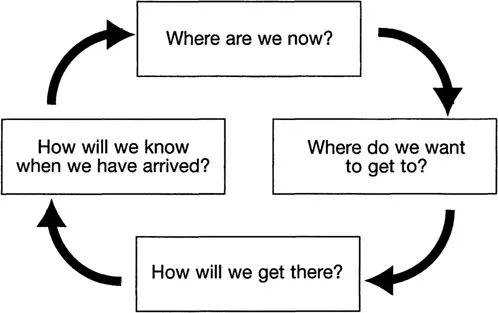
FIGURE 1 THE MARKETING PLANNING PROCESS
Where are we Now?
In a typical marketing plan template this is the section entitled ‘The Situation Analysis’. To achieve this analysis, the company must:
- ● understand who the customers are or could be;
- ● understand the needs of its customers;
- ● understand the dynamics of the competi...
Table of contents
- Cover
- Half Title
- Title
- Copyright
- Contents
- List of Figures
- List of Tables
- Foreword
- Preface
- Acknowledgements
- About the Authors
- 1 Introduction
- 2 The External Analysis
- 3 The Internal Analysis
- 4 The SWOT Analysis
- 5 Product Strategy
- 6 Sales Forecasting and Strategy
- 7 Strategy Implementation
- 8 Communications and its Role in Strategy Implementation
- 9 Marketing Research
- 10 Implementation and Control
- 11 Writing the Plan
- Glossary of Marketing Terms
- Index
Trusted by 375,005 students
Access to over 1.5 million titles for a fair monthly price.
Study more efficiently using our study tools.
Frequently asked questions
Yes, you can cancel anytime from the Subscription tab in your account settings on the Perlego website. Your subscription will stay active until the end of your current billing period. Learn how to cancel your subscription
No, books cannot be downloaded as external files, such as PDFs, for use outside of Perlego. However, you can download books within the Perlego app for offline reading on mobile or tablet. Learn how to download books offline
Perlego offers two plans: Essential and Complete
- Essential is ideal for learners and professionals who enjoy exploring a wide range of subjects. Access the Essential Library with 800,000+ trusted titles and best-sellers across business, personal growth, and the humanities. Includes unlimited reading time and Standard Read Aloud voice.
- Complete: Perfect for advanced learners and researchers needing full, unrestricted access. Unlock 1.5M+ books across hundreds of subjects, including academic and specialized titles. The Complete Plan also includes advanced features like Premium Read Aloud and Research Assistant.
We are an online textbook subscription service, where you can get access to an entire online library for less than the price of a single book per month. With over 1.5 million books across 990+ topics, we’ve got you covered! Learn about our mission
Look out for the read-aloud symbol on your next book to see if you can listen to it. The read-aloud tool reads text aloud for you, highlighting the text as it is being read. You can pause it, speed it up and slow it down. Learn more about Read Aloud
Yes! You can use the Perlego app on both iOS and Android devices to read anytime, anywhere — even offline. Perfect for commutes or when you’re on the go.
Please note we cannot support devices running on iOS 13 and Android 7 or earlier. Learn more about using the app
Please note we cannot support devices running on iOS 13 and Android 7 or earlier. Learn more about using the app
Yes, you can access Marketing Planning for the Pharmaceutical Industry by John Lidstone,Janice MacLennan in PDF and/or ePUB format, as well as other popular books in Business & Business General. We have over 1.5 million books available in our catalogue for you to explore.