eBook - ePub
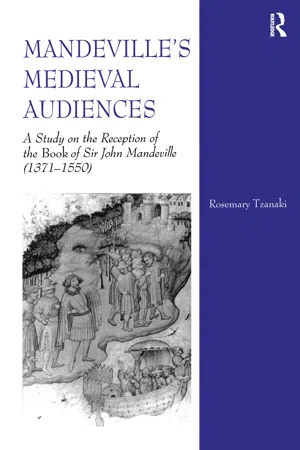
Mandeville's Medieval Audiences
A Study on the Reception of the Book of Sir John Mandeville (1371-1550)
- 318 pages
- English
- ePUB (mobile friendly)
- Available on iOS & Android
eBook - ePub
Mandeville's Medieval Audiences
A Study on the Reception of the Book of Sir John Mandeville (1371-1550)
About this book
The so-called travels of Sir John Mandeville to the Holy Land, India and Cathay were immensely popular throughout Europe during the late medieval period and were translated into nine different languages. This is a detailed study of the audiences of Mandeville's Book, with particular emphasis on its reception in England and France from the time the Book appeared in the 1350s to the mid-16th century. The multiple ways in which audiences interpreted the work, depending on wider social and cultural contexts, are analysed thematically, under the headings of pilgrimage, geography, romance, history and theology, and contrasted with what can be learned of the author's intentions. The book is well-illustrated with images taken from both manuscript and early printed editions: in her study of these and the marginal notes, Rosemary Tzanaki shows their importance for seeing what readers found of interest. Her analysis makes a significant contribution to our understanding of how people in medieval Europe perceived the outside world.
Information
1 The Pilgrimage Route
The subject of pilgrimage is a major concern of Mandeville’s Book, ostensibly an account of Sir John Mandeville’s pilgrimage to the Holy Land which almost accidentally develops into a description of the East. Mandeville himself could be seen primarily as a pilgrim rather than a general traveller, a fact reflected in the way some illustrators chose to portray him. It is therefore important to examine the ways in which Mandeville addresses pilgrim audiences and how those audiences react to the issues raised. Chief among these issues are the evolution of pilgrimage and crusade, and the specific interests of travellers to the Holy Land.
I will begin by providing an overview of pilgrimage literature, its development and modes, followed by a discussion of the crusades and attitudes towards them, particularly in the course of the fourteenth century. I will then demonstrate in what ways the Book followed traditions of pilgrimage and crusade literature and where it was more innovative, in order to identify its possible audiences before moving to more direct evidence of these.
Pilgrimages were originally undertaken in fulfilment of vows, to do penance, to ask for divine aid or from a desire to come closer to the holy figures by physical proximity to the area they had lived in. A pilgrimage could be written down to commemorate this important Christian act; a principal aim of earlier pilgrimage literature to the Holy Land was to report back on the places where Christ lived and died, in order that those who wished to travel there could find the relevant areas. Those unable to ‘worship in the places where his feet stood’, as more than one author phrased it, could learn about them ‘so that, in hearing the description of the holy places, they might be mentally transported to them, from the depths of their souls, and thus obtain from God the same rewards as those who have visited them’.1 Such pious motives were often expressed in the prologue; John of Würzburg (c. 1160-70) states:
This description I conceive will be acceptable to you for this reason, that when each of these places has by it been made known to you, should you ever by divine inspiration and protection come hither, they will all present themselves to your eyes naturally and without any delay or difficulty in finding them, as well known objects; or if perhaps you may not go thither and behold them with your corporeal eyesight, nevertheless by such knowledge and contemplation of them you may obtain a more devout sense of their holiness.2
Pilgrimage literature did not remain static. It developed in a variety of ways from the earliest pilgrim reports - the first accounts date from the age of Constantine - and simple itineraries to highly worked travel accounts. J.G. Davies3 divides the genre into nine basic categories; there are, firstly, itineraries, listing places to be visited and the routes and distances between them; these could be expanded into personal diaries. Letters, devotional manuals and maps were all part of the wider literature. However, one of the most popular styles was that of the travel account, of which it is estimated that about 526 writers produced examples between 1100 and 1500. Books of indulgences were most popular from the early fourteenth century onwards; such books include Giacomo de Verona’s Peregrinationes et indulgentia Terre Sancte (1335) and The Stacyons of Rome (1370). Itineraries, diaries and books of indulgences could be brought together to produce the more comprehensive guidebooks to specific places, from the twelfth-century Mirabilia Urbis Romae to Wynkyn de Worde’s 1498 edition of the Information for Pilgrims unto the Holy Land.
Travel accounts are of course of particular interest, as Mandeville’s Book comes under this general heading. The authors of travel accounts and their intentions varied widely depending on the period in which they were writing. Up until the mid-thirteenth century the vast majority of pilgrimage texts was written in Latin by clerics. Most of these accounts were relatively impersonal, listing the holy places and their histories. Pilgrimage was seen as a strictly moral and religious undertaking. Saewulf (1102-3), Daniel the Abbot (1106-8), Pseudo-Fetellus (c. 1130) and the author of the Pelerinaiges por aler en Iherusalem (c. 1231) all fall into this category. From the end of the thirteenth century to the end of the fourteenth century there were still many clerical authors. The German Dominican William of Boldensele in his Hodeporicon ad Terram Sanctam (1336) followed this literary tradition, indefatigably listing the appropriate Old and New Testament figures and their actions as he travelled through the Holy Land.
From the fourteenth century onwards, pilgrimage literature was also increasingly being written by laymen from all walks of life, often in the vernacular with the rise of vernacular prose literature. Such authors include lord Ogier VEQ d’Anglure (1395), the merchant Leonardo Frescobaldi (1385), the notary Jacques le Saige (1510) and bourgeois women like Margery Kempe (1414); the latter was, like some other lay pilgrims, aided by a priest in writing her account.
Such writers, while still interested in the devotional aspects of their journey, tended to stress the practical particulars to a far greater extent. In these increasingly personal accounts, details of itineraries and transport to the Holy Land, stages of travel, distances, indulgences and financial costs were given a disproportionate amount of space compared to the hagiographical legends and significance of Palestine. Ludolph von Sudheim, for example, devoted a third of his account of c. 1340 to choosing a ship and the islands, cities and natural features such as volcanoes to be admired on the journey across the Mediterranean. Niccolò of Poggibonsi’s Voyage beyond the Seas (1346-50) states that he took with him two measuring rods and that he entered all that he saw and touched on ‘two small tables’. He intends ‘to provide you with all the indulgences in order, and the distances, and the dimensions of the holy places, and also what things are within them and how they are arranged’.4 The fifteenth-century compilation Advice for Eastbound Travellers is full of practical advice on what equipment one should take, when to travel, how to choose guides and what wines to drink. Other pilgrims gave information on their personal experiences of seasickness, their pilgrim companions and encounters with the local Muslims.
Some pilgrims declared that they wrote for those wishing to make a similar journey: Arnold von Harff opens his pilgrimage account of 1499 by addressing his patrons, for whom the book has been written, ‘so that if your princely Graces should make such a pilgrimage you should have at hand, by my favour, a trusty sign-post’.5 It is uncertain how likely their princely Graces actually were to go on pilgrimage, but they would have been flattered by the assumption that they might.
Other writers, however, obviously chose their subject-matter with a view less to the salvation than to the entertainment of their audience. Mandeville, as Zacher6 has shown, was to a certain extent such an offender, but he was by no means alone in catering to human curiosity. As early as 1220 Jacques de Vitry mentioned the ‘light-hearted and inquisitive persons’ who ‘go on pilgrimage not out of devotion but out of mere curiosity and love of novelty. All they want to do is travel through unknown lands to investigate the absurd, exaggerated stories they have heard about the east’.7
By the fourteenth century clergy and laity alike pandered to this new trend of curiositas. Simon Semeonis, for instance, (1323-24), ‘describes his journey onwards from Great Britain with infinite detail relating to women’s clothes, the practices of customs officials, natural products, etc’.8 In the fourteenth and fifteenth centuries such non-religious pilgrimages had become so common that they were condemned by several writers, from Chaucer’s satire in the Canterbury Tales to the Italian Santo Brasca, on pilgrimage to Jerusalem in 1481: ‘A man should undertake this voyage solely with the intention of visiting, contemplating and adoring the most Holy mysteries ... and not with the intention of seeing the world, or from ambition, or to be able to say “I have been there” or “I have seen that” in order to be exalted by his fellow men’.9 In his Chronica Majora (1376-1420), Walsingham was equally scathing of Henry Despenser’s Flanders ‘crusade’ of 1383:
And not only laymen did this, but the religious of every sort presumed as if of one mind to undertake the journey, having sought but not obtained permission. It was to their great shame and detriment that they decided to go on pilgrimage not so much for the sake of Jesus, but in order to see the countryside and the world.10
These, then, are the particulars of the pilgrimage genre Mandeville is writing in when he gives his account of the journey to the Holy Land. He draws on many traditions, taking and conflating details and incidents from various sources, forming an intricate patchwork of borrowings. Those of Mandeville’s sources in the first part of the book classifiable as pilgrimage literature include William of Boldensele’s Liber de quibusdam ultramarinis partibus of 1333 as a framework, supplemented where appropriate with information from Pseudo-Odoric’s Liber de Terra Sancta (c. 1330), Burchard of Mount Sion’s Descriptio Terrae Sanctae (c. 1283), Eugesippus’ Tractatus de distanciis locorum Terrae Sanctae (first half of the twelfth century), John of Würzburg’s Descriptio Terrae Sanctae (c. 1160-70), Thietmar’s Peregrinatio (c. 1217) and the continuator of William of Tyre (after 1170).
In the Book, as in the literature and culture of the twelfth to the fifteenth centuries, pilgrimage is also inextricably linked to crusade. The concept of crusade itself is the subject of debate; traditionalists only allow expeditions to the Holy Land to be classified as crusades, while the pluralists define crusade rather according to evidence of papal validation and granting of crusade status, preaching of the cross and recruitment. Thus the crusades as a whole can be seen either as declining in the later Middle Ages, or, in the view of the pluralists - with which I agree - as being transformed into something new. In the context of the Book, only crusade to the Holy Land is discussed, but the process of transformation is still most relevant.
Crusade itself was seen as a form of pilgrimage and commonly referred to as a ‘pilgrimage in arms’, for example by Fulcher of Chartres in his Historia Hierosolymitana (1105-06), and crusaders as pilgrims, as in this extract from William of Tyre (c. 1170): ‘We have also described the condition of the faithful, who ... roused the princes of the kingdoms of the West to assume the responsibility of a pilgrimage for the purpose of liberating their brethren’.11 Pilgrims and crusaders had many common characteristics; their vows and privileges were similar, they carried insignia of their holy purpose, visited shrines and relics, attended religious services and might undertake their journeys as a penitential effort or in fulfilment of a vow. Indulgences were a powerful incentive to embark on either a pilgrimage or on a crusade, which, with the plenary indulgence, counted as a remission of all sins in itself.
Originally the ultimate aim of both pilgrimage and crusade was to reach the Holy Land and Jerusalem. This, more than any other factor, is what made the crusade itself a pilgrimage. Guibert of Nogent, writing c. 1104-7, said:
If ... this land was the inh...
Table of contents
- Cover Page
- Title Page
- Copyright Page
- Table of Contents
- List of Illustrations
- Preface
- Acknowledgements
- List of Abbreviations
- Introduction
- 1 The Pilgrimage Route
- 2 Geographical Information
- 3 Romantic Interludes
- 4 Historical Interest
- 5 Theological Considerations
- Conclusion
- Bibliography
- Index
Trusted by 375,005 students
Access to over 1.5 million titles for a fair monthly price.
Study more efficiently using our study tools.
Frequently asked questions
Yes, you can cancel anytime from the Subscription tab in your account settings on the Perlego website. Your subscription will stay active until the end of your current billing period. Learn how to cancel your subscription
No, books cannot be downloaded as external files, such as PDFs, for use outside of Perlego. However, you can download books within the Perlego app for offline reading on mobile or tablet. Learn how to download books offline
Perlego offers two plans: Essential and Complete
- Essential is ideal for learners and professionals who enjoy exploring a wide range of subjects. Access the Essential Library with 800,000+ trusted titles and best-sellers across business, personal growth, and the humanities. Includes unlimited reading time and Standard Read Aloud voice.
- Complete: Perfect for advanced learners and researchers needing full, unrestricted access. Unlock 1.5M+ books across hundreds of subjects, including academic and specialized titles. The Complete Plan also includes advanced features like Premium Read Aloud and Research Assistant.
We are an online textbook subscription service, where you can get access to an entire online library for less than the price of a single book per month. With over 1.5 million books across 990+ topics, we’ve got you covered! Learn about our mission
Look out for the read-aloud symbol on your next book to see if you can listen to it. The read-aloud tool reads text aloud for you, highlighting the text as it is being read. You can pause it, speed it up and slow it down. Learn more about Read Aloud
Yes! You can use the Perlego app on both iOS and Android devices to read anytime, anywhere — even offline. Perfect for commutes or when you’re on the go.
Please note we cannot support devices running on iOS 13 and Android 7 or earlier. Learn more about using the app
Please note we cannot support devices running on iOS 13 and Android 7 or earlier. Learn more about using the app
Yes, you can access Mandeville's Medieval Audiences by Rosemary Tzanaki in PDF and/or ePUB format, as well as other popular books in Histoire & Histoire du monde. We have over 1.5 million books available in our catalogue for you to explore.