- 318 pages
- English
- ePUB (mobile friendly)
- Available on iOS & Android
eBook - ePub
About this book
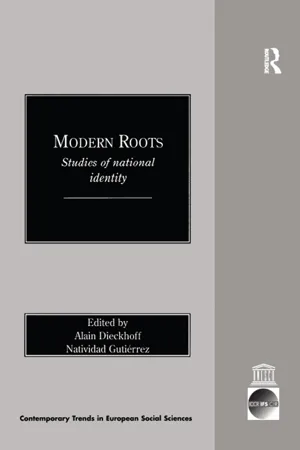
Interest in the study of national identity as a collective phenomenon is a growing concern among the social and political sciences. This book addresses the scholarly interest in examining the origins of ideologies and social practices that give historical meaning, cohesion and uniqueness to modern national communities. It focuses on the various routes taken towards the construction of cultural authenticity as an inspirational purpose of nation-building and reveals the diversity of the themes, practices and symbols used to encourage self-identification and communality. Among the techniques explored are the dramatization of suffering and tragedy, the exaltation of heroes and deeds, the evocation of landscape, nature and the arts and the delimitation of collective values to be pursued during reconstruction in post-war periods.
Information
PART I
INTRODUCTION
1 | The Study of National Identity |
The decade of the 1990s witnessed a renewed academic interest in identities. National identity is included in this revival and its study encompasses two broad perspectives. In the discussion per se the nation-state holds centre stage.
A first approach refers to the emergence in the political scenarios of social actors and movements previously marginalized and excluded from integrationist politics of nation building. The popularization of the so-called ‘right to difference’ is one of the key factors supporting the construction, negotiation and reinterpretation of identities presumably repressed or excluded. As mobilizations and demands seek an increase in political participation, it is becoming an accepted fact that no political claim for recognition within the nation-state can be substantiated and successful if it lacks a historical memory accounting for specificity of some sort (gender, racial and ethnic identities, and so on). Identities in this perspective allow disparity and fragmentation and a new wave of recognition.
A second approach visualizes identity as the arena for the unity and solidarity of peoples and for the realization of common goals. National identities reinforce social cohesion but can also activate political response from other groups who are capable of constructing their own limits of representation. In the study of national identity what fascinates is precisely this: on the one hand, the process in which absolute uniqueness is the goal inasmuch as no identity is ever the same, and, on the other, the recognition of the universal need of mankind for differentiation and the ability to handle increasingly greater degrees of distinctiveness.
Our interest in this chapter is to discuss what separates the study of national identity from other forms of collective identity. We argue that the peculiarity and ritualistic uses evident in national identity are inextricably linked to three imperatives of the nation-state: the standardization of practices, the construction of homogeneity and the delimitation of common culture for all citizens in a given territorial sovereignty.
Theories
Theories of nationalism continue influencing the study of national identity, it being practically impossible to disassociate identity from the typical polarization of views expressed in the methodology of nationalism. Is this type of identity a cultural continuum or an indoctrination sponsored by the modern state? To answer this question we first need to briefly clarify that nationalism, despite its many definitions, has one unmistakable attribute: the ‘ideal of independence’ (Smith, 1984). Nationalism is also closely linked to the policies of the state aimed at building a unified nation in a pluriethnic society, since most existing nation-states have not emerged as a result of political claims from one single ethnic group.
Modernists and historical culturalists dispute theoretical influence. While the former argue the instrumental role of the state in making the nation (Gellner, 1983), the latter looks at the cultural artefacts, rituals and memories (myths, symbols and legends) (Smith, 1991) which fulfil peoples’s ethnocentrism. Identity and ethnocentrism run parallel although ethnocentric views in our approach are not limited to the act of conventional stereotyping or ‘narrowmindness’ used as parameters of belonging. Identity nurtures itself from strong beliefs, inherited perceptions or repetitive information, helping thus to conform ‘the power of self (Smith, 1991; 1994). For this author, ‘the power of self is of a clear subjective nature but very much required in times of crisis, wars, mobilizations; it gives people willingness and reasons to act and react.
A well known example showing the influential links between identity and ethnocentrism is provided by an ancient inquiry into the origins of a collectivity, that is: where do we come from? Interest in finding out what may be the beginnings of a social group establishing or seeking differentiation has provided a creative host of ideas of origin codified, according to Smith, in mythological accounts. The exaltation of beginning and origin is certainly a powerful and attractive cultural construct for the making of national identity. But this implies the unfolding of various problems, some of them dangerous. In the multicultural world of today, no nation is able to venture an open veneration of single origin when many other ethnic components coexist in the same sovereign territory. This is particularly true after the Second World War and the genocidal atrocities committed in the name of racial purity. The modern democracies of nation-states, their projects and policies for tolerance and multiculturalism, are inclined to neutralize any possible attempts to institutionalize rights and privileges unilaterally. So, would it be of relevance for modern citizens of nation-states to know their origins? Or, as Gellner has put it, do nations have navels?, in reference to mankind’s impossibility to know what the past was really about. A few days before his sudden death in 1995 Gellner said, at the Warwick Debates, that ‘my own view is that some nations possess genuine ancient navels, some have navels invented for them by their own nationalist propaganda and some are altogether navel-less. My belief is also that the middle category is by far the largest, but I stand open to correction by genuine research’ (Gellner, 1997, pp. 90-6).
National identity recurs to fabrication and idealization if one follows the category of nations bearing ‘invented navels’. The myth of origin of the Mexican nation is a case in point. There are no sociological or demographic arguments to support the claim that the majority of Mexican people are the result of interbreeding, between Spanish and Indian communities, from the early sixteenth century onwards. However, the myth of the mestizo people (people of mixed culture and race) has two important functions in the making of the modern Mexican nation. On the one hand, it produces (a) the idea of common origin for antagonistic groups and (b) the mestizo population itself – the result of an imposed myth of origin – became the yardstick of national integration for indigenous peoples in terms of adoption of language (Spanish), religion (Christianity) and way of life (urbanization). The result has been, so far, an elastic formula, or common identity, that has contributed significantly to the foundations of a diversified nation: social cohesion, political unity and cultural originality (Gutiérrez, 1998).
There are several routes to studying national identity. The possibilities are not surprising as the identity of any nation seeks to fulfil three aspirations, authenticity, originality and continuity. Hence, we identify two logical stages of national identity regarding the fulfilment of the above aspirations and the relevance of including the state of disciplines and science. On the one hand, we refer to the identification of sources in order to identify uniqueness, essence or personality. On the other, we include the inculcation of such essence into the population. Uniqueness may be found in the collective personality, thus psychoanalytical approaches have permeated most research on identity (see Claret in this volume) but also geography and art are two other well known sources. The study of collective behaviour was a useful instrument in the organization of the masses into new ways of seeking to respond to the challenges of nation building such as the introduction of a political culture, spread of mass literacy, communications and cultural homogenization. Official agencies were created to involve the masses in national goals, creating at the same time scientific interest in identifying people’s character. A neat picture of people’s character may reveal intimate, subjective or emotional tracts such as temperament, attitude, acceptance or reluctance to change and continuity. If the collective behaviour appeared to be far from satisfying ideals or plans, corrective measures could be applied. Thus, education became the tool for forging, redeeming or civilizing the masses. Space geography encompasses a wide arena for the search and recreation of national identity because it provides informed accounts of people’s sensibility towards landscape, ‘geo-political visions’ (Dijkink, 1996) and natural environment. Amazement and pride of natural beauty create a suitable framework for elaborating symbols, narratives and tourist attractions of a given land, for instance, the Alps (see Zimmer in this volume). There is nothing one can do to improve or correct nature; thus, it is better appreciated as an intense inspiration for numberless possibilities of national pride or defense against cultural attack. An illustrative case was the pre-independentist claims of Peruvian intellectuals who rejected French eighteenth century environmental determinism, regarding the New World as naturally underdeveloped (De Paw and Leclerc called America, the girlish continent in puberty). But Peruvians retorted, arguing that a mild climate is not only a healthy phenomenon but also a priceless and exclusive possession for some, not for all (Gutierrez, 1990). Nature and landscape cannot be separated from the organization of social life. Evidence of this is the fact that they have frequently become an issue of political dispute in defining territorial frontiers and cultural boundaries and drawing the pertinent maps to reflect the changes. G. Dijknik, referred to above, provides the notion of ‘geo-political vision’ to give an account of peoples’ construction of order and threat regarding the balance of power and security policies of states on the basis of geographical position and/or natural resources, transnational economies and minorities within nation-states (pp. 6-7).
Nations cannot survive without cultural history. One of the most deeply rooted collective emotions is a people’s defense of self-determination. Creativity, artistic and literary movements, as well as people’s sensibility to achieve (and preserve) independence, reflect a capacity to discover, reconstruct, depict or invent a distinctive collective self. A complex interrelation of cultural movements starting with Romanticism, the production of intellectuals and writers and the development of disciplines like archaeology, anthropology and philology, to mention but a few, have contributed to the search for and research of a cultural patrimony which gives an important substance to our understanding of national identity.
There is of course an impressive wealth of cultural patrimony. The challenge of understanding national identity from the perspective of the social sciences and humanities is not only to survey museum collections or debate cultural policies but to look critically at the way in which citizens relate to, defend and feel their patrimony, rituals or commemorations. Thus, no single approach is enough to study national identity and its various interconnections. Instead, and given the richness of sources inspiring identity, a combination of theoretical trends and a creative design of methodologies are concerns of modern research. Moreover, it is forever tempting to identify the construction of identity as a momentum of celebration and dignified remembrance, but identity is also nurtured by the collective experience in tragedy, suffering, humiliation and hostility. National identity cannot be reduced to the cultural expression of an ancient art, a literary piece, a monument or a sports competition, it constitutes a valid type and system of information ritually socialized. Thus, we now turn to a consideration of the specific nature of national identity.
The Peculiarity of National Identity
A useful point of departure is to bear in mind that national identity is, first and foremost, the self-identification of the peoples of nation-states. Therefore, its full expression can only be appreciated within a modern context, although its evolution and construction reveals discernible links with an accumulation of various historical pasts. This premise helps to clarify unmistakable attributes of national identity with respect to other types of collective identity, these being class, gender and race. Consequently, nation-states distinguish themselves from previous forms of polity or grouping due to the following facts and operations: they rule citizens either by liberal or authoritarian means and principles, that is, they establish a system of duties, rights and obligations regardless of race or ethnicity; at other times, they apply criteria of ethnic and racial differentiation.
Nation-states exist because of their belief, capacity and potentiality in exercizing self-rule and in defending their sovereign rights. A nation-state administers one clearly defined territory and seeks self-sufficiency through its own economy and commercial transactions. It believes in linguistic and cultural homogeneity as a condition for implementing equality and achieving common goals. It develops institutions and codes of practice which help it to standardize a wide range of factors such as the division of labour, the unification of loyalties and the activities and customs affecting everyday life, namely the educational system and mass media. Lastly, but no less important, a nation-state displays pride in its various pasts, its traditions and historicity, through which it claims and legitimizes modern nationhood.
At this point it would be useful to draw a line separating national identity from other types of collective identity which have provided a fresh reappraisal of civil society. These collective identities correspond to the first approach in studying identity, as mentioned at the beginning of this chapter. Normally, these groups seeking identity through mobilization focus their action on opposition to the state. Such groups, which are indeed numerous, include urban squatters and ecologists, socialist feminist groups, human rights campaigners, gay and lesbian coalitions, fundamentalists, workers co-operatives and peasant activists, defenders of the rain forest, antinuclear protesters and Afro-Caribbean musicians. These collective identities, also referred to as ‘new’ identities, have mainly emerged due to the events and influences of ‘daily life’. The result: a rejection of existing institutional channels. The aim (one at least): to construct or negotiate more democratic spaces in which to act with greater autonomy (Alvarez and Escobar, 1992).
These groups embody a critique of institutionalization and centralization of power and resources. Their discourse enhances the restricted confines of their action in that they are obliged to work in partial, local and limited areas. In other words, small groups seek to find their own limited or domestic space and construct, recombine or invent an identity accordingly. Since the scope of the collectivity is reduced it does not require support for dissemination, although the interest of the media, together with assistance from other collectivities, are regularly provided.
In contrast, national identity has not emerged spontaneously or locally, it is learned and acquired and thus requires massive institutional support (e.g., schools, educational campaigns, mass media) as it aims at influencing the overall population of a national territory. Not all groups – ethnic, racial, gender – inhabiting a territory, identify with or are loyal to the dominant ethnic group representing the nation. Hence, the relevance of national identity is to achieve sustainable levels of assimilation and socialization among the population – no matter how diverse – by displaying and inculcating those socio-political facts (dates, sagas, episodes, heroes, nature) that celebrate the formation of nation-states – as all encompassing vertical and horizontal unities. Citizens are united by common culture and in this way express identity;, in this way they learn what to do and how to perform (Renan’s daily plebiscite – see Guibernau in this volume) in order to make possible the functioning and reproduction of the national collectivity; by the same token they also acquire a common set of beliefs, training and loyalties. People are made to believe that they have the same beginning (ancestry and origin) (Smith, 1984) and share a similar destiny (Bauer, 1979). Moreover, such communal self-identification creates powerful emotional sentiments and attitudes because national identity makes people aware of themselves as a unique collectivity co...
Table of contents
- Cover
- Half Title
- Title Page
- Copyright Page
- Table of Contents
- List of Contributors
- Preface
- Acknowledgements
- PART I: INTRODUCTION
- PART II: DIMENSIONS OF NATIONAL IDENTITY
- PART III: SYMBOLIZING THE NATION
- PART IV: TEACHING NATIONAL IDENTITY
- PART V: DISRUPTED NATIONAL IDENTITIES
- PART VI: CONCLUSION
Trusted by 375,005 students
Access to over 1.5 million titles for a fair monthly price.
Study more efficiently using our study tools.
Frequently asked questions
Yes, you can cancel anytime from the Subscription tab in your account settings on the Perlego website. Your subscription will stay active until the end of your current billing period. Learn how to cancel your subscription
No, books cannot be downloaded as external files, such as PDFs, for use outside of Perlego. However, you can download books within the Perlego app for offline reading on mobile or tablet. Learn how to download books offline
Perlego offers two plans: Essential and Complete
- Essential is ideal for learners and professionals who enjoy exploring a wide range of subjects. Access the Essential Library with 800,000+ trusted titles and best-sellers across business, personal growth, and the humanities. Includes unlimited reading time and Standard Read Aloud voice.
- Complete: Perfect for advanced learners and researchers needing full, unrestricted access. Unlock 1.5M+ books across hundreds of subjects, including academic and specialized titles. The Complete Plan also includes advanced features like Premium Read Aloud and Research Assistant.
We are an online textbook subscription service, where you can get access to an entire online library for less than the price of a single book per month. With over 1.5 million books across 990+ topics, we’ve got you covered! Learn about our mission
Look out for the read-aloud symbol on your next book to see if you can listen to it. The read-aloud tool reads text aloud for you, highlighting the text as it is being read. You can pause it, speed it up and slow it down. Learn more about Read Aloud
Yes! You can use the Perlego app on both iOS and Android devices to read anytime, anywhere — even offline. Perfect for commutes or when you’re on the go.
Please note we cannot support devices running on iOS 13 and Android 7 or earlier. Learn more about using the app
Please note we cannot support devices running on iOS 13 and Android 7 or earlier. Learn more about using the app
Yes, you can access Modern Roots by Alain Dieckhoff,Natividad Gutiérrez in PDF and/or ePUB format, as well as other popular books in Social Sciences & Sociology. We have over 1.5 million books available in our catalogue for you to explore.