eBook - ePub
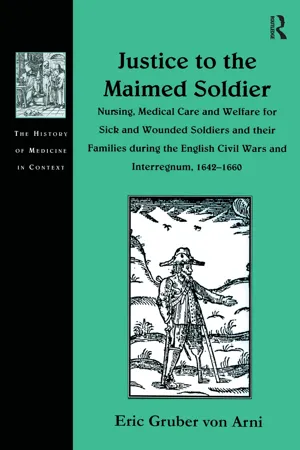
Justice to the Maimed Soldier
Nursing, Medical Care and Welfare for Sick and Wounded Soldiers and their Families during the English Civil Wars and Interregnum, 1642–1660
- 300 pages
- English
- ePUB (mobile friendly)
- Available on iOS & Android
eBook - ePub
Justice to the Maimed Soldier
Nursing, Medical Care and Welfare for Sick and Wounded Soldiers and their Families during the English Civil Wars and Interregnum, 1642–1660
About this book
In the popular imagination, the notion of military medicine prior to the twentieth century is dominated by images of brutal ignorance, superstition and indifference. In an age before the introduction of anaesthetics, antibiotics and the sterilisation of instruments, it is perhaps unsurprising that such a stereotyped view has developed, but to what degree is it correct? Whilst it is undoubtedly true that by modern standards, the medical care provided in previous centuries was crude and parochial, it would be wrong to think that serious attempts were not made by national bodies to provide care for those injured in the military conflicts of the past. In this ground breaking study, it is argued that both sides involved in the civil wars that ravaged the British Isles during the mid seventeenth century made concerted efforts to provide medical care for their sick and wounded troops. Through the use of extensive archival sources, Dr Gruber von Arni has pieced together the history of the welfare provided by both Parliamentarian and Royalist causes, and analyses the effectiveness of the systems they set up.
Chapter 1
Introduction
To judge fairly of those who lived long before us ... we should put quite apart both the usages and the notions of our own age ... and strive to adopt for the moment such as prevailed in theirs.1
Civil wars are probably the most brutal form of warfare in which mankind has indulged and those fought in the British Isles during the mid-seventeenth century were no exception. Surprisingly, although innumerable volumes have been written about pertinent political events, campaigns, opposing strategies and their impact upon communities, military casualties suffered during the English Civil Wars, the Commonwealth and Interregnum have attracted scant attention. A comprehensive search of related literature, ranging from contemporary writers to late twentieth-century authors, reveals that these victims were widely ignored and excluded from comment. The majority of published sources either fail to mention military casualties or, where they do, simply quote speculative mortality figures. Occasional references are made to the victims of plague or other fevers whilst comments about the wounded remain restricted to military leaders and noteworthy personalities.2 Indeed, in a large percentage of works consulted, a glance at the indices found no reference to casualties, hospitals or nurses except in a very few, notable, cases.3 The personal expectations of sick and wounded soldiers regarding health care are seldom considered or documented. Even a search for appropriate imagery amongst contemporary literature and drama failed to elicit guidance although the character Bosola in Webster's The Duchess of Malfi offers one soldier's perception of his fate when he complains that:
there are rewards for hawks, and dogs, when they have done us service; but for a soldier, that hazards his limbs in a battle, nothing but a kind of geometry is his last supportation ... to hang in a pair of slings ... upon a pair of crutches, from hospital to hospital ... And yet do not you scorn us, for places in the court are like beds in the hospital, where this man's head lies at that man's foot.4
The reader may look in vain for a substantive discussion regarding what actually happened to sick and wounded soldiers or who cared for them. Such neglect by writers and historians is the more amazing given that the impact of the Civil Wars throughout the nation was more pronounced and significant than any other conflict in British history, including the two World Wars.
Some recent authors have argued that warfare in the medieval and early modern periods had scant effect on medicine.5 By way of contrast, this work argues that, in reality, in combination with a rising awareness of individual and public responsibility, the Civil Wars elicited a dramatic improvement in facilities afforded to military casualties and their dependants. More importantly, improvements in medicine, nursing and welfare facilities initiated during these wars established many precedents and standards with which later provisions, institutions and objectives can be directly compared. Unfortunately, as a subject for study, military nursing in particular has been undervalued and ignored by historians and even nurses themselves.6 Whether this is the product of longstanding male attitudes towards subjects regarded as having a feminine bias or the belief amongst historians that the subject was unlikely to produce sufficient data from which to formulate conclusions is a matter for speculation.
It may seem invidious for an observer, viewing the situation from a distance of three and a half centuries, to attempt to define acceptable standards for mid-seventeenth-century nursing and medical practice and make comparisons with those of the late twentieth century. This is particularly so when it is considered that we cannot be sure what the patients' expectations or agendas were.7 So, at the beginning of the twenty-first millennium, how realistic is it to attempt an assessment of the quality, availability and effectiveness of the care provided in the military hospitals of the Civil War and Interregnum in the light of surviving evidence? We know that both parties in the conflict established hospitals for the sick and wounded of their armies although considerably less Royalist medical documentation has survived than Parliamentarian. This would appear to make comparative study difficult. In an empirical study such as this, the reader must remain aware that contemporary writers were often closely involved with the events they were reporting therefore bias and prejudice cannot be excluded. In addition considerable gaps occur in the documentary evidence that survives as a result of poor storage, exigencies of war and less than efficient clerical work on the part of the originators. For example, entries in parish records of the mid-seventeenth century are notoriously irregular and unreliable. Equally importantly, it has been necessary to view material relevant to the 60 years leading up to the outbreak of the Civil Wars in 1642 in order to set the scene and to facilitate a wider appreciation of the subject background and, to that end, this introduction contains a significant element relevant to that purpose.
In reality, there are many aspects of patient care that have remained constant over the centuries. Despite the mainstream changes in political thought and attitudes that emerged during the Reformation, many traditional work-practices and values survived amongst trades and professions independent of the varying cultural background of practitioners. Mid-seventeenth-century practitioners inherited many attitudes, traditions and regulations from their earlier medieval forebears who took, as their guiding principles, the Bible's New Testament 'Comfortable or Corporal Works of Mercy'.8 This fundamental recipe for Christian charity, that formed the basis of patient care throughout the fourteenth and fifteenth centuries, was taken from Christ's 'Parable of the Talents' which established six Christian prerequisites for salvation:
For I was an hungred, and ye gave me meat: I was thirsty, and ye gave me drink:
I was a stranger, and ye took me in:
Naked, and ye clothed me: I was sick, and ye visited me:
I was in prison and ye came unto me.9
I was a stranger, and ye took me in:
Naked, and ye clothed me: I was sick, and ye visited me:
I was in prison and ye came unto me.9
A seventh requirement, that of giving Christian burial to the dead, was added later based upon the concept of speeding the soul of the departed through purgatory.10 The original 1515 statutes for the Savoy Hospital specifically demanded that, in addition to praying for the soul of the founder, the staff were required to give bread to the hungry, drink to the thirsty, clothe the naked, visit the sick and bury the dead. As a biblical text Parliamentarians could accept these principles without difficulty. It would not, therefore, be unreasonable to suggest that these standards were inherited by the nursing sisters who remained in the hospital in 1642 and passed on to their subsequently recruited colleagues.11
The early seventeenth century had seen many changes in medical practice brought about by doctors such as John French (?1616-1657), Thomas Sydenham (1624-1689), and John Radcliffe (1652-1714), all of whom emphasised improved conditions in the sick room as a means of restoring their patients to health, a situation requiring a concomitant rise in nursing care standards. In principle medieval physicians shunned aggressive forms of treatment, which they saw as dangerous to both patient and professional reputation, and propounded a regimen, based on the principles of Galen, the classical Greek physician, specific to each patient's needs although, in hospitals, it was more usual to adopt a single code of practice, the regimen sanitatis or guide to healthy living. Each regimen was based upon the six 'non-naturals' deemed necessary for life. These centred upon factors familiar to most people today and included a controlled, suitable environment, rest and exercise, adequate sleep, appropriate food and drink, excretion and retention and freedom from stress.12
By the middle of the seventeenth century doctors were turning increasingly to chemical compounds and drugs, such as opium, as the professional physicians gradually changed their allegiance from Galenic medicine to the more recent sixteenth-century theories of the Swiss Paracelsus who had rejected the old theories in preference for his advocacy of the use of chemicals and drugs as specific cures for specific diseases.13 As nurses acquired their expertise through experience and routine women's education without too much interference from the monopolistic medical hierarchy they were less affected by these changes. Indeed, Galenic theory was rather more 'nurse-friendly' in so far that it placed greater reliance upon the alleviation of symptoms, not merely with removing offensive humours. Control of the patient's environment, diet and other aspects of care which formed such an important element in patient care fell naturally within the scope of nursing practice and were, therefore, of particular importance. That is not to say that the Paracelsian approach using specific creams, ointments or drugs was ignored but the general tendency was to adopt an holistic approach to care as is evident in the writings of Lady Grace Mildmay, 1552-1620, who wrote 'the physic which bringeth the body and parts thereof into an union in itself, by little and little, worketh the most safe and effectual operation to the preservation ...
Table of contents
- Cover
- Half Title
- Title
- Copyright
- Contents
- List of Maps
- List of Tables
- List of Illustrations
- List of Abbreviations
- Note on Dates and Spelling
- Acknowledgements
- Preface
- 1 Introduction
- 2 The King's Army in Oxford, 1642-1646
- 3 The Army of Parliament, 1642-1648
- 4 Parliamentary Administration of Casualty Care
- 5 War in the Celtic Nations
- 6 Casualty Care during Maritime Conflict and Overseas Campaigns
- 7 Permanent Military Hospitals
- 8 Contemporary Treatments
- 9 Nursing Personalities of the Civil Wars and Interregnum
- 10 Conclusion
- Appendix I
- Appendix II
- Appendix III
- Appendix IV
- Appendix V
- Appendix VI
- Appendix VII
- Appendix VIII
- Appendix IX
- Bibliography
- Index
Trusted by 375,005 students
Access to over 1.5 million titles for a fair monthly price.
Study more efficiently using our study tools.
Frequently asked questions
Yes, you can cancel anytime from the Subscription tab in your account settings on the Perlego website. Your subscription will stay active until the end of your current billing period. Learn how to cancel your subscription
No, books cannot be downloaded as external files, such as PDFs, for use outside of Perlego. However, you can download books within the Perlego app for offline reading on mobile or tablet. Learn how to download books offline
We are an online textbook subscription service, where you can get access to an entire online library for less than the price of a single book per month. With over 1.5 million books across 990+ topics, we’ve got you covered! Learn about our mission
Look out for the read-aloud symbol on your next book to see if you can listen to it. The read-aloud tool reads text aloud for you, highlighting the text as it is being read. You can pause it, speed it up and slow it down. Learn more about Read Aloud
Yes! You can use the Perlego app on both iOS and Android devices to read anytime, anywhere — even offline. Perfect for commutes or when you’re on the go.
Please note we cannot support devices running on iOS 13 and Android 7 or earlier. Learn more about using the app
Please note we cannot support devices running on iOS 13 and Android 7 or earlier. Learn more about using the app
Yes, you can access Justice to the Maimed Soldier by Eric Gruber von Arni in PDF and/or ePUB format, as well as other popular books in History & World History. We have over 1.5 million books available in our catalogue for you to explore.