- 166 pages
- English
- ePUB (mobile friendly)
- Available on iOS & Android
eBook - ePub
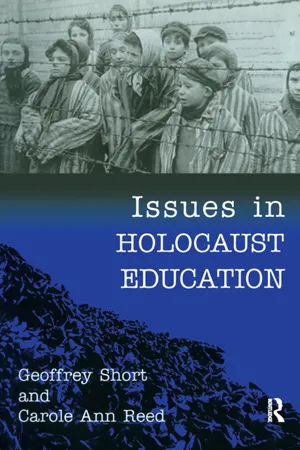
Issues in Holocaust Education
About this book
This original contribution to understanding the nature of Holocaust education in schools tackles an issue that has gained significant interest over the past decade, and is of increasing relevance due to a growing intolerance across Europe and elsewhere. The authors examine a range of issues including the need for Holocaust education, the factors that facilitate or inhibit its evolution, and the indifferent response of the antiracist movement to the attempted annihilation of European Jewry. The empirical content sheds light on the attitudes and practices of teachers and on the prospects of drawing on the Holocaust to further the goal of participatory democracy. The themes and illustrative research are discussed in the context of developments in two locations, the United Kingdom and Canada, and the findings will be germane to an international audience. The volume will prove invaluable to academics and policy makers concerned with social policy, sociology, education and history, as well as to teachers of the Holocaust.
Chapter 1
Why Teach about the Holocaust?
The Promotion of Understanding
It is our contention that if the Holocaust is taught well the case for its inclusion in the school curriculum is unassailable. Whether or not one goes as far as Daniel Goldhagen (1996:4) in viewing the attempted annihilation of European Jewry as ‘the most shocking event of the (twentieth) century,’ it was, indisputably, one of the watershed events of that century and some may consider this, in itself, sufficient justification for teaching it. The Holocaust, however, is more than just a major historical landmark, for its unprecedented character enables us to construe the past in a different light and also helps shape our perception of seminal developments in our own time. Certainly, aspects of world history since 1945 and, most obviously, developments in the Middle East, cannot fully be comprehended without some awareness of the fate of the Jews in Nazi-occupied Europe. The Holocaust exemplifies a body of knowledge that ‘constantly throws light on, widens and deepens (our) view of countless other things’ (Peters, 1966:159) and, as such, an awareness of its significance can be seen as a defining characteristic of an educated person. But nothing that has been said thus far makes the case for granting space in the curriculum to the Holocaust, rather than to some other historical event that appreciably expands our understanding. Schools, of necessity, have to be selective in their curricular content, and to press the claims of the Holocaust we should note the view of some philosophers of education that becoming educated also involves an understanding of persons or, ‘knowledge of our own and other minds’ (Hirst and Peters, 1970:63). For this purpose, study of the Holocaust appears ideally suited as there can be no more potent illustration of the depths of human depravity or the resilience of the human spirit. It is difficult to envisage a medium more conducive to learning about the psychology of prejudice, obedience, conformity and altruism; nor one more likely to stimulate discussion of the antecedent variables that predispose some of us to acquire these attributes and others to reject them. Learning about the Holocaust also shows the importance of taking into account a host of socio-historical factors as well as psychological ones if we are fully to understand the darker side of human behaviour.
The Role of the Holocaust in Developing Political Literacy
The most compelling reason for studying the Holocaust is to help secure the future against further violations of human rights whether based on ethnicity, religion, gender, sexual orientation or disability. The eighteenth-century British statesman and political theorist, Edmund Burke, famously remarked that ‘the only thing necessary for the triumph of evil is for good men to do nothing.’ Arguably, the Holocaust illustrates the truth of this contention as powerfully as any episode in human history, but one of the preconditions of individuals taking action against evil is that they recognise the evil for what it is in good time. In the words of the renowned writer and Auschwitz survivor, Primo Levi (1987:396), ‘We cannot understand (the Holocaust) but we can and must understand from where it springs and we must be on our guard. If understanding is impossible, knowing is imperative, because what happened could happen again.’ It is the need to foster such knowledge and understanding in the hope of preventing a repetition that constitutes much of the raison d’être for teaching the Holocaust in schools. Indeed, at a time when many societies, culturally more diverse than ever before, are threatened by a rising tide of nationalism and xenophobia, a study of the Holocaust would seem to deserve the highest priority. Not only can the subject contribute to students’ understanding of racism, by illustrating the nature of critical concepts such as scapegoating, stereotyping and nationalism; it can also make plain the socio-political, economic, historical and psychological conditions under which racism is likely to flourish. Moreover, the Holocaust offers an opportunity to demonstrate an important dimension of the prejudiced frame of mind that came to light in the well-known, if controversial, American study, The Authoritarian Personality published in 1950. The authors, Theodor Adorno and his colleagues, claimed that highly prejudiced individuals rarely have an antipathy towards a specific group, such as Jews, but are antagonistic towards all outgroups and ‘aliens.’ The eminent social psychologist, Gordon Allport (1954), in his seminal text, The Nature of Prejudice, strongly concurred:
One of the facts of which we are most certain is that people who reject one out-group will tend to reject other out-groups. If a person is anti-Jewish he is likely to be anti-Catholic, anti-Negro, anti-any out-group.
(Allport, 1954:68)
The range of ‘undesirables’ targeted by the Nazis clearly testifies to the truth of this contention and teachers should deepen their students’ understanding of the racist mindset by discussing Nazi policy towards the Slavs, the Roma and Sinti, homosexuals and the disabled. They might also allude to the Nazi attitude towards Muslims for the same reason. [Alfred Rosenberg (1934:665), the Nazis’ key racial theorist, warned in his book The Myth of the Twentieth Century that the white peoples of Europe should be on their guard ‘against the united hatreds of coloured races and mongrels led in the fanatical spirit of Mohammed.’]
In the context of racism, learning about the Holocaust has other benefits too, not the least of which is that it highlights the dangers of allowing the growth of an incipient xenophobia to go unchecked. Students acquainted with the Holocaust can hardly fail to appreciate that racism is not a phenomenon restricted by its nature to name-calling in the playground or discrimination in the labour and housing markets. On the contrary, they are forced to recognise it as a virulent toxin that can involve unimaginable brutality and lead to the cold-blooded and systematic slaughter of millions. In a multi-ethnic society, such knowledge is an essential component of responsible citizenship.
While the Holocaust may be useful in helping students learn about various facets of racism, it is an ideal medium for enabling them to understand and combat anti-Semitism. In the course of their socialisation, students of secondary school age may well acquire the same sort of misconceptions about Jews that were prevalent in Germany and elsewhere during the Nazi era (see Chapter 4). Studying the Holocaust and the years leading up to it provides teachers with an opportunity to focus upon and expose the ill-founded basis of these beliefs. Moreover, a study of the Holocaust can not only shed light on the nature of anti-Semitism and of racism in general, but has the advantage of doing so ‘naturally.’ By this we mean that the subject is acknowledged by all except those on the lunatic fringe to be an integral part of the Second World War and, as such, is not likely to be regarded by students as an irrelevance inserted into the curriculum for reasons of political correctness. In contrast, activities that fall under the rubric of conventional antiracist education may well be seen in this way and, as a result, fail to make headway in dislodging racist beliefs. [We elaborate on this point in Chapter 3.]
In relation to political literacy more broadly defined, a study of the Holocaust and the socio-political developments that gave rise to it, may prompt students to consider the measures that liberal democracies need to take in order to safeguard their fundamental freedoms. They may debate, for example, whether such societies should extend the principle of free speech to members of political parties who are unwilling to extend it to others. They may reflect on whether the interests of human rights are best served by the authorities failing to take action against suspected war criminals simply because the passage of time has diminished the chances of a successful prosecution. And they may also think about the responsibilities of the individual when confronted by evil, for one of the potential benefits of studying the Holocaust is that it can demonstrate, by focusing on the activities of rescuers, that people are not necessarily reduced to the role of impotent bystanders in the face of oppressive dictatorships; individuals can be seen to make a difference. Indeed, by focusing on the heroism of ordinary men and women who risked their lives, and often the lives of their families to protect Jews, students can observe that people much like themselves can make a difference. At the same time, by learning of the failure of the mass of the population in Nazi-occupied Europe to hide and care for Jews, the reluctance of the churches to speak out and the refusal of many countries to take substantial numbers of refugees, students may come to appreciate more fully than they otherwise might, the dangers inherent in turning a blind eye to evil. Finally, the Holocaust provides students with an opportunity to reflect critically on aspects of their own culture (and, above all, on its religious and literary traditions) that depict ethnic minorities in an unfavourable light and to reflect further on the implications of such a depiction (Julius, 2000). In sum, learning about the Holocaust can constitute an educational experience that allows the democratic majority to protect itself against the consequences of racist discourse, demagoguery and propaganda.
Holocaust Denial
An additional reason for studying the Holocaust is the need to combat denial. We know that much of the physical evidence of the camps was deliberately destroyed by the Nazis in the latter stages of the war and as a result, their ideological heirs have felt free to maintain that all talk of death camps is a fiction invented by Jews for political and financial gain. The roots of Holocaust denial can be traced back to Paul Rassinier’s Le Passage de la Ligne in 1948 (cited in Lipstadt, 1993) and more or less the same deception has been peddled periodically ever since. Scurrilous publications such as The Rumour of Auschwitz by Robert Faurisson (1979) and The Hoax of the Twentieth Century by Arthur Butz (1976) either dispute the existence of death camps or cast doubt on their capacity to carry out murder on the scale that has been claimed. The authors are all neo-Nazi sympathisers who have sought to rid themselves of the electoral liability of the Holocaust. According to James Dalrymple (1992), these and other revisionist ‘historians’:
share one common theme and one common problem. The theme is anti-Semitism and the problem is the Holocaust. The clear evidence that upwards of 6 million Jews were slaughtered by the Nazis stands like a monolithic barrier to (their) ambitions.
(Dalrymple, 1992:207)
For many years it was possible to dismiss the deniers as ‘a small group of political extremists and radical-fringe pseudo-historians … whose arguments (lay) far beyond the accepted pale of scholarly discourse’ (Lipstadt, 1992:66). But in recent years their modus operandi has changed and they are now attempting to convince:
the world that they are engaged in a serious historical enterprise. Their books and journals have been given an academic format and they have worked hard to find ways to insinuate themselves into the arena of serious historical debate and deliberation.
(Lipstadt, ibid., 67)
Not everyone, however, agrees that Holocaust denial needs to be taken seriously. In a recently acclaimed book that has attracted a great deal of publicity on both sides of the Atlantic, Peter Novick (op. cit.) writes as follows:
The argument for raising Holocaust consciousness that has been advanced with the greatest urgency is, by any sober evaluation, the most absurd: the alleged necessity of responding to the tiny band of cranks, kooks and misfits who deny that the Holocaust took place.
(Novick, op.cit., 270)
Novick’s dismissive attitude towards the threat posed by deniers stems from what he sees as their disturbed psychological state. He refers to them as ‘screwballs’ and ‘fruitcakes’ in addition to ‘cranks, kooks and misfits’ and seems convinced that due to their mental affliction they can safely be ignored. In a similar vein, Finkelstein (op.cit., 68) argues that ‘there is no evidence that Holocaust deniers exert any more influence in the United States than the flat-earth society does.’ Novick cites a 1994 opinion poll finding in the United States to justify his complacency, for the poll showed that only around one per cent of the respondents doubted the Holocaust’s existence. But he conveniently overlooks evidence from outside the United States which arguably paints a much more disturbing picture. In Sweden, for example, a survey carried out in 1996 and 1997 of nearly eight thousand students in sixty towns revealed that ‘a third of… 12- to 18-year-olds do not believe the Nazis’ extermination of the Jews ever occurred …’ (de Laine, 1997). It was this finding that prompted Swedish Prime Minister, Göran Perrson, to initiate moves that led to the setting up of the international task force on Holocaust education referred to in the Preface. ‘Israeli authorities … claim similar attitudes (to those found in Sweden) have come to light in Britain, Canada, Germany and France’ (Leigh, 1997) and while it does not necessarily follow that high levels of scepticism reflect the influence of Holocaust deniers (Bruchfeld, 2000), the possibility ought not to be discounted. Nor does it follow that psychiatric disturbance offers the only way to account for the failure of deniers to make much headway in the United States. Indeed, we believe, contrary to Novick, that a more convincing explanation for their lack of success is to be found in the high level of Holocaust consciousness in the country. We thus have no hesitation in arguing that Holocaust education should be expanded, and its quality improved, as a bulwark against those who would deny or trivialise the heinous crimes of the Third Reich. While we recognise that the inclusion of the Holocaust in the curriculum is not, in itself, an adequate means of countering the sophistry of the deniers, we have no doubt that its absence from the curriculum will make it easier for them to influence the gullible.
It would be a mistake to associate Holocaust denial only with neo-Nazis, for in recent years the phenomenon has spread widely throughout the Arab world (Fisk, 1996; Matar, 2001) and has played a major role in the ideology of some fundamentalist Muslim groups such as Hizb-ut-Tahrir that actively recruit in the West. Aware that the Holocaust is often invoked to reinforce the moral justification for modern-day Israel, – ‘the certificate of its political legitimacy’ to use Bauman’s (1989) metaphor – these rabidly anti-Zionist groups have a vested interest in asserting that the Holocaust is a myth ‘invented by the Israelis to justify their seizure of Palestinian Arab land’ (Fisk, ibid.). In so far as Islamic communities throughout the world sympathise with the Palestinian cause, studying the Holocaust (and its aftermath) in an informed and dispassionate manner may help some young Muslims to repudiate those aspects of fundamentalist propaganda that espouse Holocaust denial in order to discredit the Jewish State.
The Limitations of Holocaust Education
As is widely known, the American poet and philosopher, George Santayana (1905) wrote that those who cannot remember the past are condemned to repeat it. Keeping alive the memory of the Holocaust may well be a sine qua non of avoiding a recurrence, but Santayana was wrong to emphasise memory rather than understanding and naive to imply that all who learn about the Holocaust will necessarily come to revile it and all it represented. If handled intelligently and with sensitivity, an engagement with the subject may help some students to understand and abhor racism in general and anti-Semitism in particular, but it is unlikely to have this effect on all students, for as Gordon Allport (op. cit.) pointed out nearly fifty years ago, the racial attitudes of certain individuals are impervious to rational persuasion. He observed that in some people, ‘realism is low; the individual neither knows nor cares what the facts are concerning minority groups … The functional significance of these attitudes lies deep, and nothing short of an upheaval in the character structure will change them’ (Allport, 1954:505). However, he was equally insistent:
that the ethnic attitudes of many individuals lack internal integration. They are shifting and amorphous, and for the most part are linked to the immediate situation. The person himself may be said to be ambivalent – or, more accurately, multivalent, for, lacking a firm attitude structure, he bends with every pressure. It is with this group that pro-tolerance appeals may be effective. … This type is susceptible to education.
(ibid., 505-506. Emphasis added)
The aim of Holocaust education, is thus not to eradicate anti-Semitism and every other manifestation of racism, for as Allport makes clear, there will always be some individuals with a pathological need to hate. But they must never be allowed to influence, let alone dominate, public opinion. The function of Holocaust education is rather to inoculate the generality of the population against racist and anti-Semitic propaganda and thereby restrict its appeal to a disaffected and politically insignificant rump.
Dissenting Voices
Although the Holocaust is taught in schools in a number of countries, and sometimes as part of a statutory curriculum (Wyman, 1996a), it should not be assumed that this development has been universally welcomed by academics otherwise sympathetic to the teaching of Jewish history. In the United Kingdom the best-known critic of Holocaust education in schools is Lionel Kochan, an historian who urged the British Government, when it was planning the National Curriculum, to omit the Holocaust from the history syllabus on the grounds that ‘disseminating a knowledge of Nazi barbarism (is) fraught with danger’ (Kochan, 1989:25). His argument, in part, echoes Hegel’s (1818) assertion that ‘what experience and history teach is … that peoples and governments have never learned anything from history.’ In Kochan’s own words, ‘knowledge of past brutality and violence has never prevented their repetition.’ He asks: ‘Have all the scholarly investigations into the causes of wars ever prevented a recurrence? We hear a great deal about the supposed “lessons” of the Holocaust (but) the precedent of the “lessons” of war offers no encouragement at all’ (ibid.). Kochan’s main argument, however, concerns the impact of the Holocaust on Jewish children’s sense of their ethnic identity. He quotes the former Chief Rabbi of th...
Table of contents
- Cover
- Half Title
- Title Page
- Copyright Page
- Dedication
- Table of Contents
- Preface
- Acknowledgements
- 1 Why Teach about the Holocaust?
- 2 The Development of Holocaust Education in the United Kingdom and Canada
- 3 Antiracist Education and the Holocaust
- 4 Curricular, Organisational and Ethical Issues
- 5 Teachers’ Attitudes and Practices
- 6 Holocaust Education and Citizenship
- 7 Holocaust Curricula
- 8 Holocaust Museums
- 9 Teaching the Holocaust to Young Children
- Endnote
- Bibliography
- Name Index
- Subject Index
Trusted by 375,005 students
Access to over 1.5 million titles for a fair monthly price.
Study more efficiently using our study tools.
Frequently asked questions
Yes, you can cancel anytime from the Subscription tab in your account settings on the Perlego website. Your subscription will stay active until the end of your current billing period. Learn how to cancel your subscription
No, books cannot be downloaded as external files, such as PDFs, for use outside of Perlego. However, you can download books within the Perlego app for offline reading on mobile or tablet. Learn how to download books offline
Perlego offers two plans: Essential and Complete
- Essential is ideal for learners and professionals who enjoy exploring a wide range of subjects. Access the Essential Library with 800,000+ trusted titles and best-sellers across business, personal growth, and the humanities. Includes unlimited reading time and Standard Read Aloud voice.
- Complete: Perfect for advanced learners and researchers needing full, unrestricted access. Unlock 1.5M+ books across hundreds of subjects, including academic and specialized titles. The Complete Plan also includes advanced features like Premium Read Aloud and Research Assistant.
We are an online textbook subscription service, where you can get access to an entire online library for less than the price of a single book per month. With over 1.5 million books across 990+ topics, we’ve got you covered! Learn about our mission
Look out for the read-aloud symbol on your next book to see if you can listen to it. The read-aloud tool reads text aloud for you, highlighting the text as it is being read. You can pause it, speed it up and slow it down. Learn more about Read Aloud
Yes! You can use the Perlego app on both iOS and Android devices to read anytime, anywhere — even offline. Perfect for commutes or when you’re on the go.
Please note we cannot support devices running on iOS 13 and Android 7 or earlier. Learn more about using the app
Please note we cannot support devices running on iOS 13 and Android 7 or earlier. Learn more about using the app
Yes, you can access Issues in Holocaust Education by Geoffrey Short,Carole Ann Reed in PDF and/or ePUB format, as well as other popular books in History & World History. We have over 1.5 million books available in our catalogue for you to explore.